Dermatrans
Italy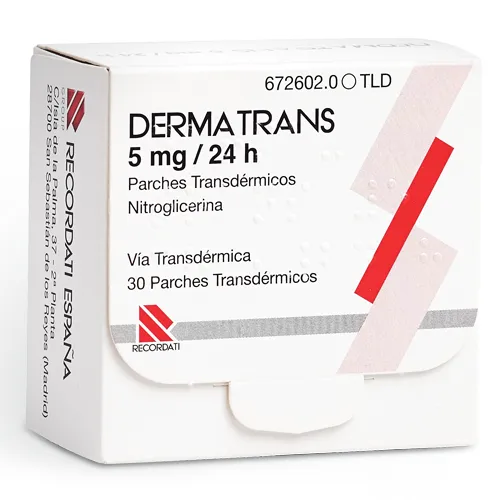
Instructions for Use
Table of Contents
- DERMATRANS 5 mg/24 hours transdermal patch, 10 mg/24 hours transdermal patch, 15 mg/24 hours transdermal patch
- 1. What DERMATRANS is and what it is used for
- 2. What you should know before using DERMATRANS
- 3. How to use DERMATRANS
- 4. Possible side effects
- 5. How to store DERMATRANS
- 6. Package contents and other information
PATIENT INFORMATION LEAFLET: INFORMATION FOR THE USER
DERMATRANS 5 mg/24 hours transdermal patch, 10 mg/24 hours transdermal patch, 15 mg/24 hours transdermal patch
Glyceryl trinitrate
Please read all of this leaflet carefully before you start using this medicine because it contains important information for you.
- Keep this leaflet. You may need to read it again.
- If you have any questions, ask your doctor or pharmacist.
- This medicine has been prescribed for you only. Do not give it to other people, even if they have the same symptoms as yours, because it could be harmful.
- If you experience any side effect, including those not listed in this leaflet, tell your doctor or pharmacist. See section 4.
Contents of this leaflet:
- What DERMATRANS is and what it is used for
- What you need to know before using DERMATRANS
- How to use DERMATRANS
- Possible side effects
- How to store DERMATRANS
- Contents of the pack and other information
1. What DERMATRANS is and what it is used for
The DERMATRANS transdermal patches contain the active substance glyceryl trinitrate, a
vasodilator used in heart diseases, which belongs to a group of medicines called
organic nitrates.
DERMATRANS patches are applied to the skin, and the active substance passes through the
skin and enters the body.
DERMATRANS is indicated for the prevention of angina attacks, taken either as monotherapy or in
combination with other anti-anginal therapies.
Angina typically manifests as pain or a feeling of pressure in the chest, which may
radiate to the neck or arm. The pain occurs when the heart is not receiving sufficient
oxygen. DERMATRANS is not indicated for the treatment of acute angina episodes. In such
cases, the usual sublingual tablet or spray should be used to treat acute attacks.
DERMATRANS patches are for external use only.
2. What you should know before using DERMATRANS
Do not use DERMATRANS
- if you are allergic (hypersensitive) to glyceryl trinitrate, related organic nitrates, or any of the other excipients of this medicine (listed in section 6);
- if you are currently experiencing or have recently had shock associated with very low blood pressure;
- if you have medical conditions such as headache, vomiting, or convulsive seizures associated with increased intracranial pressure, including that caused by head trauma;
- if you suffer from heart failure due to obstruction, such as narrowing of the aortic orifice or the atrioventricular orifice of the heart (aortic stenosis or mitral stenopenia, respectively), or from fibrotic thickening of the thin sac-like membrane surrounding the heart (constrictive pericarditis);
- if you are taking medicines for erectile dysfunction (e.g., sildenafil or other PDE-5 inhibitors). Nitrates must not be administered to patients being treated with sildenafil or any other medicine used to treat erectile dysfunction. Patients receiving nitrate therapy must not take sildenafil or any other medicine for the treatment of erectile dysfunction. The combination of a nitrate with sildenafil or any other PDE-5 inhibitor may cause a sudden and severe drop in blood pressure, which could lead to fainting, loss of consciousness, or even heart attack (see also section “Other medicines and DERMATRANS”);
- if you are taking medicines containing riociguat, a soluble guanylate cyclase stimulator;
- if you suffer from severe hypotension (systolic blood pressure below 90 mm Hg);
- if you suffer from severe reduction in blood volume due to blood loss or loss of body fluids (severe hypovolemia);
- if you suffer from severe anemia;
- if you suffer from toxic fluid accumulation in the lungs (toxic pulmonary edema).
Warnings and precautions
Talk to your doctor or pharmacist before using DERMATRANS:
- if you plan to discontinue treatment. Discontinuation of treatment with DERMATRANS should be done gradually, replacing the patch with decreasing oral doses of long-acting nitrates;
- if you need to undergo magnetic resonance imaging (MRI), electrical stimulation of the heart to restore normal heart rhythm (defibrillation or cardioversion), or prior to thermal therapy (diathermy). You must remove the DERMATRANS patch before undergoing these procedures;
- if you have had, or recently had, a heart attack (myocardial infarction), or if you rapidly develop symptoms of heart failure (acute heart failure) such as shortness of breath, severe fatigue, or leg swelling. Your doctor may ask you to undergo laboratory tests to assess your cardiovascular function;
- if you develop severe hypotension during treatment with DERMATRANS, removal of the patch may be necessary. If you experience collapse or shock, the DERMATRANS patch must be removed;
- in case of chest pain (acute anginal attacks), if your heart does not receive enough blood and oxygen (unstable angina), or in case of heart attack (myocardial infarction). DERMATRANS must not be used as immediate treatment for these conditions;
- if you experience severe headache or if your blood pressure values are below normal (hypotension). This may occur with an excessively high initial dose. It is recommended to increase the dose gradually until the optimal effect is achieved;
- if you are taking other nitrates or sublingual glyceryl trinitrate, as your body may develop resistance to the effects of these substances following repeated exposure (cross-tolerance);
- if you have experienced or previously experienced low blood pressure induced by glyceryl trinitrate. In this case, a slowing of the heart rate (paradoxical bradycardia) and worsening of angina may occur;
- if you have a disease of the optic nerve (closed-angle glaucoma);
- if your blood oxygenation level is insufficient (hypoxemia) due to severe anemia, lung disease, or reduced blood supply to the heart (ischemic heart failure). Patients with these medical conditions often suffer from an imbalance in the ventilation/perfusion ratio, an indicator of respiratory function. In such patients, glyceryl trinitrate may worsen the ventilation/perfusion imbalance and cause further reduction in blood oxygenation;
- if your angina is caused by thickening of the heart muscle (hypertrophic cardiomyopathy). Nitrates may worsen this type of angina;
- if you experience an increased frequency of anginal attacks during periods without the patch. Your doctor may assess the need for additional antianginal therapy;
- if you develop skin sensitization symptoms (itching, burning, inflammation), stop treatment and consult your doctor.
Other medicines and DERMATRANS
Concomitant administration of medicines for the treatment of erectile dysfunction (e.g., sildenafil or other PDE-5 inhibitors) enhances the hypotensive effects of nitrates and must therefore be avoided (see also section “Do not use DERMATRANS”).
Concomitant treatment with riociguat, a soluble guanylate cyclase stimulator, must be avoided, as concomitant use may cause hypotension (see also section “Do not use DERMATRANS”).
Concomitant treatment with
- medicines used to lower high blood pressure, such as calcium channel blockers, ACE inhibitors (for the treatment of congestive heart failure), beta-blockers (used to manage cardiac arrhythmias), diuretics (to increase fluid elimination from the body), and other antihypertensives,
- tricyclic antidepressants (medicines for the treatment of depressive disorders),
- neuroleptics (medicines used to manage psychoses),
- major tranquilizers (sedatives),
- as well as alcohol consumption, and concomitant use of amifostine (a cytoprotective agent in chemotherapy and radiotherapy)
- and acetylsalicylic acid (an NSAID), may enhance the blood pressure-lowering effects (hypotensive effects) of DERMATRANS. Concomitant treatment with dihydroergotamine may reduce the effect of DERMATRANS.
Non-steroidal anti-inflammatory drugs (NSAIDs), except acetylsalicylic acid, may reduce the
therapeutic response to DERMATRANS.
Inform your doctor or pharmacist if you are taking, have recently taken, or might take any other
medicines.
Pregnancy, breastfeeding, and fertility
DERMATRANS must not be used during pregnancy, especially during the first three months, unless
your doctor has specifically instructed you to do so.
Due to limited information on the presence of glyceryl trinitrate in human breast milk, a risk to the
breastfed infant cannot be excluded. Your doctor will decide whether to discontinue breastfeeding or
the use of DERMATRANS.
No data are available on the effect of DERMATRANS on male fertility.
If you are pregnant, suspect you may be pregnant, plan to become pregnant, or are breastfeeding,
consult your doctor or pharmacist before taking this medicine.
Driving and using machines
Especially at the beginning of treatment or when dose adjustments are made, DERMATRANS may
affect your ability to drive or operate machinery, as it may alter your reaction time or rarely cause
low blood pressure in the upright position and dizziness, and in exceptional cases, fainting due to
overdose.
If you experience these effects, you must avoid driving or operating machinery.
3. How to use DERMATRANS
Use DERMATRANS exactly as directed by your doctor. If you have any doubts, consult your
doctor or pharmacist.
The recommended dose is one DERMATRANS 5 mg/24 hour patch applied to the skin once daily.
Your doctor may instruct you to remove the patch after a period shorter than 24 hours and may
advise you not to apply a new patch for at least 8 hours each day. You must replace the DERMATRANS
patch according to the instructions provided by your doctor. Your doctor may prescribe a maximum
daily dose of 15 mg of glyceryl trinitrate, equivalent to one DERMATRANS 15 mg/24 hour patch
once daily.
Use in children and adolescents
DERMATRANS must not be used in children and adolescents under 18 years of age.
Duration of treatment with DERMATRANS
Treatment with DERMATRANS may continue for several years; however, your doctor will want to
examine you regularly to decide whether treatment should continue or the therapeutic regimen
should be modified.
How to apply the patch
The patch should be applied to clean, dry skin, not on wounds, skin lesions, blemishes, or on an
area where a cream, lotion, or talcum powder has recently been applied. It is recommended to
apply DERMATRANS transdermal patches to the skin of the chest (see Figure 1), or on the outer
and upper part of the arm, free from redness or irritation, and to vary the application sites.
The application area may be shaved if necessary. Avoid areas that form folds or are subject to
friction during movement.

Figure 1
Do not apply two patches consecutively to the same area.
The DERMATRANS patch must be applied to the skin immediately after removal from its pouch, as
follows:
(1) Open the pouch by tearing at the marked notch (do not use scissors) (see Figure 2).

Figure 2
(2) Hold the patch between the thumb and index finger at the smaller end of the protective liner,
indicated by a notch (see Figure 3).
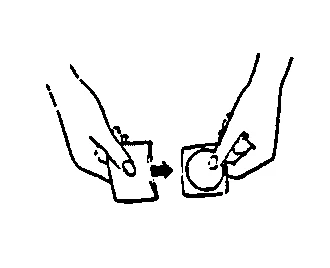
Figure 3
(3) With the other hand, peel off the protective liner and discard it (see Figure 4). Do not touch the
adhesive side of the patch, as it may not adhere properly to the skin.
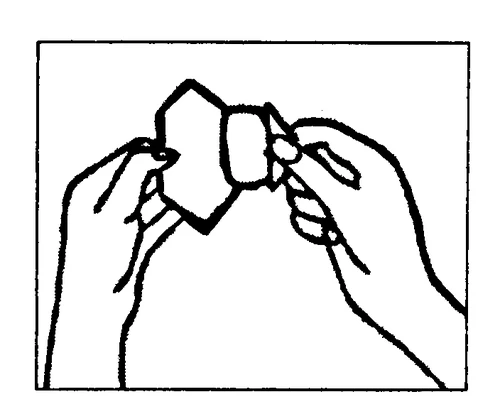
Figure 4
(4) Apply the patch to the skin and remove the remaining part of the protective liner.
Press firmly over the entire surface of the patch for about 10 seconds. Run a finger along the edges
to ensure good adhesion.
Hands must be washed before and after applying DERMATRANS.
To remove the patch, simply lift one edge and gently pull it off.
After use, fold the patch in half with the adhesive sides facing inward and dispose of it in a trash
container out of reach of children.
What to do if the patch comes off
If DERMATRANS is applied correctly, it is unlikely to come off. However, if the patch does detach,
it should be replaced with a new one, and the original treatment schedule should be resumed.
If you use more DERMATRANS than you should
If you are exposed to high doses of glyceryl trinitrate, you may experience severe lowering of
blood pressure, increased heart rate, collapse, fainting, and alteration of hemoglobin
(methemoglobinemia).
If you or someone else applies too many patches at the same time, remove them carefully and
thoroughly wash the underlying skin to reduce absorption. If hypotension or collapse occurs,
elevation of the legs or, if necessary, compressive bandaging is recommended.
If you forget to change the patch
If you forget to change the patch at the scheduled time, replace it as soon as possible, then continue
with the normal dosing schedule for the next patch.
If you stop using DERMATRANS
When you stop treatment with DERMATRANS, you may experience recurrent angina attacks.
If you have any doubts about how to use this medicine, consult your doctor or pharmacist.
4. Possible side effects
Like all medicines, this medicine can cause side effects, although not everybody gets them.
The following side effects have been reported:
Very common side effects (may affect more than 1 in 10 people):
- nausea;
- vomiting.
Common side effects (may affect more than 1 and fewer than 10 in 100 people):
- headache.
Uncommon side effects (may affect more than 1 and fewer than 10 in 1,000 people):
- skin inflammation due to contact (contact dermatitis);
- redness and irritation of the skin at the patch application site;
- itching;
- burning sensation.
Rare side effects (may affect more than 1 and fewer than 10 in 10,000 people):
- increased heart rate (tachycardia);
- low blood pressure when standing (orthostatic hypotension), which may be experienced as transient episodes of mental confusion;
- hot flushes;
- increased heart rate observed during diagnostic tests.
Very rare side effects (may affect fewer than 1 in 10,000 people):
- dizziness;
- fainting (syncope).
Side effects with unknown frequency:
- irregular heartbeat (palpitations);
- generalized skin rash (generalized rash).
If any of these side effects worsen or persist, inform your doctor.
Reporting of side effects
If you experience any side effect, including those not listed in this leaflet, talk to your doctor or pharmacist. You can also report side effects directly via the national reporting system at: www.agenziafarmaco.gov.it/it/responsabili
By reporting side effects, you can help provide more information on the safety of this medicine.
5. How to store DERMATRANS
Keep this medicine out of the sight and reach of children.
Do not store above 25°C. DERMATRANS must be stored in its original intact sachet.
Do not use this medicine after the expiry date stated on the carton and sachets. The expiry date refers to the last day of that month.
Do not dispose of medicines via wastewater or household waste. Ask your pharmacist how to dispose of medicines no longer required. This will help protect the environment.
6. Package contents and other information
What DERMATRANS contains
DERMATRANS patches contain the active substance glyceryl trinitrate and are available in three
formats:
DERMATRANS 5 mg/24 hours contains 15.70 mg of the active substance glyceryl trinitrate and
releases approximately 5 mg of glyceryl trinitrate per day (0.2 mg/hour);
the release area of the patch is 6.38 cm². The identification code printed on the backing film is NR5.
DERMATRANS 10 mg/24 hours contains 31.37 mg of the active substance glyceryl trinitrate and
releases approximately 10 mg of glyceryl trinitrate per day (0.4 mg/hour);
the release area of the patch is 12.75 cm². The identification code printed on the backing film is NR10.
DERMATRANS 15 mg/24 hours contains 47.04 mg of the active substance glyceryl trinitrate and
releases approximately 15 mg of glyceryl trinitrate per day (0.6 mg/hour);
the release area of the patch is 19.12 cm². The identification code printed on the backing film is NR15.
The other components are an adhesive substance (acrylate-vinyl acetate), an adhesive agent (hydrogenated abietic acid phthalate), and a cross-linking agent (polybutyl titanate), which together with the active substance are coated onto a support film (lacquered polypropylene sheet). The adhesive layer is covered with a double-sided siliconized aluminium protective sheet, which is removed before using the patch.
Description of the appearance of DERMATRANS and contents of the pack
DERMATRANS consists of transdermal adhesive patches. Each patch is individually sealed in a protective pouch.
Pack sizes: 15 or 30 patches. Not all pack sizes may be marketed.
Marketing Authorization Holder and Manufacturer
This medicinal product is authorized in the Member States of the European Economic Area under the
following names:
Ireland Dermatrans
Italy Dermatrans
Portugal Dermatrans
Spain Dermatrans
Similar Medications
-
Adesitrin
Form: patch, transdermal
Active substance Dosage NITROGLYCERIN — Manufacturer: Merus Labs Luxco II S.a.r.l.
-
Deponit
Form: patch, transdermal
Active substance Dosage NITROGLYCERIN — Manufacturer: Merus Labs Luxco II S.a.r.l.
-
Epinitril
Form: patch, transdermal
Active substance Dosage NITROGLYCERIN — Manufacturer: Viatris Healthcare Limited
-
Keritrina
Form: patch, transdermal
Active substance Dosage NITROGLYCERIN — Manufacturer: LAVIPHARM PHARMACEUTICAL PRODUCTS COMMERCIAL AND INDUSTRIAL SOCIETE ANONYME
-
Niglina
Form: patch, transdermal
Active substance Dosage NITROGLYCERIN — Manufacturer: IBSA FARMACEUTICI ITALIA S.R.L.
-
Niredil
Form: patch, transdermal
Active substance Dosage NITROGLYCERIN — Manufacturer: SPA SOCIETA' PRODOTTI ANTIBIOTICI S.P.A.
-
Nitroderm TTS
Form: patch, transdermal
Active substance Dosage NITROGLYCERIN — Manufacturer: SANDOZ S.P.A.
-
Nitroglycerin Doc Generici
Form: patch, transdermal
Active substance Dosage NITROGLYCERIN — Manufacturer: DOC GENERICI SRL
-
Nitroglycerin Eg
Form: patch, transdermal
Active substance Dosage NITROGLYCERIN — Manufacturer: EG S.P.A.
-
Nitroglycerin Eg Stada
Form: patch, transdermal
Active substance Dosage NITROGLYCERIN — Manufacturer: LAVIPHARM PHARMACEUTICAL PRODUCTS COMMERCIAL AND INDUSTRIAL SOCIETE ANONYME
-
Nitroglycerin Teva
Form: patch, transdermal
Active substance Dosage NITROGLYCERIN — Manufacturer: TEVA ITALIA S.R.L.
-
Nitroglycerin Zentiva
Form: patch, transdermal
Active substance Dosage NITROGLYCERIN — Manufacturer: ZENTIVA ITALIA S.R.L.
This page has been machine-translated and may contain inaccuracies. The original data is available in the manufacturing country's language.
Last data check: May 11, 2026 · Data source: Agenzia Italiana del Farmaco (AIFA)