Niglina
Italy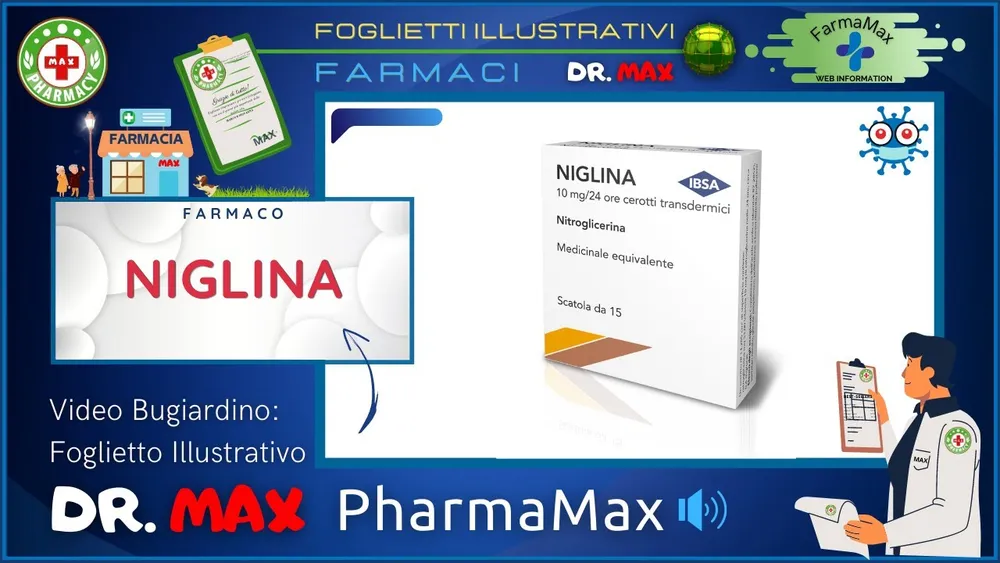
Table of Contents
- PACKAGE LEAFLET
- NIGLINA 5 mg/24 hours transdermal patches, 10 mg/24 hours transdermal patches, 15 mg/24 hours transdermal patches
- 1. What NIGLINA is and what it is used for
- 2. What you should know before using NIGLINA
- 3. How to use NIGLINA
- 4. Possible side effects
- 5. How to store NIGLINA
- 6. Package contents and other information
PACKAGE LEAFLET
NIGLINA 5 mg/24 hours transdermal patches, 10 mg/24 hours transdermal patches, 15 mg/24 hours transdermal patches
Nitroglycerin
Generic medicine
Please read this leaflet carefully before using this medicine because it contains important information for you.
- Keep this leaflet. You may need to read it again.
- If you have any questions, ask your doctor or pharmacist.
- This medicine has been prescribed for you only. Do not give it to other people, even if their symptoms are the same as yours, as it could be harmful.
- If you experience any adverse reaction, including those not listed in this leaflet, consult your doctor or pharmacist. See section 4.
Contents of this leaflet:
- What NIGLINA is and what it is used for
- What you need to know before using NIGLINA
- How to use NIGLINA
- Possible side effects
- How to store NIGLINA
- Contents of the pack and other information
1. What NIGLINA is and what it is used for
NIGLINA patches contain the active substance nitroglycerin, a vasodilator.
NIGLINA is indicated for the prevention of angina pectoris attacks (chest pain), taken as monotherapy or in combination with other anti-anginal therapy.
2. What you should know before using NIGLINA
Do not use NIGLINA:
- if you are allergic to nitroglycerin or related organic nitrates, or to any of the excipients listed in section 6;
- if you suffer from severe anemia;
- if you have increased pressure in the head (intracranial pressure), bleeding in the brain (cerebral hemorrhage), head trauma (cranial trauma), an eye disease causing increased pressure in the eyes and vision problems (closed-angle glaucoma);
- if you suffer from acute circulatory failure associated with a marked drop in blood pressure (shock);
- if you suffer from heart failure caused by heart valve defects (mitral stenosis), inflammation of the membrane lining the heart (constrictive pericarditis), or any obstruction to blood outflow, for example
caused by narrowing of the aorta (aortic stenosis), a heart disease (hypertrophic cardiomyopathy), or fluid accumulation in the space between the heart and the membrane surrounding it (pericardial tamponade);
- during treatment with medicines used for erectile dysfunction (phosphodiesterase-5 inhibitors) and medicines that cause blood vessel dilation (nitrates);
- if you are taking riociguat, a medicine used to treat pulmonary hypertension;
- if you suffer from low blood pressure (blood pressure below 90 mmHg);
- if you have severe reduction in blood volume (severe hypovolemia).
Warnings and precautions
Talk to your doctor or pharmacist before using NIGLINA:
- if you recently had a heart attack (myocardial infarction);
- if you have serious heart problems (acute heart failure);
- if you suffer from narrowing of heart valves (aortic and/or mitral stenosis);
- if you experience a drop in blood pressure when moving from a sitting to a standing position;
- if you suffer from low blood pressure, severe anemia, lack of oxygen (hypoxia), respiratory problems; or if you suffer from an eye disease (closed-angle glaucoma).
During treatment, you will undergo frequent medical check-ups. Your doctor will evaluate your health status to prescribe an appropriate dosage.
Children and adolescents
The safety and efficacy of NIGLINA have not yet been established.
Other medicines and NIGLINA
Inform your doctor or pharmacist if you are taking, have recently taken, or might take any other medicines.
Do not use NIGLINA together with:
- medicines used for erectile dysfunction (e.g., sildenafil or other PDE-5 inhibitors), as they may increase the blood pressure-lowering effect, potentially leading to increased reduction in blood supply to the heart (myocardial ischemia) and possibly causing a heart attack (see section "Do not use NIGLINA");
- riociguat, a soluble guanylate cyclase stimulator, as concomitant use may cause hypotension (see section "Do not use NIGLINA"). Inform your doctor if you are taking:
- medicines used for high blood pressure (calcium channel blockers, ACE inhibitors, diuretics, antihypertensives);
- medicines used to treat high blood pressure or heart rhythm problems (beta-blockers);
- medicines used for depression (antidepressants, tricyclic antidepressants);
- medicines used to treat psychiatric disorders (major tranquilizers);
- acetylsalicylic acid and amifostine, as they may increase the blood pressure-lowering effect (hypotensive effect) of NIGLINA;
- medicines used for pain and inflammation (indomethacin and other NSAIDs), except acetylsalicylic acid, as they may reduce the effect of NIGLINA;
- a medicine used for migraine (dihydroergotamine), as the effect of nitroglycerin may be reduced if taken concurrently, potentially causing constriction of the heart's blood vessels.
Fertility, pregnancy, and breastfeeding
If you are pregnant, suspect you may be pregnant, planning a pregnancy, or breastfeeding, consult your doctor or pharmacist before using this medicine.
Fertility
No data are available on the effect of NIGLINA on fertility in humans.
Pregnancy
There are insufficient data on the use of nitroglycerin during pregnancy; therefore, the use of NIGLINA during pregnancy is not recommended.
Your doctor will prescribe NIGLINA only if strictly necessary.
Breastfeeding
It is not known whether nitroglycerin passes into breast milk.
The use of NIGLINA during breastfeeding is not recommended.
Driving and using machines
NIGLINA, especially at the beginning of treatment or if alcohol is consumed, may impair reaction ability because it may cause a drop in blood pressure when moving from a lying to a standing position (postural hypotension), nausea, and dizziness. Therefore, caution is advised when driving or operating machinery.
NIGLINA and alcohol
Consumption of alcohol during treatment is not recommended. If you consume alcohol, the blood pressure-lowering effect of NIGLINA may increase.
3. How to use NIGLINA
Use this medicine exactly as instructed by your doctor or pharmacist.
If you have any doubts, consult your doctor or pharmacist.
Treatment is generally started with one NIGLINA 5 mg/24 hour patch applied to the skin once daily. The dose should be individually adjusted during treatment to achieve optimal therapeutic effect, possibly using NIGLINA 10 mg/24 hours or NIGLINA 15 mg/24 hours.
The maximum recommended daily dose is 15 mg of nitroglycerin.
NIGLINA must be administered intermittently, meaning with a daily nitrate-free interval to prevent the development of nitrate tolerance. This nitrate-free interval should correspond to a period during which the patient remains free of anginal attacks.
The nitrate-free interval must last at least 8 hours.
Use in children and adolescents
NIGLINA is not recommended.
How to apply the patch
It is recommended to apply NIGLINA transdermal patches to clean, dry skin (without cream residues), on the chest or the outer upper part of the arm, avoiding areas with redness or irritation. Application sites should be rotated.
The application area may be shaved if necessary. Areas prone to folding or subject to friction during movement should be avoided.
If you use more NIGLINA than you should
If you accidentally use too much NIGLINA, contact your doctor immediately or go to the nearest hospital.
The risk of overdose is very low due to the controlled release of nitroglycerin.
Symptoms of overdose may include:
- decrease in blood pressure ≤90 mmHg;
- transient loss of consciousness (syncope);
- pallor;
- sweating;
- weak pulse;
- increased heart rate (tachycardia);
- mental confusion in upright position;
- headache;
- bluish discoloration of the skin and mucous membranes (cyanosis);
- unconsciousness (coma);
- seizures;
- weakness;
- dizziness;
- nausea;
- vomiting;
- diarrhea.
In patients treated with other organic nitrates, a blood disorder (methemoglobinemia) has been reported. This adverse reaction cannot be excluded as possibly caused by an overdose of nitroglycerin.
At very high doses, intracranial pressure may increase. This may lead to cerebral symptoms.
In case of overdose, stop or reduce the use of the medicine.
Remove the patch and wash the application site.
Lie down with your legs elevated and contact your doctor immediately or go to the nearest hospital for appropriate treatment.
If you forget to change the patch
If you forget to change the patch at the scheduled time, replace it as soon as possible, then continue with the original dosing schedule for the next patch.
If you stop using NIGLINA
When stopping treatment with NIGLINA, you may experience a recurrence of anginal attacks.
Discontinue the treatment gradually and under close medical supervision.
If you have any questions about the use of this medicine, consult your doctor or pharmacist.
4. Possible side effects
Like all medicines, this one can cause side effects, although not everyone experiences them.
The frequency of occurrence of side effects is defined as follows: very common (≥ 1/10), common (≥ 1/100, <1/10), uncommon (≥ 1/1000, <1/100), rare (≥ 1/10000, <1/1000), very rare (<1/10000), not known (frequency cannot be estimated from the available data).
Very common (may affect more than 1 in 10 people):
- Headache (cephalalgia)
- Stomach disturbances (nausea and vomiting)
Common (may affect up to 1 in 10 people):
- Dizziness
- Mental confusion
- Drowsiness
- Decrease in blood pressure (hypotension) upon changing from a sitting or lying position to standing, which may lead to an increased heart rate (reflex tachycardia)
- Weakness
- Mild and transient irritation at the application site
Uncommon (may affect up to 1 in 100 people):
- Worsening of chest pain symptoms (angina pectoris)
- Temporary loss of consciousness (collapse), sometimes accompanied by a reduced heart rate (bradyarrhythmia)
- - Skin redness (erythema) at the patch application site
- - Itching, burning at the application site
- Inflammation of the skin (contact dermatitis)
- Hot flushes
- Palpitations
Very rare (may affect up to 1 in 10,000 people):
- Stomach burning (pyrosis)
Not known (frequency cannot be estimated from the available data):
- Skin reaction (exfoliative dermatitis)
- Sudden and temporary loss of consciousness (syncope)
Like all nitrate-containing preparations, NIGLINA commonly causes headaches, varying in intensity according to the dose, due to cerebral vessel dilation: these usually occur at the beginning of treatment and disappear after a few days without interrupting therapy. If headaches persist even during intermittent treatment, mild analgesics may be used. If headaches do not respond to this type of treatment, it is advisable to reduce the dosage of nitroglycerin or discontinue treatment.
A slight increase in heart rate can be avoided, if necessary, by combining treatment with a beta-blocker.
After removal of the transdermal patch, any mild skin redness usually disappears within a few hours. The application site should be rotated regularly to prevent local irritation.
Regarding possible cardiovascular side effects, orthostatic hypotension, tachycardia, palpitations, hot flushes, and dizziness are adverse effects that mainly occur at the beginning of treatment.
Severe reductions in blood pressure may be associated with nausea, vomiting, restlessness, pallor, and excessive sweating.
During treatment, a temporary condition characterized by reduced oxygen levels in the blood (hypoxemia) may occur, possibly affecting the heart (myocardial hypoxia), particularly if you suffer from coronary artery disease (coronary artery disease).
The use, especially prolonged use, of topical products may lead to sensitization phenomena; in such cases, treatment should be discontinued and appropriate therapeutic measures adopted.
Side effects may occur more frequently in cases of overdose or allergy (hypersensitivity).
Reporting of side effects
If you experience any side effect, including those not listed in this leaflet, consult your doctor or pharmacist. Side effects can also be reported directly via the national reporting system at the following website:
https://www.aifa.gov.it/content/segnalazioni-reazioni-avverse
Reporting side effects helps provide more information on the safety of this medicine.
5. How to store NIGLINA
Keep this medicine out of the sight and reach of children.
NIGLINA must be stored in its original intact sachet.
Do not use this medicine after the expiry date stated on the carton and sachets after
Exp. The expiry date refers to the last day of that month.
Do not dispose of any medicine via wastewater or household waste. Ask your pharmacist how to
dispose of medicines no longer required. This will help protect the environment.
6. Package contents and other information
What NIGLINA contains
NIGLINA 5 mg/24 hours transdermal patches
One patch with a surface area of 6.670 cm contains:
Active substance:
nitroglycerin 26.60 mg (releases 5 mg of nitroglycerin over 24 hours, approximately 0.2 mg/hour)
Other components: Acrylic acid copolymer (durotak 87-2852), sorbitan oleate, propylene glycol, low-density polyethylene, polyester.
NIGLINA 10 mg/24 hours transdermal patches
One patch with a surface area of 13.285 cm contains:
Active substance:
nitroglycerin 53.00 mg (releases 10 mg of nitroglycerin over 24 hours, approximately 0.4 mg/hour)
Other components: Acrylic acid copolymer (durotak 87-2852), sorbitan oleate, propylene glycol, low-density polyethylene, polyester.
NIGLINA 15 mg/24 hours transdermal patches
One patch with a surface area of 20.035 cm contains:
Active substance:
nitroglycerin 80.00 mg (releases 15 mg of nitroglycerin over 24 hours, approximately 0.6 mg/hour)
Other components: Acrylic acid copolymer (durotak 87-2852), sorbitan oleate, propylene glycol, low-density polyethylene, polyester.
Description of the appearance of NIGLINA and pack contents
Transdermal patches. Box containing 15 patches for each dosage strength.
Marketing Authorization Holder
IBSA Farmaceutici Italia S.r.l.
Via Martiri di Cefalonia, 2, 26900 Lodi
Manufacturer
ALTERGON Italia S.r.l.
Zona Industriale ASI 83040 Morra De Sanctis (AV)