Keritrina
ItalyTable of Contents
- Package leaflet: Information for the user
- Keritrina 5 mg/24 hours transdermal patches, 10 mg/24 hours transdermal patches, 15 mg/24 hours transdermal patches
- 1. What Keritrina is and what it is used for
- 2. What you need to know before using Keritrina
- 3. How to use Keritrina
- 4. Possible side effects
- 5. How to store Keritrina
- 6. Package contents and other information
Package leaflet: Information for the user
Keritrina 5 mg/24 hours transdermal patches, 10 mg/24 hours transdermal patches, 15 mg/24 hours transdermal patches
Nitroglycerin
Generic medicine
Please read this leaflet carefully before using this medicine because it contains important information for you.
- Keep this leaflet. You may need to read it again.
- If you have any questions, ask your doctor or pharmacist.
- This medicine has been prescribed for you only. Do not give it to others, even if their symptoms are the same as yours, as it could be harmful.
- If you experience any side effects, including those not listed in this leaflet, talk to your doctor or pharmacist. See section 4.
Contents of this leaflet:
- What Keritrina is and what it is used for
- What you need to know before using Keritrina
- How to use Keritrina
- Possible side effects
- How to store Keritrina
- Contents of the pack and other information
1. What Keritrina is and what it is used for
Keritrina is an adhesive patch containing the active substance nitroglycerin, which is released into the body through the skin. Nitroglycerin belongs to a group of medicines called nitrates that dilate blood vessels and make blood flow easier.
Keritrina is used to treat angina pectoris, a painful chest tightness that occurs when the heart muscles do not receive enough blood and oxygen.
Keritrina may be used to treat angina pectoris alone or in combination with other medicines such as beta-blockers and/or calcium antagonists.
Keritrina 5 mg/24 hours is also used for:
- preventing phlebitis (blockage of a vein, usually in the legs, causing swelling);
- preventing extravasation (leakage of fluids from veins) due to intravenous treatments expected to last 2 or more days.
2. What you need to know before using Keritrina
Do not use Keritrina
- if you are allergic to nitroglycerin, to any organic nitrate or to any of the other ingredients of this medicine (listed in section 6);
- if you have severe circulatory system failure associated with severe drop in blood pressure (shock);
- if you have a condition associated with: o increased pressure inside the head or cerebral hemorrhage or head trauma or increased pressure inside the eye (closed-angle glaucoma);
- if you have severe anemia;
- if you have heart failure due to: o narrowing (stenosis) of the mitral valve; o inflammation of the lining of the heart (constrictive pericarditis); o obstruction to blood leaving the heart, such as narrowing (stenosis) of the aortic valve; o disease causing thickening of the heart walls (hypertrophic cardiomyopathy); o fluid accumulation around the heart (pericardial tamponade);
- if you are taking medicines for erectile dysfunction (phosphodiesterase type 5 inhibitors) such as sildenafil (Viagra), as this may cause a severe drop in blood pressure;
- if you suffer from very low blood pressure (systolic pressure below 90 mmHg);
- if you have low circulating blood volume (severe hypovolemia);
- if you are taking a medicine containing the active substance riociguat used to treat high blood pressure in the lungs.
Warnings and precautions
Talk to your doctor or pharmacist before using Keritrina if any of the following conditions apply to you:
- if you recently had a heart attack or suffer from acute heart failure;
- if you suffer from hypoxemia (reduced arterial blood oxygen content) due to severe anemia;
- if you suffer from hypoxemia due to lung disease or severe heart disease (ischemic heart failure);
- if you have thickening of the heart muscle (hypertrophic cardiomyopathy).
Take particular care:
- and inform your doctor that you are using KERITRINA if you need to undergo procedures involving magnetic or electric fields, such as magnetic resonance imaging (MRI), cardioversion or defibrillation (an electric shock used to restore the heart to its normal rhythm), or diathermy (heat production in body tissues by radiation to treat or relieve certain conditions), because the patch must be removed before these procedures;
- if you are using the therapy intermittently, because during periods when the transdermal patch is not applied, you may experience an increased frequency of angina attacks. In such cases, your doctor will assess whether to prescribe another medicine;
- you may experience a loss of response (tolerance) to nitroglycerin patches; if this occurs, the effect of sublingual nitroglycerin may also be reduced;
- if your blood pressure becomes very low, consult your doctor, who will advise whether to continue using Keritrina or to remove the patch.
If you are using Keritrina to prevent phlebitis, your doctor will regularly check the site where the infusion is administered.
Children and adolescents
Keritrina must not be used in pediatric patients.
Other medicines and Keritrina
Tell your doctor or pharmacist if you are taking, have recently taken, or might take any other medicines.
Do not use Keritrina together with:
- medicines for erectile dysfunction (phosphodiesterase type 5 inhibitors) such as sildenafil (Viagra), because when taken together with Keritrina they may cause a severe drop in blood pressure;
- medicines containing the active substance riociguat, used to treat high blood pressure in the lungs.
Inform your doctor if you are taking:
- calcium channel blockers, beta-blockers, ACE inhibitors, antihypertensives, diuretics (medicines used to lower blood pressure, for fluid retention or heart problems);
- tricyclic antidepressants and major tranquilizers (medicines used to treat anxiety or depression);
- dihydroergotamine, used for example to treat migraine;
- amifostine (a medicine used to reduce side effects of certain cancer treatments or radiotherapy);
- acetylsalicylic acid;
- non-steroidal anti-inflammatory drugs (NSAIDs) (used to treat pain and inflammation).
Keritrina and alcohol
Do not drink alcohol while using Keritrina, as alcohol may enhance the drop in blood pressure that can occur when using the patch.
Pregnancy, breastfeeding and fertility
If you are pregnant, think you may be pregnant, planning to become pregnant, or are breastfeeding, consult your doctor or pharmacist before using this medicine.
Pregnancy
If you are pregnant, your doctor will assess whether the benefits to you clearly outweigh the risks to the fetus before prescribing Keritrina, especially during the first three months of pregnancy.
Breastfeeding
There is insufficient information on the passage of nitroglycerin into breast milk.
Your doctor will decide whether to discontinue breastfeeding or to stop treatment with Keritrina, taking into account the benefits of breastfeeding for the child and the benefits of treatment for the mother.
Fertility
There are no data available on the effect of Keritrina on male fertility.
There are no data supporting specific recommendations for women of childbearing potential.
Driving and using machines
Keritrina may affect your reactions or may rarely cause dizziness or low blood pressure when standing up, particularly at the beginning of treatment or when the dose is changed. If you experience these symptoms, do not drive and do not operate machinery.
3. How to use Keritrina
Use this medicine exactly as directed by your doctor. If you have any doubts, consult your doctor.
The response to Keritrina varies from patient to patient; therefore, you must use the dose prescribed by your doctor.
Treatment of angina pectoris
Keritrina is used to prevent angina and not to treat an acute attack. In case of an acute angina attack, you must use another medicine prescribed by your doctor.
The recommended initial dose is normally 1 Keritrina patch 5 mg/24 hours per day.
For maintenance therapy, your doctor will prescribe 1 Keritrina patch 10 mg/24 hours (normal maintenance dose) or 1 Keritrina patch 15 mg/24 hours.
Prevention of phlebitis and extravasation
Your doctor will apply a Keritrina 5 mg/24 hour patch to an area of skin distant from the vein where the cannula is inserted, at the same time the cannula is placed.
It is advisable to replace the patch daily. Treatment with Keritrina should be discontinued at the end of the intravenous therapy.
Prolonged or frequent administration of long-acting nitrates, including Keritrina or other transdermal patches, may lead to loss of response (tolerance) or reduced therapeutic efficacy.
Therapeutic efficacy can be maintained by removing the patch for 8–12 hours each day, usually at night.
Apply the patch to a clean, dry, undamaged area of skin on the chest or arms, free of hair or residues of ointments or creams.
The patch may be applied continuously for 24 hours or intermittently, by removing it for several hours, usually during sleep.
After the prescribed use, remove the patch and dispose of it properly, then apply a new patch to a different site.
To ensure good adhesion, press the patch firmly for a few seconds with the palm of your hand.
To avoid local irritation, wait a few days before reapplying a patch to the same site.
If the patch detaches, apply a new one to a different location.
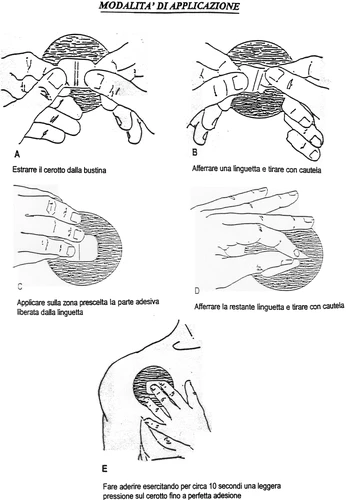
Apply the patch according to the following instructions:
- Remove the patch from the sachet;
- Grasp one tab and carefully peel it off;
- Apply the adhesive side, released from the tab, to the chosen site;
- Grasp the remaining tab and carefully peel it off;
- Press gently for about 10 seconds to ensure complete adhesion of the patch.
Use in elderly patients
Dose adjustment is normally not required; your doctor will prescribe the most appropriate dose for you.
If you use more Keritrina than you should
If you accidentally apply too many patches, remove them immediately and contact your doctor or go to the nearest hospital without delay.
While waiting for medical help, raise your legs to counteract low blood pressure or bend your legs to exert some pressure.
High doses of nitroglycerin may cause:
- low blood pressure
- increased heart rate
- collapse
- fainting.
Cases of a blood disorder (methaemoglobinaemia) have been reported following overdose.
If you forget to use Keritrina
If you forget to change the Keritrina patch at the scheduled time, do so as soon as you remember, and apply the new patch as described above.
If you forget to use the patch for one day, do not apply two or more patches at the same time to make up for the missed dose.
If you stop using Keritrina
Do not stop treatment abruptly.
If switching from chronic therapy to another type of treatment, nitroglycerin should be gradually withdrawn (over 4–6 weeks) while initiating the new treatment.
If you have any questions about the use of this medicine, consult your doctor or pharmacist.
4. Possible side effects
Like all medicines, this medicine may cause side effects, although not everybody gets them.
Very common side effects (may affect more than 1 in 10 people)
- nausea and vomiting.
Common side effects (may affect up to 1 in 10 people)
- headache. Headaches often improve after a few days, without the need to stop treatment. If you experience headache also during intermittent therapy, you may use mild analgesics. If headache does not respond to this type of treatment, consult your doctor, who will evaluate whether it is appropriate to reduce the nitroglycerin dosage or discontinue treatment.
Uncommon side effects (may affect up to 1 in 100 people)
- contact dermatitis (skin inflammation with symptoms such as redness, itching, and skin peeling);
- skin rash at the site of patch application, with itching, redness, burning sensation, skin irritation. Any mild redness usually disappears within a few hours after removing the patch. Regularly change the patch application site to prevent local irritation.
Rare side effects (may affect up to 1 in 1,000 people)
- increased heart rate;
- tachycardia;
- sudden drop in blood pressure, especially when standing up;
- hot flushes.
Very rare side effects (may affect up to 1 in 10,000 people)
- dizziness.
Side effects not known (frequency cannot be determined from available data)
- palpitations;
- rash affecting large areas of skin.
Reporting of side effects
If you experience any side effect, including those not listed in this leaflet, talk to your doctor or pharmacist. You can also report side effects directly via the national reporting system at https://www.aifa.gov.it/content/segnalazioni-reazioni-avverse. By reporting side effects, you can help provide more information on the safety of this medicine.
5. How to store Keritrina
Keep this medicine out of the sight and reach of children.
Do not use this medicine after the expiry date stated on the packaging after "Exp".
The expiry date refers to the last day of that month.
Do not store above 30°C.
Do not dispose of any medicine via wastewater or household waste. Ask your pharmacist how to dispose of medicines you no longer use. This will help protect the environment.
6. Package contents and other information
What Keritrina contains
Keritrina 5 mg/24 hours transdermal patches
- The active substance is nitroglycerin. Each patch with a surface area of 7 cm² contains 22.4 mg of nitroglycerin, released over 24 hours.
- The other components are: acrylic copolymer, sorbitan monooleate.
- Patch composition: silicone-coated polyester, low-density polyethylene.
Keritrina 10 mg/24 hours transdermal patches
- The active substance is nitroglycerin. Each patch with a surface area of 14 cm² contains 44.8 mg of nitroglycerin, released over 24 hours.
- The other components are: acrylic copolymer, sorbitan monooleate.
- Patch composition: silicone-coated polyester, low-density polyethylene.
Keritrina 15 mg/24 hours transdermal patches
- The active substance is nitroglycerin. Each patch with a surface area of 21 cm² contains 67.2 mg of nitroglycerin, released over 24 hours.
- The other components are: acrylic copolymer, sorbitan monooleate.
- Patch composition: silicone-coated polyester, low-density polyethylene.
Description of the appearance of Keritrina and contents of the pack
Pack containing 15 transdermal patches.
Marketing Authorization Holder and Manufacturer
Marketing Authorization Holder
Lavipharm S.A.
Agias Marinas Street, GR-190 02 Peania, Attica, Greece
Manufacturer
Lavipharm S.A.
Agias Marinas Street, GR-190 02 Peania, Attica, Greece