Niredil
ItalyTable of Contents
- Package leaflet: Information for the user
- NIREDIL 5 mg/24 hours transdermal patches, 10 mg/24 hours transdermal patches, 15 mg/24 hours transdermal patches
- 1. What NIREDIL is and what it is used for
- 2. What you need to know before using NIREDIL
- 3. How to use NIREDIL
- 4. Possible side effects
- 5. How to store NIREDIL
- 6. Package contents and other information
Package leaflet: Information for the user
NIREDIL 5 mg/24 hours transdermal patches, 10 mg/24 hours transdermal patches, 15 mg/24 hours transdermal patches
Nitroglycerin
Generic medicine
Please read all of this leaflet carefully before you start using this medicine because it contains important information for you.
- Keep this leaflet. You may need to read it again.
- If you have any questions, ask your doctor or pharmacist.
- This medicine has been prescribed for you only. Do not give it to other people, even if their symptoms are the same as yours, as it may be harmful.
- If you experience any side effects, including those not listed in this leaflet, tell your doctor or pharmacist. See section 4.
Contents of this leaflet:
- What NIREDIL is and what it is used for
- What you need to know before using NIREDIL
- How to use NIREDIL
- Possible side effects
- How to store NIREDIL
- Contents of the pack and other information
1. What NIREDIL is and what it is used for
NIREDIL transdermal patch contains the active substance nitroglycerin, which belongs to the group of vasodilator medicines used in the treatment of certain heart diseases. This medicine works by dilating blood vessels and improving blood circulation and oxygen supply to the heart.
The transdermal patch is applied to the skin, and the active substance passes through the skin and enters the body.
NIREDIL, either alone or in combination with other medicines, is indicated for the prevention and treatment of chest pain caused by inadequate oxygen supply to the heart (angina pectoris).
2. What you need to know before using NIREDIL
Do not use NIREDIL
- if you are allergic to nitroglycerin or to any of the other ingredients of this medicine (listed in section 6);
- if you are allergic to other medicines similar to nitroglycerin (organic nitrates);
- if you have low levels of red blood cells in the blood (anemia);
- if you have increased pressure within the eye (glaucoma) or within the skull, or in case of head trauma or cerebral hemorrhage;
- if you have an acute circulatory disorder with a severe drop in blood pressure (shock);
- if you have heart problems such as heart failure due to obstruction, as in the case of narrowing (stenosis) of the aortic or mitral valve, or if you suffer from an inflammatory disease causing thickening of the membrane surrounding the heart (constrictive pericarditis), or from a heart disease causing marked thickening of the heart walls and altering normal blood flow (hypertrophic obstructive cardiomyopathy), or in case of fluid or blood accumulation around the heart (cardiac tamponade);
- if you are pregnant or breastfeeding (see section Pregnancy and breastfeeding);
- if the person using this medicine is a child;
- if you are taking medicines for erectile dysfunction, sometimes called impotence (see section Other medicines and NIREDIL);
- if you have very low blood pressure (severe hypotension);
- if you have a severe reduction in circulating blood volume (severe hypovolemia);
- if you are taking riociguat, a medicine used to treat pulmonary hypertension (see section Other medicines and NIREDIL).
Warnings and precautions
Talk to your doctor or pharmacist before using NIREDIL.
This medicine is not intended for acute angina attacks requiring immediate intervention.
Use this medicine with caution and under direct medical supervision in the following situations:
- if you have recently suffered from heart problems such as myocardial infarction or acute heart failure;
- if you have low levels of oxygen in the blood (hypoxemia) due to reduced red blood cells (anemia), lung problems (hypoventilation), or heart problems (ischemic heart failure);
- if you suffer from chest pain (angina) caused by an enlarged heart (hypertrophic cardiomyopathy), as nitroglycerin may worsen these conditions.
Prolonged use of this medicine over time may cause allergic reactions, which resolve upon removal of the patch, or a reduction/loss of effectiveness of nitroglycerin itself or of similar medicines (tolerance and cross-tolerance), which can be avoided by applying the patch intermittently (see section How to take NIREDIL). The patch must be removed if you experience excessive lowering of blood pressure (severe hypotension) or if you are undergoing medical procedures such as Magnetic Resonance Imaging, cardioversion, defibrillation, or diathermy treatment.
If you temporarily discontinue treatment with this medicine, your doctor will advise you on alternative therapies to prevent an increased frequency of chest pain due to heart problems (angina pectoris).
If you are elderly, avoid sudden changes in posture, as this medicine may initially cause dizziness upon standing due to a rapid drop in blood pressure (orthostatic hypotension).
This medicine may increase levels of certain substances in the urine, such as catecholamines and vanillylmandelic acid, thereby altering the results of related laboratory tests.
Other medicines and NIREDIL
Tell your doctor or pharmacist if you are taking, have recently taken, or might take any other medicines.
Do not use NIREDIL together with medicines used to facilitate erection, such as sildenafil (Viagra®), as these may enhance the blood pressure-lowering effect.
Do not use NIREDIL with riociguat, a medicine used to treat pulmonary hypertension, as concomitant use may increase the blood pressure-lowering effect (see section Do not use NIREDIL).
Use caution if you are taking the following medicines, as they may enhance the blood pressure-lowering effect of NIREDIL:
- medicines used to regulate blood pressure or heart function, such as calcium channel blockers, beta-blockers, ACE inhibitors, and other antihypertensives;
- medicines used to increase urine elimination (diuretics);
- medicines used in disorders of the central nervous system, such as neuroleptics, antidepressants, and major tranquilizers;
- a medicine called amifostine, used in certain types of cancer;
- a medicine called acetylsalicylic acid, used to relieve inflammation and pain.
Use caution if you are taking non-steroidal anti-inflammatory drugs (NSAIDs), except acetylsalicylic acid, as they may reduce the effectiveness of nitroglycerin.
Use caution and inform your doctor if you are taking a medicine for headache called dihydroergotamine, as nitroglycerin may increase its blood levels.
NIREDIL and alcohol
Avoid drinking alcohol during treatment with NIREDIL, as it may cause an excessive drop in blood pressure.
Pregnancy and breastfeeding
If you are pregnant, suspect you may be pregnant, plan to become pregnant, or are breastfeeding, consult your doctor or pharmacist before using this medicine.
Do not use this medicine if you are pregnant, especially during the first trimester, or if you are breastfeeding, unless absolutely necessary and only after your doctor has evaluated the risks and benefits for you and the fetus or newborn.
Driving and using machines
Avoid driving or operating machinery if you experience any of the following symptoms: reduced ability to respond to stimuli, dizziness, or a sensation of vertigo upon standing due to a rapid drop in blood pressure (orthostatic hypotension), which may occur especially at the beginning of treatment or after dose adjustments.
NIREDIL contains propylene glycol
This medicine contains propylene glycol, which may cause skin irritation.
3. How to use NIREDIL
Use this medicine exactly as directed by your doctor or pharmacist. If you
have any doubts, consult your doctor or pharmacist.
The recommended starting dose is 5 mg (one NIREDIL 5 mg/24 hour patch) per day, followed by an
increase to 10 mg (one NIREDIL 10 mg/24 hour patch) per day, or if necessary to 15
mg (one NIREDIL 15 mg/24 hour patch) per day.
Your doctor will tell you whether the patch should be applied continuously for 24 hours, or
intermittently, by removing it for several hours, usually during sleep.
If you experience a decrease in the effectiveness of the medicine, your doctor may recommend that you remove the patch for 8-12 hours each day.
Apply the patch after washing your hands, on a clean, dry, undamaged area of skin on the chest or arms, free of hair or residues from ointments or creams.
It is advisable to change the application site daily.
Do not remove the patch during bathing or physical exercise, as it remains firmly adhered to the skin.
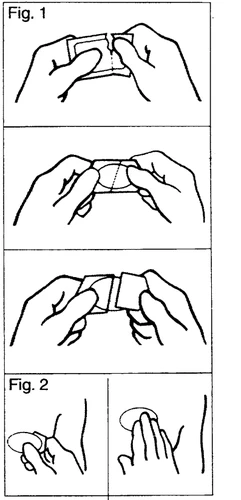
Apply the patch following these instructions:
- Open the sachet by tearing it at the marked notch (do not use scissors to avoid damaging the patch) and remove the patch (Fig. 1)
- Hold the patch between your thumb and index finger. With the other hand, peel off the protective liner and discard it (Fig. 1)
- Avoid touching the adhesive side of the patch, and apply it to the skin while holding the part still covered by the protective liner between your thumb and index finger
- Remove the remaining part of the protective liner and press firmly for about 10 seconds over the entire surface of the patch (Fig. 2)
- Press along the edges with your finger to ensure good adhesion (Fig. 2)
- Wash your hands after applying the patch
- After use, the patch should be folded with the adhesive side inward and disposed of properly.
Use in children
This medicine must not be used in children.
If you use more NIREDIL than you should
Due to its slow-release formulation, overdose risks are rare.
However, if you experience any of the following symptoms, remove the patch immediately and contact your doctor without delay or go to the nearest hospital:
- severe drop in blood pressure leading to increased heart rate (hypotension with reflex tachycardia);
- loss of consciousness (collapse or syncope);
- bluish discoloration of the skin (cyanosis);
- coma, seizures;
- alteration in the structure of haemoglobin (methaemoglobinaemia). Treatment includes immediate removal of the patch, elevation of the patient's legs while kept in a horizontal position, or compression bandaging of the legs to increase
blood pressure and promote recovery of consciousness; in cases of methaemoglobinaemia, intravenous administration of medicines such as methylene blue or toluidine blue.
If you stop using NIREDIL
Discontinuation of treatment with this medicine should be carried out gradually,
especially if starting a new therapy with other medicines.
If you have any questions about the use of this medicine, consult your doctor or pharmacist.
4. Possible side effects
Like all medicines, this medicine can cause side effects, although not everybody gets them.
The following side effects may occur:
Very common (may affect more than 1 in 10 people)
- nausea and vomiting.
Common (may affect up to 1 in 10 people)
- temporary headache (headache), which can be relieved by administering pain-relieving medicines (mild analgesics), reducing the dose of nitroglycerin, or discontinuing treatment.
Uncommon (may affect up to 1 in 100 people)
- itching, burning, irritation, and skin problems such as contact dermatitis and erythema, which can be resolved by changing the patch application site or removing the patch.
Rare (may affect up to 1 in 1,000 people)
- increased heart rate (tachycardia), which can be managed by administering medicines that regulate heart activity such as beta-blockers;
- drop in blood pressure upon changing position (orthostatic hypotension);
- hot flushes;
- increased heart rate during specific diagnostic tests.
Very rare (may affect up to 1 in 10,000 people)
- dizziness.
Not known (frequency cannot be estimated from the available data)
- severe loss of consciousness (syncope);
- increased awareness of heartbeat (palpitations);
- skin problems such as skin rashes.
Reporting of side effects
If you experience any side effect, including those not listed in this leaflet, talk to your doctor or pharmacist. You can also report side effects directly via the national reporting system at the following website:
www.agenziafarmaco.gov.it/content/come-segnalare-una-sospetta-reazione-avversa .
By reporting side effects, you can help provide more information on the safety of this medicine.
5. How to store NIREDIL
Keep this medicine out of the sight and reach of children.
Do not use this medicine after the expiry date which is stated on the packaging after
"Expiry".
The expiry date refers to the last day of that month.
Store this medicine in the original packaging.
Do not dispose of any medicine via wastewater or household waste. Ask your pharmacist how to dispose of medicines no longer required. This will help protect the environment.
6. Package contents and other information
What NIREDIL contains
NIREDIL 5 mg/24 hours transdermal patches
- The active substance is nitroglycerin. Each patch contains 26.60 mg of nitroglycerin and releases 5 mg over 24 hours at a rate of 0.2 mg/hour.
- The other components are: acrylic acid copolymer (durotak 87-2852), sorbitan oleate, propylene glycol, low-density polyethylene, polyester.
NIREDIL 10 mg/24 hours transdermal patches
- The active substance is nitroglycerin. Each patch contains 53.00 mg of nitroglycerin and releases 10 mg over 24 hours at a rate of 0.4 mg/hour.
- The other components are: acrylic acid copolymer (durotak 87-2852), sorbitan oleate, propylene glycol, low-density polyethylene, polyester.
NIREDIL 15 mg/24 hours transdermal patches
- The active substance is nitroglycerin. Each patch contains 80.00 mg of nitroglycerin and releases 15 mg over 24 hours at a rate of 0.6 mg/hour.
- The other components are: acrylic acid copolymer (durotak 87-2852), sorbitan oleate, propylene glycol, low-density polyethylene, polyester.
Description of the appearance of NIREDIL and contents of the pack
Pack of 15 transdermal patches.
Each patch is sealed in an individual pouch.
The adhesive side of the patch is covered by a protective liner which must be removed before use.
Marketing Authorization Holder
SPA – Società Prodotti Antibiotici S.p.A.
Via Biella, 8
20143 Milan
Italy
Manufacturer
ALTERGON ITALIA S.R.L.
Zona Industriale
83040 Morra De Sanctis (AV)
Italy