Ionosteril
Ukraine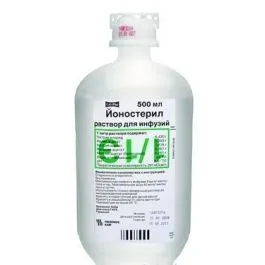
Instructions for Use
INSTRUCTIONS FOR MEDICAL USE OF THE MEDICINAL PRODUCT IONOSTERIL (JONOSTERIL)
Composition:
active substances: 1 l of solution contains:
| sodium chloride |
………………………………. |
6.430 g, |
| sodium acetate trihydrate |
………………………………. |
3.674 g, |
| potassium acetate |
………………………………. |
0.393 g, |
| calcium acetate |
………………………………. |
0.261 g, |
| magnesium acetate tetrahydrate |
………………………………. |
0.268 g; |
Excipients: water for injections, diluted hydrochloric acid, sodium hydroxide.
Pharmaceutical form. Infusion solution.
Main physico-chemical properties: clear, colourless solution;
pH = 5.0–7.0.
Titratable acidity – 1–10 mmol NaOH/L.
Theoretical osmolarity – 291 mOsm/L.
Pharmacotherapeutic group.
Solutions used for correction of water-electrolyte balance disorders. Electrolytes. ATC code B05BB01.
Pharmacological properties.
Pharmacodynamics.
Yoosteril is an isotonic electrolyte solution (balanced electrolyte solution) containing principal cations balanced in accordance with plasma composition, and is used for correction of fluid and electrolyte imbalances. Electrolytes are used to restore and maintain normal osmotic conditions in the extracellular and intracellular compartments. Acetate is oxidized and contributes to alkalinization balance. Due to the metabolizable anions contained in Yoosteril, the solution can also be used in patients predisposed to acidosis.
Electrolytes Na+, K+, Mg++, Ca++, and Cl– serve to restore or correct water-electrolyte homeostasis (including blood volume, osmotic balance, acid-base status, and specific ion effects). The organic anion acetate is metabolized to bicarbonate.
Pharmacokinetics.
After administration of the solution, the interstitial space (interstitium), which constitutes 2/3 of the extracellular space, is primarily filled. Only 1/3 of the infused volume remains in the intravascular space; therefore, the solution produces only short-term hemodynamic effects.
The kidneys are the main regulators of fluid balance. Sodium, magnesium, and chloride are excreted by the kidneys and, to a minor extent, through the skin and gastrointestinal tract. 90% of potassium is excreted in urine and 10% through the gastrointestinal tract. Individual components of the solution do not exhibit negative pharmacokinetic properties when administered simultaneously in an infusion solution. Electrolyte excretion depends on individual patient requirements, metabolic conditions, and renal function.
Clinical characteristics.
Indications.
- For fluid and electrolyte replacement in patients with balanced acid-base status and existing or threatened acidosis.
- For short-term restoration of intravascular fluid volume.
- Isotonic dehydration of various etiologies.
- Hypotonic dehydration.
Contraindications.
- Hypersensitivity to the active substances or to any of the excipients.
- Hypervolemia (fluid overload).
- Hyperkalemia.
- Edema, hypertonic dehydration, severe renal or cardiac insufficiency.
Additional contraindications for subcutaneous administration:
- Severe dehydration.
- Life-threatening conditions such as collapse, shock, sepsis, or severe electrolyte disturbances.
- Skin infections or allergic skin disorders at the injection site.
Special precautions.
Use only a clear solution from an undamaged package. The solution must be administered using a sterile administration set and should be used immediately after opening the container. From a microbiological standpoint, the infusion solution should be used immediately after addition of any substances. If immediate use is not possible, the mixed solution must be stored under appropriate conditions (no more than 24 hours at 2–8 °C) prior to administration.
Any unused portions of the medicinal product after single administration must be discarded. Administration must be performed under aseptic conditions.
Interaction with other medicinal products and other forms of interaction.
Since the product contains electrolytes, the following interactions should generally be considered when administering Yoosteril:
Sodium: corticosteroids may lead to sodium and fluid retention (edema and hypertension).
Potassium: potassium-sparing diuretics (Amiloride, Spironolactone, Triamterene, alone or in combination) (risk of hyperkalemia); Succinylcholine (risk of hyperkalemia); Tacrolimus, Cyclosporine (risk of hyperkalemia); ACE inhibitors, angiotensin II receptor antagonists (risk of hyperkalemia). Hyperkalemia may be life-threatening, especially in patients with renal insufficiency.
Calcium: digitalis glycosides (increased glycoside toxicity due to calcium); thiazide diuretics (risk of hypercalcemia); vitamin D (risk of hypercalcemia).
Subcutaneous administration: anticoagulants may increase the risk of impaired blood hemostasis.
Special precautions for use.
Prolonged administration in large volumes requires monitoring of blood and urine electrolytes and diuresis.
IonoSteril must be used with caution and strict adherence to general safety measures in patients with the following conditions:
- Hypernatremia.
- Hyperchloremia.
- Hypercalcemia.
- Renal insufficiency (due to sodium, potassium, and calcium content of the infusion).
- Cardiovascular diseases (due to sodium and potassium content).
- Conditions requiring restricted sodium intake (e.g., generalized edema, pulmonary edema, hypertension, eclampsia).
- Conditions that may lead to hyperkalemia (e.g., adrenal insufficiency, extensive tissue damage such as severe burns).
- Diseases associated with elevated vitamin D levels, such as sarcoidosis (due to calcium content).
Due to the calcium content of the preparation, the following precautions must be observed:
- General safety measures must be followed to prevent extravasation of the solution during infusion.
- The same device must not be used to simultaneously administer the solution and transfuse blood.
The preparation must be used with caution for subcutaneous administration in patients with coagulation disorders or those receiving anticoagulant therapy (e.g., warfarin).
The preparation should be administered to children with congenital lactate metabolism disorders only after an individual benefit/risk assessment.
When administered subcutaneously, the injection site must not be damaged or show signs of edema. If pain occurs during subcutaneous administration, the infusion rate should be reduced and, if necessary, the injection site changed.
When infusing under pressure in emergency situations, all air must be removed or withdrawn from the container or system, as there is a risk of air embolism.
Use during pregnancy or breastfeeding.
IonoSteril may be used during pregnancy or breastfeeding only by intravenous route. Clinical data on subcutaneous use during pregnancy or breastfeeding are lacking.
In eclampsia, IonoSteril should be used only after an individual benefit/risk assessment.
Ability to affect reaction speed when driving or operating machinery.
IonoSteril has no effect on the ability to drive vehicles or operate other automated systems.
Administration and Dosage
For intravenous and subcutaneous administration. The dosage is determined according to the patient's clinical condition and prescribed based on individual fluid and electrolyte requirements. The use of concomitant medications should be taken into account.
Dosage for intravenous administration.
Adults (including elderly patients) and children aged 12 years and older:
Maximum infusion rate
The maximum infusion rate depends on the patient's clinical condition.
Correction of electrolyte and fluid imbalance
The infusion rate should be 5 mL/kg body weight/hour (equivalent to 350 mL/hour for a body weight of 70 kg).
Short-term intravascular volume replacement
For short-term intravascular volume replacement, the volume of infused solution should be 3–4 times greater than the volume of lost blood. In cases of massive blood loss, administration of colloids should be considered.
Maximum daily dose
The maximum daily dose depends on the patient's fluid and electrolyte requirements.
Correction of electroly, and fluid imbalance
The volume of infused solution should not exceed 40 mL/kg body weight/day (equivalent to 5.48 mmol sodium and 0.16 mmol potassium/kg body weight/day).
Short-term intravascular volume replacement
The volume of solution required for administration is determined solely based on the individual clinical condition of the patient; therefore, no maximum daily dose is established.
Children.
The infusion rate may vary according to the child's clinical condition and age.
Infusion rate:
| Infants (29 days – 12 months): |
6 – 8 mL/kg body weight/hour |
| Children 2–6 years: |
4 – 6 mL/kg body weight/hour |
| Children 7–12 years: |
2 – 4 mL/kg body weight/hour |
Maximum daily dose
Correction of electrolyte and fluid imbalance
The maximum daily dose varies according to the patient's age and clinical condition. Generally, the volume of infused solution should not exceed 40 mL/kg body weight/day (equivalent to 5.48 mmol sodium and 0.16 mmol potassium/kg body weight/day). If necessary, individual additional requirements for fluid or potassium should be taken into account.
Short-term restoration of intravascular volume (in cases of high extracellular fluid losses)
The volume of solution required is determined solely based on the individual patient's clinical condition; therefore, no maximum daily dose is defined.
The maximum sodium administration dose must not be exceeded. The maximum daily sodium administration dose is 20–40 mL/kg body weight/day (equivalent to ~3–5 mmol sodium/kg body weight/day).
Dosing for subcutaneous administration.
Adults (including elderly patients) and children from 12 years of age:
Maximum infusion rate
The infusion rate depends on the patient's requirements and tolerance. The infusion rate is generally 20–125 mL/hour and should not exceed 125 mL/hour.
Maximum daily dose
The daily dose is generally 500–2000 mL/day.
The maximum daily dose depends on the patient's requirements and clinical condition and is 3000 mL. Up to 1500 mL of this volume can be administered at one injection site. For volumes exceeding this limit, another injection site must be selected.
Subcutaneous administration is indicated for fluid and electrolyte volume replacement and for the treatment of mild to moderate dehydration.
Ioysteril should be used according to the indications. The duration of subcutaneous administration should not exceed 30 days.
Children.
The use of Ioysteril for subcutaneous administration in children is not recommended.
Overdose.
In case of accidental overdose or excessive infusion rate of Ioysteril, hyperhydration or sodium overload may occur, with a risk of edema development, particularly in conditions associated with impaired renal sodium excretion. Electrolyte and acid-base imbalances may also occur.
Treatment in case of overdose: discontinue the infusion, enhance renal elimination and implement appropriate negative balancing; in cases of oligoanuria, hemodialysis may be necessary if required.
Adverse reactions.
Frequency of adverse reactions:
| Very common |
(≥ 1/10) |
| Common |
(≥ 1/100 to <1/10) |
| Uncommon |
(≥ 1/1000 to <1/100) |
| Rare |
(≥ 1/10000 to <1/1000) |
| Very rare |
(≥ 1/10000) |
| Not known |
Frequency cannot be estimated from the available data. |
Adverse reactions related to skin and subcutaneous tissue
Uncommon: hypersensitivity reactions such as urticaria, associated with intravenous administration of magnesium salts.
General disorders and administration site reactions
Rare: febrile reactions, inflammation at the application site, local pain or reactions, venous irritation, injection site thrombosis (phlebitis), bruising, edema, tachycardia.
Unknown: local edema may occur following subcutaneous administration.
Shelf life.
3 years.
Storage conditions.
Store in the original packaging at a temperature not exceeding 25 °C.
Keep out of reach of children.
Incompatibilities.
Due to the calcium content in Ionosteril, precipitates may form when used with medicinal products containing oxalate, phosphate, carbonate or hydrogencarbonate.
Packaging.
500 ml in plastic bottles. 10 bottles with the instructions for medical use in cardboard boxes.
500 ml in Freeflex bag No.1.
Prescription category.
Prescription only.
Manufacturer.
Fresenius Kabi Deutschland GmbH.
Fresenius Kabi Deutschland GmbH.
Manufacturer's address and location.
Freseniusstrasse 1, 61169 Friedberg, Germany.
Freseniusstrasse 1, 61169 Friedberg, Germany.
Marketing Authorization Holder.
Fresenius Kabi Deutschland GmbH.
Fresenius Kabi Deutschland GmbH.
Address of the Marketing Authorization Holder.
Else-Kroner-Strasse, 1,
61352 Bad Homburg, V.d.H. Germany.
Else-Kroner-Strasse,1,
61352 Bad Homburg, V.d.H. Germany.
Frequently Asked Questions
What is Ionosteril prescribed for?
The drug is used to restore the balance of fluids and electrolytes in the body. It is applied in cases of dehydration, for short-term replenishment of intravascular fluid volume, and for the correction of acid-base imbalances (e.g., in acidosis).
How should Ionosteril be taken correctly?
The drug is administered intravenously or subcutaneously. Dosage and infusion rate are determined individually by a physician, depending on the patient's condition, age, and fluid requirements. For subcutaneous administration, the duration of the course should not exceed 30 days.
Who should not use this drug?
Contraindications include hypersensitivity to the composition, edema, hyperhydration (excess fluid), high blood potassium levels (hyperkalemia), as well as severe heart or kidney failure. For subcutaneous administration, it must not be used in the presence of skin infections or allergies at the injection site, or in states of shock or collapse.
What are the possible side effects of Ionosteril?
Possible allergic skin reactions (urticaria), inflammation, pain, or irritation of the veins at the injection site, edema, bruising, tachycardia, or increased body temperature. Local edema may occur with subcutaneous administration.
Can the drug be combined with other medicines?
Caution is required when taking corticosteroids, certain diuretics, blood pressure medications, and anticoagulants. It is also important to note that due to the calcium content in the solution, precipitates may form if mixed with drugs containing oxalate, phosphate, carbonate, or bicarbonate.
Can the drug be used during pregnancy or breastfeeding?
During this period, the drug is permitted for use only via intravenous administration. There is no data regarding the safety of subcutaneous administration for pregnant and breastfeeding women.
Similar Medications
-
Acesol
Form: solution for infusion
Active substance Dosage sodium acetate 200 mg/100 ml sodium chloride 500 mg/100 ml potassium chloride 100 mg/100 ml Manufacturer: PJSC "Infuziya"
-
Darrow solution
Form: solution for infusion
Active substance Dosage sodium chloride 0.4 g/100 ml potassium chloride 0.267 g/100 ml sodium lactate 0.594 g/100 mL Manufacturer: PJSC "Infuziya"
-
Disol
Form: solution for infusion
Active substance Dosage sodium acetate 200 mg/100 ml sodium chloride 600 mg 100 ml Manufacturer: PJSC "Infuziya"
-
Hartmann's solution
Form: solution for infusion
Active substance Dosage sodium chloride 0.6 g/100 mL potassium chloride 0.04 g/100 ml sodium lactate 0.303 g/100 ml calcium chloride 0.02013 g/100 ml magnesium chloride 0.02 g/100 ml Manufacturer: PJSC "Infuziya"
-
Isosol
Form: solution for infusion
Active substance Dosage sodium chloride 5.26 mg/ml potassium chloride 0.37 mg/ml calcium chloride 0.37 mg/ml magnesium chloride 0.30 mg/ml sodium acetate 6.80 mg/ml Manufacturer: Subsidiary Enterprise "Farmatreyd"
-
Osmolife
Form: solution for infusion
Active substance Dosage sodium chloride 6.80 g/L potassium chloride 0.30 g/l magnesium chloride 0.20 g/L calcium chloride 0.37 g/L sodium acetate 3.27 g/l malic acid 0.67 g/l Manufacturer: PJSC "Halychpharm"
-
Plasmalit
Form: solution for infusion
Active substance Dosage sodium chloride 0.526 g/100 mL sodium gluconate 0.502 g/100 ml sodium acetate 0.368 g/100 ml potassium chloride 0.037 g/100 mL magnesium chloride 0.03 g/100 ml Manufacturer: PJSC "Infuziya"
-
Plasmoven®
Form: solution for infusion
Active substance Dosage sodium chloride 6.80 mg/ml potassium chloride 0.30 mg/ml calcium chloride 0.37 mg/ml magnesium chloride 0.20 mg/ml sodium acetate 3.27 mg/ml L-malic acid 0.67 mg/ml Manufacturer: PJSC «Pharmaceutical Company «Darnitsa»
-
Ringer lactate solution
Form: solution for infusion
Active substance Dosage sodium chloride 0.602 g/100 ml potassium chloride 0.0373 g/100 ml sodium lactate 0.3138 g/100 ml calcium chloride 0.0294 g/100 ml Manufacturer: PJSC "Infuziya"
-
Ringer lactate solution
Form: solution for infusion
Active substance Dosage sodium chloride 0.602 g/100 ml potassium chloride 0.0373 g/100 ml sodium lactate 0.3138 g/100 ml calcium chloride 0.0294 g/100 ml Manufacturer: PJSC "Halychpharm"
-
Ringer malate
Form: solution for infusion
Active substance Dosage sodium chloride 6.80 mg/ml potassium chloride 0.30 mg/ml magnesium chloride 0.094 mg/ml calcium chloride 0.37 mg/ml sodium acetate 1.971 mg/ml L-malic acid 0.67 mg/ml Manufacturer: Yuria-Pharm LLC
-
Ringer solution
Form: solution for infusion
Active substance Dosage sodium chloride 0.86 g/100 mL potassium chloride 0.03 g/100 ml calcium chloride 0.0322 g/100 ml Manufacturer: PJSC "Halychpharm"
This page has been machine-translated and may contain inaccuracies. The original data is available in the manufacturing country's language.
Last data check: July 21, 2026 · Data source: Державний реєстр лікарських засобів України