Ringer solution
Ukraine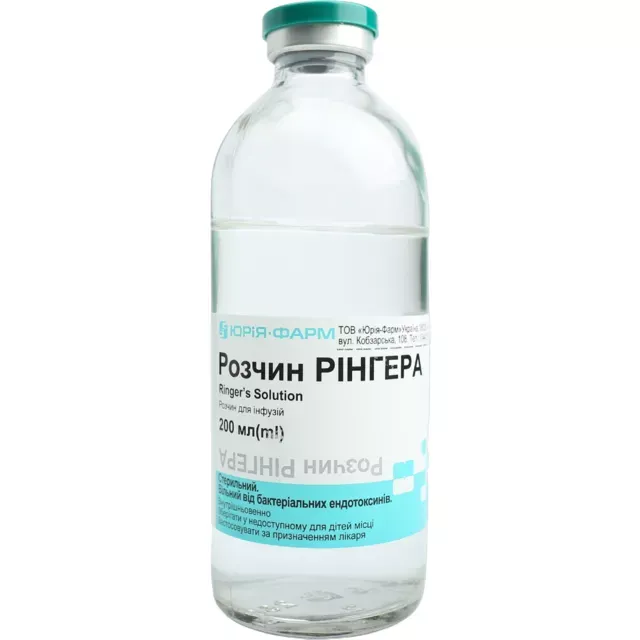
Table of Contents
INSTRUCTIONS FOR MEDICAL USE OF THE MEDICINAL PRODUCT RINGER'S SOLUTION
Composition:
Active substances: sodium chloride, potassium chloride, calcium chloride dihydrate;
100 ml of solution contain: sodium chloride – 0.86 g; potassium chloride – 0.03 g; calcium chloride dihydrate – 0.0322 g;
Excipient: water for injections.
Ion composition per 1000 ml of medicinal product: Na+ – 147.15 mmol; K+ – 4.02 mmol; Ca2+ – 2.19 mmol; Cl- – 155.6 mmol.
Pharmaceutical form. Infusion solution.
Main physicochemical properties: clear, colorless liquid; theoretical osmolarity – 308.94 (309) mOsm/L; pH 5.00–7.50.
Pharmacotherapeutic group. Solutions for intravenous administration. Solutions used for correction of electrolyte balance disorders. ATC code B05B B01.
Pharmacological Properties
Pharmacodynamics. Ringer's solution is a source of water and electrolytes. It may induce diuresis depending on the patient's condition.
Sodium, the main cation of extracellular fluid, primarily participates in controlling water distribution, fluid balance, and osmotic pressure of body fluids. Sodium is also associated with chloride and bicarbonate in the regulation of acid-base balance of body fluids.
Potassium, the main intracellular cation, is involved in carbohydrate utilization and protein synthesis, and is required for the regulation of nerve conduction and muscle contraction, especially in the heart.
Chloride, the main extracellular anion, is closely related to sodium metabolism, and changes in the body's acid-base balance are reflected in chloride concentration changes. Infusion of a large amount of chloride ions may cause loss of bicarbonate ions, leading to acidosis. For this reason, Ringer's solution is buffered with lactate or acetate.
Calcium, an essential cation, provides the structural framework of bones and teeth (in the form of calcium phosphate and calcium carbonate). In its ionized form, calcium is required for the functional mechanism of blood coagulation, normal cardiac function, and regulation of neuromuscular excitability.
Pharmacokinetics. Na+ and Cl– ions administered with Ringer's solution undergo the same pharmacokinetics as those ingested with food. They freely distribute throughout all organs, tissues, and interstitial spaces and are excreted via glomerular filtration in the kidneys. Significant reabsorption of Na+ and Cl– ions occurs in the renal tubules, primarily in the loop of Henle and distal tubules, including mechanisms blocked by loop and thiazide diuretics, respectively.
Potassium ions (K+) are freely filtered at the glomeruli but almost completely reabsorbed in the proximal tubules, with only 10% of filtered K+ ions excreted. Secretion in the distal tubules and collecting ducts can significantly increase K+ elimination. The kidneys have a limited capacity to conserve K+ concentration. Therefore, when Na+ concentration in the distal tubules is high, K+ loss can be substantial and lead to hypokalemia. This justifies the inclusion of K+ in Ringer's solution.
Calcium ion (Ca2+) homeostasis is tightly regulated by hormones and rarely requires clinical intervention with intravenous infusion of calcium-containing solutions.
Clinical characteristics.
Indications.
Used in hypovolemia and extracellular dehydration due to prolonged vomiting, diarrhea, extensive burns, frostbite, peritonitis, severe infectious diseases, shock conditions, collapse; during surgical intervention and in the postoperative period.
Used for dilution of concentrated electrolyte solutions.
Contraindications.
- Extracellular hyperhydration or hypervolemia;
- hypertonic dehydration;
- hypernatremia;
- hyperkalemia;
- hypercalcemia;
- hyperchloremia;
- pulmonary edema;
- cerebral edema;
- hypercoagulation;
- thrombophlebitis;
- metabolic alkalosis;
- severe renal failure (with oliguria/anuria);
- decompensated heart failure;
- severe arterial hypertension;
- generalized edema and liver cirrhosis associated with ascites;
- concomitant use with cardiac glycosides (digitalis).
Interaction with other medicinal products and other types of interactions.
Interaction due to the presence of sodium in the solution:
- corticosteroids and carbenoxolone cause sodium and water retention (with edema and arterial hypertension).
Increased sodium retention in the body may occur when using the following medicinal products concomitantly: nonsteroidal anti-inflammatory drugs, androgens, anabolic hormones, estrogens, corticotropin, mineralocorticoids, vasodilators, or ganglion blockers.
Interaction due to the presence of potassium in the solution:
- potassium-sparing diuretics (e.g., amiloride, spironolactone, triamterene);
- angiotensin-converting enzyme (ACE) inhibitors;
- tacrolimus, cyclosporine;
- angiotensin II receptor blockers.
When used concomitantly with potassium-containing preparations, the risk of hyperkalemia increases.
All these drugs increase potassium concentration in plasma and may lead to potentially fatal hyperkalemia, especially in renal failure, which in turn potentiates hyperkalemia.
Interaction due to the presence of calcium in the solution:
- cardiac glycosides (digitalis), whose effects are enhanced in the presence of calcium, may cause serious, sometimes fatal, cardiac arrhythmias;
- thiazide diuretics or vitamin D may cause hypercalcemia.
Interaction with ceftriaxone:
Do not administer Ringer's solution and ceftriaxone simultaneously, even if different infusion systems and different administration sites are used (see section "Special precautions").
Special precautions for use
During prolonged parenteral therapy, laboratory parameters should be monitored and the patient's clinical status assessed every 6 hours (depending on the infusion rate) to monitor electrolyte concentrations and fluid-electrolyte balance.
Intravenous administration of solutions may lead to fluid and/or solute overload, hyperhydration, congestion, and pulmonary edema. The risk of dilutional effects is inversely proportional to the electrolyte concentration. Conversely, the risk of solute overload causing congestion with peripheral edema and pulmonary edema is directly proportional to the electrolyte concentration.
Due to its sodium ion content, this solution should be used with caution in patients with arterial hypertension, renal or cardiovascular insufficiency, congestive heart failure (especially in the postoperative period), preeclampsia, hyperaldosteronism, elderly patients, and in patients with clinical conditions associated with sodium retention and edema.
Sodium-containing solutions should be administered cautiously to patients receiving corticosteroids or corticotropin.
Due to its potassium content, caution is required when administering this solution to patients with cardiac disease or clinical conditions associated with potassium retention, such as renal insufficiency or adrenocortical insufficiency, acute dehydration, or extensive tissue destruction as seen in severe burns.
In patients with impaired renal excretory function, administration of this solution may lead to retention of sodium or potassium.
Calcium administration must be performed under ECG monitoring, especially in patients receiving cardiac glycosides (e.g., digoxin). Serum calcium levels do not always reflect tissue calcium levels.
Due to the presence of calcium ions in this medicinal product, caution is required when co-administering with blood products because of the risk of coagulation.
Patients receiving cardiac glycosides require special attention when calcium is administered parenterally.
Because of the calcium content in this solution:
- Extravasation should be avoided during intravenous infusion;
- The solution should be used with caution in patients with impaired renal function or diseases associated with elevated vitamin D levels, such as sarcoidosis;
- When simultaneous transfusion is required, this solution must not be administered using the same infusion set/system due to the risk of coagulation.
Fatal reactions due to precipitation of ceftriaxone-calcium in the lungs and kidneys have been reported in premature infants and neonates up to one month of age. Ceftriaxone must not be mixed or administered simultaneously with calcium-containing solutions in any patient group, either through different infusion lines or at different infusion sites.
Ceftriaxone and calcium-containing solutions may be administered sequentially if different administration sites or different infusion lines are used, or if the infusion lines are flushed with normal saline between infusions.
Ringer's solution for infusion contains insufficient concentrations of potassium or calcium to maintain the balance of these ions or correct their deficiencies. Therefore, after treatment of dehydration, the intravenous fluid should be replaced with a solution that ensures adequate balance of these ions.
Ringer's solution contains 147 mmol/L of sodium. Particular caution is recommended when administering this solution to patients on a sodium-restricted diet.
Ringer's solution contains 4 mmol/L of potassium. Particular caution is recommended when administering this solution to patients with impaired liver function or those on a potassium-restricted diet.
This solution is intended for intravenous use with sterile equipment. It is recommended to change the intravenous administration set at least every 24 hours.
The solution should be used only if it is clear and the bottle or vial is intact and sealed.
The physician should also consider the potential for adverse reactions to drugs administered concomitantly with Ringer's solution.
If an adverse reaction occurs, the infusion should be discontinued, the patient's condition assessed, and appropriate therapeutic measures initiated.
Use during pregnancy or breastfeeding
No studies on the use of Ringer's solution in pregnant women have been conducted.
It is unknown whether this medicinal product is excreted in human milk. Since most drugs are excreted in human milk, Ringer's solution should be administered to breastfeeding women with caution.
Ability to influence reaction speed when driving or operating machinery
Data are unavailable due to the exclusive use of this medicinal product under hospital conditions.
Administration and Dosage.
The solution is intended for intravenous use only.
The dosage is prescribed by a physician and depends on the patient's age, body weight, clinical condition, and laboratory parameters.
The usual adult dose is up to 1–2 liters per day; the maximum dose depends on the status of fluid and electrolyte balance, cardiovascular system, and kidney function.
The infusion rate for adults is 60–80 drops/min or as a bolus.
Administration of the solution should be based on calculated maintenance or replacement fluid requirements for each individual patient.
Parenteral preparations should be inspected visually for particulate matter and discoloration prior to administration.
Use only clear solution from an undamaged bottle or vial!
Children.
Studies on the use of Ringer's solution in children have not been conducted.
Overdose.
Administration of an excessive amount of the solution may lead to disturbances in fluid and electrolyte balance (hypervolemia, hypernatremia, hypercalcemia, hyperchloremia) and acid-base equilibrium. Treatment is symptomatic.
Overdose or too rapid infusion of this solution may result in water and sodium overload, with a risk of edema, particularly in the presence of impaired renal sodium excretion. In such cases, kidney dialysis may be required.
Excessive potassium administration may lead to hyperkalemia, especially in patients with impaired renal function. Symptoms may include: limb paresthesia, muscle weakness, paralysis, cardiac arrhythmias, heart block, cardiac arrest, and confusion.
Treatment of hyperkalemia includes administration of calcium, insulin (with glucose), sodium bicarbonate, ion-exchange resins, or dialysis.
Excessive administration of calcium salts may cause hypercalcemia. Symptoms of hypercalcemia may include anorexia, nausea, vomiting, constipation, abdominal pain, muscle weakness, mental disturbances, polydipsia, polyuria, nephrocalcinosis, kidney stones, and in severe cases, cardiac arrhythmias and coma. Too rapid intravenous administration of calcium salts may also cause numerous symptoms of hypercalcemia, as well as an unusual taste in the mouth (chalk-like taste), hot flashes, and peripheral vasodilation. Mild asymptomatic hypercalcemia can usually be resolved by discontinuing calcium or other contributing agents such as vitamin D. Severe hypercalcemia requires urgent treatment, e.g., loop diuretics, hemodialysis, calcitonin, bisphosphonates, or trisodium edetate.
Excessive chloride administration may lead to bicarbonate loss, resulting in acidosis. Treatment is symptomatic.
Side effects
Electrolyte imbalances (potassium, calcium, sodium, chloride), chloride acidosis, and hyperhydration may occur; heart failure in patients with cardiac diseases or pulmonary edema; tachycardia; hypersensitivity reactions, allergic reactions; reactions at the site of administration.
Side effects may arise due to improper administration techniques: febrile reactions, infections at the injection site, pain or reactions at the site of administration, venous irritation, venous thrombosis or phlebitis extending from the site of administration, as well as extravasation.
Side effects may also occur when additional medicinal products are added to the solution; the nature of the added substance/medicinal product determines the likelihood of the corresponding adverse reaction.
If side effects occur, administration of the solution should be discontinued, the patient's condition assessed, and appropriate medical assistance provided.
Reporting suspected adverse reactions
Reporting adverse reactions following marketing authorization is important. It allows continuous monitoring of the benefit-risk balance of the medicinal product. Healthcare professionals, pharmacists, patients, and their legal representatives should report all suspected adverse reactions and lack of efficacy via the Automated Pharmacovigilance Information System at the following link: https://aisf.dec.gov.ua.
Shelf life. 3 years.
Storage conditions.
Store at a temperature not exceeding 25 °C. Keep out of reach of children.
Incompatibilities.
Prior to use, compatibility of Ringer's solution with other concurrently administered drugs should be evaluated.
To minimize the risk of possible incompatibility arising from mixing this solution with other added medicinal products, the final infusion solution should be inspected immediately after mixing, prior to administration, and periodically during administration for cloudiness or precipitation.
Other medicinal products may be added to Ringer's solution only if they are soluble and stable in it and have a similar pH.
Ringer's solution is incompatible with ceftriaxone (see section "Special precautions for use").
Calcium salts are known to be incompatible with a wide range of medicinal products. They may form complexes leading to precipitate formation.
Listed below are medicinal products known to be incompatible with Ringer's solution and therefore should not be mixed (the list is not exhaustive):
- amphotericin B;
- cortisone;
- erythromycin lactobionate;
- ethymivan;
- ethanol;
- sodium thiopental;
- disodium edetate.
Packaging.
200 ml and 400 ml in glass bottles or flasks.
Prescription status.
Prescription only.
Manufacturer.
JSC "Halychpharm".
Manufacturer's location and address of place of business.
6/8 Opryshkivska St., Lviv, 79024, Ukraine.