Plasmalit
Ukraine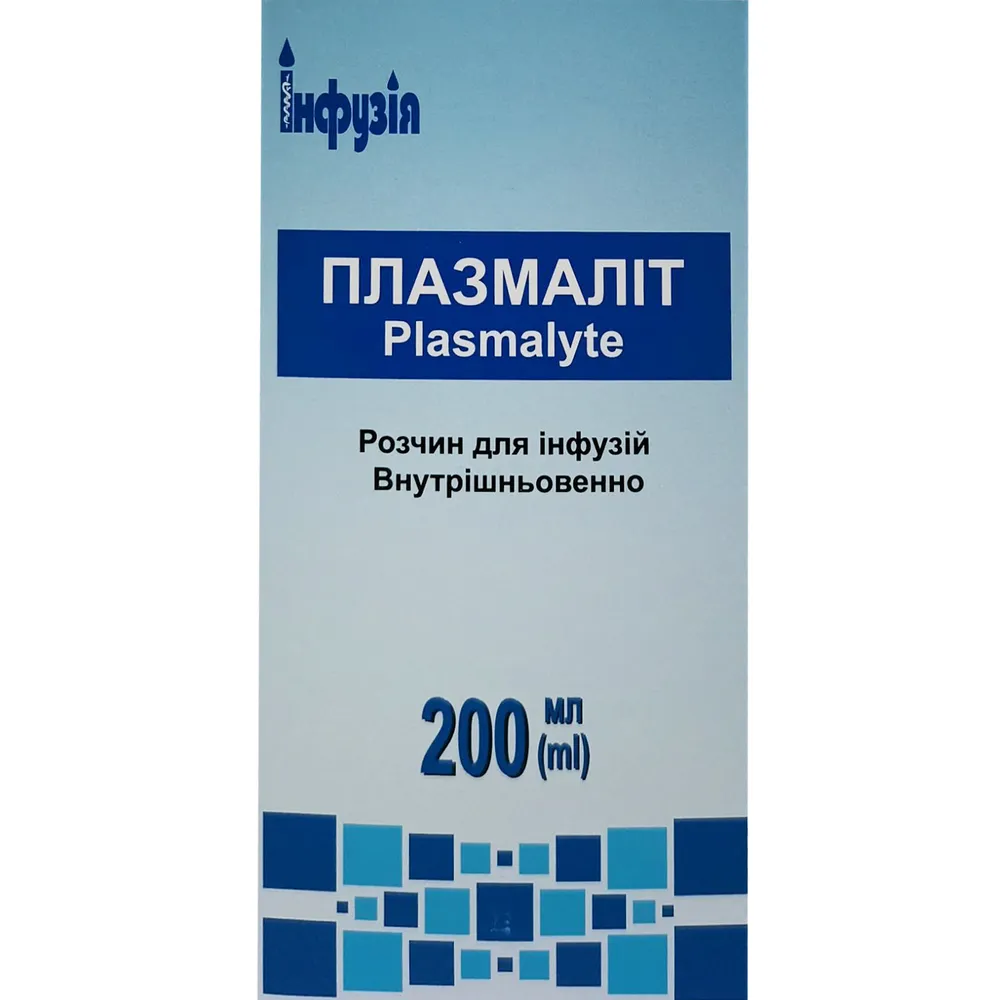
Table of Contents
INSTRUCTIONS FOR MEDICAL USE OF THE MEDICINAL PRODUCT PLASMALYTE (Plasmalyte)
Composition:
Active substances: sodium chloride, sodium gluconate, sodium acetate trihydrate, potassium chloride, magnesium chloride hexahydrate;
100 ml of solution contains: sodium chloride — 0.526 g, sodium gluconate — 0.502 g, sodium acetate trihydrate — 0.368 g, potassium chloride — 0.037 g, magnesium chloride hexahydrate — 0.03 g;
Excipients: sodium hydroxide, water for injections.
Pharmaceutical form. Infusion solution.
Main physicochemical properties: clear, colorless or slightly yellow liquid. Theoretical osmolarity — 295 mOsmol/L, pH 6.5–8.0.
Pharmacotherapeutic group. Solutions for intravenous administration. Solutions used for correction of electrolyte balance disorders.
ATC code B05B B01.
Pharmacological Properties
Pharmacodynamics
Plasmalyte is an isotonic electrolyte solution. In composition and ion content, Plasmalyte is practically equivalent to blood plasma.
The pharmacological properties of the medicinal product Plasmalyte are determined by the properties of its components (water, sodium, potassium, magnesium, chloride, acetate, and gluconate). The primary effect of the medicinal product Plasmalyte consists in filling the extracellular space (including interstitial and intravascular compartments).
Sodium acetate and gluconate are bicarbonate-generating salts with alkalizing properties.
When other drugs are added to the medicinal product Plasmalyte, the overall pharmacodynamics of the solution will depend on the properties of the added drug.
Pharmacokinetics
The pharmacokinetic properties of the medicinal product Plasmalyte are determined by the ions contained in its composition (sodium, potassium, magnesium, chloride, acetate, and gluconate).
Acetate is metabolized in muscles and peripheral tissues to bicarbonate without liver involvement.
When any other medicinal products are added to Plasmalyte, the combined pharmacokinetic properties of the solution will depend on the properties of the added drug.
Clinical characteristics.
Indications.
Plasmalyte, infusion solution, is indicated:
- for replacement of lost fluid (e.g., in burns, head injuries, fractures, infections, peritonitis);
- for replacement of lost fluid during surgery;
- in hemorrhagic shock and clinical conditions requiring rapid transfusion (compatible with blood);
- in mild to moderate metabolic acidosis, as well as in disorders of lactate metabolism.
Contraindications.
- Hyperchloremia;
- hypernatremia;
- hyperkalemia;
- renal failure;
- heart block;
- metabolic or respiratory alkalosis;
- hypocalcemia or hypochlohydria;
- concomitant use of potassium-sparing diuretics (amiloride, potassium canrenoate, spironolactone, triamterene) (see section "Interaction with other medicinal products and other forms of interaction");
- hypersensitivity to any component of the medicinal product.
Interaction with other medicinal products and other forms of interaction.
Interaction related to the presence of sodium
- Corticosteroids and carbenoxolone, associated with sodium and water retention, may cause edema or hypertension.
Interaction related to the presence of potassium
The following combinations may lead to increased serum potassium concentration and potentially fatal hyperkalemia, especially in the presence of renal failure, which potentiates the hyperkalemic effect.
Contraindicated combinations:
- potassium-sparing diuretics (amiloride, potassium canrenoate, spironolactone, triamterene, used either alone or in combination) (see section "Contraindications").
Combinations not recommended:
- angiotensin-converting enzyme (ACE) inhibitors, angiotensin II receptor antagonists — potential risk of potentially fatal hyperkalemia (see section "Special precautions");
- tacrolimus, cyclosporine (see section "Special precautions").
Concomitant administration of Plasmalyte with the above-mentioned drugs in patients carries a risk of developing severe, potentially fatal hyperkalemia, particularly in the presence of severe renal failure.
Interaction related to the presence of magnesium
- Neuromuscular blockers such as tubocurarine, succinylcholine, and vecuronium — the effects of these agents are potentiated by magnesium;
- acetylcholine — release and action of acetylcholine are reduced by magnesium salts, which may contribute to maintenance of neuromuscular blockade;
- aminoglycoside antibiotics and nifedipine — have an additive effect when used with parenteral magnesium, thereby enhancing neuromuscular blockade.
Interaction related to the presence of acetate and gluconate (which are metabolized to bicarbonate)
Plasmalyte should be administered with caution to patients who are concurrently receiving drugs whose renal excretion depends on acid-base status. Due to its alkalinizing effect, Plasmalyte may interfere with the elimination of such drugs.
- Renal clearance of acidic drugs such as salicylates, barbiturates, and lithium may be increased due to alkalinization of urine by bicarbonate formed during metabolism of acetate and gluconate.
- Renal clearance of basic drugs such as sympathomimetics (e.g., ephedrine, pseudoephedrine) and psychostimulants (e.g., dexamphetamine sulfate, fenfluramine hydrochloride) may be reduced for the same reason.
Special precautions for use.
Electrolyte balance
The medicinal product Plasmalyte is not indicated for the treatment of hypochloremic and hypokalemic alkalosis.
Plasmalyte is not indicated for the primary treatment of severe forms of metabolic acidosis or for the treatment of hypomagnesemia.
Use in patients at risk of or with existing hypermagnesemia.
Parenteral administration of magnesium salts should be used with caution in patients with severe renal impairment and in patients with myasthenia gravis. Monitoring for clinical signs of hypermagnesemia is mandatory, especially during treatment of eclampsia (see section "Interaction with other medicinal products and other forms of interaction").
Use in patients with hypocalcemia.
Plasmalyte does not contain calcium; in addition, the alkalinizing effect of the preparation may lead to an increase in plasma pH and a decrease in the concentration of ionized calcium (which is not protein-bound). Therefore, Plasmalyte should be administered with particular caution to patients with hypocalcemia.
Use in patients at risk of or with existing hyperkalemia.
Solutions containing potassium salts should be administered with caution to patients with heart disease or conditions predisposing to hyperkalemia, such as renal insufficiency or adrenal insufficiency, acute dehydration, or massive tissue damage (e.g., in severe burns). Monitoring of plasma potassium ion levels is necessary in patients at risk of hyperkalemia.
The following combinations with Plasmalyte are not recommended due to the potential for increased plasma potassium concentration, which may result in potentially fatal hyperkalemia, particularly in the presence of renal insufficiency, where hyperkalemic effects are enhanced (see section "Interaction with other medicinal products and other forms of interaction"):
- angiotensin-converting enzyme (ACE) inhibitors, angiotensin II receptor antagonists;
- tacrolimus, cyclosporine;
- potassium-sparing diuretics (amiloride, potassium canrenoate, spironolactone, triamterene).
Use in patients with hypokalemia.
Although Plasmalyte solution contains potassium at a concentration similar to that in blood plasma, this is insufficient to achieve a beneficial effect in cases of severe hypokalemia; therefore, it should not be used for this purpose.
Fluid balance / renal function.
Risk of volume overload or excess solute and electrolyte disturbances.
When administering Plasmalyte, the patient's clinical condition and laboratory parameters (fluid-electrolyte balance, electrolyte concentrations in blood and urine, and acid-base balance) should be monitored.
Depending on the volume and rate of infusion, intravenous administration of Plasmalyte may cause volume overload and/or excessive intake of solutes, leading to hyperhydration/hypervolemia. Particular caution is required when administering large-volume infusions to patients with cardiac, pulmonary, or renal insufficiency.
Use in patients with hypervolemia or hyperhydration or in conditions causing sodium retention and edema.
Plasmalyte should be administered with particular caution to patients with hypervolemia or hyperhydration.
Solutions containing sodium chloride should be administered with caution to patients with arterial hypertension, heart failure, peripheral edema or pulmonary edema, impaired renal function, pre-eclampsia, hyperaldosteronism, or other conditions associated with sodium retention (see section "Interaction with other medicinal products and other forms of interaction").
Use in patients with severe renal impairment.
Plasmalyte should be administered with particular caution to patients with severe renal insufficiency. In such patients, administration of Plasmalyte may lead to retention of sodium, potassium, or magnesium.
Acid-base balance
Plasmalyte should be administered with particular caution to patients with alkalosis or at risk of developing alkalosis. Excessive administration of Plasmalyte may lead to metabolic alkalosis due to the presence of acetate and gluconate ions in its composition (see section "Interaction with other medicinal products and other forms of interaction").
Other conditions
Hypersensitivity reactions.
Hypersensitivity reactions, including anaphylactic reactions, have been reported during administration of Plasmalyte.
If any signs of hypersensitivity occur, the infusion should be stopped immediately and appropriate measures should be taken to manage the clinical manifestations of the hypersensitivity reaction.
Other.
The medicinal product should be used with caution in the postoperative period immediately after discontinuation of muscle relaxants, as magnesium salts may cause recurrent neuromuscular blockade (see section "Interaction with other medicinal products and other forms of interaction").
When Plasmalyte is used concomitantly with parenteral nutrition, the total amount of administered electrolytes should be taken into account, and the infusion volume should be adjusted as necessary.
Effect on laboratory test results when administering solutions containing gluconate.
False-positive results in the Aspergillus Platelia ELISA test (Bio-Rad Laboratories) have been reported in patients receiving Plasmalyte solutions containing gluconate. Subsequent investigations confirmed that these patients were free from Aspergillus infection. Therefore, positive results of this test in patients receiving gluconate-containing solutions should be interpreted with caution and confirmed by other diagnostic methods.
Administration.
Adding other medicinal products to Plasmalyte or using incorrect administration techniques may lead to chills due to the introduction of pyrogens. In case of an adverse reaction, the infusion should be stopped immediately.
(Information on incompatibilities and principles of adding other medicinal products is provided in the sections "Interaction with other medicinal products and other forms of interaction" and "Incompatibilities").
Use during pregnancy or breastfeeding.
There is no information on the experience of using Plasmalyte in pregnant women or women who are breastfeeding. It may be administered to pregnant women or women who are breastfeeding only after careful assessment of the expected benefit of therapy for the mother and the potential risk to the fetus/child.
Ability to affect reaction speed when driving vehicles or operating machinery.
There are no data on the effect of Plasmalyte on the ability to drive vehicles or operate machinery.
Method of Administration and Dosage
Adults, elderly patients, adolescents, children
The dosage and rate of administration depend on the patient's age, body weight, clinical and physiological condition, and concomitant therapy.
Recommended dosage: from 500 mL to 3 liters / 24 hours.
Rate of administration
The infusion rate in adults, elderly patients, and adolescents is typically 40 mL/kg / 24 hours. When used to replace fluid losses during surgery, the infusion rate may be increased to approximately 15 mL/kg/hour.
Use in elderly patients
Cardiovascular, renal, and hepatic diseases are common among elderly patients, and they often receive concomitant medication. These factors should be taken into account when selecting the type of infusion solution, volume, and infusion rate.
Pediatric use
Controlled studies on the safety and efficacy of Plasmalyte in children have not been conducted.
Method of administration — intravenous.
The solution should be administered using sterile equipment, following aseptic techniques. The infusion system should be primed with Plasmalyte solution to displace air from the tubing.
Plasmalyte solution may be administered before, during, or after blood transfusion.
Due to its iso-osmolarity, the solution can be administered via a peripheral vein.
Before administration, the solution should be visually inspected for the presence of particulate matter or discoloration. The solution should not be used if clarity is lost or if the packaging integrity is compromised.
The outer transparent plastic bag should be removed immediately before use. Sterility of the solution is ensured by the inner polymer bag. After connecting the infusion system, the medicinal product must be used immediately.
Polymer bags must not be connected together, as this may lead to air embolism due to residual air entering from one bag before the complete administration of the solution from another bag.
Squeezing polymer bags to increase the infusion rate may result in air embolism if air remains in the bag due to incomplete removal prior to starting administration.
Ventilated intravenous administration systems must not be used in conjunction with polymer bags when the air inlet valve is open — this may lead to air embolism.
Additional medicinal products, if necessary, may be added to the solution before or during infusion via a dedicated port on the infusion system.
Children
The medicinal product may be administered to children aged 12 years and older.
Overdose
Excessive or rapid administration of Plasmalyte may lead to hyperhydration and sodium overload, with a risk of edema, particularly in patients with impaired renal sodium excretion. In such cases, hemodialysis may be required.
Excessive potassium administration may lead to hyperkalemia, especially in patients with renal insufficiency. Symptoms include paresthesia of extremities, muscle weakness, paralysis, cardiac arrhythmias, heart block, cardiac arrest, and confusion. Treatment of hyperkalemia includes administration of calcium, insulin (with glucose), sodium bicarbonate, or hemodialysis.
Excessive magnesium administration may lead to hypermagnesemia, characterized by loss of deep tendon reflexes and respiratory depression due to neuromuscular blockade. Other symptoms of hypermagnesemia may include nausea, vomiting, skin flushing, thirst, hypotension due to peripheral vasodilation, drowsiness, confusion, muscle weakness, bradycardia, coma, and cardiac arrest. There are reports of successful treatment of supralethal hypermagnesemia using artificial ventilation, intravenous calcium chloride, and forced diuresis with mannitol infusion.
Excessive administration of chlorides may lead to decreased bicarbonate levels and development of acidosis.
Excessive administration of substances such as sodium acetate and sodium gluconate, which are metabolized to form bicarbonate anions, may lead to hypokalemia and metabolic alkalosis, particularly in patients with impaired renal function. Symptoms may include mood changes, fatigue, dyspnea, muscle weakness, and cardiac arrhythmias. Muscle hypertonia, twitching, and seizures may occur, particularly in patients with hypocalcemia. Treatment of metabolic alkalosis associated with excessive bicarbonate concentration primarily involves adequate correction of fluid and electrolyte balance.
When overdose is related to additives in the infusion solution, signs and symptoms will depend on the properties of the specific added medicinal product. In case of accidental overdose, administration should be discontinued and the patient should be evaluated for relevant signs and symptoms associated with the administered drug. If necessary, appropriate symptomatic and supportive measures should be provided.
Side effects
Known cases of adverse reactions associated with the use of Plazmalit, infusion solution, are listed below according to organ system classification as per MedDRA [Medical Dictionary for Regulatory Activities].
Immune system disorders: Hypersensitivity reactions, including anaphylactic reactions, tachycardia, palpitations, chest pain, chest discomfort, dyspnea, increased respiratory rate, hyperemia, asthenia, malaise, piloerection ("goosebumps"), peripheral edema, hyperthermia, urticaria.
Unwanted reactions reported with similar medicinal products: hypotension, dyspnea, cold sweat, chills, hyperkalemia.
Metabolism and nutrition disorders: Hypervolemia.
Nervous system disorders: Convulsions.
Vascular disorders: Thrombophlebitis, venous thrombosis.
Skin and subcutaneous tissue disorders: Urticaria.
General disorders and administration site conditions: Burning sensation; chills; pain at injection site; phlebitis, infection, irritation or other reaction at the injection site; extravasation.
Investigations: False-positive results in the Bio-Rad Laboratories Platelia Aspergillus ELISA test (see section "Special precautions for use").
Suspected adverse reactions reporting
Reporting of suspected adverse reactions after medicinal product registration is important. It allows ongoing monitoring of the benefit-risk balance of the medicinal product. Healthcare and pharmacy professionals, as well as patients or their legal representatives, are encouraged to report any suspected adverse reactions and lack of efficacy via the Automated Pharmacovigilance Information System at the following link: https://aisf.dec.gov.ua.
Shelf life. 3 years.
Storage conditions. Store in the original packaging at a temperature not exceeding 25 °C, in a place inaccessible to children.
Incompatibilities
When adding other medicinal products, aseptic techniques must be followed. After adding a medicinal product, the solution should be thoroughly mixed. The solution containing additives should be used immediately and must not be stored.
Some medicinal products may be incompatible with Plazmalit. Therefore, compatibility with Plazmalit must be verified before adding any medicinal product, and the instructions for medical use accompanying each medicinal product should be carefully reviewed.
Before adding any substance or medicinal product, ensure that it is soluble and/or stable in water and that the pH of the preparation falls within the specified range (pH 7.4). After adding a medicinal product, inspect the solution for color change, precipitation, insoluble complexes, or crystals.
Medicinal products incompatible with Plazmalit solution must not be used.
Prior to administration, the chemical and physical stability of any additive at the specified pH value (pH 7.4) of Plazmalit must be confirmed.
Packaging. 200 ml, 400 ml in a bottle; 1 bottle per carton.
Prescription status. Prescription only.
Manufacturer. Private Joint-Stock Company "Infuziya".
Manufacturer's address and location of manufacturing site.
84A Nemirivske Highway, village Vinnitski Khutory, Vinnitsa district, Vinnitsa region, 23219, Ukraine.