Isosol
Ukraine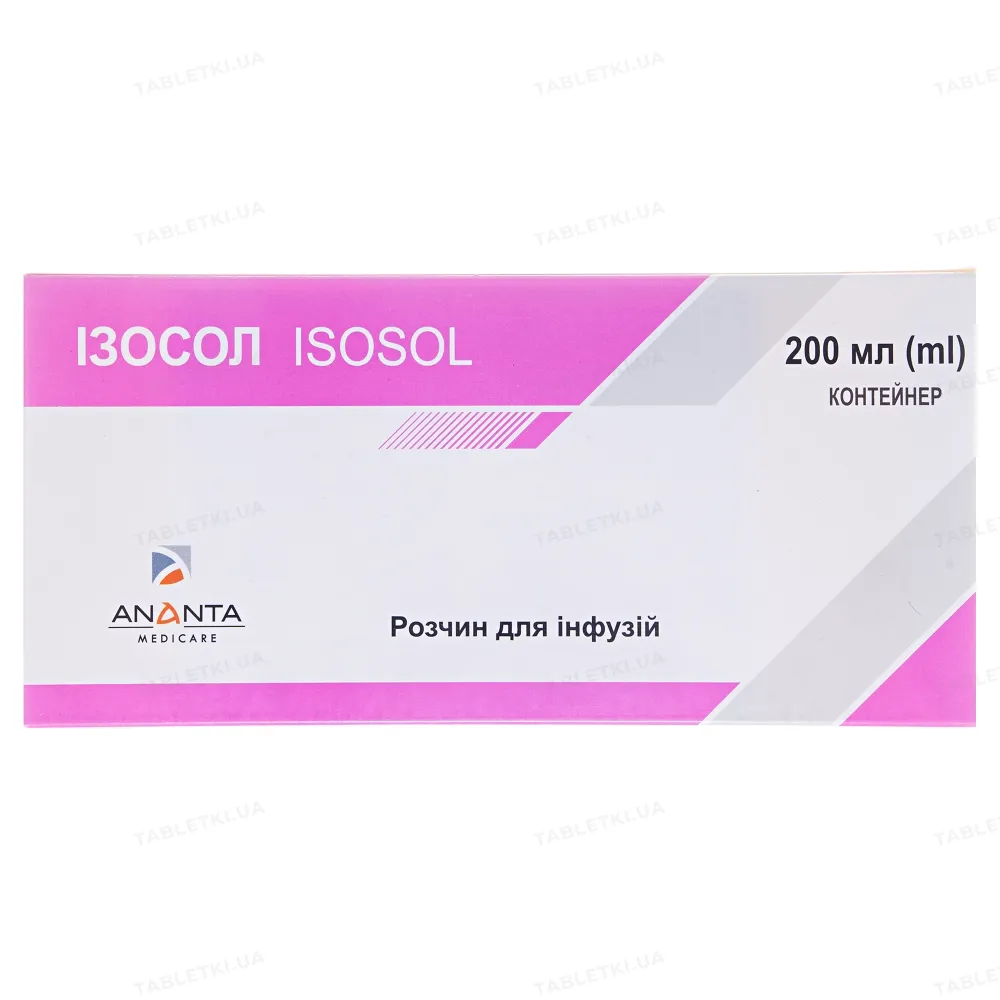
Table of Contents
INSTRUCTIONS FOR MEDICAL USE OF THE MEDICINAL PRODUCT ISOSOL (ISOSOL)
Composition:
Active substances: sodium chloride, potassium chloride, calcium chloride dihydrate, magnesium chloride hexahydrate, sodium acetate trihydrate;
100 ml of solution contain: sodium chloride – 0.526 g, potassium chloride – 0.037 g, calcium chloride dihydrate – 0.037 g, magnesium chloride hexahydrate – 0.030 g, sodium acetate trihydrate – 0.680 g;
Excipient: water for injections
Pharmaceutical form. Infusion solution.
Main physicochemical properties: clear, colorless liquid;
Molar composition, mmol per 1000 ml of product: sodium ion – 140.0; potassium ion – 5.0; calcium ion – 2.5; magnesium ion – 1.5; chloride ion – 103.0; acetate ion – 50.0.
Theoretical osmolarity – approximately 302 mOsmol/L.
Pharmacotherapeutic group.
Solutions for intravenous administration. Solutions used for correction of electrolyte balance disorders. ATC code B05B B01.
Pharmacological properties.
Pharmacodynamics. Isosol is a source of water and electrolytes. It may induce diuresis depending on the patient's condition. The drug improves blood rheological properties and tissue perfusion, enhances the efficacy of blood transfusion measures in massive blood loss and severe forms of shock. It also exhibits a detoxifying effect due to a transient increase in fluid volume, reduction of toxic substances concentration in blood, and activation of diuresis.
Sodium, the main cation of extracellular fluid, participates primarily in controlling water distribution, fluid balance, and osmotic pressure of body fluids. Sodium is also associated with chloride and bicarbonate in the regulation of acid-base balance of body fluids.
Potassium, the main intracellular cation, participates in carbohydrate utilization and protein synthesis, and is required for regulation of nerve conduction and muscle contraction, especially in the heart.
Chloride, the main extracellular anion, is closely related to sodium metabolism, and changes in the body's acid-base balance are reflected by changes in chloride concentration.
Calcium, an essential cation, is responsible for the formation of bones and teeth (in the form of calcium phosphate and calcium carbonate). In its ionized form, calcium is required for the functional mechanism of blood coagulation, normal cardiac function, and regulation of neuromuscular excitability.
Pharmacokinetics.
Na+ and Cl- ions, administered with Isosol, undergo the same pharmacokinetics as those ingested with food. They freely distribute throughout all organs, tissues, and interstitial spaces and are excreted via glomerular filtration in the kidneys. Significant reabsorption of Na+ and Cl- ions occurs in the renal tubules, primarily in the loop of Henle and distal tubules, including mechanisms blocked by loop and thiazide diuretics, respectively.
Potassium ions (K+) are freely filtered in the glomeruli but almost completely reabsorbed in the proximal tubules, with only 10% of filtered K+ ions being excreted. Secretion in the distal tubules and collecting ducts can significantly increase K+ elimination. The kidneys have a limited ability to retain K+ concentration. Therefore, when the concentration in the distal tubules is high, K+ loss can be substantial, potentially leading to hypokalemia. This justifies the presence of K+ in Isosol.
Calcium ion (Ca2+) homeostasis is well regulated by hormones and rarely requires clinical intervention via intravenous infusion.
Magnesium ions (Mg2+) remain in the vascular compartment for a short time and rapidly distribute into all tissues. Magnesium ions are primarily excreted in urine.
Acetate ions are converted into bicarbonate in the body.
Clinical characteristics.
Indications.
Hypovolemia and extracellular (isotonic) dehydration due to prolonged vomiting, massive blood loss, diarrhea, extensive burns, severe infectious diseases, shock conditions, or inability to orally administer the required daily amount of water and electrolytes. Used for dissolving other compatible concentrated solutions of medicinal products intended for parenteral administration.
Contraindications.
- Decompensated heart failure;
- Extracellular hyperhydration;
- Hypervolemia;
- Hypertonic dehydration;
- Elevated blood levels of ions contained in the drug (hyperkalemia, hypernatremia, hypercalcemia);
- Oliguria and anuria;
- Acute renal failure;
- Pulmonary edema, cerebral edema;
- Hypercoagulation, thrombophlebitis;
- Metabolic alkalosis;
- Treatment with high doses of corticosteroids.
Interaction with other medicinal products and other types of interactions.
Concomitant use of the following medicinal products may increase sodium/potassium retention in the body: nonsteroidal anti-inflammatory drugs, androgens, anabolic steroids, estrogens, corticotropin, mineralocorticoids, vasodilators or ganglion blockers, tacrolimus, cyclosporine, potassium-sparing diuretics, angiotensin-converting enzyme (ACE) inhibitors.
Succinylcholine and potassium administered simultaneously may cause significant hyperkalemia, thereby enhancing adverse effects on cardiac rhythm. Magnesium salts may potentiate the depolarizing effect of neuromuscular blockers such as succinylcholine, vecuronium, or tubocurarine. Therefore, concomitant administration of this drug with medications containing the above substances is not recommended.
Increased urinary alkalinity due to bicarbonate ion formation during acetate metabolism enhances the excretion of certain drugs (such as quinidine, salicylates, lithium) and reduces the excretion of sympathomimetics (such as amphetamine).
When used in combination with cardiac glycosides, the likelihood of their toxic effects increases.
Special precautions for use.
Great caution should be exercised when administering large infusion volumes to patients with cardiac or pulmonary insufficiency, edema, renal impairment, or hepatic cirrhosis accompanied by ascites.
During prolonged parenteral therapy, laboratory parameters should be monitored every 6 hours (depending on the infusion rate), and the patient's clinical condition should be assessed to control electrolyte concentrations and fluid-electrolyte balance.
Administration of intravenous solutions may lead to fluid and/or solute overload, hyperhydration, congestion, and pulmonary edema. The risk of developing dilutional effects is inversely proportional to the electrolyte concentration. The risk of solute overload causing congestion with peripheral edema and pulmonary edema is directly proportional to the electrolyte concentration.
Due to its sodium ion content, the solution should be administered with caution to patients with renal or cardiovascular insufficiency, congestive heart failure (especially in the postoperative period), elderly patients, and patients with clinical conditions associated with sodium retention and edema, peripheral or pulmonary edema, hypertension, preeclampsia, hyperaldosteronism, or other clinical states associated with sodium retention in the body.
Solutions containing sodium should be used cautiously in patients receiving corticosteroids or corticotropin.
Since the drug contains potassium, caution is required when administering the solution to patients with heart disease, severe renal insufficiency, or conditions that may lead to hyperkalemia (e.g., renal or adrenocortical insufficiency, acute dehydration, or extensive tissue destruction as seen in severe burns).
The preparation contains potassium at a concentration close to that in plasma; however, it should not be used to correct potassium deficiency in cases of severe hypokalemia.
Since the medicinal product contains calcium ions, its administration should be monitored by ECG, especially in patients receiving cardiac glycosides (e.g., digoxin). Serum calcium levels do not always reflect tissue calcium levels. In patients with impaired renal excretory function, administration of the solution may lead to sodium or potassium retention. Caution is also required when co-administering blood products due to the potential risk of coagulation. The drug should be used cautiously in patients with conditions associated with elevated vitamin D levels, such as sarcoidosis.
Since the medicinal product contains magnesium ions, caution is required when administering the solution to patients with impaired renal function, cardiac disorders, or myasthenia gravis. Clinical signs of hypermagnesemia should be monitored, especially during treatment of eclampsia.
The drug should be used with caution in the postoperative period following neuromuscular blockade, as magnesium salts may enhance or prolong neuromuscular blockade effects.
Administration of the drug may cause metabolic alkalosis due to the presence of acetate ions; however, the drug is not indicated for the treatment of severe metabolic or respiratory acidosis.
During treatment with parenteral administration of Isosol, adequate patient nutrition should be ensured.
This solution is intended for intravenous use with sterile equipment. The intravenous administration set should be replaced at least every 24 hours.
The solution should be used only if it is clear and the container is intact and sealed.
The physician should also consider the potential for adverse reactions to drugs used concomitantly with Isosol.
If an adverse reaction occurs, the infusion should be discontinued, the patient's condition assessed, and appropriate therapeutic measures initiated.
Use during pregnancy or breastfeeding.
Studies on the use of this drug in pregnant women have not been conducted. It is not known whether this drug is excreted in human milk. Since most drugs are excreted in human milk, the drug should be administered with caution during lactation.
Effect on the ability to drive and use machines.
During treatment, caution should be exercised when driving or operating machinery.
Administration and Dosage
The solution is intended for intravenous use only.
The volume of infusion solution should be determined individually by the physician according to the patient's clinical condition, degree of dehydration, age, body weight, and laboratory parameters.
The usual infusion volume for adults is 210 ml/hour (for a body weight of 70 kg) or 3 ml/kg body weight/hour. The infusion rate for adults is 70 drops/minute. The maximum daily volume is 30 ml/kg body weight and depends on the patient's fluid and electrolyte balance, cardiovascular status, and renal function.
The required volume of solution should be calculated based on the patient's fluid requirements.
Before administration, parenteral preparations should be visually inspected for the presence of visible foreign particles and discoloration.
Children
Do not use in children.
Overdose
Administration of an excessive amount of the solution may lead to disturbances in fluid and electrolyte balance (hypervolemia, hypernatremia, hypercalcemia, hyperchloremia) and acid-base equilibrium; venous congestion, edema (including pulmonary or cerebral edema), hyperhydration, manifested by excessive skin turgor; increased plasma osmolarity.
Treatment In case of development of the above-mentioned conditions, administration of the drug should be discontinued. In cases of hyperhydration, diuretics or laxatives should be administered. In cases of hypervolemia, extracorporeal clearance methods should be used. In cases of concurrent extracellular hyperhydration with intracellular dehydration, as well as in hypernatremia, 5% glucose solution should be administered.
Adverse Reactions
Immune system: hypersensitivity reactions, allergic reactions, or anaphylaxis/anaphylactoid symptoms.
Metabolism and nutrition: electrolyte disturbances (potassium, calcium, sodium, chloride), chloride-induced acidosis, hyperhydration.
Nervous system: seizures provoked by acetate-induced alkalosis.
Cardiac: heart failure in patients with cardiac disorders; tachycardia, bradycardia.
Respiratory, thoracic and mediastinal: pulmonary edema.
General disorders and administration site conditions: chest tightness or chest pain; febrile reaction (fever), infection or pain at the injection site, malaise, venous irritation, thrombophlebitis or phlebitis starting from the injection site, accidental subcutaneous leakage of the drug during administration.
Skin and subcutaneous tissue: local or generalized urticaria (skin rash, erythema, pruritus).
Adverse reactions may be related to the drugs for which Isosol was used as a solvent.
In case of any adverse events, side effects, or lack of therapeutic effect, please report to the following address: 85 Sambirska Street, Drohobych, Lviv region, Ukraine, 82111; Tel.: (03244) 3-99-94; Fax: (03244) 2-40-27; Email: [email protected]; 24-hour hotline: +38 (068) 302-50-85.
Shelf life. 2 years.
Storage conditions.
Store at a temperature not exceeding 25 °C. Do not freeze.
Keep out of reach of children.
Incompatibility.
Before using Isosol, its compatibility with other concurrently administered drugs should be evaluated. Isosol must not be mixed with agents containing carbonates, sulfates, or phosphates. Also, Isosol should not be mixed with other medicinal products unless compatibility has been established. Prior to adding any drug to Isosol, it must be confirmed that the drug is soluble and stable in water at the pH of Isosol (6.6 – 7.4).
To minimize the risk of potential incompatibility arising from mixing this solution with other drugs, the final infusion solution should be inspected for turbidity or precipitation.
Packaging. 100 ml, 200 ml, 250 ml, 400 ml, or 500 ml in a container; 1 container per cardboard box.
Prescription status. Prescription only.
Manufacturer.
Subsidiary enterprise "Pharmatrade".
Manufacturer's address.
85 Sambirska Street, Drohobych, Lviv region, Ukraine, 82111
Marketing Authorization Holder.
Subsidiary enterprise "Pharmatrade".
Address of the Marketing Authorization Holder.
85 Sambirska Street, Drohobych, Lviv region, Ukraine, 82111