Hartmann's solution
Ukraine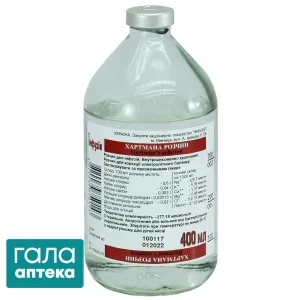
Table of Contents
INSTRUCTIONS FOR MEDICAL USE OF THE MEDICINAL PRODUCT HARTMANN’S SOLUTION
Composition:
Active substances: sodium chloride, potassium chloride, sodium lactate, calcium chloride dihydrate, magnesium chloride hexahydrate;
100 ml of solution contains: sodium chloride – 0.6 g; potassium chloride – 0.04 g; sodium lactate – 0.303 g; calcium chloride dihydrate – 0.02013 g; magnesium chloride hexahydrate – 0.02 g;
Ionic composition per 1000 ml of solution: Na+ – 129.7 mmol; K+ – 5.36 mmol; Ca++ – 1.37 mmol;
Mg++ – 0.98 mmol; Cl¯ – 112.74 mmol; lactate – 27.03 mmol;
Excipient: water for injections.
Pharmaceutical form. Infusion solution.
Main physicochemical properties: clear, colorless liquid; theoretical osmolarity 277.18 mOsmol/L; pH 5.5–7.5.
Pharmacotherapeutic group. Blood substitutes and perfusion solutions. Solutions used for correction of electrolyte balance disorders. Electrolytes.
ATC code B05B B01.
Pharmacological properties.
Pharmacodynamics. An electrolyte solution with a balanced electrolyte content. Replenishes the deficit of circulating blood volume. Corrects water and electrolyte balance and exhibits detoxifying effects. The lactate contained in the medicinal product is metabolized into bicarbonate anions, which contribute to the restoration of blood acid-base balance. The solution is similar to isotonic.
Pharmacokinetics. Following intravenous administration, the drug causes a short-term increase in blood osmolarity. The drug does not remain in the blood for long and passes into tissues within approximately half an hour. The components of the drug are excreted in urine.
Clinical Characteristics
Indications. Hypovolemia and isotonic dehydration associated with metabolic acidosis. For pre-, intra-, and postoperative maintenance of fluid balance. Rehydration of the interstitial space following colloid volume replacement of circulating blood.
Contraindications. Hypervolemia, hypernatremia (including due to corticosteroid use), hyperkalemia, hypermagnesemia, hyperchloremia, hypercalcemia, extracellular hyperhydration, hypertonic dehydration, alkalosis, lactic acidosis, arterial hypertension, cardiovascular and/or renal insufficiency (including acute renal failure), hepatic insufficiency (due to reduced bicarbonate formation from lactate), pulmonary edema, thrombophlebitis, conditions associated with increased blood coagulability, decompensated heart defects; oliguria and anuria, cerebral edema.
Interaction with other medicinal products and other forms of interaction. When potassium-sparing diuretics, angiotensin-converting enzyme (ACE) inhibitors, and potassium-containing preparations are used, the risk of developing hyperkalemia increases. When administered concomitantly with cardiac glycosides, the toxic effect of the latter is enhanced due to the presence of Ca++ ions in the solution.
The medicinal product is incompatible with cefamandole, amphotericin, ethyl alcohol, thiopental, aminocaproic acid, metaraminol, ampicillin, vibramycin, and monocycline.
Sodium retention in the body may increase when used concomitantly with the following medicinal products: nonsteroidal anti-inflammatory drugs, androgens, anabolic hormones, estrogens, corticotropin, mineralocorticoids, vasodilators, or ganglion blockers.
Due to the presence of lactate, which increases pH (alkalinizing effect), the medicinal product should be used with caution when co-administered with drugs whose renal elimination is pH-dependent. Renal clearance of salicylates, barbiturates, and lithium may be reduced, while that of sympathomimetics and stimulants (such as dexamphetamine sulfate, phenylpropanolamine hydrochloride) may be increased.
Special precautions for use
Electrolyte levels, fluid balance, pH and pCO₂ should be monitored. The drug should be used with caution in patients with respiratory insufficiency, acute dehydration, and in patients receiving concomitant corticosteroid therapy.
Due to its sodium content, the drug should be used with caution in patients with congestive heart failure, particularly in the postoperative period, elderly patients, and patients with clinical conditions associated with sodium retention and edema, as well as in patients with hypoxia and hepatic insufficiency.
Since the drug contains sodium lactate, it should be administered with particular caution to patients predisposed to hypernatremia (e.g., those with adrenocortical insufficiency, non-diabetic diabetes, or extensive tissue damage) and in patients with cardiac disorders.
Solutions containing sodium should be used with caution in patients receiving corticosteroids or corticotropin.
Administration of intravenous solutions may lead to fluid and/or solute overload, hyperhydration, congestive states, and pulmonary edema. The risk of dilutional effects is inversely proportional to the electrolyte concentration. The risk of solute overload causing congestive states with peripheral edema and pulmonary edema is directly proportional to the electrolyte concentration.
If any signs of hypersensitivity reactions occur, infusion of the solution should be stopped immediately and appropriate treatment initiated.
Potassium content requires caution when administering the solution to patients with cardiac disorders and clinical conditions associated with potassium retention.
In patients with impaired renal excretory function, administration of the solution may lead to retention of sodium or potassium.
Calcium administration should be performed with monitoring of cardiac activity by ECG, especially in patients receiving digitalis. Serum calcium levels do not always reflect tissue calcium levels.
Due to the presence of calcium ions in the medicinal product, caution is required when co-administering with blood products, as there is a risk of coagulation.
Lactate is a substrate for gluconeogenesis; therefore, blood glucose levels should be carefully monitored in patients with type 2 diabetes mellitus.
Use during pregnancy or breastfeeding. The drug should be used during pregnancy only if the expected benefit outweighs the potential risk to the fetus. There are no clinical data on the use of the drug during breastfeeding.
Ability to influence reaction rate when driving or operating machinery. There are no data on the effect of the medicinal product on the ability to drive or operate machinery, as it should be used exclusively under hospital conditions.
Administration and Dosage.
Administer intravenously. Administer intravenously by drip infusion. The dose is determined by the physician according to the patient's condition. The maximum infusion rate is 5 ml/kg/hour, i.e., 350 ml/hour for a body weight of 70 kg. The maximum daily dose for adults is 40 ml/kg/day (on average, 2500–3000 ml at a rate of 60 drops/minute). The duration of treatment depends on the patient's condition. During the first 24 hours, the daily requirement and half of the fluid deficit should be provided; during the following 2 days, one-quarter of the fluid deficit should be replaced daily. Thus, the total fluid deficit is corrected within 72 hours. When restoring previously lost fluid, ongoing losses should be taken into account and replaced accordingly.
Children. Experience with the use of the drug in pediatric practice is lacking.
Overdose. In case of overdose or too rapid infusion of the solution, disturbances in water and electrolyte balance may occur, as well as cardiopulmonary decompensation (including acute circulatory failure, pulmonary edema). In such cases, administration of the drug should be discontinued and symptomatic therapy initiated.
Excessive lactate administration may lead to the development of metabolic alkalosis, which in turn may be accompanied by hypokalemia. Symptoms: mood changes, fatigue, shortness of breath, muscle weakness, polydipsia, polyuria, impaired thinking, arrhythmia. Increased muscle tone, twitching, and tetanic seizures may develop in patients with hypocalcemia.
Adverse Reactions.
Disturbances of water-electrolyte and acid-base balance: electrolyte imbalance (including hypernatraemia, hyperkalaemia, hyperchloraemia), hypervolaemia, hyperhydration, metabolic alkalosis, chloride acidosis.
General body reactions: allergic or anaphylactic reactions (fever, pruritus, cough, sneezing, dyspnoea, localized or generalized urticaria, angioneurotic oedema).
Changes at infusion site: inflammation, swelling, rash, pruritus, erythema, pain, burning, numbness at the infusion site, thrombophlebitis.
Psychiatric disorders: panic attack.
In case of adverse reactions, infusion of the solution should be discontinued, the patient's condition should be assessed, and appropriate medical assistance provided.
Shelf life. 5 years.
Storage conditions. Store at a temperature not exceeding 25 °C. Keep out of reach of children.
Incompatibility. Hartmann’s solution is not recommended for use as a diluent for antibiotics during infusion, or for dilution of anti-inflammatory agents, sodium thiopental, ethyl alcohol, or aminocaproic acid due to chemical incompatibility.
Packaging. 200 ml, 250 ml, 400 ml, or 500 ml in bottles.
Prescription status. Prescription only.
Manufacturer. Private Joint-Stock Company "Infuziya".
Manufacturer's address and location of business operations.
84A Nemirivske Shose St., Vinnytski Khutory Village, Vinnytsia District, Vinnytsia Oblast, Ukraine, 23219.
INSTRUCTION
on medical use of medicinal product
HARTMANN’S SOLUTION
(Hartman’s solution)
Composition:
Active substances: sodium chloride, potassium chloride, sodium lactate, calcium chloride dihydrate, magnesium chloride hexahydrate;
100 ml of solution contains: sodium chloride – 0.6 g; potassium chloride – 0.04 g; sodium lactate – 0.303 g; calcium chloride dihydrate – 0.02013 g; magnesium chloride hexahydrate – 0.02 g;
Ionic composition per 1000 ml of solution: Na+ – 129.7 mmol; K+ – 5.36 mmol; Ca++ – 1.37 mmol;
Mg++ – 0.98 mmol; Cl¯ – 112.74 mmol; lactate – 27.03 mmol;
Excipient: water for injections.
Pharmaceutical form. Infusion solution.
Main physicochemical properties: clear, colourless liquid; theoretical osmolarity 277.18 mOsmol/L; pH 5.5–7.5.
Pharmacotherapeutic group. Blood substitutes and perfusion solutions. Solutions used for correction of electrolyte balance disorders. Electrolytes.
ATC code B05BB01.
Pharmacological properties.
Pharmacodynamics. A saline solution with a balanced electrolyte content. Restores circulating blood volume deficit. Corrects water-electrolyte and acid-base balance and exerts a detoxifying effect. Lactate, a component of the medicinal product, is metabolized into bicarbonate anions, which contribute to the restoration of blood acid-base balance. The solution is close to isotonic.
Pharmacokinetics. Following intravenous administration, plasma osmolarity increases transiently. The drug does not remain in the bloodstream for long and distributes into tissues within approximately 30 minutes. The components are excreted in urine.
Clinical characteristics.
Indications. Hypovolaemia and isotonic dehydration associated with metabolic acidosis. For pre-, intra-, and postoperative fluid balance maintenance. Rehydration of interstitial space after colloid volume replacement of circulating blood.
Contraindications. Hypervolaemia, hypernatraemia (including due to corticosteroid use), hyperkalaemia, hypermagnesaemia, hyperchloraemia, hypercalcaemia, extracellular hyperhydration, hypertonic dehydration, alkalosis, lactic acidosis, arterial hypertension, cardiovascular and/or renal failure (including acute renal failure), hepatic failure (due to reduced bicarbonate formation from lactate), pulmonary oedema, thrombophlebitis, conditions with increased blood coagulability, decompensated heart defects; oliguria and anuria, cerebral oedema.
Interaction with other medicinal products and other types of interactions.
Concomitant use with potassium-sparing diuretics, angiotensin-converting enzyme (ACE) inhibitors, and potassium-containing preparations increases the risk of hyperkalaemia. When used simultaneously with cardiac glycosides, the toxicity of the latter is enhanced due to the presence of Ca++ ions in the solution.
The medicinal product is incompatible with cefamandole, amphotericin, ethanol, thiopental, aminocaproic acid, metaraminol, ampicillin, vibramycin, and monocycline.
Sodium retention may increase when used concomitantly with nonsteroidal anti-inflammatory drugs (NSAIDs), androgens, anabolic hormones, estrogens, corticotropin, mineralocorticoids, vasodilators, or ganglion blockers.
Due to the presence of lactate, which increases pH, the drug should be used cautiously when co-administered with drugs whose renal elimination is pH-dependent. Renal clearance of salicylates, barbiturates, and lithium may decrease, while that of sympathomimetics and stimulants (such as dextroamphetamine sulfate, phenylpropanolamine hydrochloride) may increase.
Special precautions. Blood electrolyte levels, fluid balance, pH, and pCO2 should be monitored. The drug should be used cautiously in patients with respiratory insufficiency, acute dehydration, and those receiving concomitant corticosteroid therapy.
Due to sodium ion content, the drug should be used cautiously in patients with congestive heart failure (especially in the postoperative period), elderly patients, patients with clinical conditions associated with sodium retention and oedema, and patients with hypoxia or hepatic insufficiency.
Since the preparation contains sodium lactate, it should be used with particular caution in patients predisposed to hypernatraemia (e.g., adrenal cortical insufficiency, diabetes insipidus, or extensive tissue damage) and in patients with heart disease.
Sodium-containing solutions should be used cautiously in patients receiving corticosteroids or corticotropin.
Intravenous infusion may cause fluid and/or electrolyte overload, hyperhydration, congestion, and pulmonary oedema. The risk of dilution is inversely proportional to electrolyte concentration. The risk of solution overload leading to congestion with peripheral oedema and pulmonary oedema is directly proportional to electrolyte concentration.
In case of any signs of hypersensitivity reaction, infusion should be stopped immediately and appropriate treatment initiated.
The potassium content requires caution when administering the solution to patients with heart disease or clinical conditions associated with potassium retention.
In patients with impaired renal excretory function, administration of the solution may lead to sodium or potassium retention.
Calcium administration should be performed with ECG monitoring of cardiac activity, especially in patients receiving digitalis. Serum calcium levels do not always reflect tissue calcium levels.
Due to the presence of calcium ions in the medicinal product, caution is required when co-administering with blood products, as there is a risk of coagulation.
Lactate is a substrate for gluconeogenesis; therefore, blood glucose levels should be carefully monitored in patients with type 2 diabetes mellitus.
Use during pregnancy or breastfeeding. The drug should be used during pregnancy only if the expected benefit outweighs the potential risk to the fetus. There are no clinical data on the use of the drug during breastfeeding.
Ability to affect reaction rate when driving or operating machinery. There are no data on the effect of the medicinal product on reaction speed during driving or operating machinery, as it is intended for use exclusively in a hospital setting.
Administration and dosage. Administer intravenously by drip infusion. Dosage is determined by the physician according to the patient's condition. Maximum infusion rate is 5 ml/kg/h, i.e., 350 ml/h for a 70 kg patient. The maximum daily dose for adults is 40 ml/kg/day (on average 2500–3000 ml at a rate of 60 drops/min). Duration of treatment depends on the patient's condition. Within the first 24 hours, daily fluid requirement and half of the fluid deficit should be replenished; over the next two days, one-quarter of the fluid deficit should be replenished daily. Thus, the total fluid deficit is corrected within 72 hours. When replacing previously lost fluid, ongoing losses should also be considered and replenished accordingly.
Children. Experience with the use of the drug in paediatric practice is lacking.
Overdose. In case of overdose or too rapid infusion, disturbances in water and electrolyte balance, cardiorespiratory decompensation (including acute circulatory failure, pulmonary oedema) may occur. In such cases, infusion should be discontinued and symptomatic therapy initiated.
Excessive lactate administration may lead to metabolic alkalosis, which in turn may be accompanied by hypokalaemia. Symptoms include mood changes, fatigue, dyspnoea, muscle weakness, polydipsia, polyuria, cognitive disturbances, arrhythmia. Muscle hypertonia, twitching, and tetanic seizures may develop in patients with hypocalcaemia.
Adverse reactions.
Disturbances of water-electrolyte and acid-base balance: electrolyte imbalance (including hypernatraemia, hyperkalaemia, hyperchloraemia), hypervolaemia, hyperhydration, metabolic alkalosis, chloride acidosis.
General body reactions: allergic or anaphylactic reactions (fever, pruritus, cough, sneezing, dyspnoea, localized or generalized urticaria, angioedema).
Changes at infusion site: inflammation, swelling, rash, pruritus, erythema, pain, burning, numbness at infusion site, thrombophlebitis.
Psychiatric disorders: panic attack.
In case of adverse reactions, infusion of the solution should be discontinued, the patient's condition assessed, and appropriate medical assistance provided.
Shelf life. 5 years.
Storage conditions. Store at a temperature not exceeding 25 °C. Keep out of reach of children.
Incompatibility. Hartmann’s solution is not recommended for use as a diluent for antibiotics during infusion, or for dilution of anti-inflammatory agents, sodium thiopental, ethyl alcohol, or aminocaproic acid due to chemical incompatibility.
Packaging. 200 ml, 250 ml, 400 ml, or 500 ml in bottles.
Prescription status. Prescription only.
Manufacturer. Private Joint-Stock Company "Infuziya".
Manufacturer's address and location of business operations.
84A Nemirivske Shose St., Vinnytski Khutory Village, Vinnytsia District, Vinnytsia Oblast, Ukraine, 23219.