Elocta
Italy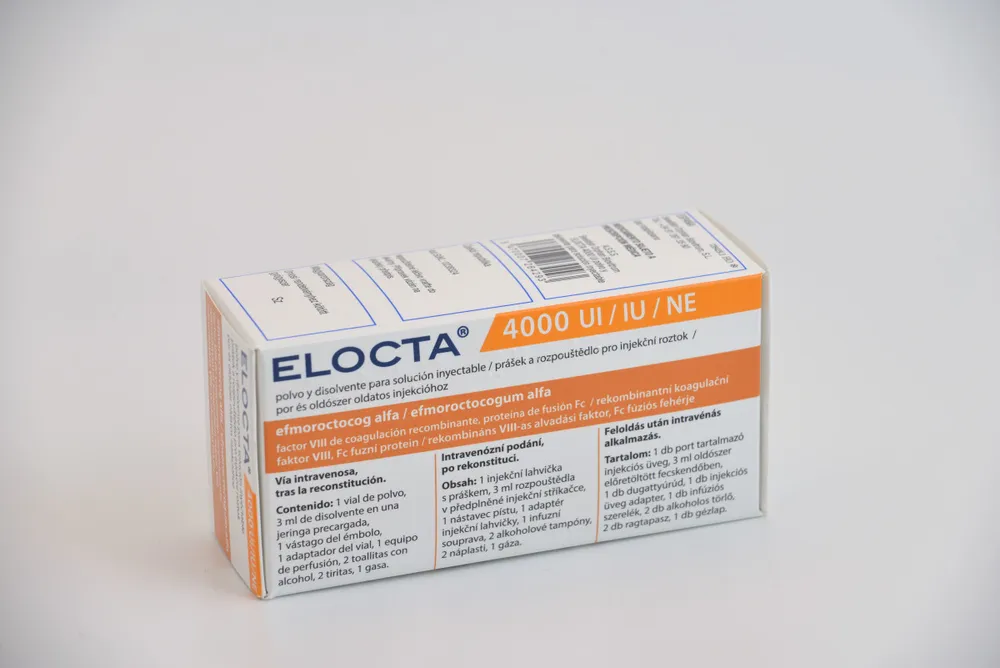
Instructions for Use
Table of Contents
- ELOCTA 250 IU powder and solvent for solution for injection, 500 IU powder and solvent for solution for injection, 750 IU powder and solvent for solution for injection, 1000 IU powder and solvent for solution for injection, 1500 IU powder and solvent for solution for injection, 2000 IU powder and solvent for solution for injection, 3000 IU powder and solvent for solution for injection, 4000 IU powder and solvent for solution for injection
- 1. What ELOCTA is and what it is used for
- 2. What you need to know before using ELOCTA
- 3. How to use ELOCTA
- 4. Possible side effects
- 5. How to store ELOCTA
- 6. Package contents and other information
Package leaflet: Information for the user
ELOCTA 250 IU powder and solvent for solution for injection, 500 IU powder and solvent for solution for injection, 750 IU powder and solvent for solution for injection, 1000 IU powder and solvent for solution for injection, 1500 IU powder and solvent for solution for injection, 2000 IU powder and solvent for solution for injection, 3000 IU powder and solvent for solution for injection, 4000 IU powder and solvent for solution for injection
efmoroctocog alfa (recombinant coagulation factor VIII)
Please read all of this leaflet carefully before you start using this medicine because it contains important information for you.
- Keep this leaflet. You may need to read it again.
- If you have any questions, ask your doctor, pharmacist, or nurse.
- This medicine has been prescribed for you only. Do not give it to other people, even if they have the same symptoms as yours, because it may be harmful.
- If you experience any side effects, including those not listed in this leaflet, tell your doctor, pharmacist, or nurse. See section 4.
Contents of this leaflet
- What ELOCTA is and what it is used for
- What you need to know before using ELOCTA
- How to use ELOCTA
- Possible side effects
- How to store ELOCTA
- Contents of the pack and other information
1. What ELOCTA is and what it is used for
ELOCTA contains the active substance efmoroctocog alfa, a fusion protein consisting of recombinant coagulation factor VIII and Fc. Factor VIII is a natural protein produced by the body and is essential for blood clot formation and for stopping bleeding.
ELOCTA is a medicine used for the treatment and prevention of bleeding in patients of all age groups with haemophilia A (an inherited bleeding disorder caused by factor VIII deficiency).
ELOCTA is produced using recombinant technology, without adding any components of human or animal origin during the manufacturing process.
How ELOCTA works
In patients with haemophilia A, factor VIII is missing or does not work properly. ELOCTA works by replacing the missing or deficient factor VIII. ELOCTA increases factor VIII levels in the blood and temporarily corrects the tendency to bleed.
2. What you need to know before using ELOCTA
Do not use ELOCTA:
- if you are allergic to efmoroctocog alfa or to any of the other ingredients of this medicine (listed in section 6).
Warnings and precautions
Talk to your doctor, pharmacist, or nurse before using ELOCTA.
- There is a possibility, although low, that you may develop an anaphylactic reaction (a severe and sudden allergic reaction) to ELOCTA. Signs of an allergic reaction may include generalized itching, hives, chest tightness, difficulty breathing, and low blood pressure. If any of these symptoms occur, stop the infusion immediately and contact your doctor.
- The development of inhibitors (antibodies) is a known complication that may occur during treatment with any factor VIII medicine. Inhibitors, especially at high levels, may prevent the treatment from working properly, and you or your child will be closely monitored for the development of such inhibitors. If ELOCTA does not control bleeding in you or your child, inform your doctor immediately.
Cardiovascular events
If you have heart disease or are at risk of heart disease, exercise particular caution when using factor VIII medicines and consult your doctor.
Catheter-related complications
If a central venous access device (CVAD) is required, the risk of CVAD-related complications should be considered, including local infections, presence of bacteria in the blood, and catheter-site thrombosis.
Documentation
It is strongly recommended to record the name and batch number of the product each time you receive ELOCTA.
Other medicines and ELOCTA
Inform your doctor or pharmacist if you are currently using, have recently used, or might use any other medicines.
Pregnancy and breastfeeding
If you are pregnant, suspect you may be pregnant, planning a pregnancy, or breastfeeding, consult your doctor or pharmacist before taking this medicine.
Driving and using machines
No effects on the ability to drive or operate machinery have been observed.
ELOCTA contains sodium
This medicine contains less than 1 mmol (23 mg) of sodium per vial, i.e. essentially ‘sodium-free’.
However, depending on your body weight and the dose you need to take, you may receive more than one vial. Take this into account if you are on a low-sodium diet.
3. How to use ELOCTA
Treatment with ELOCTA will be initiated by a doctor experienced in the care of patients with haemophilia. Use this medicine exactly as instructed by your doctor (see Instructions for preparation and administration). If you have any doubts, consult your doctor, pharmacist, or nurse.
ELOCTA is administered by intravenous infusion. Your doctor will calculate the dose of ELOCTA (in International Units or “IU”) based on your individual need for factor VIII replacement therapy and whether it is being used for prevention or treatment of bleeding episodes. Contact your doctor if you feel that bleeding is not adequately controlled with your current dose.
How often you will need to receive an infusion depends on how ELOCTA works in your specific case. Your doctor will perform appropriate laboratory tests to monitor that factor VIII levels in your blood are adequate.
Treatment of bleeding episodes
The dose of ELOCTA is calculated according to body weight and the desired factor VIII levels. The required factor VIII levels depend on the severity and location of the bleeding.
Prevention of bleeding episodes
The usual dose of ELOCTA is 50 IU per kg of body weight, administered every 3 to 5 days. The dose may be adjusted by your doctor within a range of 25 to 65 IU per kg of body weight. In some cases, particularly in younger patients, shorter dosing intervals or higher doses may be required.
Use in children and adolescents
ELOCTA can be used in children and adolescents of any age. Higher doses or more frequent infusions may be necessary in children under 12 years of age.
If you use more ELOCTA than you should
Inform your doctor as soon as possible. Always use ELOCTA exactly as instructed by your doctor. If you have any doubts, consult your doctor, pharmacist, or nurse.
If you forget to use ELOCTA
Do not take a double dose to make up for the missed dose. Take the missed dose as soon as you remember, then continue with your regular dosing schedule. If you have any doubts, consult your doctor or pharmacist.
If you stop using ELOCTA
Do not stop treatment with ELOCTA without consulting your doctor. If you stop treatment with ELOCTA, you may no longer be protected against bleeding episodes, or an ongoing bleed may not stop.
If you have any questions about the use of this medicine, consult your doctor, pharmacist, or nurse.
4. Possible side effects
Like all medicines, this medicine can cause side effects, although not everyone gets them.
If severe allergic reactions (anaphylactic reactions) occur suddenly, the infusion must be stopped immediately. You should contact your doctor immediately if you experience any of the following symptoms of an allergic reaction: facial swelling, rash, generalized itching, hives, tightness in the chest, difficulty breathing, burning and stinging pain at the infusion site, chills, hot flushes, headache, low blood pressure, general feeling of malaise, nausea, restlessness and rapid heartbeat, dizziness or loss of consciousness.
In children who have not previously been treated with factor VIII medicines, the development of inhibitory antibodies (see section 2) may be very common (more than 1 in 10 patients); however, in patients who have previously received treatment with factor VIII (more than 150 days of treatment), the risk is uncommon (less than 1 in 100 patients). If this occurs, the medicine may no longer work properly and you may experience persistent bleeding. If this happens, contact your doctor immediately.
The following side effects may occur with this medicine:
Uncommon side effects (may affect up to 1 in 100 people)
Headache, dizziness, altered taste sensation, slowed heartbeat, high blood pressure, hot flushes, vascular pain after infusion, cough, lower abdominal pain, skin rash, papular rash, catheter-associated thrombosis, joint swelling, muscle pain, back pain, joint pain, general malaise, chest pain, feeling cold, feeling hot, and low blood pressure.
Reporting of side effects
If you experience any side effect, including those not listed in this leaflet, talk to your doctor, pharmacist, or nurse. You can also report side effects directly via the national reporting system listed in Annex V. By reporting side effects, you can help provide more information on the safety of this medicine.
5. How to store ELOCTA
Keep this medicine out of the sight and reach of children.
Do not use this medicine after the expiry date stated on the carton and on the label of the
vial after “Exp./EXP”. The expiry date refers to the last day of that month. Do not use
this medicine if it has been stored at room temperature for more than 6 months.
Store in a refrigerator (2 °C – 8 °C).
Do not freeze.
Keep in the original packaging to protect the medicine from light.
Alternatively, ELOCTA may be stored at room temperature (up to 30 °C) for a single period
not exceeding 6 months. Please record on the carton the date when ELOCTA was removed from the
refrigerator and stored at room temperature. Once stored at room temperature, the product must not be
placed back into the refrigerator.
After reconstitution, ELOCTA should be used immediately. If you cannot use the ELOCTA solution
immediately after reconstitution, it must be used within 6 hours. Do not store the prepared solution in
the refrigerator. Protect the prepared solution from direct sunlight.
The reconstituted solution should range from clear to slightly opalescent and colourless. Do not use this
medicine if you notice that the solution is cloudy or contains particles.
Dispose of any unused solution properly. Do not dispose of medicines via wastewater or household waste.
Ask your pharmacist how to dispose of medicines you no longer use. This will help protect the environment.
6. Package contents and other information
What ELOCTA contains
- The active substance is efmoroctocog alfa (a recombinant coagulation factor VIII fused with Fc protein). Each vial of ELOCTA nominally contains 250, 500, 750, 1000, 1500, 2000, 3000, or 4000 IU of efmoroctocog alfa.
- The other components are sucrose, sodium chloride, histidine, calcium chloride dihydrate, polysorbate 20, sodium hydroxide, hydrochloric acid, and water for injections. If you are on a low-sodium diet, see section 2.
Description of the appearance of ELOCTA and contents of the pack
ELOCTA is supplied as a powder and solvent for solution for injection. The powder is presented as a white to off-white powder or cake. The solvent provided for preparing the injectable solution is a clear, colourless solution. After reconstitution, the solution for injection is clear to slightly opalescent and colourless.
Each pack of ELOCTA contains 1 vial of powder, 3 mL of solvent in a pre-filled syringe, 1 syringe plunger rod, 1 vial adapter, 1 infusion set, 2 alcohol-impregnated swabs, 2 plasters, and 1 gauze pad.
Marketing Authorisation Holder
Swedish Orphan Biovitrum AB (publ)
SE-112 76 Stockholm
Sweden
Tel.: +46 8 697 20 00
Manufacturer
Swedish Orphan Biovitrum AB (publ)
Norra Stationsgatan 93
SE-113 64 Stockholm
Sweden
More detailed information on this medicinal product is available on the website of the European Medicines Agency: http://www.ema.europa.eu/ .
For instructions on preparation and administration, turn over the package leaflet.
Instructions for preparation and administration
ELOCTA must be administered by intravenous (i.v.) infusion after dissolving the powder for injectable solution in the solvent provided in the pre-filled syringe. The ELOCTA pack contains:
A) 1 Vial of powder
B) 3 mL solvent in pre-filled syringe
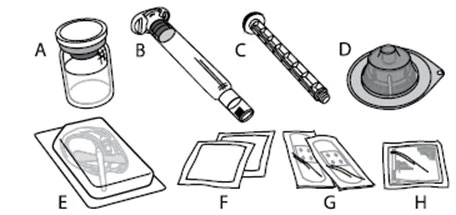
C) 1 Syringe plunger rod
D) 1 Vial adapter
E) 1 Infusion set
F) 2 Alcohol-impregnated swabs
G) 2 Plasters
H) 1 Gauze pad
ELOCTA must not be mixed with other injectable solutions or infusions.
Wash your hands before opening the pack.
Preparation
- Check the name and dosage shown on the packaging and ensure that it contains the correct medicine. Check the expiry date on the ELOCTA carton. Do not use an expired medicine.
- If ELOCTA has been stored in the refrigerator, allow the ELOCTA vial (A) and the solvent syringe (B) to reach room temperature before use. Do not use external heat sources.
- Place the vial on a clean, flat surface.
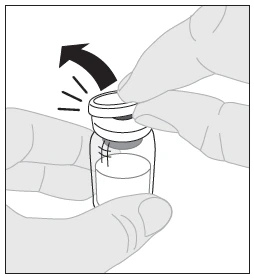
Remove the plastic pull-off seal from the ELOCTA vial.
-
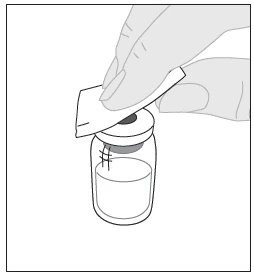
Clean the top of the vial with one of the alcohol-impregnated swabs (F) supplied in the pack and allow it to air dry. Once cleaned, do not touch the top of the vial or allow it to come into contact with other objects.
-
Open the paper protective cap of the transparent plastic vial adapter (D). Do not remove the adapter from its protective seal. Do not touch the inside of the vial adapter packaging.
-
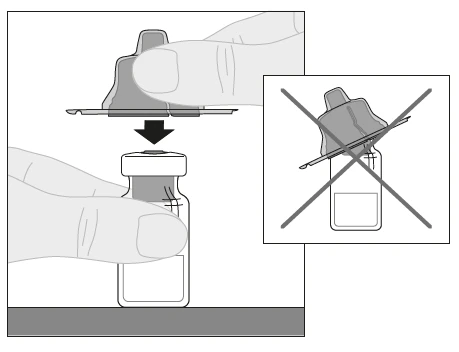
Place the vial on a flat surface. Hold the vial adapter with its protective seal and position it perpendicularly over the vial. Press firmly downwards until the adapter clicks into place on the top of the vial, with the spike piercing the vial stopper.
-
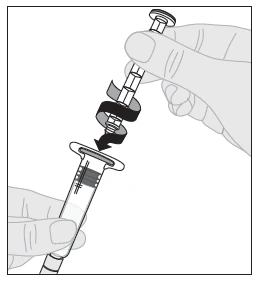
To connect the syringe plunger rod (C) to the syringe containing the solvent, insert the end of the plunger rod into the opening in the syringe plunger. Rotate the plunger rod firmly clockwise until it is securely seated in the syringe plunger.
-
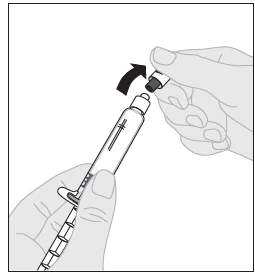
Break the white tamper-evident plastic seal on the solvent syringe by bending the perforated seal until it breaks. Set aside the broken seal on a flat surface with the top side facing down. Do not touch the inside of the broken seal or the tip of the syringe.
-
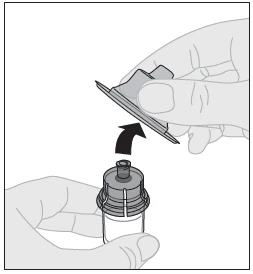
Remove the protective seal from the adapter and discard it.
-
To connect the syringe containing the solvent to the vial adapter, insert the syringe tip into the opening of the adapter. Press firmly and rotate the syringe clockwise to secure it tightly.
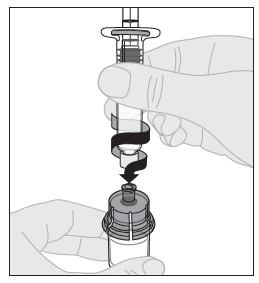
-
Slowly push the plunger rod to inject all the solvent into the ELOCTA vial.
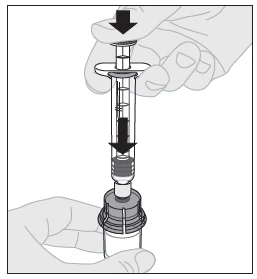
-
With the syringe still attached to the adapter and continuing to press on the plunger rod, gently rotate the vial until the powder is completely dissolved.
Do not shake.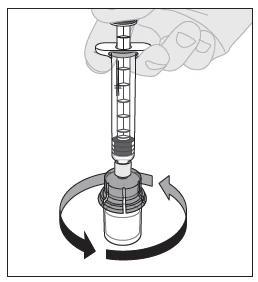
-
The final solution should be inspected visually before administration. The solution should be clear to slightly opalescent and colourless. Do not use the solution if it is cloudy or contains visible particles.
-
Invert the vial, continuing to press the syringe plunger fully. Slowly pull back the plunger rod to draw all the solution into the syringe through the vial adapter.
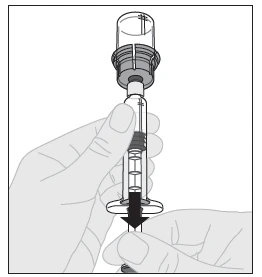
-
Disconnect the syringe from the vial adapter by gently pulling the vial and rotating it anticlockwise.
Note: If more than one vial of ELOCTA is used for infusion, each vial must be prepared separately according to instructions (steps 1–13), and the solvent syringe must be removed, leaving the vial adapter in place. A single large luer-lock syringe may be used to draw up the contents from individual vials after preparation.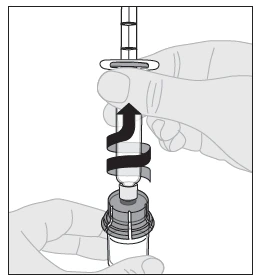
-
Discard the vial and the adapter.
Note: If the solution is not used immediately, the syringe must be carefully recapped with its original cap. Do not touch the tip of the syringe or the inside of the cap.
After reconstitution, ELOCTA may be stored at room temperature prior to administration for up to 6 hours. After this time, ELOCTA must be discarded. Protect from direct sunlight.
Administration (intravenous infusion)
ELOCTA must be administered using the infusion set (E) provided in the pack.
-
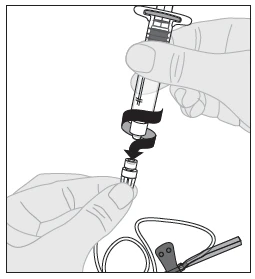
Open the infusion set packaging and remove the cap from the end of the tubing. Connect the syringe containing the reconstituted ELOCTA solution to the end of the infusion set tubing by rotating clockwise.
-
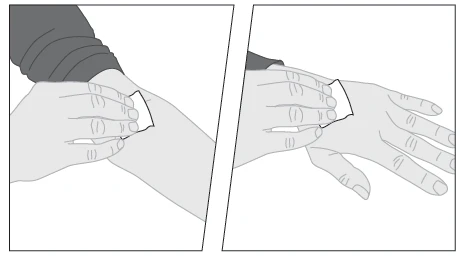
If necessary, apply a tourniquet and clean the infusion site by thoroughly wiping the skin with the other alcohol-impregnated swab included in the pack.
-
Remove any air present in the infusion set tubing by slowly pushing the plunger rod until the liquid reaches the needle of the infusion set. Do not push the solution through the needle. Remove the transparent plastic protective cap from the needle.
-
Insert the needle of the infusion set into a vein, as instructed by your doctor or nurse, and remove the tourniquet. If desired, one of the plasters (G) provided in the pack may be used to secure the plastic wings of the needle at the infusion site. The prepared product should be administered intravenously over several minutes. For increased comfort, your doctor may adjust the recommended infusion rate.
-
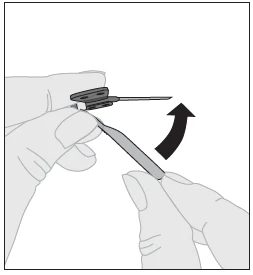
After completing the infusion and removing the needle, cover the needle with the protective cap and close it until it clicks.
-
Dispose of the used needle, any remaining solution, the syringe, and the empty vial safely in a designated medical waste container, as these materials may pose a risk to others if not properly disposed of. Do not reuse any used materials.
Similar Medications
-
Advate
Form: solution for injection, powder and solvent
Active substance Dosage OCTOCOG ALFA — Manufacturer: TAKEDA MANUFACTURING AUSTRIA AG
-
Adynovi
Form: solution for injection, powder and solvent
Active substance Dosage Rurioctocog alfa pegol — Manufacturer: BAXALTA INNOVATIONS GMBH
-
Afstyla
Form: solution for injection, powder and solvent
Active substance Dosage LONOCTOGEN ALFA — Manufacturer: CSL BEHRING GMBH
-
Altuvoct
Form: solution for injection, powder and solvent
Active substance Dosage EFANESOCTOCOG ALFA — Manufacturer: SWEDISH ORPHAN BIOVITRUM AB (PUBL)
-
Emowil
Form: solution for injection, powder and solvent
Active substance Dosage LYOPHILIZED HUMAN BLOOD COAGULATION FACTOR VIII — Manufacturer: KEDRION S.P.A.
-
Esperoct
Form: solution for injection, powder and solvent
Active substance Dosage FACTOR VIII — Manufacturer: NOVO NORDISK A/S
-
Haemoctin
Form: solution for injection, powder and solvent
Active substance Dosage HUMAN PLASMA COAGULATION FACTOR VIII — Manufacturer: BIOTEST PHARMA GMBH
-
JIVI
Form: solution for injection, powder and solvent
Active substance Dosage DAMOCTOCOG ALFA PEGOL — Manufacturer: BAYER AG
-
Kovaltry
Form: solution for injection, powder and solvent
Active substance Dosage OCTOCOG ALFA — Manufacturer: BAYER AG
-
Novoeight
Form: solution for injection, powder and solvent
Active substance Dosage HUMAN COAGULATION FACTOR VIII — Manufacturer: NOVO NORDISK A/S
-
Nuwiq
Form: solution for injection, powder and solvent
Active substance Dosage SIMOCTOCOG ALFA — Manufacturer: OCTAPHARMA AB
-
Recombinate
Form: solution for injection, powder and solvent
Active substance Dosage OCTOCOG ALFA — Manufacturer: BAXALTA INNOVATIONS GMBH
This page has been machine-translated and may contain inaccuracies. The original data is available in the manufacturing country's language.
Last data check: May 11, 2026 · Data source: Agenzia Italiana del Farmaco (AIFA)