Nuwiq
Italy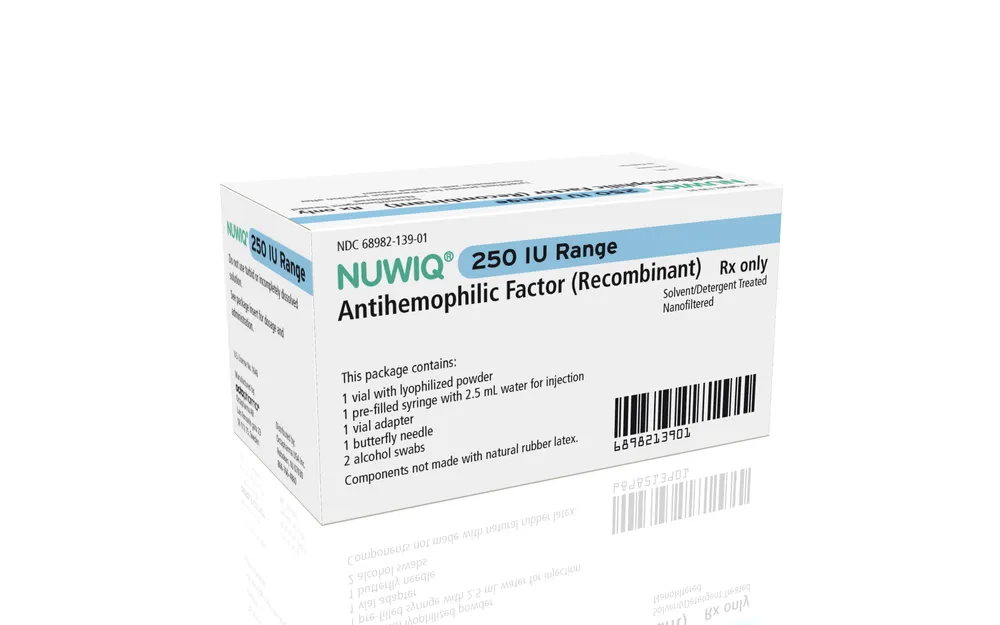
Table of Contents
- Package leaflet: Information for the user
- Nuwiq 250 IU powder and solvent for solution for injection, 500 IU powder and solvent for solution for injection, 1,000 IU powder and solvent for solution for injection, 1,500 IU powder and solvent for solution for injection, 2,000 IU powder and solvent for solution for injection, 2,500 IU powder and solvent for solution for injection, 3,000 IU powder and solvent for solution for injection, 4,000 IU powder and solvent for solution for injection
- 1. What Nuwiq is and what it is used for
- 2. What you need to know before using Nuwiq
- 3. How to use Nuwiq
- 4. Possible side effects
- 5. How to store Nuwiq
- 6. Package contents and other information
- The following information is intended exclusively for healthcare professionals:
Package leaflet: Information for the user
Nuwiq 250 IU powder and solvent for solution for injection, 500 IU powder and solvent for solution for injection, 1,000 IU powder and solvent for solution for injection, 1,500 IU powder and solvent for solution for injection, 2,000 IU powder and solvent for solution for injection, 2,500 IU powder and solvent for solution for injection, 3,000 IU powder and solvent for solution for injection, 4,000 IU powder and solvent for solution for injection
simoctocog alfa (recombinant human coagulation factor VIII)
Please read all of this leaflet carefully before you start using this medicine because it contains important information for you.
- Keep this leaflet. You may need to read it again.
- If you have any questions, ask your doctor.
- This medicine has been prescribed for you only. Do not pass it on to others, even if they have the same symptoms as yours, because it could be harmful.
- If you experience any adverse reaction, including those not listed in this leaflet, contact your doctor. See section 4.
Contents of this leaflet:
- What Nuwiq is and what it is used for
- What you need to know before using Nuwiq
- How to use Nuwiq
- Possible side effects
- How to store Nuwiq
- Contents of the pack and other information
1. What Nuwiq is and what it is used for
Nuwiq contains as its active substance recombinant human coagulation factor VIII (simoctocog alfa). Factor VIII is necessary for blood to form clots and stop bleeding. In patients with haemophilia A (congenital factor VIII deficiency), factor VIII is missing or does not function properly.
Nuwiq replaces the missing factor VIII and is used for the treatment and prevention of bleeding episodes in patients with haemophilia A, and can be used across all age groups.
2. What you need to know before using Nuwiq
Do not use Nuwiq
- if you are allergic to the active substance simoctocog alfa or to any of the other ingredients of this medicine (listed in section 6). If you are unsure, consult your doctor.
Warnings and precautions
Talk to your doctor before using Nuwiq.
There is a rare possibility that you may experience anaphylaxis (a severe and sudden allergic reaction) to Nuwiq. You should be aware of the early signs of allergic reactions listed in section 4, “Allergic reactions”.
If any of these symptoms occur, stop the injection immediately and contact your doctor.
The development of inhibitors (antibodies) is a known complication that may occur during treatment with all factor VIII medicines. Inhibitors, especially at high levels, may prevent the treatment from working properly, and you or your child will be closely monitored for the development of such inhibitors. If Nuwiq does not control bleeding in you or your child, inform your doctor immediately.
Cardiovascular events
In patients with existing cardiovascular risk factors, replacement therapy with FVIII may increase cardiovascular risk.
Catheter-related complications
If a central venous access device (CVAD) is required, the risk of CVAD-related complications should be considered, including local infections, presence of bacteria in the blood, and thrombosis at the catheter site.
It is important to keep the batch number of the administered Nuwiq.
Therefore, each time you receive a new package of Nuwiq, record the date and the batch number (shown on the package after Lot) and keep this information in a safe place.
Other medicines and Nuwiq
Inform your doctor if you are taking, have recently taken, or might take any other medicines.
Pregnancy and breastfeeding
If you are pregnant, suspect you may be pregnant, planning a pregnancy, or breastfeeding, consult your doctor before using this medicine.
Driving and using machines
Nuwiq does not affect the ability to drive vehicles or operate machinery.
Nuwiq contains sodium
This medicine contains 18.4 mg of sodium (the main component of table salt) per vial. This corresponds to 0.92% of the maximum daily recommended dietary intake for an adult.
3. How to use Nuwiq
Treatment with Nuwiq will be initiated by a doctor experienced in the management of patients with haemophilia A.
Use this medicine exactly as instructed by your doctor or nurse. If you have any doubts, consult your doctor or nurse.
Nuwiq is usually administered intravenously (into a vein) by a doctor or a nurse experienced in caring for patients with haemophilia A. You or another person may also administer Nuwiq by injection, but only after adequate training.
Your doctor will calculate the dose of Nuwiq (in International Units = IU) based on your condition, body weight, and intended use of the medicine (prophylaxis or treatment of bleeding). How often you need to administer the injection depends on how effective Nuwiq is for you. Typically, treatment for haemophilia A should be continued for life.
Prophylaxis of bleeding
The usual dose of Nuwiq is 20–40 IU per kg of body weight, administered every 2–3 days.
However, in some cases, particularly in younger patients, more frequent injections or higher doses may be required.
Treatment of bleeding
The dose of Nuwiq is calculated based on your body weight and the factor VIII levels to be achieved. Target factor VIII levels depend on the severity and location of the bleeding.
If you feel that the effect of Nuwiq is insufficient, discuss this with your doctor. Your doctor will prescribe appropriate laboratory tests to ensure that factor VIII levels are adequate. This is particularly important if you are undergoing major surgery.
Patients who develop factor VIII inhibitors
If factor VIII levels in plasma do not reach the expected levels with Nuwiq or if bleeding is not adequately controlled, this may be due to the development of factor VIII inhibitors. Your doctor will perform the necessary checks. You may require a higher dose of Nuwiq or a different product to control bleeding episodes. Do not increase the total dose of Nuwiq to manage bleeding episodes without consulting your doctor.
Use in children and adolescents
The way Nuwiq is used in children and adolescents is not different from that in adults. Since factor VIII medicines may need to be administered more frequently in children and adolescents, a central venous access device (CVAD) may be necessary. A CVAD is an external connector that allows access to the bloodstream via a catheter without the need for repeated skin punctures.
If you use more Nuwiq than you should
Symptoms of overdose have not been reported. If you have injected more Nuwiq than prescribed, inform your doctor immediately.
If you forget to use Nuwiq
Do not take a double dose to make up for the missed dose. Administer the next dose as scheduled and continue as directed by your doctor.
If you stop using Nuwiq
Do not stop treatment with Nuwiq without consulting your doctor.
If you have any questions about the use of this medicine, consult your doctor.
4. Possible side effects
Like all medicines, this medicine can cause side effects, although not everybody will experience them.
Stop using this medicine immediately and contact a doctor urgently if:
- you notice symptoms of an allergic reaction. Allergic reactions may include rash, hives (itchy rash), including generalized hives, swelling of the lips or tongue, shortness of breath, wheezing, chest tightness, vomiting, restlessness, low blood pressure, and dizziness. These may be early signs of anaphylactic shock. If severe and sudden allergic (anaphylactic) reactions occur (very rare: may affect 1 in 10,000 people), the injection must be stopped immediately, and you must contact your doctor straight away. Severe symptoms require prompt emergency treatment.
- you notice that the medicine no longer works properly (bleeding is not stopped or becomes frequent). In children and previously untreated adolescents receiving factor VIII treatment, the development of inhibitory antibodies (see section 2) can be very common (more than 1 in 10 patients).
However, in patients who have previously received factor VIII treatment (more than 150 days of treatment), the risk is uncommon (less than 1 in 100 patients). If this occurs, the medicine may stop working effectively and you or your child may experience persistent bleeding. If this happens, you must contact your doctor immediately.
Common side effects may affect up to 1 in 10 users:
Hypersensitivity, fever.
Uncommon side effects may affect up to 1 in 100 users:
Tingling or numbness (paresthesia), headache, dizziness, vertigo, dyspnea, dry mouth, back pain, inflammation at the injection site, pain at the injection site, general feeling of physical discomfort (malaise), hemorrhagic anemia, anemia, chest pain, positive test for non-neutralizing antibodies (in previously treated patients).
Reporting of side effects
If you experience any side effects, including those not listed in this leaflet, consult your doctor. You can also report side effects directly through the national reporting system listed in Annex V. By reporting side effects, you can help provide more information on the safety of this medicine.
5. How to store Nuwiq
Keep this medicine out of the sight and reach of children.
Do not use this medicine after the expiry date stated on the label of the box and the vial following EXP. The expiry date refers to the last day of that month.
Store in a refrigerator (2 °C – 8 °C). Do not freeze. Keep the vial in the original packaging to protect from light.
Before reconstitution of Nuwiq powder, it may be stored at room temperature (up to 25 °C) for a period not exceeding 1 month. Record the start date of the room temperature storage period on the package. Do not re-refrigerate Nuwiq after it has been stored at room temperature.
Use the reconstituted solution immediately.
Do not use the medicine if you notice any visible signs of tampering with the packaging seal, particularly the syringe and/or the vial.
Do not dispose of medicines via wastewater or household waste. Ask your pharmacist how to dispose of medicines no longer required. This will help protect the environment.
6. Package contents and other information
What Nuwiq contains
Powder:
- The active substance is recombinant human coagulation factor VIII (simoctocog alfa). Each vial of powder contains 250, 500, 1,000, 1,500, 2,000, 2,500, 3,000 or 4,000 IU of simoctocog alfa.
- Each reconstituted solution contains approximately 100, 200, 400, 600, 800, 1,000, 1,200 or 1,600 IU/mL of simoctocog alfa.
- The other ingredients are sucrose, sodium chloride, calcium chloride dihydrate, arginine hydrochloride, disodium citrate dihydrate, poloxamer 188. See section 2, "Nuwiq contains sodium".
Solvent:
Water for injections
Description of the appearance of Nuwiq and contents of the pack
Nuwiq is supplied as a powder and solvent for solution for injection. It is a white to ivory-coloured powder in a glass vial. The solvent is water for injections in a pre-filled glass syringe.
After reconstitution, the solution is clear, colourless and free from foreign particles.
Each pack of Nuwiq contains:
- 1 vial of powder containing 250, 500, 1,000, 1,500, 2,000, 2,500, 3,000 or 4,000 IU of simoctocog alfa
- 1 pre-filled syringe containing 2.5 mL of water for injections
- 1 vial adapter
- 1 butterfly needle
- 2 single-use alcohol swabs
Marketing Authorisation Holder and Manufacturer
Octapharma AB, Lars Forssells gata 23, 112 75 Stockholm, Sweden
For further information about this medicinal product, contact the local representative of the Marketing Authorisation Holder:
België/Belgique/Belgien Lietuva
Octapharma Benelux (Belgium) Octapharma Nordic AB (Sweden)
Tél/Tel: +32 2 3730890 Tel: +46 8 56643000
България Luxembourg/Luxemburg
Octapharma Nordic AB (Sweden) Octapharma Benelux (Belgium)
Teл.: +46 8 56643000 Tél/Tel: +32 2 3730890
Česká republika Magyarország
Octapharma CZ s.r.o. Octapharma Nordic AB (Sweden)
Tel: +420 266 793 510 Tel: +46 8 56643000
Danmark Malta
Octapharma Nordic AB (Sweden) Octapharma Nordic AB (Sweden)
Tlf: +46 8 56643000 Tel: +46 8 56643000
Deutschland Nederland
Octapharma GmbH Octapharma Benelux (Belgium)
Tel: +49 2173 9170 Tel: +32 2 3730890
Eesti Norge
Octapharma Nordic AB (Sweden) Octapharma AS
Tel: +46 8 56643000 Tlf: +47 63988860
Ελλάδα Österreich
Octapharma Hellas SA Octapharma Handelsgesellschaft m.b.H.
Τηλ: +30 210 8986500 Tel: +43 1 610321222
España Polska
Octapharma S.A. Octapharma Poland Sp. z o.o.
Tel: +34 91 6487298 Tel: +48 22 2082734
France Portugal
Octapharma France Octapharma Produtos Farmacêuticos Lda.
Tél: +33 1 41318000 Tel: +351 21 8160820
Hrvatska România
Octapharma Nordic AB (Sweden) Octapharma Nordic AB (Sweden)
Tel: +46 8 56643000 Tel: +46 8 56643000
Ireland Slovenija
Octapharma AB (Sweden) Octapharma Nordic AB (Sweden)
Tel: +46 8 56643000 Tel: +46 8 56643000
Ísland Slovenská republika
Octapharma AS (Norway) Octapharma AG, o.z.z.o.
Sími: +47 63988860 Tel: +421 2 54646701
Italia Suomi/Finland
Kedrion S.p.A. Octapharma Nordic AB
Tel: +39 0583 767507 Puh/Tel: +358 9 85202710
Κύπρος Sverige
Octapharma Nordic AB (Sweden) Octapharma Nordic AB
Τηλ: +46 8 56643000 Tel: +46 8 56643000
Latvija United Kingdom (Northern Ireland)
Octapharma Nordic AB (Sweden) Octapharma Limited
Tel: +46 8 56643000 Tel: +44 161 8373770
More detailed information on this medicinal product is available on the European Medicines Agency website: http://www.ema.europa.eu .
The following information is intended exclusively for healthcare professionals:
On-demand treatment
The dose administered and the frequency of administration should always be adjusted according to the clinical response in individual cases.
In the case of the following bleeding events, factor VIII activity must not fall below the indicated plasma activity level (expressed as % of normal or IU/dL) during the corresponding period. The table below may be used as a guide for dosing during bleeding episodes and surgical procedures.
| Bleeding severity / Surgical procedure | Required Factor VIII level (%) (IU/dL) | Dosing frequency (hours) / Duration of therapy (days) | |-------------------------------------------|--------------------------------------------|------------------------------------------------------------| | Bleeding | | | | Early haemarthrosis, muscle bleeding, or oral bleeding | 20–40 | Repeat every 12–24 hours for at least 1 day, until the bleeding episode resolves or healing is achieved. | | More extensive haemarthrosis, muscle bleeding, or acute disabling haematoma | 30–60 | Repeat infusion every 12–24 hours for 3–4 days or more, until pain and acute impairment have resolved. | | Potentially life-threatening bleeding | 60–100 | Repeat infusion every 8–24 hours until the threat has subsided. | | Surgical procedure | | | | Minor surgery, including tooth extraction | 30–60 | Every 24 hours, for at least 1 day, until healing is achieved. | | Major surgery (pre- and postoperative) | 80–100 | Repeat infusion every 8–24 hours until adequate wound healing is achieved, followed by therapy for at least 7 days to maintain factor VIII activity at 30–60% (IU/dL). |
INSTRUCTIONS FOR PREPARATION AND ADMINISTRATION
- Allow the syringe containing solvent (water for injections) and the vial containing powder to reach room temperature. This can be achieved by holding them in your hands until they reach the same warmth. Do not heat the vial or pre-filled syringe by any other method. Maintain this temperature during reconstitution.
- Remove the pull-off cap from the powder vial to expose the central portion of the rubber stopper. Do not remove the grey stopper or the metal ring around the top of the vial.
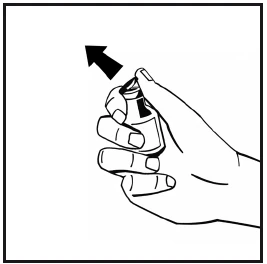
- Wipe the top of the vial with a single-use alcohol swab. Allow the alcohol to dry.
- Remove the paper covering from the vial adapter packaging. Do not remove the adapter from its packaging.
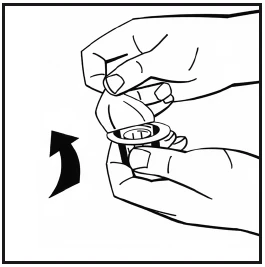
- Place the powder vial on a flat surface and hold it steady. Take the adapter packaging and place the vial adapter onto the center of the rubber stopper of the powder vial. Press firmly down on the adapter packaging until the spike of the adapter penetrates the rubber stopper. The adapter will lock onto the vial at this point.
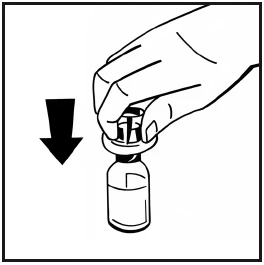
- Remove the paper covering from the pre-filled syringe packaging. Grasp the plunger at the end and do not touch the barrel of the syringe. Screw the threaded end of the plunger onto the plunger of the syringe containing the solvent. Turn clockwise until slight resistance is felt.
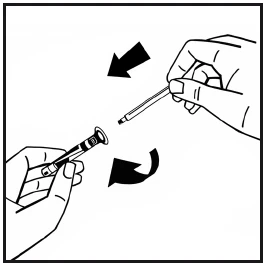
- Remove the plastic anti-tamper tip from the solvent syringe by detaching the perforated seal of the closure cap. Do not touch the inside of the closure cap or the tip of the syringe. If the solution is not used immediately, cap the filled syringe with the plastic anti-tamper cap for storage.
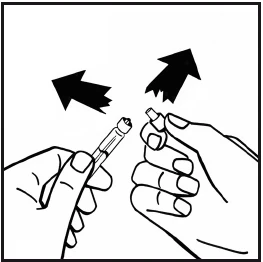
- Remove the adapter packaging and discard it.
- Firmly attach the solvent syringe to the vial adapter by turning clockwise until resistance is felt.
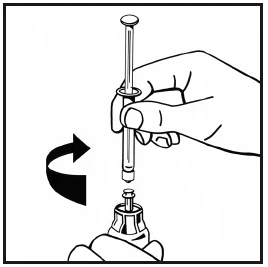
- Slowly inject all the solvent into the powder vial by depressing the plunger.
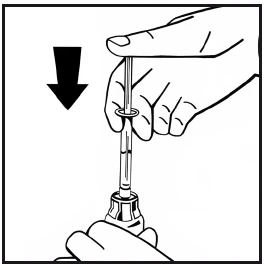
- Without removing the syringe, gently swirl or rotate the vial several times in a circular motion to dissolve the powder. Do not shake. Wait until the powder is completely dissolved.
- Before administration, visually inspect the final solution for particles. The solution should be clear and colorless, nearly free of visible particles. Do not use cloudy solutions or those containing deposits.
- Invert the vial attached to the syringe and slowly draw the reconstituted solution into the syringe. Ensure that the entire contents of the vial are transferred into the syringe.
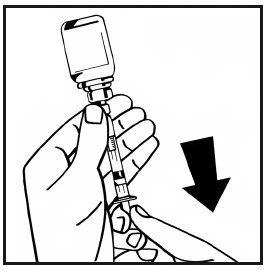
- Unscrew the filled syringe from the vial adapter by turning counterclockwise and discard the empty vial.
- The solution is now ready for immediate use. Do not refrigerate.
- Clean the selected injection site with one of the provided alcohol swabs.
- Attach the provided infusion set to the syringe. Insert the infusion needle into the selected vein. If a tourniquet was used to help locate the vein, remove it before beginning to inject the solution. Blood must not enter the syringe, as this may lead to fibrin clot formation.
- Inject the solution intravenously at a slow infusion rate, not exceeding 4 mL per minute.
If more than one vial of powder is used for a single treatment, the same needle may be reused.
The vial adapter and syringe are for single use only.