Hederine ointment
Ukraine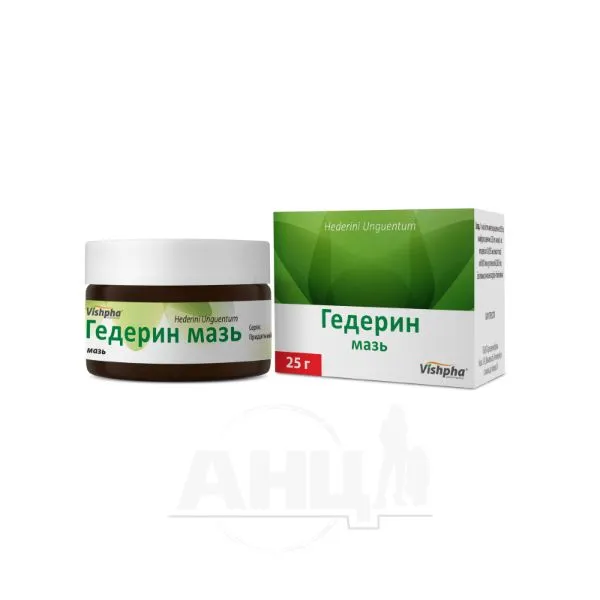
Instructions for Use
INSTRUCTIONS FOR MEDICAL USE OF THE MEDICINAL PRODUCT HEDERINI OINTMENT (HEDERINI UNGUENTUM)
Composition:
Active substances: 1 g of ointment contains racemic menthol 30.5 mg, racemic camphor 52.5 mg, thymol 1 mg, fir oil (Pine oil) 0.0555 ml, eucalyptus oil (Eucalyptus oil) 0.015 ml, nutmeg oil (Nutmeg oil) 0.0055 ml;
Excipient: white soft paraffin.
**Pharmaceutical form.** Ointment.
Main physicochemical properties: white semi-transparent ointment with a strong characteristic odor.
Pharmacotherapeutic group.
Agents used for cough and colds. ATC code R05X.
Pharmacological properties.
Pharmacodynamics.
The mechanism of action of the drug is determined by its active ingredients and involves stimulation of nerve endings and reflex dilation of arterioles and capillaries. The drug exerts a distracting, local irritant, and analgesic effect, as well as moderate anti-inflammatory, antiseptic, and spasmolytic effects.
Pharmacokinetics.
Not determined.
Clinical characteristics.
Indications.
Complex therapy of acute respiratory diseases accompanied by rhinitis, nasal congestion, cough, headache; joint and muscle pain, neuralgia, myositis, arthritis, myalgia, arthralgia, rheumatism, ischias.
Contraindications.
Hypersensitivity to the components of the drug. Bronchial asthma, pertussis, predisposition to seizures, damaged or inflamed skin, open wounds at application sites, dermatitis, eczema.
Special precautions.
Avoid contact of the ointment with eyes and mucous membranes. Do not apply the ointment to damaged skin.
When rubbed into the skin, a sensation of coldness followed by warmth, mild burning, and tingling may occur.
Hands must be thoroughly washed after each application of the ointment. If strong skin irritation occurs, rubbing should be discontinued.
Interaction with other medicinal products and other forms of interaction.
Unknown.
Special warnings.
Use during pregnancy or breastfeeding. The ointment should be used during pregnancy or breastfeeding only with caution, under medical supervision, taking into account the risk/benefit ratio.
Ability to affect reaction speed when driving or operating machinery. Generally does not affect, but the possibility of dizziness or seizures should be considered.
Method of Administration and Dosage.
For external use as a rubbing agent. For adults and children aged 6 years and older, apply a thin layer of ointment 2–4 times daily:
For joint and muscle pain, neuralgia, myositis, arthritis, myalgia, arthralgia, rheumatism, sciatica – rub into the skin of the affected area, then apply a warm compress over it;
For nasal congestion or stuffy nose – apply the ointment to intact skin on the wings of the nose;
For cough associated with colds – apply the ointment to the upper areas of the chest and neck and gently rub in with light massaging movements for 3–5 minutes;
For headache – apply the ointment to the skin of the temples.
For children aged 3 to 5 years, apply a thin layer of ointment to the upper back area 2–3 times daily, but under no circumstances on the face or wings of the nose.
The treatment course lasts 3–5 days.
Children.
The medicinal product may be used in children aged 3 years and older.
Overdose.
Sensation of intense warmth and burning at the application site; possible increase in the severity of adverse reactions. Treatment is symptomatic.
Side effects.
Possible allergic reactions (including hyperemia, itching, rash, urticaria), skin irritation, contact dermatitis; headache, dizziness, excitement; seizures possibly caused by camphor; bronchospasm. Dermatitis may occur in children.
Reporting of adverse reactions after drug registration is important. It allows continuous monitoring of the benefit-risk balance of the medicinal product. Medical and pharmaceutical professionals, as well as patients or their legal representatives, should report all suspected adverse reactions and lack of efficacy through the Automated Information System for Pharmacovigilance at the following link: https://aisf.dec.gov.ua.
Shelf life. 3 years.
Do not use the medicinal product after the expiry date stated on the packaging.
Storage conditions.
Store in a tightly closed container at a temperature not exceeding 25 °C, protected from light and kept out of reach of children.
Packaging.
20 g or 25 g in a jar; 1 jar in a carton.
Availability category. Over-the-counter.
Manufacturer.
LLC "DKP "Pharmaceutical Factory".
Manufacturer's address and place of business.
4 Korolova Street, Stanishivka, Zhytomyr district, Zhytomyr region, 12430, Ukraine.
Frequently Asked Questions
What is Hederine ointment prescribed for?
The drug is used for complex therapy in common cold diseases (runny nose, nasal congestion, cough, headache), as well as for joint and muscle pain, neuralgia, arthritis, rheumatism, and sciatica.
How to correctly use Hederine ointment?
For adults and children from 6 years of age, apply a thin layer of the ointment 2–4 times daily. For muscle or joint pain, rub it into the skin and apply a warm bandage. For a runny nose, apply to the sides of the nose; for a cough, apply to the neck and upper chest (rubbing gently for 3–5 minutes); for a headache, apply to the temples. For children aged 3 to 5 years, apply the ointment to the upper part of the back 2–3 times daily, but it is strictly forbidden to apply it to the face and the sides of the nose.
Who should not use this drug?
Contraindications include hypersensitivity to the components, bronchial asthma, whooping cough, tendency to seizures, as well as damaged or inflamed skin, open wounds, dermatitis, or eczema.
What are the possible side effects of Hederine ointment?
Possible allergic reactions (itching, rash, urticaria), skin irritation, headache, dizziness, excitement, or seizures. Bronchospasm and dermatitis (especially in children) are also possible.
Can the ointment be used during pregnancy or breastfeeding?
The ointment should be used during these periods with caution and only as prescribed by a physician, taking into account the risk/benefit ratio.
What should be done if severe skin irritation occurs?
If severe irritation occurs, stop rubbing in the ointment. Hands must be washed thoroughly after each application.
How does the drug affect the ability to drive a vehicle?
The drug generally does not affect reaction speed; however, the possibility of dizziness or seizures should be taken into account.
Similar Medications
-
Doctor mom
Form: ointment
Active substance Dosage levomenthol 30.5 mg camphor 52.5 mg thymol 1 mg turpentine oil 0.056 ml eucalyptus oil 0.015 ml nutmeg oil 0.005 ml Manufacturer: Uniq Pharmaceuticals Laboratories (branch of J. B. Chemicals and Pharmaceuticals Ltd.)
-
Eucalyptus balm for colds dr. tais
Form: ointment
Active substance Dosage eucalyptus oil 7.5 g pine needle oil 7.5 g racemic camphor 5 g -
Oxolin
Form: ointment
Active substance Dosage oxolinic acid 2.5 mg/g Manufacturer: JSC "Lubnipharm"
-
Oxolin lavender
Form: ointment
Active substance Dosage oxolinic acid 2.5 mg/g Manufacturer: Joint Ukrainian-Spanish Enterprise "SPERKO UKRAINE" (full production cycle, batch release; quality control)
-
Oxolinic ointment
Form: ointment
Active substance Dosage oxolinic acid 2.5 mg/g Manufacturer: Ternofarm LLC
-
Oxolinum
Form: ointment
Active substance Dosage oxolinic acid 2.5 mg/g Manufacturer: PJSC "Chempharmplant "Chervona Zirka"
-
Rastiran
Form: ointment
Active substance Dosage racemic menthol 30.5 mg racemic camphor 52.5 mg thymol 1 mg fir oil 0.0555 ml eucalyptus oil 0.015 ml nutmeg oil 0.0055 ml Manufacturer: DKP "Pharmaceutical Factory" LLC
-
Vicks active balm with menthol and eucalyptus
Form: ointment
Active substance Dosage levomenthol 27.5 mg camphor 50 mg eucalyptus oil 15 mg turpentine oil 50 mg Manufacturer: Procter and Gamble Manufacturing GmbH
This page has been machine-translated and may contain inaccuracies. The original data is available in the manufacturing country's language.
Last data check: July 21, 2026 · Data source: Державний реєстр лікарських засобів України