Vicks active balm with menthol and eucalyptus
Ukraine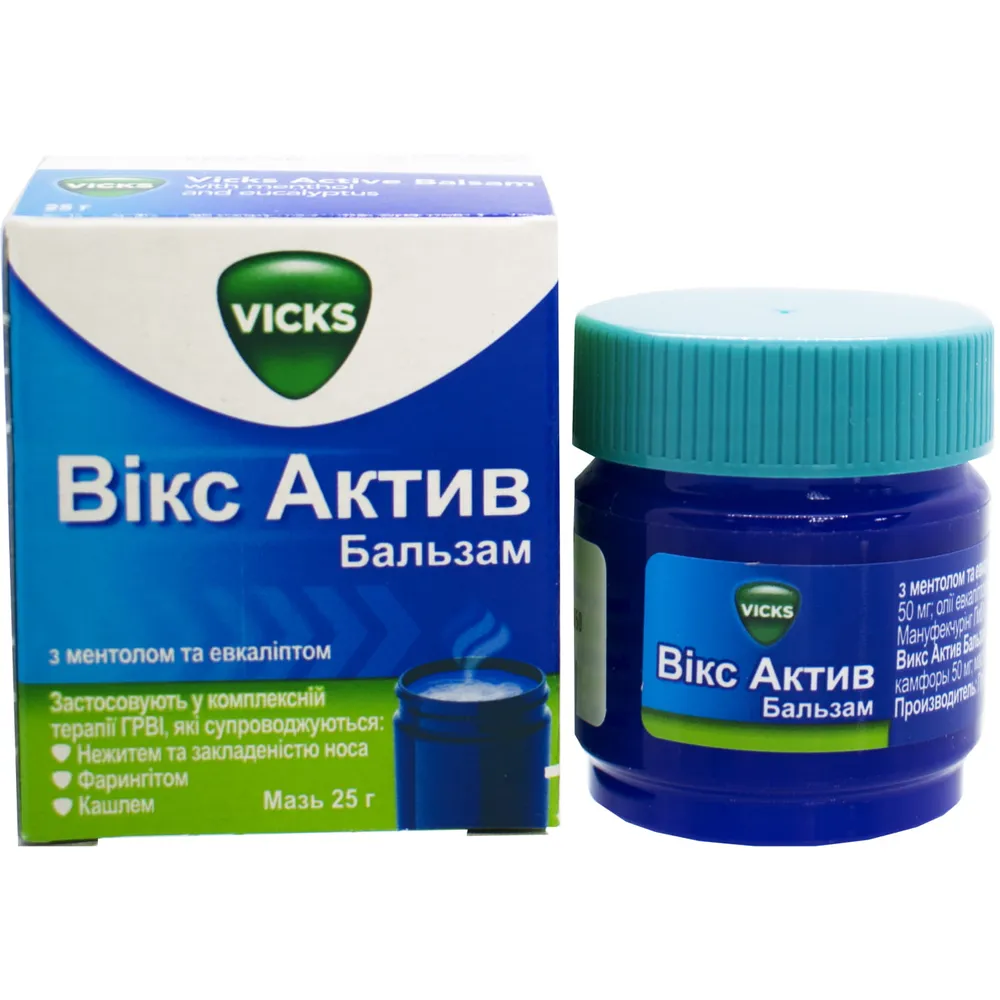
Table of Contents
INSTRUCTIONS FOR MEDICAL USE OF VICKS ACTIVE BALSAM WITH MENTHOL AND EUCALYPTUS
Composition:
Active substances: levomenthol, camphor, eucalyptus oil, turpentine oil;
1 g of ointment contains levomenthol 27.5 mg; camphor 50 mg; eucalyptus oil 15 mg; turpentine oil 50 mg;
Excipients: thymol, cedar oil, white soft paraffin.
Pharmaceutical form. Ointment.
Main physicochemical properties: soft oily ointment of white or yellowish color with a characteristic odor.
Pharmacotherapeutic group. Combined preparations used for cough and colds. ATC code R05X.
Pharmacological Properties
Pharmacodynamics
The medicinal product contains a mixture of essential oils, the vapors of which are gradually released from the lipophilic base of the ointment (paraffin). As a result, the air in the nasal cavity becomes saturated with vapors of essential oils, which, together with the inhaled air, reach the site of action—receptors on the surface of the mucous membranes of the nose, pharynx, and bronchi. The vapors of medicinal substances, which include menthol, camphor, eucalyptus oil (the main component of which is eucalyptol), and purified turpentine oil, can induce hyperemia and exhibit a secretolytic effect upon entering the respiratory tract. Eucalyptus oil has expectorant and weakly expressed spasmolytic effects; turpentine oil exerts an antiseptic action. Studies on the effect of the constant combination of active substances have demonstrated additional antitussive activity.
The release of vapors occurs gradually when the ointment is rubbed into the skin, or rapidly and intensively when hot water is added and used for inhalation.
Upon application of the product, nasal congestion is reduced and nasal breathing is improved for up to 8 hours.
Pharmacokinetics
Due to the lipophilic base, absorption of the medicinal product occurs slowly and to a minor extent. Elimination of the product occurs partially via the respiratory tract and partially via the kidneys.
Clinical characteristics.
Indications.
Use as part of complex therapy for acute respiratory diseases accompanied by rhinitis, nasal congestion, pharyngitis, and cough.
Contraindications.
- Hypersensitivity to any component of the drug.
- Skin irritation or inflammation, open wounds, burns or dermatoses; childhood diseases with rashes.
- Bronchial asthma, pertussis, croup, and other respiratory tract diseases associated with increased airway sensitivity (active substances in inhalations may provoke bronchial smooth muscle spasms).
- Do not use for inhalations in acute lung inflammations.
- Seizures, history of epileptic seizures.
- Children under 2 years of age (risk of laryngospasm).
- Do not use for inhalations in children under 6 years of age.
Interaction with other medicinal products and other forms of interactions.
Eucalyptus oil enhances liver enzyme activity and may potentiate the effect of other drugs or prolong their duration of action, especially during prolonged use of the product.
Special precautions for use.
Do not swallow. Do not apply to damaged skin, open wounds, or mucous membranes of the nose and oral cavity. Do not use on the face. Avoid contact of the product with eyes. Do not heat the product. Do not apply tight bandages, do not use simultaneously with personal heating devices, and do not apply warming bandages over the balm.
Patients with persistent or chronic cough due to smoking, asthma, pulmonary emphysema, chronic bronchitis, or if cough is accompanied by excessive sputum production, should consult a physician.
In case of accidental ingestion or overdose, seek immediate medical advice.
Use during pregnancy or breastfeeding.
During pregnancy, do not use the product without prior consultation with a physician. The product should not be applied to the area of the mother's mammary glands during breastfeeding, as there is a potential risk of reflex apnea in the infant.
Ability to influence reaction rate when driving or operating machinery.
Has no effect.
Method of Administration and Dosage
The medicinal product is intended for external use only or for inhalation.
Rubbing in
Apply 2–4 times daily to the skin over the sternum, neck, and back, and gently rub in with light massaging movements.
Adults: 2 or 3 teaspoons (10–15 mL) of balm should be rubbed gently and effortlessly into the skin over the sternum, neck, and back.
Children from 2 years of age: ½–1 teaspoon of balm (2.5–5 mL) should be gently rubbed into the skin over the sternum and back.
It is advisable to wear light clothing to facilitate inhalation of vapors. Application of the ointment before bedtime is particularly recommended, as the essential oils contained in the ointment evaporate over 8 hours.
Inhalation
Adults and children aged 6 years and older: Add 1–2 teaspoons of balm (5–10 mL) to a container with a wide surface area. Heat 1 liter of water (but not in a microwave oven), bringing it close to boiling without actually boiling, and pour the hot water into the prepared container. The resulting steam should be used for inhalation over 10–15 minutes.
During inhalation, do not reheat the water; also, do not reheat or reuse the solution.
Children must not be left unattended during inhalation due to the risk of scalding.
Inhalations should be performed with eyes closed or covered to avoid possible irritation of the eye conjunctiva.
Discontinue use and consult a physician if cough or other symptoms do not resolve within 3–6 days, recur, or are accompanied by fever, skin rash, or persistent headache.
Children
The product may be used for rubbing in children aged 2 years and older; for inhalation – in children aged 6 years and older.
Overdose
Overdose may cause skin irritation.
The product usually does not exhibit systemic toxic effects when the recommended dose is exceeded. However, excessive topical application over large skin areas may potentially cause toxic symptoms such as nephrotoxicity and central nervous system disturbances (immediately after application of camphor).
Accidental exposure of the product into the nose or face of infants and children may cause apnea due to spasm of the glottis (laryngospasm), a condition requiring emergency medical assistance.
Accidental ingestion of the medicinal product may cause gastrointestinal disturbances such as vomiting and diarrhea. Treatment is symptomatic.
In the event of symptoms of camphor intoxication (after accidental ingestion of a large amount of the product), such as nausea, vomiting, abdominal pain, headache, dizziness, sensation of warmth or facial flushing, excitement, hallucinations, seizures, respiratory depression, or coma, hospitalization and medical supervision are indicated. In cases of respiratory depression, intubation is strictly recommended, and if necessary, assisted mechanical ventilation and intensive care measures should be provided.
Patients with severe gastrointestinal or neurological symptoms of poisoning require medical supervision and symptomatic treatment. Induction of vomiting is not recommended.
Side effects.
Local reactions. Redness, irritation of the eyes, skin and mucous membranes, eye pain, increased lacrimation (during inhalation), allergic dermatitis, hypersensitivity reactions; local reactions may occur in the form of skin redness accompanied by itching (contact dermatitis), urticaria, rashes.
Skin irritation or allergic reactions are usually mild and occur very rarely. Inhalation of vapors, as well as breathing in vapors during rubbing, may cause reflex-induced symptoms such as wheezing, cough, dyspnea, and breathing difficulties due to narrowing of the airways. This may lead to an asthmatic condition and respiratory arrest.
Central nervous system. Hallucinations, seizures.
General disorders and administration site reactions. Application site burns, frequency unknown.
Systemic reactions. Due to the recommended route of administration, systemic effects are very weak, and adverse reactions caused by systemic action have not been observed. If an adverse reaction occurs, the patient must immediately discontinue use of the product, remove any residual product with a paper towel, and initiate appropriate treatment for skin disorders.
Shelf life. 4 years.
Storage conditions. Store at temperatures not exceeding 25 °C, in a place inaccessible to children.
Packaging. 25 g, 50 g, or 100 g in a jar with a screw cap; 1 jar per carton.
Prescription status. Over-the-counter.
Manufacturer. Procter & Gamble Manufacturing GmbH.
Manufacturer's address and place of business.
Procter & Gamble Str. 1, 64521, Groß-Gerau, Hesse, Germany.