Rastiran
Ukraine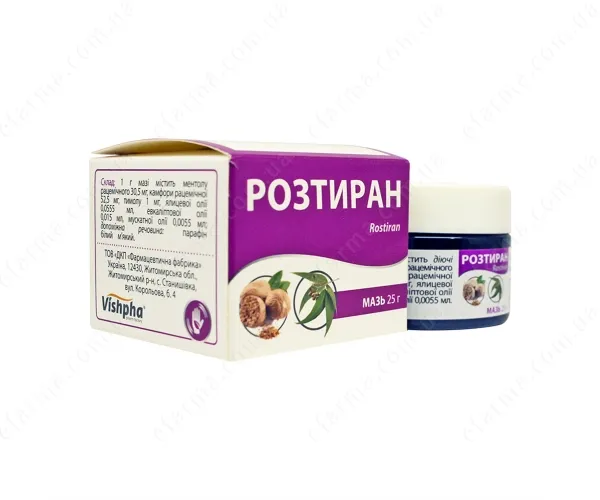
Table of Contents
INSTRUCTION FOR MEDICAL USE OF THE MEDICINAL PRODUCT ROSTIRAN (ROSTIRAN)
Composition:
Active substances: racemic menthol, racemic camphor, thymol, fir oil (Pine oil), eucalyptus oil (Eucalyptus oil), nutmeg oil (Nutmeg oil);
1 g of ointment contains: racemic menthol 30.5 mg; racemic camphor 52.5 mg; thymol 1 mg; fir oil (Pine oil) 0.0555 ml; eucalyptus oil (Eucalyptus oil) 0.015 ml; nutmeg oil (Nutmeg oil) 0.0055 ml;
Excipient: white soft paraffin.
Pharmaceutical form. Ointment.
Main physicochemical properties: white semitransparent ointment with a strong characteristic odor.
Pharmacotherapeutic group. Combined preparations for use in cough and colds. ATC code R05X.
Pharmacological properties.
Pharmacodynamics.
The mechanism of action of the drug is determined by its active ingredients and involves stimulation of nerve endings, reflex dilation of arterioles and capillaries. The drug exerts distracting, local irritant, analgesic, moderate anti-inflammatory, antiseptic, and spasmolytic effects.
Clinical characteristics.
Indications.
Complex therapy of acute respiratory diseases accompanied by rhinitis, nasal congestion, cough, headache.
Joint and muscle pain, neuralgia, myositis, arthritis, myalgia, arthralgia, rheumatism, ischias.
Contraindications.
Hypersensitivity to the components of the drug. Bronchial asthma, pertussis, pseudocroup, tendency to seizures; skin integrity disorders, including burns, and purulent skin diseases.
Interaction with other medicinal products and other types of interactions.
Unknown.
Special precautions for use
Avoid contact of the ointment with eyes and mucous membranes. Do not apply the ointment to damaged skin.
When rubbed into the skin, a sensation of cold is initially felt, followed by warmth, mild burning, and tingling.
Hands should be thoroughly washed after each application of the ointment. If strong skin irritation occurs, application should be discontinued.
Use during pregnancy or breastfeeding. Due to lack of experience with the use of the drug during pregnancy or breastfeeding, administration to patients in these groups is not recommended.
Ability to affect reaction rate when driving or operating machinery. Generally has no effect; however, the possibility of dizziness and seizures should be taken into account.
Method of Administration and Dosage
For external use only, as a rubbing agent. For adults and children aged 6 years and older, apply a thin layer of ointment 2–4 times daily:
For nasal congestion or stuffy nose: apply the ointment to intact skin of the nasal wings;
For cough associated with common cold: apply the ointment to the upper areas of the chest and neck and gently massage in with light movements for 3–5 minutes;
For headache: apply the ointment to the skin of the temples;
For joint and muscle pain, neuralgia, myositis, arthritis, myalgia, arthralgia, rheumatism, sciatica: rub into the skin of the affected area and apply a warm compress over it.
For children aged 3 to 5 years, apply a thin layer of ointment 2–3 times daily to the upper back area, but in no case on the face or nasal wings.
The treatment course lasts 3–5 days.
Children. The efficacy and safety of the drug in children under 3 years of age have not been sufficiently studied. Use with caution in children aged 3 years and older, only on medical advice and under medical supervision.
Overdose.
Sensation of intense warmth and burning at the site of ointment application; possible intensification of adverse reactions. If ingested accidentally, symptoms may include abdominal pain, nausea, vomiting, diarrhea, signs of central nervous system depression, dizziness, ataxia, seizures, flushing, drowsiness, and respiratory difficulty.
Treatment: wash off the applied product with soap and water; gastric lavage; symptomatic therapy.
Adverse reactions.
Skin and subcutaneous tissue disorders: allergic reactions are possible, including hyperemia, itching, rash, urticaria, skin irritation, dermatitis, including contact dermatitis, especially in children.
Nervous system disorders: headache, dizziness, excitement; seizures possibly caused by camphor may occur.
Respiratory system disorders: increased risk and frequency of bronchospasm, especially in children.
If adverse reactions occur, treatment should be discontinued immediately.
Shelf life. 3 years.
Do not use the medicinal product after the expiry date stated on the packaging.
Storage conditions.
Store in tightly closed container at temperature not exceeding 25 °C, protected from light and out of reach of children.
Packaging. 25 g in a jar in a carton.
Supply category. Over-the-counter.
Manufacturer.
LLC "DKP "Pharmaceutical Factory".
Manufacturer's address and place of business.
4, Korolova St., Stanishivka, Zhytomyr district, Zhytomyr region, 12430, Ukraine.