Oxolin
Ukraine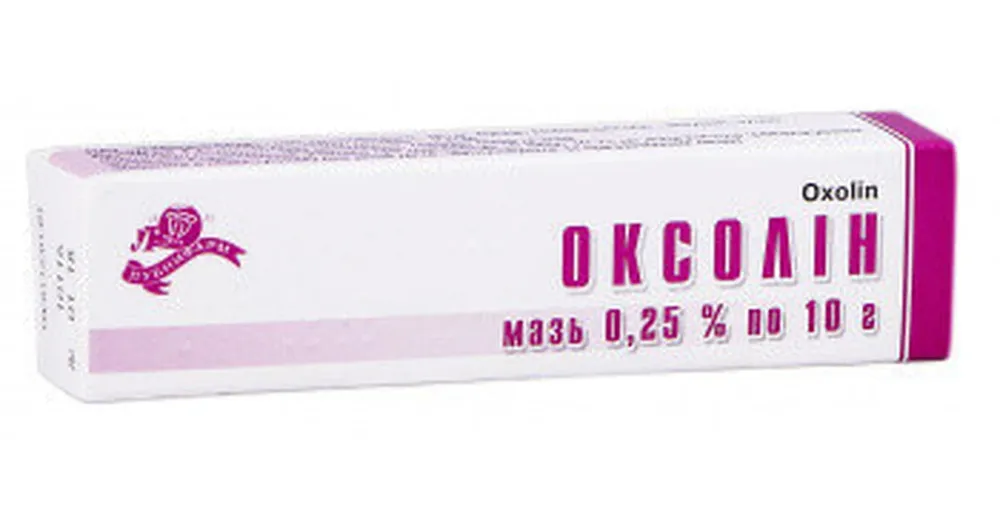
Instructions for Use
INSTRUCTION FOR MEDICAL USE OF THE MEDICINAL PRODUCT OXOLIN
Composition:
Active substance: oxolin;
1 g of ointment contains 2.5 mg of oxolin;
Excipients: mineral oil; white soft paraffin.
Pharmaceutical form. Ointment.
Main physicochemical properties: thick homogeneous mass of white or white with a yellowish tint. A pinkish tint may appear upon storage.
Pharmacotherapeutic group.
Drugs used for cough and colds. Other anti-cold medicinal products. ATC code R05X.
Pharmacological properties.
Pharmacodynamics.
Oxolin is an antiviral agent for topical use. It has virucidal activity, blocking the binding sites of the influenza virus (mainly type A2) with the surface of the cell membrane, thus protecting cells from virus penetration. Viruses sensitive to oxolin include Herpes simplex, varicella-zoster virus, adenoviruses, viruses causing infectious warts, and molluscum contagiosum.
Pharmacokinetics.
The drug is non-toxic; no systemic effects have been observed with local application, and it does not accumulate in the body. When applied to the mucous membrane, 20% of the drug is absorbed and is excreted mainly by the kidneys within 24 hours.
Clinical characteristics.
Indications.
Prophylaxis of influenza, treatment of viral rhinitis.
Contraindications.
Individual hypersensitivity to the active substance or to other components of the medicinal product.
Interaction with other medicinal products and other forms of interaction.
Concomitant intranasal use with adrenomimetic agents may lead to drying of the nasal mucosa.
Special precautions.
The ointment is not intended for application to the mucous membrane of the eyes. The product must not be applied to damaged skin.
Special precautions for use.
Use during pregnancy or breastfeeding.
There are no data on the safety and efficacy of Oxolinum during pregnancy or breastfeeding; therefore, the drug is not recommended for use during these periods.
Ability to affect reaction rate when driving or operating machinery.
Has no effect.
Method of Administration and Dosage.
Influenza prophylaxis: apply the medication to the nasal mucosa 2–3 times daily for 25 days or during contact with infected individuals.
Treatment of viral rhinitis: apply the medication to the nasal mucosa 2–3 times daily for 3–4 days.
Children.
Data on the safety and efficacy of the medication in children are lacking.
Overdose.
No cases of overdose have been reported to date.
Symptoms: possible sensation of burning on the nasal mucosa and rhinorrhea.
Treatment: discontinue use of the ointment; wash off any residual product with warm water.
Side effects.
At the site of ointment application, a burning sensation which quickly subsides may occur; increased nasal discharge; blue discoloration of the mucous membrane. Hypersensitivity reactions are possible.
Shelf life. 3 years.
Storage conditions.
Store in the original packaging at a temperature from 2 °C to 8 °C.
Keep out of reach of children.
Freezing is not permitted.
Packaging.
10 g in a tube, 1 tube per cardboard box.
Availability category. Over-the-counter.
Manufacturer.
JSC "Lubnipharm".
Manufacturer's location and address of its business activity.
16, Barvinkova Street, Lubny, Poltava region, 37500, Ukraine.
Frequently Asked Questions
What is Oxolin prescribed for?
The drug is used for the prevention of influenza, as well as for the treatment of viral rhinitis.
How should Oxolin be used correctly?
For influenza prevention, apply the ointment to the nasal mucosa 2–3 times a day for 25 days or upon contact with infected individuals. When treating viral rhinitis, application is performed 2–3 times a day for 3–4 days.
What side effects may occur from using the ointment?
Possible sensations of burning at the application site (which subside quickly), increased nasal discharge, blue discoloration of the mucous membrane, or the development of hypersensitivity reactions.
Who should not use this drug?
The product should not be used in case of individual hypersensitivity to the active substance or other components of the drug.
Can the ointment be applied to the eyes or damaged skin?
The ointment is not intended for application to the mucous membrane of the eyes, nor should it be applied to damaged skin.
How does the drug interact with other medicines?
If the ointment is used in the nose simultaneously with adrenomimetic agents, it may lead to drying of the nasal mucosa.
Can the product be used by pregnant or breastfeeding women?
Since data regarding safety and efficacy are unavailable, use of the drug during these periods is not recommended.
What should be done in case of overdose?
Discontinue use of the ointment and wash off any remaining product with warm water.
Similar Medications
-
Doctor mom
Form: ointment
Active substance Dosage levomenthol 30.5 mg camphor 52.5 mg thymol 1 mg turpentine oil 0.056 ml eucalyptus oil 0.015 ml nutmeg oil 0.005 ml Manufacturer: Uniq Pharmaceuticals Laboratories (branch of J. B. Chemicals and Pharmaceuticals Ltd.)
-
Eucalyptus balm for colds dr. tais
Form: ointment
Active substance Dosage eucalyptus oil 7.5 g pine needle oil 7.5 g racemic camphor 5 g -
Hederine ointment
Form: ointment
Active substance Dosage racemic menthol 30.5 mg racemic camphor 52.5 mg thymol 1 mg juniper oil 0.0555 ml eucalyptus oil 0.015 ml nutmeg oil 0.0055 ml Manufacturer: DKP "Pharmaceutical Factory" LLC
-
Oxolin lavender
Form: ointment
Active substance Dosage oxolinic acid 2.5 mg/g Manufacturer: Joint Ukrainian-Spanish Enterprise "SPERKO UKRAINE" (full production cycle, batch release; quality control)
-
Oxolinic ointment
Form: ointment
Active substance Dosage oxolinic acid 2.5 mg/g Manufacturer: Ternofarm LLC
-
Oxolinum
Form: ointment
Active substance Dosage oxolinic acid 2.5 mg/g Manufacturer: PJSC "Chempharmplant "Chervona Zirka"
-
Rastiran
Form: ointment
Active substance Dosage racemic menthol 30.5 mg racemic camphor 52.5 mg thymol 1 mg fir oil 0.0555 ml eucalyptus oil 0.015 ml nutmeg oil 0.0055 ml Manufacturer: DKP "Pharmaceutical Factory" LLC
-
Vicks active balm with menthol and eucalyptus
Form: ointment
Active substance Dosage levomenthol 27.5 mg camphor 50 mg eucalyptus oil 15 mg turpentine oil 50 mg Manufacturer: Procter and Gamble Manufacturing GmbH
This page has been machine-translated and may contain inaccuracies. The original data is available in the manufacturing country's language.
Last data check: July 21, 2026 · Data source: Державний реєстр лікарських засобів України