Eucalyptus balm for colds dr. tais
Ukraine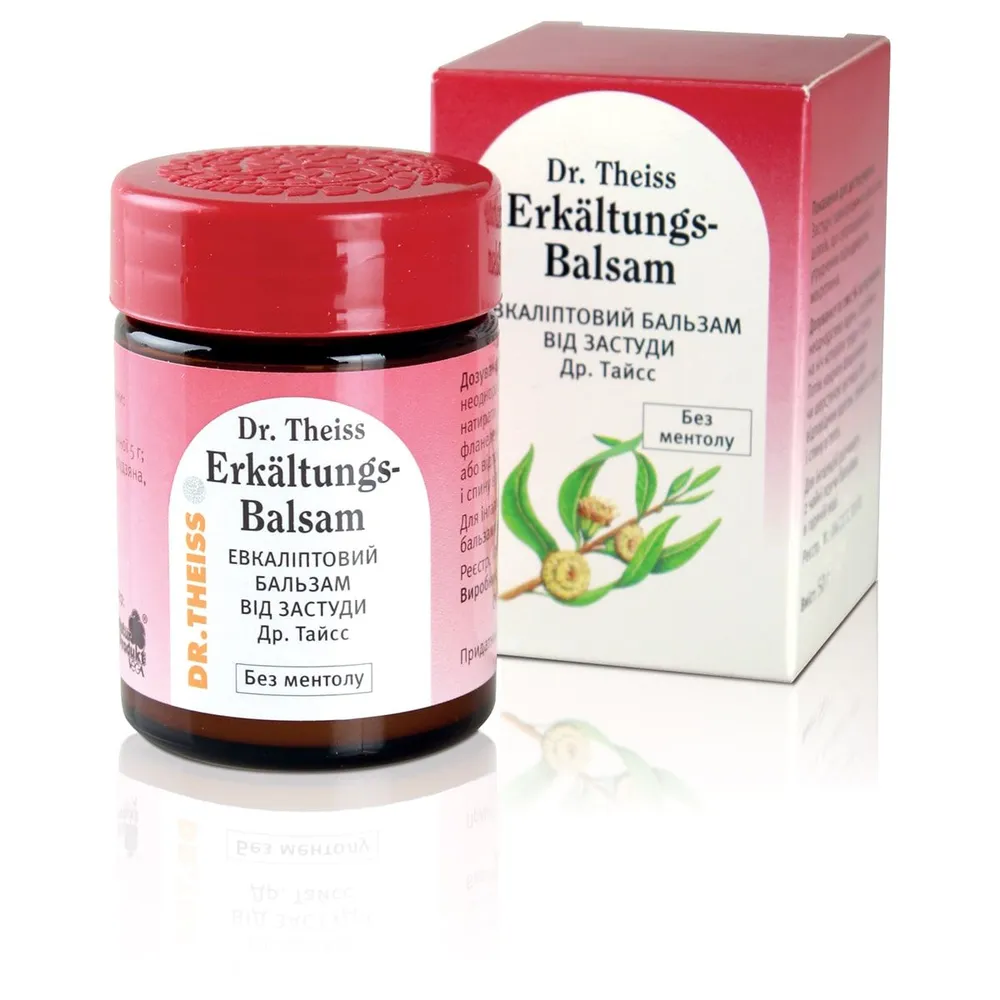
Table of Contents
INSTRUCTIONS FOR MEDICAL USE OF THE MEDICINAL PRODUCT DR. THEISS EUCALYPTUS COLD BALSAM
Composition:
Active ingredients: eucalyptus oil (Eucalypti aetheroleum), pine needle oil (Pini silvestris aetheroleum), racemic camphor;
100 g of ointment contains: eucalyptus oil (Eucalypti aetheroleum) 7.5 g, pine needle oil (Pini silvestris aetheroleum) 7.5 g, racemic camphor 5 g;
Excipients: corn oil, hard fat, yellow wax.
Pharmaceutical form. Ointment.
Main physicochemical properties: homogeneous, semi-transparent mass of light yellow color with a characteristic odour of eucalyptus and camphor.
Pharmacotherapeutic group. Medicinal products used in cough and colds. ATC code R05X.
Pharmacological Properties
Pharmacodynamics
"Dr. Theiss Eucalyptus Balm for Colds" is a herbal medicinal product with anti-cold, expectorant, and antibacterial properties. The effect of the preparation is determined by its constituent components. The vapors of essential oils exert anti-congestive and secretomotor actions, reducing the viscosity of sputum and improving its clearance from the respiratory tract. All active ingredients contained in the preparation exhibit strong antimicrobial activity.
Eucalyptus oil exerts anti-congestive, expectorant, and mild spasmolytic effects on the mucous membranes of the respiratory tract. When applied to the skin, eucalyptus oil produces a mild local irritant effect.
Camphor, when used externally, exerts anti-congestive and irritant actions.
Pine needle oil exhibits anti-congestive and antibacterial properties and acts as an irritant on the skin.
Pharmacokinetics
Pharmacokinetic studies have not been conducted.
Clinical characteristics.
Indications.
Respiratory tract infections associated with difficult expectoration of mucus.
Contraindications.
Hypersensitivity to the active substances or to any of the excipients.
Bronchial asthma, pertussis, pseudocroup, and other respiratory tract diseases associated with increased airway sensitivity — since inhalation of the product may cause bronchial muscle spasm; skin disorders (eczema, dermatitis) and childhood diseases with exanthema; skin damage of any etiology at the site of application; predisposition to seizures.
Do not use for inhalation in acute respiratory tract inflammation or acute lung inflammation.
Contraindicated for use in children under 2.5 years of age, since products containing 1,8-cineole, like other essential oils, may cause laryngospasm; in children with a history of seizures (febrile or other).
Interaction with other medicinal products and other forms of interaction.
Eucalyptus oil enhances hepatic microsomal enzyme activity. Therefore, the effect of other medicinal products, particularly amidopyrine, amphetamine, and phenobarbital, may be weakened and/or shortened. This cannot be excluded with prolonged use or application over large skin areas.
If simultaneous use of any other medicinal products is required, medical advice should be sought.
Special precautions for use
The medicinal product should be used only externally and for inhalations.
Do not apply to mucous membranes, including the nasal mucosa, or to the area around the eyes. Do not apply the preparation to facial skin. Apply exclusively to healthy skin.
Care should be taken to ensure that children do not touch with their hands the areas of skin to which the preparation has been applied. After applying the ointment, hands should be thoroughly washed.
If the medicinal product accidentally gets into a child's nose or onto the face, apnea due to laryngeal spasm (laryngospasm) may occur — a condition requiring immediate medical attention.
Topical application in children aged 2.5 to 4 years is not recommended due to insufficient data.
Inhalations are not recommended for children under 12 years of age. Inhalations in school-aged children should be performed under adult supervision.
If dyspnea, fever, or purulent sputum occur, medical advice must be sought immediately.
Use during pregnancy or breastfeeding
The safety of using this medicinal product during pregnancy or breastfeeding has not been established.
Due to insufficient data, this preparation should not be used during pregnancy or breastfeeding.
Effect on the ability to drive or operate machinery
Studies on the influence of this medicinal product on the ability to drive vehicles or operate machinery have not been conducted.
Method of Administration and Dosage
For adults and children aged 4 years and older: apply a thin layer to the chest and back 2–3 times daily throughout the day and before bedtime. To retain warmth, cover the area with flannel or wool fabric, or dress warmly.
For inhalations: for adults and children aged 12 years and older, dissolve 1–2 teaspoons of balm in 0.5–1 liter of hot, but not boiling water. Cover the head with a towel and inhale the vapors for 5–10 minutes. When using an inhaler, follow the device's operating instructions.
The duration of treatment is determined individually by a physician, but on average does not exceed 3–5 days. If during this period the patient's condition does not improve or symptoms such as dyspnea, headache, fever, purulent or bloody sputum or nasal discharge occur, immediate medical attention is required.
Children.
Do not use in children under 2.5 years of age. Use is not recommended in children aged 2.5 to 4 years. Inhalations are indicated for children aged 12 years and older.
Overdose.
Toxicity is practically excluded when used correctly at recommended doses.
Overdose may cause skin irritation.
Incorrect use.
Accidental ingestion of the ointment may cause gastrointestinal disturbances such as vomiting and diarrhea. Acute poisoning has been observed after significant accidental internal intake, with symptoms including nausea, vomiting, abdominal pain, headache, dizziness, sensation of warmth/flushing, seizures, respiratory depression, and coma.
In mild cases, discontinuation of the medicinal product is sufficient. Patients with severe gastrointestinal or neurological symptoms of poisoning should be monitored and treated symptomatically. Do not induce vomiting.
Adverse reactions.
Possible irritation of the skin and mucous membranes; headache, dizziness, excitement, occurrence of convulsions.
Cough and bronchospasm may be intensified. Inhalations (as well as inhaling vapors during external use) may cause symptoms such as wheezing (stridor), shortness of breath (dyspnea), or narrowing of the airways with difficulty breathing (obstructive dyspnea). As a reflex response to the use of the medicinal product, bronchospasm may occur, leading to asthma-like conditions and respiratory arrest.
Isolated cases of hallucinations have been reported. Allergic reactions, contact dermatitis, and other skin hypersensitivity reactions such as skin rash, urticaria, redness, and itching of the skin may occur.
External application over large areas of the body may lead to toxic symptoms, such as nephrotoxicity and central nervous system disturbances (following direct application of camphor).
If any adverse reactions occur, discontinue use of the product immediately and consult a physician without delay.
Shelf life. 3 years.
Storage conditions.
Store in the original packaging at a temperature not exceeding 25 ºC.
Keep out of reach of children.
Packaging.
20 g or 50 g in a glass jar. 1 jar per cardboard box.
Availability. Over-the-counter (without prescription).
Manufacturer/Applicant.
Dr. Theiss Naturwaren GmbH.
Manufacturer's address and location of business operations.
Michelinstrasse 10, 66424 Homburg, Germany.