Miraclin
Italy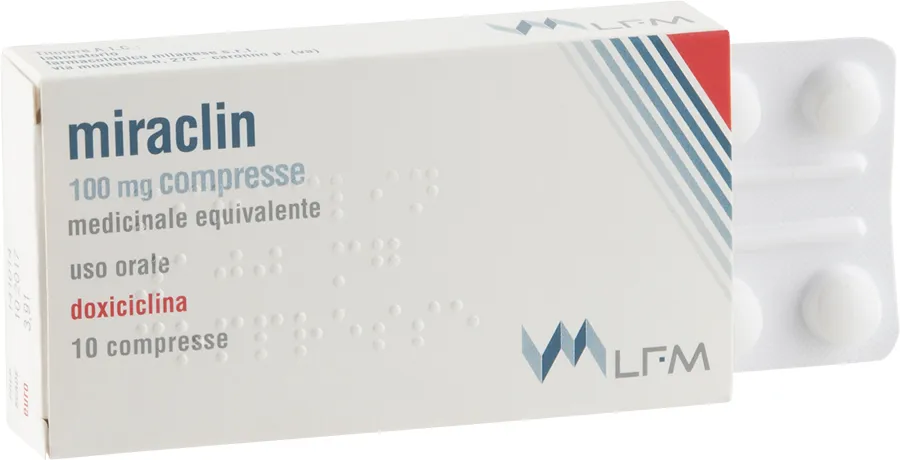
Instructions for Use
Package leaflet: Information for the patient
MIRACLIN 100 mg tablets
Doxycycline
Generic medicine
Please read all of this leaflet carefully before taking this medicine because it contains important information for you.
- Keep this leaflet. You may need to read it again.
- If you have any questions, ask your doctor or pharmacist.
- This medicine has been prescribed for you only. Do not give it to others, even if they have the same symptoms as yours, because it could be harmful.
- If you experience any side effects, including those not listed in this leaflet, talk to your doctor or pharmacist. See section 4.
Contents of this leaflet:
- What MIRACLIN is and what it is used for
- What you need to know before taking MIRACLIN
- How to take MIRACLIN
- Possible side effects
- How to store MIRACLIN
- Contents of the pack and other information
1. What MIRACLIN is and what it is used for
MIRACLIN contains the active substance doxycycline, which belongs to a group of antibiotic medicines called tetracyclines, used to treat infections caused by bacteria.
MIRACLIN is indicated for the treatment of infections caused by certain types of bacteria that are susceptible to tetracyclines.
2. What you should know before taking MIRACLIN
Do not take MIRACLIN
- if you are allergic to doxycycline or to any of the other ingredients of this medicine (listed in section 6);
- if you are allergic to other medicines of the same family as MIRACLIN (tetracyclines);
- if you suffer from esophageal obstruction disorders (the organ connecting the throat to the stomach), such as strictures or a condition called achalasia, characterized by failure of the esophagus to relax during swallowing, thus causing pain and difficulty in swallowing food and/or drinks;
- if you are pregnant or breastfeeding.
This medicine is not indicated for children under twelve years of age (see sections “Warnings and precautions” and “Pregnancy and breastfeeding”).
Warnings and precautions
Talk to your doctor or pharmacist before taking MIRACLIN.
Inform your doctor before using MIRACLIN:
- if you have liver problems; your doctor will prescribe MIRACLIN cautiously, as administration of this medicine at high doses and for periods longer than 2 weeks may cause liver problems. If this occurs, your doctor will discontinue treatment;
- if you have kidney problems, even severe ones (renal insufficiency). Accumulation in the blood of tetracycline antibiotics such as MIRACLIN may occur, which could worsen renal insufficiency and also cause liver problems. In this case, your doctor will reduce your dose of MIRACLIN to prevent worsening of kidney problems and to avoid the onset of liver problems, and will monitor your blood levels of doxycycline and liver function;
- if you suffer from a condition in which food from the stomach flows back into the esophagus, with symptoms such as heartburn, acid reflux, and regurgitation (gastroesophageal reflux). In this case, your doctor will consider alternative treatments to MIRACLIN, as MIRACLIN may worsen these symptoms;
- if you have a muscle disorder characterized by severe muscle weakness (myasthenia gravis);
- if you have an immune system disorder causing joint pain, skin rashes, and fever (systemic lupus erythematosus). This condition may worsen with the use of MIRACLIN.
Contact your doctor if any of the following conditions appear or worsen during treatment with MIRACLIN (also see section 4):
- diarrhea, which may be mild but in some cases can be fatal (fatal colitis). Diarrhea may occur with the use of nearly all antibiotics, including MIRACLIN, and is due to disruption of the normal intestinal bacterial flora, allowing excessive growth of a bacterium called Clostridium difficile. If diarrhea occurs, your doctor will closely monitor you, as Clostridium difficile infection may occur even up to two months after stopping treatment with this medicine;
- if during treatment you experience difficulty swallowing or pain behind the breastbone, stop treatment immediately and consult your doctor. In fact, use of MIRACLIN has been associated with cases of inflammation of the esophageal mucosa (esophagitis) and esophageal lesions (esophageal ulcers), even severe ones. Take MIRACLIN with plenty of water, even with meals, and remain in an upright position for at least 1 hour after taking it. Do not take this medicine immediately before going to bed;
- skin redness or other sunburn-like skin reactions (photosensitization reactions) following exposure to sunlight or UV rays (e.g., tanning beds). Avoid excessive exposure to sunlight or UV rays (e.g., tanning beds) during treatment with MIRACLIN, especially if you are predisposed to such reactions. Sometimes, use of this medicine may cause severe skin reactions such as widespread skin peeling (exfoliative dermatitis), nearly total skin and mucosal tissue death (toxic epidermal necrolysis), red patches or circular spots, often with central blisters, mainly on the trunk (Stevens-Johnson syndrome); skin redness, fever, inflammation of various organs, enlarged lymph nodes, and increased levels in the blood of a type of white blood cells called “eosinophils” (DRESS syndrome). Mouth, throat, nose, limbs, genital ulcers, and conjunctivitis (red, swollen eyes) may also be present. If you experience skin reactions during treatment, stop treatment immediately and consult your doctor;
- increased pressure of the fluid inside the skull (benign intracranial hypertension), possibly associated with vision loss, sometimes permanent. If visual disturbances occur during treatment, stop treatment with MIRACLIN immediately and consult your doctor;
- infections caused by microorganisms resistant to doxycycline (superinfections) or bacteria insensitive to tetracyclines (i.e., bacteria against which tetracyclines are ineffective). If this occurs, treatment with MIRACLIN must be stopped immediately, and your doctor will start a different therapy;
- liver problems. If liver function problems occur, stop treatment with MIRACLIN immediately;
- muscle weakness caused by an abnormal immune system reaction (myasthenia gravis);
- an immune system disorder causing joint pain, skin rashes, and fever (systemic lupus erythematosus). This condition may worsen with the use of MIRACLIN.
During treatment with MIRACLIN, your doctor will perform frequent check-ups to assess liver, kidney, and bone marrow function.
During treatment for sexually transmitted infections (gonococcal infections), there is a risk of masking symptoms of coexisting syphilis (a serious sexually transmitted infection). To rule out syphilis, your doctor will perform blood tests for at least 4 months after starting treatment with MIRACLIN.
If you take this medicine for prolonged periods, your doctor will perform periodic blood tests (blood count) and assessments of liver and kidney function.
While taking MIRACLIN, you may experience an increase in vaginal infections (moniliasis).
Children
MIRACLIN, like other tetracyclines, must not be administered to children under 12 years of age. MIRACLIN may reduce growth in children born between the 22nd and 37th week of pregnancy (preterm neonates), but this effect is reversible if treatment is discontinued.
In neonates and children up to 12 years of age, this medicine may cause reduced growth of leg bones (fibula), reversible upon discontinuation of treatment; permanent tooth discoloration (yellow-brown) or reduced enamel formation (enamel hypoplasia).
Moreover, with high doses, cases of increased intracranial pressure with bulging of the membranes covering the unfused skull in neonates (bulging fontanelles) have been reported, which resolve rapidly upon discontinuation of treatment.
Other medicines and MIRACLIN
Inform your doctor or pharmacist if you are taking, have recently taken, or might take any other medicines.
The following medicines must not be taken together with MIRACLIN:
- methoxyflurane, a medicine used during anesthesia or for pain relief (analgesic). Severe, even fatal, kidney damage may occur;
- systemic retinoids, medicines used to treat psoriasis, a skin inflammatory disease, and other skin conditions, due to the risk of reversible increased intracranial pressure (benign intracranial hypertension).
Inform your doctor or pharmacist if you are also taking the following medicines:
- lithium (a medicine to stabilize mood), methotrexate (used for tumors and autoimmune diseases), digoxin (used to increase the force of heart contraction), and ergot derivatives (used for headaches): concomitant administration of MIRACLIN may increase the toxic effects of these medicines;
- anticoagulants (medicines used to thin the blood), such as warfarin. MIRACLIN may reduce blood clotting ability (prothrombin activity). Your doctor may adjust the dose of anticoagulants you are taking with MIRACLIN, if necessary;
- penicillins (a type of antibiotic), as possible interference between the antibacterial activities of MIRACLIN and this class of antibiotics may occur. Avoid concomitant use of MIRACLIN and penicillins;
- anticonvulsants, medicines used for seizures such as barbiturates (phenobarbital, primidone), carbamazepine, and phenytoin;
- oral contraceptives (medicines used to prevent pregnancy). Taking MIRACLIN may reduce the effectiveness of oral contraceptives, potentially leading to unintended pregnancies or abnormal vaginal bleeding between periods. In this case, use of alternative or additional contraceptive measures is recommended;
- cyclosporine (a medicine used to prevent organ transplant rejection). Taking MIRACLIN may increase cyclosporine's toxic effects;
- medicines or preparations for stomach acidity containing aluminum salts, calcium salts, magnesium salts, or medicines or products containing iron salts, zinc, or bismuth taken orally. MIRACLIN should be taken at least 2 hours before or 2 hours after taking any of these medicines or preparations, as they reduce the effectiveness of MIRACLIN.
Laboratory tests
If you need to undergo urine tests, inform your doctor and healthcare staff that you are taking MIRACLIN, as this medicine may alter the results of certain laboratory tests (false increases in urinary catecholamine levels in fluorescence tests).
MIRACLIN with food, drinks, and alcohol
During treatment with MIRACLIN, avoid consuming:
- alcohol. The effectiveness of MIRACLIN may be reduced by simultaneous consumption of alcoholic beverages.
- milk, milk-based drinks, or dairy products
MIRACLIN should be taken at least 2 hours before or 2 hours after consuming these foods, as they reduce the effectiveness of the medicine.
Pregnancy, breastfeeding, and fertility
If you are pregnant, suspect you may be pregnant, plan to become pregnant, or are breastfeeding, consult your doctor or pharmacist before taking this medicine.
Pregnancy
Do not take MIRACLIN during pregnancy, as this medicine crosses the placenta and may harm the fetus.
Breastfeeding
Tetracycline antibiotics, such as MIRACLIN, pass into breast milk. Therefore, do not take MIRACLIN while breastfeeding.
Fertility
The impact of MIRACLIN on fertility is unknown.
Driving and using machines
There are no reports indicating that treatment with MIRACLIN may interfere with the ability to drive or operate machinery.
MIRACLIN contains sodium
MIRACLIN contains less than 1 mmol (23 mg) of sodium per tablet, i.e., essentially “sodium-free”.
3. How to take MIRACLIN
Take this medicine exactly as directed by your doctor or pharmacist. If you have any doubts, consult your doctor or pharmacist.
The recommended dose is 2 tablets (200 mg) as a single dose on the first day of treatment, followed by 1 tablet (100 mg) daily for the following days. For severe infections, your doctor will determine the appropriate dose.
Duration of treatment
Your doctor will decide the duration of treatment with MIRACLIN based on the severity and course of the infection.
For infections caused by the bacterium Streptococcus group A, treatment must last at least 10 days.
To ensure that the bacteria causing the infection are sensitive to MIRACLIN and that the treatment is effective, your doctor may perform a specific test called an antibiogram before starting treatment. This test evaluates bacterial sensitivity to various antibiotics.
Method of administration
Take each dose during meals with a large amount of water (a full glass) to avoid irritation of the oesophagus (see "MIRACLIN with food, drink and alcohol").
Take the medicine while standing or sitting upright, and do not lie down for at least one hour after taking the medicine.
If you take more MIRACLIN than you should
It is important never to take more medicine than prescribed. If you accidentally ingest or take an excessive dose of MIRACLIN, contact your doctor immediately or go to the nearest hospital.
If you forget to take MIRACLIN
Do not take a double dose to make up for the missed dose.
If you stop taking MIRACLIN
If you stop treatment with MIRACLIN prematurely, the outcome of therapy may be compromised. It is recommended not to discontinue treatment with this medicine before the fever and other signs of infection have disappeared.
If you have any questions about the use of this medicine, consult your doctor or pharmacist.
4. Possible side effects
Like all medicines, this medicine can cause side effects, although not everyone gets them.
STOP using MIRACLIN immediately if you experience any of the following side effects, as they may be serious:
- severe allergic reaction (anaphylactic shock)
- swelling of the face, neck, lips, tongue, and throat leading to difficulty swallowing and breathing (angioedema)
- exacerbation of a chronic autoimmune inflammation affecting various organs (systemic lupus erythematosus)
- autoimmune-type allergic reaction affecting small blood vessels, with appearance of reddish spots on the skin (Schönlein-Henoch purpura)
- allergic reaction to the medicine with skin redness, fever, inflammation of various organs, swollen lymph nodes, and increased number in the blood of a type of white blood cells called eosinophils (DRESS syndrome)
- increased pressure of the fluid inside the skull (benign intracranial hypertension in adults) or bulging of the soft areas of the skull known as "fontanelles" (in newborns). Possible symptoms of benign intracranial hypertension include headache, vomiting, visual disturbances including blurred vision, a blind spot surrounded by normal vision (scotoma), double vision (diplopia), and possible loss of vision, sometimes permanent (see section 2 "Warnings and precautions")
- severe inflammation of the final part of the intestine called colon (colitis) caused by excessive growth of a bacterium called Clostridium difficile (pseudomembranous colitis) (see section 2)
- injury to the inner lining of the esophagus (esophageal ulcer) (see section 2)
- severe acute hypersensitivity with almost complete necrosis of the skin and mucous membranes (toxic epidermal necrolysis)
- severe acute hypersensitivity of the skin and mucous membranes to substances and medicines (Stevens-Johnson syndrome)
- widespread and severe redness with skin peeling (exfoliative dermatitis)
- anemia due to excessive destruction of red blood cells (hemolytic anemia).
The following side effects may occur during treatment with MIRACLIN:
Very common (may affect more than 1 in 10 people):
- skin redness or other sunburn-like reactions due to light sensitivity (photosensitization) when exposed to sunlight or ultraviolet radiation (e.g., sunbeds).
Common (may affect up to 1 in 10 people):
- severe, rapidly occurring allergic reactions (anaphylactic reactions, anaphylactoid reactions)
- allergy (hypersensitivity) to the medicine
- low blood pressure (hypotension)
- inflammation of the membrane surrounding the heart (pericarditis)
- difficulty breathing (dyspnea)
- autoimmune-type allergic reaction with fever, skin redness, joint pain, and other symptoms (serum sickness)
- fluid accumulation causing swelling in various parts of the body, especially ankles and/or legs (peripheral edema)
- increased heart rate (tachycardia)
- urticaria
- headache
- nausea and vomiting
- skin redness (skin eruptions with small raised areas and reddish spots on the skin (maculopapular eruptions))
Uncommon (may affect up to 1 in 100 people):
- stomach pain or discomfort with a feeling of fullness (dyspepsia)
- burning sensation in the stomach or esophagus (pyrosis)
- inflammation of the stomach lining (gastritis)
Rare (may affect up to 1 in 1,000 people):
- abnormal perception of ringing, buzzing, hissing, pulsations, or other sounds in the ear in the absence of external noise (tinnitus)
- redness
- esophageal lesions (esophageal ulcers) and inflammation of the esophageal mucosa (esophagitis)
- inflammation of the small intestine and colon (enterocolitis)
- skin inflammation and lesions around the anus or external genital organs, with Candida infection (a fungus)
- abdominal pain
- diarrhea
- difficulty swallowing (dysphagia)
- inflammation of the tongue (glossitis)
- liver damage (hepatotoxicity)
- inflammation of the liver (hepatitis)
- changes in liver function
- yellowing of the skin and whites of the eyes (jaundice)
- inflammation of the pancreas (pancreatitis)
- inflammation of blood vessels with skin necrosis and hypersensitivity reactions (erythema multiforme)
- complete or partial detachment of one or more nails following exposure to sunlight or ultraviolet radiation (e.g., in a sunbed) (photo-onycholysis)
- joint pain (arthralgia)
- muscle pain (myalgia)
- worsening of symptoms of a disease causing severe muscle weakness called myasthenia gravis
- increased levels of nitrogen in the blood
- reduced number of platelets in the blood (thrombocytopenia)
- increased number of a type of white blood cells called eosinophils (eosinophilia)
- reduced number of a type of white blood cells called neutrophils (neutropenia)
- disease originating from altered porphyrin metabolism, substances that are part of blood and other tissues (porphyria)
- decreased appetite
- microscopic lesions of the thyroid gland
- the Jarisch-Herxheimer reaction, which causes fever, chills, headache, muscle pain, and skin rash, is usually self-limiting. It occurs shortly after starting doxycycline treatment for spirochete infections such as Lyme disease
- darker spots on the skin (skin hyperpigmentation)
Not known (frequency cannot be estimated from available data):
- changes in tooth color and/or failure of tooth development
Reporting of side effects
If you experience any side effect, including those not listed in this leaflet, talk to your doctor or pharmacist. You can also report side effects directly via the national reporting system at the website
https://www.aifa.gov.it/content/segnalazioni-reazioni-avverse. By reporting side effects, you can help provide more information on the safety of this medicine.
5. How to store MIRACLIN
Keep this medicine out of the sight and reach of children.
Do not use this medicine after the expiry date which is stated on the packaging after "Exp.".
The expiry date refers to the last day of that month.
Do not store above 25 °C.
Do not dispose of any medicine via wastewater or household waste. Ask your pharmacist
how to dispose of medicines you no longer use. This will help protect the environment.
6. Package contents and other information
What MIRACLIN contains
- The active substance is doxycycline hyclate. Each tablet contains 115.4 mg of doxycycline hyclate, equivalent to 100 mg of anhydrous doxycycline base.
- The other components are: microcrystalline cellulose, dibasic calcium phosphate, crospovidone, magnesium stearate, maize starch, sodium carboxymethylstarch, talc, sodium lauryl sulfate, colloidal silicon dioxide.
Description of the appearance of MIRACLIN and the contents of the pack
MIRACLIN is available as 100 mg tablets in a carton containing 10
100 mg tablets in blisters.
Marketing Authorization Holder and Manufacturer
Laboratorio Farmacologico Milanese S.r.l. – Via Monterosso, 273 - 21042 Caronno Pertusella (VA)
Similar Medications
-
Bassado
Form: tablets
Active substance Dosage DOXYCYCLINE HYCLATE — Manufacturer: PFIZER ITALIA S.R.L.
-
Farmodoxi
Form: tablets
Active substance Dosage DOXYCYCLINE HYDROCHLORIDE — Manufacturer: ITALFARMACO S.P.A.
This page has been machine-translated and may contain inaccuracies. The original data is available in the manufacturing country's language.
Last data check: May 11, 2026 · Data source: Agenzia Italiana del Farmaco (AIFA)