Farmodoxi
Italy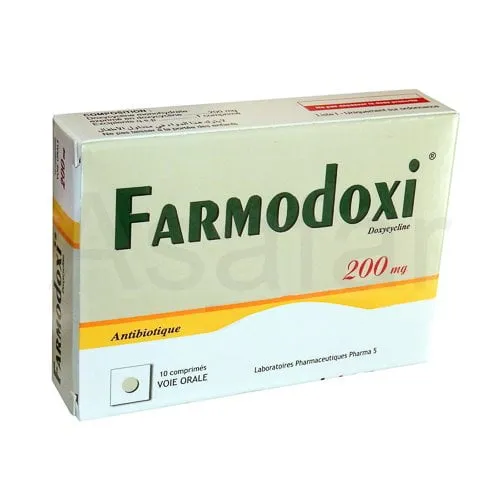
Table of Contents
Package leaflet: Information for the patient
Farmodoxi 100 mg tablets
doxycycline
Please read all of this leaflet carefully before taking this medicine because it contains
important information for you.
- Keep this leaflet. You may need to read it again.
- If you have any questions, ask your doctor or pharmacist.
- This medicine has been prescribed for you only. Do not give it to other people, even if their symptoms are the same as yours, as it may be harmful.
- If you experience any side effects, including those not listed in this leaflet, contact your doctor or pharmacist. See section 4.
Contents of this leaflet:
- What Farmodoxi is and what it is used for
- What you need to know before taking Farmodoxi
- How to take Farmodoxi
- Possible side effects
- How to store Farmodoxi
- Contents of the pack and other information
1. What Farmodoxi is and what it is used for
Farmodoxi contains doxycycline, a substance belonging to a group of antibiotics called tetracyclines, which are used in the treatment of certain infections.
Farmodoxi is used for the treatment of infections caused by Gram-positive and Gram-negative microorganisms sensitive to tetracyclines.
2. What you should know before taking Farmodoxi
Do not take Farmodoxi
- if you are allergic to doxycycline or any of the other ingredients of this medicine (listed in section 6);
- if you have obstructive disorders of the oesophagus, such as strictures or achalasia;
- if you are pregnant or planning to become pregnant (see "Pregnancy and breastfeeding");
- if you are breastfeeding (see "Pregnancy and breastfeeding").
Do not take this medicine if any of the conditions listed above apply to you.
If you have any doubts, speak with your doctor or pharmacist before taking Farmodoxi.
Do not take Farmodoxi during periods of tooth development (pregnancy, infancy, children under 8 years of age), as its use may cause permanent discoloration of teeth (yellow-grey-brown) or impair proper tooth growth.
In certain circumstances (e.g., severe or life-threatening conditions), your doctor may decide that the benefits outweigh this risk in children under 8 years of age and may prescribe Farmodoxi.
Warnings and precautions
Talk to your doctor or pharmacist before taking Farmodoxi.
During treatment with this medicine:
- Avoid excessive exposure to sunlight or artificial UV light and stop treatment if allergic reactions occur (photosensitivity), such as skin rashes (see "Possible side effects"). Use sunscreens offering partial or total protection.
- Take the tablets with plenty of water to reduce the risk of oesophageal irritation and ulcers (see "Oesophagitis" and "How to take Farmodoxi").
- Be aware that the absorption of the medicine by the body is reduced if you are simultaneously taking medicines containing bismuth subsalicylate (used for temporary gastrointestinal disorders) (see "Other medicines and Farmodoxi tablets").
- Be aware that taking Farmodoxi may increase the incidence of vaginal candidiasis.
Long-term treatment cycles require periodic monitoring of blood composition (haematological parameters) and kidney and liver function.
Exercise particular caution with Farmodoxi:
- If you have impaired liver function, as administration of doxycycline at high doses and for periods longer than two weeks may cause liver function disturbances, which therefore need to be monitored, and treatment should be discontinued in case of abnormal reactions.
- If you have impaired kidney function; your doctor may decide to reduce the dosage in this case;
- If you have renal insufficiency, since even normal doses of tetracyclines may lead to accumulation of the medicine in the body with possible liver damage. In this case, dosage adjustments are necessary depending on the degree of kidney function, possibly requiring monitoring of tetracycline blood levels (which should never exceed 15 mcg/mL) and liver function. Furthermore, bear in mind that tetracyclines have an anti-anabolic effect which may worsen renal insufficiency.
- If diarrhoea develops during treatment with Farmodoxi or in the period following (even beyond two months). Indeed, cases of diarrhoea associated with the bacterium Clostridium difficile (CDAD) have been reported with the use of antibiotics including doxycycline, with severity ranging from mild diarrhoea to inflammation of the colon (colitis). Antibiotic treatment indeed alters the normal colonic flora and leads to excessive growth of Clostridium difficile. If you suspect you have CDAD, contact your doctor immediately.
- If you suffer from myasthenia gravis (a progressive muscle disease characterized by severe muscle weakness).
Cases of bulging fontanelles in newborns and benign intracranial hypertension in adults have been reported with full-dose administration of the medicine. These effects are rapidly reversible upon discontinuation of treatment.
Oesophagitis
Cases of oesophageal inflammation (oesophagitis) and oesophageal ulcers, sometimes severe, have been reported.
Take the medicine with plenty of water, even during meals, and remain in an upright position for at least one hour after ingestion. It is not recommended to take the medicine immediately before going to bed.
If symptoms such as difficulty swallowing or retrosternal pain occur during treatment, stop taking the medicine immediately and consult your doctor to evaluate whether instrumental investigations are needed.
If you have confirmed gastro-oesophageal reflux (backflow of acidic stomach contents into the oesophagus), your doctor may consider alternative therapeutic options.
Gonococcal infections
Taking the medicine for treatment of gonococcal infections may mask symptoms of syphilis, which could coexist. In such cases, blood tests should therefore be performed for at least 4 months.
Superinfections
As with other antibiotics, treatment with tetracyclines may lead to superinfections caused by resistant bacteria or fungi (e.g., possible occurrence of enterocolitis due to resistant staphylococci). Continuous monitoring is essential during treatment, and if a resistant microorganism appears, treatment should be stopped and appropriate therapy initiated.
Children and adolescents
Farmodoxi must not be taken by children and adolescents under 8 years of age (see "Do not take Farmodoxi").
Doxycycline, like other tetracyclines, forms a stable calcium complex in developing bone tissue. A reduced growth rate of the fibula has been observed in premature infants who received oral tetracycline at a dose of 25 mg/kg every six hours.
Additionally, cases of bulging fontanelles in newborns have been reported with full-dose administration.
These reactions are reversible upon discontinuation of treatment.
The use of tetracyclines during tooth development (second half of pregnancy, neonatal period, and early childhood up to 8 years of age) may cause permanent discoloration of teeth (yellow-grey-brown); this occurs especially after prolonged use of these antibiotics, but has also been observed after short but repeated treatment courses. Enamel abnormalities have also been reported; therefore, doxycycline should not be administered to this patient group unless alternative medicines are unavailable or may be ineffective or contraindicated.
Other medicines and Farmodoxi
Inform your doctor or pharmacist if you are taking, have recently taken, or might take any other medicine.
Farmodoxi may affect the way some medicines work and, conversely, some medicines may affect the action of Farmodoxi.
Rare cases of increased blood concentrations of the following medicines have been reported during concomitant administration of tetracyclines:
- lithium (used for psychiatric disorders),
- methotrexate (used in the treatment of certain autoimmune diseases and some cancers),
- digoxin (used for certain heart conditions),
- ergot derivatives (used in the treatment of migraine).
Talk to your doctor or pharmacist if you are taking one or more of the following medicines:
- Oral anticoagulants (e.g., warfarin), due to the risk of prolonged blood clotting time. Since tetracyclines may reduce blood clotting, your doctor may reduce the dosage of concomitantly administered anticoagulant medicines.
- Penicillins, due to possible interference between the antibacterial activities of the two medicines.
- Anticonvulsants, such as barbiturates (phenobarbital, primidone), carbamazepine, or phenytoin;
- Oral contraceptives, as taking tetracyclines may reduce the effectiveness of oral contraceptive treatments;
- Cyclosporine (used after organ transplants), as doxycycline may increase cyclosporine blood levels. Any co-administration should therefore be closely monitored.
Interactions with other medicines:
- Systemic retinoids, due to the risk of increased pressure inside the skull (benign intracranial hypertension);
- Methoxyflurane (a medicine used in general anaesthesia), due to the risk of kidney damage (nephrotoxicity), potentially fatal.
Furthermore, oral absorption of tetracyclines is reduced by:
- antacid preparations containing aluminium, calcium, or magnesium;
- milk or dairy products;
- products containing iron salts and oral preparations containing zinc or bismuth. Avoid simultaneous intake and, if possible, leave at least 2 hours between administration of these products and tetracyclines.
Interactions with laboratory tests
False increases in urinary catecholamine levels (tests for diagnosis or monitoring of phaeochromocytoma, a tumour of the adrenal gland) may occur due to interference with the fluorescence test.
Farmodoxi with food, drinks and alcohol
Oral absorption of tetracyclines is reduced by milk or dairy products; therefore, avoid simultaneous intake and, if possible, leave at least 2 hours between consumption of milk or dairy products and tetracycline administration.
Avoid alcohol consumption during treatment with Farmodoxi.
Pregnancy and breastfeeding
If you are pregnant, suspect you may be pregnant, planning to become pregnant, or breastfeeding, consult your doctor or pharmacist before taking this medicine.
Do not take Farmodoxi during pregnancy or while breastfeeding (see "Do not take Farmodoxi").
Driving and using machines
Farmodoxi does not affect the ability to drive or use machinery.
Farmodoxi contains sodium
Farmodoxi contains less than 1 mmol (23 mg) of sodium per tablet, i.e., essentially "sodium-free".
3. How to use Farmodoxi
Take this medicine exactly as directed by your doctor or pharmacist. If
you have any doubts, consult your doctor or pharmacist.
The recommended doses are listed below. Your doctor may prescribe different doses depending on
the infection being treated.
Usual dose (for chest, lung or nasal, urinary tract, eye infections, and other infections):
Children aged between 8 and 12 years:
Farmodoxi should be used to treat acute infections in children aged between 8 and
12 years only in situations where other medicines are not available or are considered potentially
ineffective.
In such cases, the usual doses are:
For children weighing up to 45 kg:
First day: 4.4 mg per kg of body weight (as a single dose or divided into two doses), then
2.2 mg per kg of body weight (as a single dose or divided into two doses) from the second day
onwards.
The duration of treatment depends on the infection being treated. In more severe infections, up to
4.4 mg per kg of body weight may be given throughout the treatment period.
For children weighing more than 45 kg:
the adult dose should be administered: 200 mg on the first day, then 100 mg daily.
The duration of treatment depends on the infection being treated.
Adults and children aged between 12 and 18 years:
200 mg on the first day, then 100 mg daily. The duration of treatment depends on the infection being
treated.
Take the tablets during meals with plenty of water (a full glass).
Take the medicine in an upright position, at least one hour before going to sleep (see
“Warnings and precautions”).
In case of severe infections, strictly follow your doctor's instructions.
In all infections caused by group A beta-haemolytic streptococcus, treatment must last at least
ten days.
The duration of treatment will depend on the course of the infection; however, it is advisable not to
discontinue therapy until after fever and clinical symptoms have disappeared.
For maximum therapeutic safety, it is advisable in all cases to perform laboratory tests (antibiogram) to confirm that the bacterial strain responsible for the infection is
sensitive to tetracyclines.
If you take more Farmodoxi than you should
If you accidentally take an excessive dose of Farmodoxi, call a doctor or go to the
nearest hospital, taking the medicine pack with you. This way, the doctor will know immediately what you have taken.
In case of overdose, gastric lavage (gastrolusis) may be necessary. Blood dialysis (haemodialysis) is not indicated in cases of overdose, as it does not alter the duration of the medicine's presence in the blood.
If you forget to take Farmodoxi
If you forget to take Farmodoxi, take it as soon as you remember. However, if it is almost time for your next dose, skip the missed dose. Do not take a double dose to make up for the forgotten dose.
If you stop using Farmodoxi
If you have any questions about using this medicine, consult your doctor or pharmacist.
4. Possible side effects
Like all medicines, this medicine can cause side effects, although not everyone gets them.
If you experience any of the side effects listed below, contact your doctor as soon as possible:
Very common (may affect more than 1 in 10 people):
- allergic skin reactions to sunlight (photosensitization).
Common (may affect up to 1 in 10 people):
- anaphylactic reactions, including hypersensitivity, Schönlein-Henoch purpura (a disease characterized by inflammation of small blood vessels), low blood pressure (hypotension), inflammation of the membrane surrounding the heart (pericarditis), swelling of the skin and mucous membranes (angioedema), exacerbation of systemic lupus erythematosus (a chronic autoimmune disease causing disorders in various parts of the body, particularly the skin), difficulty in breathing (dyspnea), serum sickness reaction, fluid accumulation in the body (peripheral edema), increased heart rate (tachycardia), and urticaria;
- headache;
- nausea;
- vomiting;
- erythematous or pustular eruptions (erythematous or maculopapular rashes).
Uncommon (may affect up to 1 in 100 people):
- digestive disorders (dyspepsia), for example, stomach burning (pyrosis) or gastritis.
Rare (may affect up to 1 in 1,000 people):
- blood abnormalities: reduced platelet count (thrombocytopenia), destruction of red blood cells (haemolytic anaemia), reduced neutrophil count (neutropenia), increased eosinophil count (eosinophilia);
- drug rash with eosinophilia and systemic symptoms (DRESS syndrome);
- microscopic brown pigmentation of the thyroid gland;
- loss of appetite (anorexia);
- porphyria (a rare metabolic disorder);
- increased pressure within the skull (benign intracranial hypertension) in adults, with possible symptoms such as headache, vomiting, visual disturbances including blurred vision, appearance of an area of blindness, partial or complete within the visual field (scotoma), double vision (diplopia), or permanent vision loss; the occurrence of clinical symptoms, including headache or visual disturbances, should raise suspicion of intracranial hypertension; if increased intracranial pressure is suspected during tetracycline treatment, administration must be discontinued;
- ringing in the ears (tinnitus);
- flushing;
- antibiotic-associated colitis (pseudomembranous colitis);
- Clostridium difficile diarrhea (see "Warnings and precautions");
- inflammation of the esophagus (esophagitis), esophageal ulcers;
- enterocolitis;
- inflammatory lesions (with candidiasis) around the anus and genital organs;
- abdominal pain;
- diarrhea;
- difficulty in swallowing (dysphagia);
- inflammation of the tongue (glossitis);
- liver damage (hepatotoxicity), hepatitis, altered liver function, yellowing of the skin and mucous membranes (jaundice);
- inflammation of the pancreas (pancreatitis);
- severe skin reactions (toxic epidermal necrolysis, Stevens-Johnson syndrome, erythema multiforme);
- exfoliative dermatitis;
- nail disorders (photo-onycholysis);
- joint pain (arthralgia);
- muscle pain (myalgia);
- exacerbation of symptoms in myasthenia gravis, a progressive muscle disease characterized by marked muscle weakness;
- increased blood nitrogen concentration (azotemia) (BUN).
Frequency not known (frequency cannot be estimated from the available data):
- changes in tooth color and/or failure of tooth development;
- the Jarisch-Herxheimer reaction, which causes fever, chills, headache, muscle pain, and skin rash, is usually self-limiting. It occurs shortly after starting doxycycline treatment for spirochete infections such as Lyme disease.
Additional side effects in children
Rare (may affect up to 1 in 1,000 patients):
- bulging fontanelles in newborns.
Side effects can be minimized by using the lowest effective dose for the shortest duration needed to control symptoms.
Following the instructions in this leaflet reduces the risk of side effects.
Reporting of side effects
If you experience any side effect, including those not listed in this leaflet, talk to your doctor or pharmacist. You can also report side effects directly via the national reporting system at https://www.aifa.gov.it/content/segnalazioni-reazioni-avverse.
By reporting side effects, you can help provide more information on the safety of this medicine.
5. How to store Farmodoxi
Keep this medicine out of the sight and reach of children.
Do not store above 25°C.
Do not use this medicine after the expiry date stated on the packaging after “Exp”.
The expiry date refers to the last day of that month.
Do not dispose of any medicine via wastewater or household waste. Ask your pharmacist how to
dispose of medicines you no longer use. This will help protect the environment.
6. Package contents and other information
What Farmodoxi contains
- The active substance is doxycycline. Each tablet contains 115.4 mg of doxycycline hyclate (equivalent to 100 mg of anhydrous doxycycline base).
- The other components are: microcrystalline cellulose, calcium hydrogen phosphate, crospovidone, magnesium stearate, corn starch, sodium carboxymethyl starch, talc, sodium lauryl sulfate, colloidal silicon dioxide.
Description of the appearance of Farmodoxi and contents of the pack
Farmodoxi is available in tablet form.
The pack contains 10 tablets of 100 mg.
Marketing Authorization Holder and Manufacturer
Marketing Authorization Holder:
Italfarmaco S.p.A. - V.le F. Testi, 330 Milan
Manufacturer:
Laboratorio Farmacologico Milanese S.r.l. – Caronno Pertusella (VA)
April 2026