Panzyga 100 mg/ml solution for infusion
Spain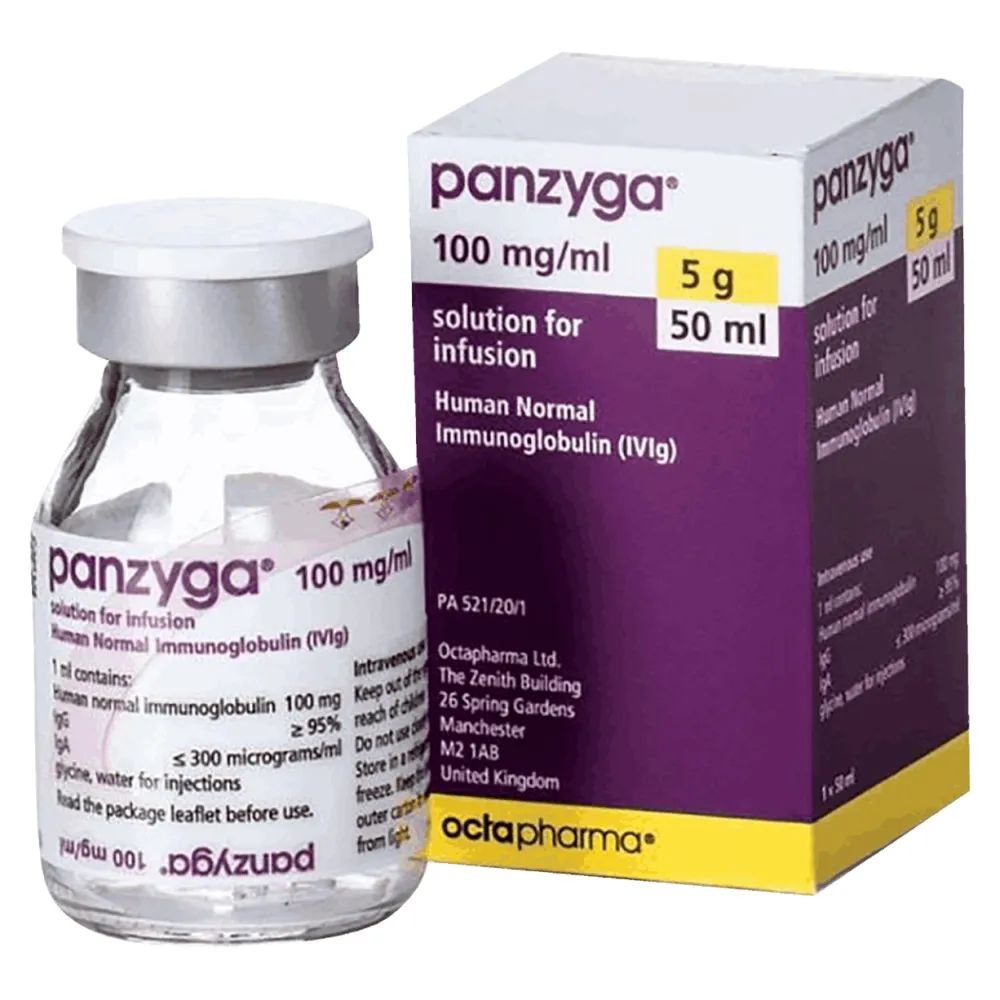
Instructions for Use
Patient Information Leaflet
Introduction
Patient Information Leaflet
Panzyga 100 mg/ml solution for infusion
Normal human immunoglobulin (IVIg)
Read the entire leaflet carefully before you start using this medicine, as it contains important information for you.
- Keep this leaflet, as you may need to read it again.
- If you have any questions, consult your doctor or pharmacist.
- This medicine has been prescribed for you only, and you should not give it to other people, even if they have the same symptoms as you, because it may harm them.
- If you experience any adverse effects, consult your doctor or pharmacist, even if they are adverse effects not listed in this leaflet. See section 4.
Leaflet Contents
- What Panzyga is and what it is used for
- What you need to know before using Panzyga
- How to use Panzyga
- Possible side effects
- How to store Panzyga
- Contents of the pack and other information
1. What Panzyga is and what it is used for
What Panzyga is
This medicine is a solution of human normal immunoglobulin (IgG), that is, a solution of human antibodies for intravenous administration (i.e., infusion into a vein). Immunoglobulins are normal components of human blood and support the body's immune defenses. Panzyga contains all IgG classes present in the blood of healthy individuals. Appropriate doses of Panzyga can restore abnormally low IgG concentrations to normal levels.
Panzyga has a broad spectrum of antibodies against various infectious agents.
What Panzyga is used for
Panzyga is used as replacement therapy in children, adolescents (0–18 years), and adults in different patient groups:
- Patients with congenital antibody deficiency (primary immunodeficiency syndromes), such as: congenital agammaglobulinemia and hypogammaglobulinemia, common variable immunodeficiency, severe combined immunodeficiencies
- Patients with antibody deficiency (secondary immunodeficiency) due to specific diseases and/or treatments who experience severe or recurrent infections.
This medicine may be used for the treatment of adults and children and adolescents (0–18 years) who are susceptible and who have been exposed to measles or are at risk of measles exposure, and in whom active measles vaccination is not indicated or not recommended.
Panzyga may also be used in the treatment of the following autoimmune disorders (immunomodulation):
- In patients with immune thrombocytopenia (ITP), a condition in which platelets are destroyed, thus reducing their number, and who are at high risk of bleeding or prior to surgery to correct platelet count.
- In patients with Kawasaki disease, a condition causing inflammation of various organs
- In patients with Guillain-Barré syndrome, a disease causing inflammation of certain parts of the nervous system
- In patients with chronic inflammatory demyelinating polyradiculoneuropathy (CIDP), a disease causing chronic inflammation of the peripheral parts of the nervous system and resulting in muscle weakness and/or numbness, primarily in the legs and arms.
In patients with multifocal motor neuropathy (MMN), a condition characterized by slowly progressive, asymmetric weakness of the limbs without sensory loss.
2. What you need to know before using Panzyga
Do not use Panzyga:
- if you are allergic to normal human immunoglobulin or to any of the other components of this medicine (listed in section 6).
- if you have immunoglobulin A deficiency (IgA deficiency) and have developed antibodies against IgA-type immunoglobulins.
Warnings and precautions
Talk to your doctor or pharmacist before starting treatment with Panzyga.
It is strongly recommended that each time you receive a dose of Panzyga, the product name and batch number are recorded, in order to maintain a record of the batches used.
Adverse reactions may occur more frequently:
- with a high infusion rate,
- when receiving Panzyga for the first time, or, in rare cases, when there has been a prolonged interval since the previous infusion,
- when you have an untreated infection or underlying chronic inflammation.
In case of an adverse reaction, your doctor will reduce the rate of administration or stop the infusion. The treatment required for the adverse event will depend on its nature and severity.
Circumstances and conditions that increase the risk of adverse effects
- Very rarely, thromboembolic events such as heart attack, stroke, or blockage of a deep vein (e.g., in the lower leg) or of a blood vessel in the lungs may occur after administration of Panzyga. These types of events occur more frequently in patients with risk factors such as obesity, advanced age, hypertension, diabetes, previous episodes of such events, prolonged periods of immobility, or use of certain hormones (e.g., "the pill"). Ensure adequate fluid intake. In addition, Panzyga should be administered as slowly as possible.
If you have had kidney problems in the past or if you have certain risk factors such as diabetes, overweight, or are over 65 years of age, Panzyga should be administered as slowly as possible, as cases of acute renal failure have been reported in patients with these risk factors. Inform your doctor, even if any of the above-mentioned circumstances occurred in the past.
- Patients with blood groups A, B, or AB, as well as patients with certain inflammatory diseases, have an increased risk of the administered immunoglobulins destroying red blood cells (a condition known as hemolysis).
When may it be necessary to reduce the infusion rate or stop the infusion?
- Severe headaches and neck stiffness may occur rarely, several hours up to 2 days after treatment with Panzyga.
- Allergic reactions are rare, but may lead to anaphylactic shock, even in patients who have previously tolerated the treatment.
A sudden drop in blood pressure or shock may be consequences of an anaphylactic reaction.
- In very rare cases, transfusion-related acute lung injury (TRALI) may occur after receiving immunoglobulins, including Panzyga. This leads to the accumulation of fluid in the air spaces of the lungs, not due to cardiac causes. TRALI is recognized by severe difficulty in breathing, normal heart function, and an increase in body temperature (fever). Symptoms usually appear between 1 and 6 hours after receiving the treatment.
Contact your doctor or healthcare professional immediately if you experience any of the above-mentioned symptoms during or after the Panzyga infusion. They will decide whether to reduce the infusion rate or stop it completely, and whether further measures are needed.
- Occasionally, immunoglobulin solutions such as Panzyga may trigger a decrease in the number of white blood cells. This condition usually resolves spontaneously within 1 to 2 weeks.
Effects on blood tests
Panzyga contains a wide variety of different antibodies, some of which may affect blood test results. If you are having a blood test after receiving Panzyga, inform the person drawing your blood or your doctor that you have received a normal human immunoglobulin solution.
Viral safety
When medicines are manufactured from human blood or plasma, certain measures are taken to prevent transmission of infections to patients. These include:
- Careful selection of blood or plasma donors to ensure that those at risk of carrying infections are excluded.
- Testing of individual donations and plasma pools for specific markers of infections, such as viruses.
- Manufacturing steps implemented to inactivate or remove viruses during the processing of blood or plasma.
Despite these measures, when medicines derived from human blood or plasma are administered, the possibility of transmitting an infection cannot be completely ruled out. This also applies to any unknown or emerging viruses or other types of infections.
The measures taken are considered effective against enveloped viruses such as human immunodeficiency virus (HIV), hepatitis B virus, and hepatitis C virus, as well as against non-enveloped viruses such as hepatitis A virus and parvovirus B19.
Immunoglobulins have not been associated with hepatitis A virus or parvovirus B19 infections, possibly due to the presence of antibodies against these infections in the product, which provide a protective effect.
Children and adolescents
There are no specific or additional warnings or precautions applicable to children and adolescents.
Use of Panzyga with other medicines
Inform your doctor or pharmacist if you are taking, have recently taken, or might need to take any other medicines, including over-the-counter medicines, or if you have received a vaccine within the last three months.
During treatment with Panzyga, concomitant use of medicines that increase water excretion from the body (loop diuretics) should be avoided. Your doctor will decide whether you should use or continue treatment with loop diuretics.
Panzyga may interfere with the effect of vaccines containing live attenuated viruses such as:
- measles,
- rubella,
- mumps,
- varicella.
An interval of 3 months should elapse after administration of this product before vaccination with vaccines containing live attenuated viruses. In the case of measles, this interference may persist for up to 1 year.
Use of Panzyga with food, drinks and alcohol
No effects have been observed. Adequate hydration should be ensured before infusion of the medicine.
Pregnancy, breastfeeding and fertility
If you are pregnant or breastfeeding, think you may be pregnant, or are planning to become pregnant, consult your doctor or pharmacist before using or continuing to use this medicine.
The safety of this product during pregnancy has not been established in controlled clinical trials and therefore should be administered with caution to pregnant and breastfeeding women. Immunoglobulin products have been shown to frequently cross the placenta, especially during the third trimester. Clinical experience with immunoglobulins suggests that no harmful effects on pregnancy, the fetus, or the newborn are expected.
Immunoglobulins are excreted in breast milk; therefore, no negative effects are expected in neonates or infants who are breastfed.
Driving and using machines
This medicine has no effect or negligible effect on the ability to drive or use machines. However, patients who experience adverse reactions during treatment should wait until these have resolved before driving or operating machinery.
Panzyga contains sodium
This medicine contains 69 mg of sodium (a main component of table/cooking salt) per 100 ml vial. This corresponds to 3.45% of the maximum daily sodium intake recommended for an adult.
This should be taken into account in patients on a low-sodium diet.
3. How to use Panzyga
Your doctor will decide whether you need Panzyga and what dose to use. The administration of the medicine as an intravenous infusion (infusion into a vein) will be performed by healthcare professionals. The dose and dosing regimen depend on the indication, and adjustments may be necessary for individual patients.
If you have any further questions about the use of this medicine, consult your doctor or pharmacist.
Use in children and adolescents
The administration (intravenous) of the medicine in children and adolescents (0–18 years of age) does not differ from that in adults.
If you receive more Panzyga than you should
It is highly unlikely that an overdose will occur, as this medicine is normally administered under medical supervision. Nevertheless, if you receive more Panzyga than prescribed, your blood may become too thick (hyperviscous), which could increase the risk of blood clots. This is especially possible if you are a high-risk patient, for example, if you are elderly or have heart or kidney disease. Make sure you are well hydrated. Inform your doctor if you have any known medical conditions.
If you forget to use Panzyga
Consult your doctor to discuss how to proceed.
4. Possible adverse effects
Like all medicines, this medicine can cause adverse effects, although not everyone experiences them.
Contact your doctor as soon as possible if you experience any of the following serious adverse effects (all are very rare and may affect up to 1 in 10,000 infusions). In some cases, your doctor may need to interrupt the treatment and reduce your dose, or stop the treatment:
- Swelling of the face, tongue, and trachea, which may cause severe breathing difficulties
- Sudden allergic reaction with difficulty breathing, rash, wheezing, and low blood pressure
- Stroke that may cause weakness and/or loss of sensation on one side of the body
- Heart attack causing chest pain
- Blood clot causing pain and swelling in the limbs
- Blood clot in the lung causing chest pain and difficulty breathing
- Anemia causing breathlessness or paleness
- Severe kidney disorder that may cause you to stop urinating
- A lung condition called transfusion-related acute lung injury (TRALI), which causes difficulty breathing, bluish skin, fever, and low blood pressure
If you experience any of the symptoms above, contact your doctor as soon as possible.
The following adverse effects have also been reported:
Common adverse effects (may affect up to 1 in 10 infusions):
Headache, fever
Uncommon adverse effects (may affect up to 1 in 100 infusions):
- Vomiting, abdominal pain, nausea
- Skin peeling; skin inflammation; rash (pruritic); skin eruption; itching
- Weakness
- Drowsiness; dizziness
- Flu-like illness; chills
- Tachycardia
- Hypertension
- Cough
- Decrease in white blood cells; decrease in red blood cells
- Changes in blood tests indicating liver function
Rare adverse effects (may affect up to 1 in 1,000 infusions):
- Discomfort in the chest or abdomen; diarrhea
- Skin redness; itching at the infusion site
- Muscle stiffness or muscle pain; muscle pain; joint pain; pain
- Aseptic meningitis (see also section Warnings and precautions); reduced sense of touch
- Peripheral swelling; feeling of fatigue; feeling cold
- Chest pain
- Low blood pressure
- Difficulty breathing; rapid breathing
- Destruction of red blood cells; decreased hemoglobin in the blood
- Itching of the eyes
- Ear pain
Frequency not known (cannot be estimated from available data):
- Severe sudden allergic reaction; allergic reactions; facial swelling; rapid swelling under the skin
- Stroke; loss of consciousness; confusional state; migraine; sensations such as numbness, tingling, paresthesia; nervousness; agitation
- Excessive contraction of respiratory muscles causing breathing difficulties; lack of oxygen in body tissues; lung swelling; wheezing
- Muscle spasm; neck pain; limb pain
- Flushing; hot flush; excessive sweating; swelling; injection site reaction; burning sensation; feeling unwell; sensation of heat; chills; lack of energy
- Chest, jaw, and back pain due to physical exertion and problems with blood flow to the heart; low heart rate; forceful heartbeat; paleness; bluish skin and lips
- Abnormal sensitivity of the eyes to light
- Abnormal measurement of lung function
Reporting of adverse effects
If you experience any adverse effect, talk to your doctor or pharmacist, even if it is a possible adverse effect not listed in this leaflet. You can also report them directly through the national reporting system. By reporting adverse effects, you can help provide more information on the safety of this medicine.
Spain
Spanish Pharmacovigilance System for Human Medicines:
www.notificaRAM.es
5. Storage of Panzyga
Keep this medicine out of the sight and reach of children.
Do not use this medicine after the expiry date stated on the label and on the carton. The expiry date refers to the last day of the month indicated.
Store in a refrigerator (between 2 °C and 8 °C). Keep the container in the outer packaging to protect it from light. Do not freeze.
The medicine may be removed from the refrigerator for a period of 12 months (without exceeding the expiry date) and stored at temperatures above +8 °C and below +25 °C. During this period, the medicine must not be refrigerated again. Discard the medicine if it is not used within this period or after the expiry date, whichever occurs first. Record on the outer packaging the date when the product was removed from the refrigerator.
Do not use this medicine if you notice that the solution is cloudy, contains deposits, or has an intense colour.
Medicines should not be disposed of via wastewater or household waste. Ask your pharmacist how to dispose of medicines and packaging that you no longer need. This will help protect the environment.
6. Contents of the container and other information
Composition of Panzyga
- The active substance is human normal immunoglobulin (human antibodies). Panzyga contains 100 mg/ml of human proteins, of which at least 95% is immunoglobulin G (IgG).
- The other components are glycine and water for injections.
Appearance of Panzyga and contents of the container
Solution for infusion available in vials (1 g/10 ml, 2.5 g/25 ml) or in bottles (5 g/50 ml, 6 g/60 ml, 10 g/100 ml, 20 g/200 ml, 30 g/300 ml).
Pack sizes:
1 vial (1 g/10 ml or 2.5 g/25 ml)
1 bottle (5 g/50 ml; 6 g/60 ml; 10 g/100 ml; 20 g/200 ml or 30 g/300 ml)
3 bottles (3 x 10 g/100 ml or 3 x 20 g/200 ml)
The solution is transparent or slightly opalescent, colourless or slightly yellowish.
Only certain pack sizes may be marketed.
Marketing Authorization Holder
Octapharma S.A.
Avda. Castilla, 2. (P.E. San Fernando)Ed. Dublín, 2ª Planta28830 San Fernando de Henares, Madrid
Manufacturers
Octapharma
72 rue du Maréchal Foch, 67380 Lingolsheim, France
Octapharma Pharmazeutika Produktionsges.m.b.H.
Oberlaaer Strasse 235, 1100 Vienna, Austria
Octapharma GmbH
Elisabeth-Selbert-Str. 11, 40764 Langenfeld, Germany
This medicinal product is authorized in the Member States of the European Economic Area and in the United Kingdom (Northern Ireland) under the following names:
Germany, Austria, Belgium, Bulgaria, Croatia, Denmark, Slovakia, Slovenia, Spain, Estonia, Finland, France, Hungary, Ireland, Iceland, Latvia, Lithuania, Luxembourg, Malta, Norway, Netherlands, Portugal, United Kingdom (Northern Ireland), Czech Republic, Romania, Sweden: | Panzyga |
Italy: | Globiga |
Date of the most recent review of this leaflet: November 2025
This information is intended for healthcare professionals only:
- The medicine should be brought to room temperature or body temperature before use.
- The solution should be from clear to slightly opalescent and from colorless to slightly yellow.
- Do not use solutions that are cloudy or contain precipitates.
- Unused medicine or waste material must be disposed of in accordance with local requirements.
- This medicine must not be mixed with other medicinal products.
- To ensure complete administration of any medication remaining in the tubing at the end of the infusion, 0.9% sodium chloride solution (9 mg/ml) or 5% dextrose solution (50 mg/ml) may be flushed through the tubing.
Similar Medications
-
Flebogamma Dif 100 mg/ml solution for infusion
Form: solution for infusion
Active substance Dosage NORMAL HUMAN IMMUNOGLOBULIN 100 mg Manufacturer: Instituto Grifols S.A.
-
Flebogamma Dif 100 mg/ml solution for infusion
Form: solution for infusion
Active substance Dosage NORMAL HUMAN IMMUNOGLOBULIN 100 mg Manufacturer: Instituto Grifols S.A.
-
Flebogamma Dif 100 mg/ml solution for infusion
Form: solution for infusion
Active substance Dosage NORMAL HUMAN IMMUNOGLOBULIN 100 mg Manufacturer: Instituto Grifols S.A.
-
Flebogamma Dif 50 mg/ml solution for infusion
Form: solution for infusion
Active substance Dosage NORMAL HUMAN IMMUNOGLOBULIN 50 mg Manufacturer: Instituto Grifols S.A.
-
Flebogamma Dif 50 mg/ml solution for infusion
Form: solution for infusion
Active substance Dosage NORMAL HUMAN IMMUNOGLOBULIN 50 mg Manufacturer: Instituto Grifols S.A.
-
Flebogamma Dif 50 mg/ml solution for infusion
Form: solution for infusion
Active substance Dosage NORMAL HUMAN IMMUNOGLOBULIN 50 mg Manufacturer: Instituto Grifols S.A.
-
Flebogamma Dif 50 mg/ml solution for infusion
Form: solution for infusion
Active substance Dosage NORMAL HUMAN IMMUNOGLOBULIN 50 mg Manufacturer: Instituto Grifols S.A.
-
Flebogamma Dif 50 mg/ml solution for infusion
Form: solution for infusion
Active substance Dosage NORMAL HUMAN IMMUNOGLOBULIN 50 mg Manufacturer: Instituto Grifols S.A.
-
Gamunex 100 mg/ml solution for infusion
Form: solution for infusion
Active substance Dosage NORMAL HUMAN IMMUNOGLOBULIN 100 mg Manufacturer: Grifols Deutschland Gmbh
-
IG Vena 50 g/l solution for infusion
Form: solution for infusion
Active substance Dosage NORMAL HUMAN IMMUNOGLOBULIN 50 mg Manufacturer: Kedrion S.P.A.
-
IQYMUNE 100 mg/ml solution for infusion
Form: solution for infusion
Active substance Dosage HUMAN IMMUNOGLOBULIN G 100 mg Manufacturer: Laboratoire Francais Du Fractionnement Et Des Biotechnologies
-
Intratect 100 g/L solution for infusion
Form: solution for infusion
Active substance Dosage NORMAL HUMAN IMMUNOGLOBULIN 100 mg Manufacturer: Biotest Pharma Gmbh
This page has been machine-translated and may contain inaccuracies. The original data is available in the manufacturing country's language.
Last data check: May 18, 2026 · Data source: CIMA — AEMPS