Intratect 100 g/L solution for infusion
Spain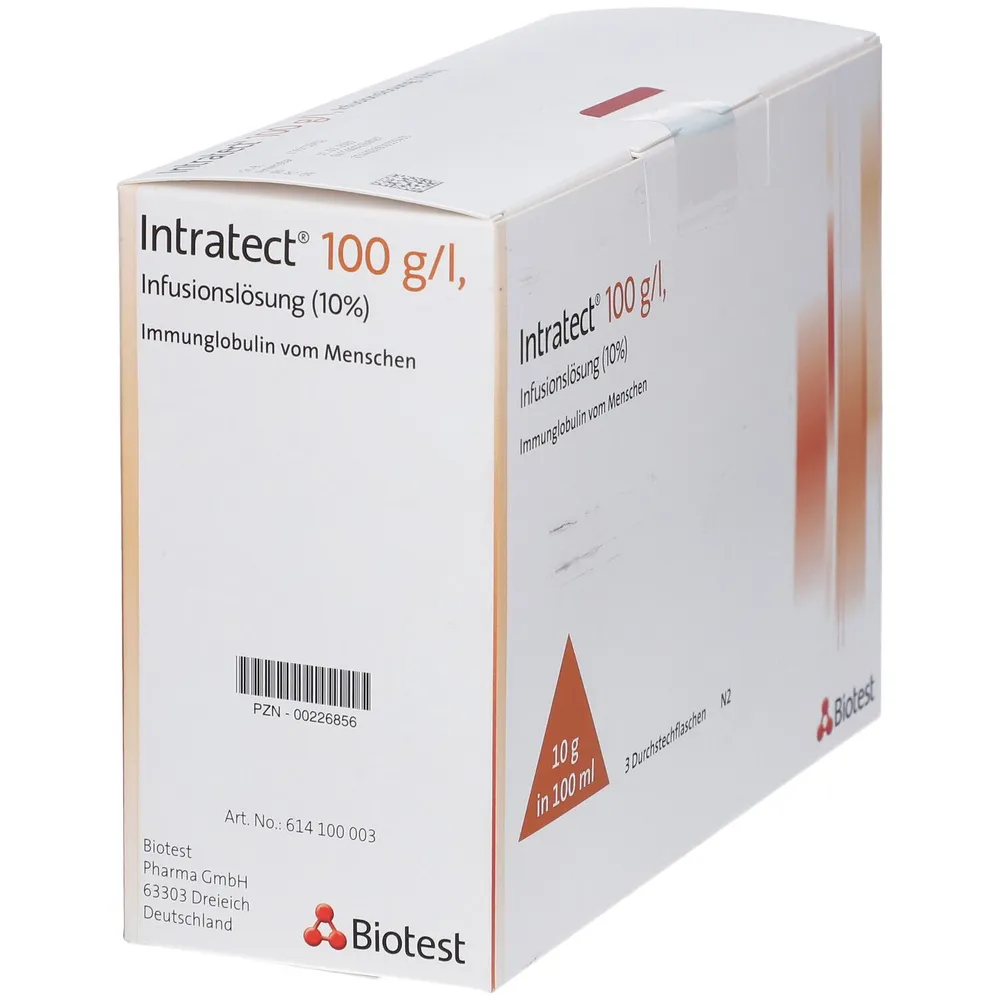
Table of Contents
- Package leaflet: Information for the user
- Introduction
- 1. What Intratect 100 g/l is and what it is used for
- 2. What you need to know before using Intratect 100 g/l
- 3. How to use Intratect 100 g/l
- 4. Possible adverse effects
- 5. Storage of Intratect 100 g/l
- 6. Contents of the pack and other information
Package leaflet: Information for the user
Introduction
Package leaflet: information for the user
Intratect 100 g/l solution for infusion
Normal human immunoglobulin (IgIV)
Read all of this leaflet carefully before you start using this medicine, because it contains important information for you.
- Keep this leaflet. You may need to read it again.
- If you have any questions, ask your doctor, pharmacist or nurse.
- If you experience any side effects, talk to your doctor, pharmacist or nurse, even if it is a side effect not listed in this leaflet. See section 4.
Contents of this leaflet
- What Intratect 100 g/l is and what it is used for
- What you need to know before using Intratect 100 g/l
- How to use Intratect 100 g/l
- Possible side effects
- How to store Intratect 100 g/l
- Contents of the pack and other information
1. What Intratect 100 g/l is and what it is used for
Intratect 100 g/l is a human blood extract containing antibodies (the body's own defense substances) against diseases, presented as a solution for intravenous infusion. The solution is ready for intravenous infusion ("drip").
Intratect 100 g/l contains normal human immunoglobulin (antibodies) obtained from blood donated by a large group of the population, and is highly likely to contain antibodies against the most common infectious diseases. Appropriate doses of Intratect 100 g/l help restore blood levels of immunoglobulin G (IgG) to normal when they are reduced.
Intratect 100 g/l is administered to adults, children, and adolescents (0–18 years) who do not have sufficient antibodies (replacement therapy) in cases of:
- patients born with a lack of antibodies (primary immunodeficiency syndrome, PIS)
- acquired lack of antibodies (secondary immunodeficiency syndrome, SIS) in patients with severe or recurrent infections and ineffective antibiotic treatment, with demonstrated specific antibody deficiency or low IgG levels (< 4 g/l)
Intratect 100 g/l is also used in adults, children, and adolescents (0–18 years) to treat inflammatory diseases (immunomodulation), such as:
- primary immune thrombocytopenia (ITP, in which the patient has low platelet counts in the blood), if the patient is about to undergo surgery or is at risk of bleeding
- Guillain-Barré syndrome (a disease that damages the nerves and may cause paralysis)
- Kawasaki disease (a childhood illness causing inflammation of various body organs and enlargement of the heart arteries), in combination with acetylsalicylic acid
- chronic inflammatory demyelinating polyneuropathy (CIDP). A chronic disease characterized by inflammation of the peripheral nerves, causing muscle weakness and/or numbness, primarily in the legs and upper extremities.
- multifocal motor neuropathy (MMN). A rare disease characterized by slowly progressive, asymmetric weakness of the limbs, without sensory loss.
2. What you need to know before using Intratect 100 g/l
Do not use Intratect 100 g/l:
- if you are allergic to human immunoglobulin or to any of the other components of this medicine (listed in section 6).
- if you have immunoglobulin A deficiency, particularly if you have antibodies against immunoglobulin A in your blood, as this may lead to anaphylaxis.
Warnings and precautions
Consult your doctor, pharmacist, or nurse before starting treatment with Intratect 100 g/l
- if you have never received this medicine before or if a long time (e.g., several weeks) has passed since your last dose (close monitoring will be required during infusion and for up to one hour after completion)
- if you have recently received Intratect 100 g/l (monitoring will be required during infusion and for at least 20 minutes after completion)
- if you have an active infection or underlying chronic inflammation
- if you have previously experienced a reaction to other antibodies (in rare cases, you may be at risk of an allergic reaction)
- if you have or have had kidney disease
- if you have received medications that may damage your kidneys (if kidney function worsens, treatment with Intratect 100 g/l may need to be discontinued)
Special caution will be taken by your doctor if you are overweight, elderly, have diabetes, suffer from low blood volume (hypovolemia), have abnormally thick blood (elevated blood viscosity), are bedridden or have been immobile for some time (immobilization), or have vascular disorders or other risk factors for thrombotic events (blood clots).
Remember: Reactions
During the infusion of Intratect 100 g/l, you will be closely monitored for any reactions (e.g., anaphylaxis). Your doctor will ensure that the infusion rate of Intratect 100 g/l is appropriate for your condition.
If you experience any of the following signs of a reaction—headache, flushing, chills, muscle pain, wheezing, rapid heartbeat, back pain, nausea, or low blood pressure—inform your doctor immediately. The infusion rate may be reduced or the infusion stopped completely.
After infusion of Intratect 100 g/l, you may experience a low white blood cell count (neutropenia), which resolves spontaneously within 7 to 14 days. If you are unsure about symptoms, consult your doctor.
In very rare cases, transfusion-related acute lung injury (TRALI) may occur after receiving immunoglobulins. This causes fluid accumulation unrelated to heart function in the air spaces of the lungs (non-cardiogenic pulmonary edema). You may experience severe difficulty breathing (respiratory distress), rapid breathing (tachypnea), abnormally low oxygen levels in the blood (hypoxia), and increased body temperature (fever). Symptoms typically appear between 1 and 6 hours after treatment. Inform your doctor immediately if you notice these reactions during infusion of Intratect 100 g/l; the infusion will be stopped immediately.
Information on transmission of infectious agents
Intratect 100 g/l is prepared from human plasma (the liquid part of blood). When medicines derived from human plasma or blood are administered, certain measures must be taken to prevent transmission of infections to patients. These measures include careful donor selection to exclude those at risk of carrying infectious diseases, testing for specific infection markers in individual donations and plasma pools, and inclusion of manufacturing steps to inactivate or remove viruses. Nevertheless, despite these measures, the possibility of transmitting infectious agents cannot be completely ruled out when administering medicines derived from human blood or plasma. This also applies to emerging or unknown viruses and other types of infections.
These measures are considered effective against enveloped viruses such as human immunodeficiency virus (HIV), hepatitis B virus, and hepatitis C virus.
The measures taken may have limited effectiveness against non-enveloped viruses, such as hepatitis A virus and parvovirus B19.
Immunoglobulins have not been associated with transmission of infections by hepatitis A virus or parvovirus B19, possibly due to the protective effect of antibodies against these infections present in the medicine.
It is strongly recommended that each time your doctor administers a dose of Intratect 100 g/l, they record the name of the product and its batch number. The batch number provides information about the specific starting materials used for your medicine. If necessary, this allows a link to be established between you and the materials used.
Use of Intratect 100 g/l with other medicines
Inform your doctor if you are taking, have recently taken, or might need to take any other medicines.
Intratect 100 g/l may reduce the effectiveness of certain vaccines, such as:
- measles vaccine
- rubella vaccine
- mumps vaccine
- varicella vaccine
You may need to wait up to three months before receiving certain vaccines or up to one year before receiving the measles vaccine.
Avoid concomitant use of loop diuretics with Intratect 100 g/l.
Effects on blood tests
Intratect 100 g/l may affect blood test results. If you undergo a blood test after receiving Intratect 100 g/l, inform the person drawing your blood or your doctor that you have received Intratect 100 g/l.
Pregnancy and breastfeeding
If you are pregnant, breastfeeding, think you may be pregnant, or plan to become pregnant, consult your doctor before using this medicine.
Your doctor will decide whether you can use Intratect 100 g/l during pregnancy or breastfeeding.
Driving and using machines
The effect of Intratect 100 g/l on the ability to drive and operate machinery is minor. Patients who experience adverse reactions during treatment should wait until these have resolved before driving or operating machinery.
3. How to use Intratect 100 g/l
Intratect 100 g/l is intended for intravenous administration (infusion into a vein) by a physician or nursing staff. The dose will depend on your condition and body weight. Your doctor will determine the exact amount to administer.
At the beginning of the infusion, you will receive Intratect 100 g/l at a slow rate. Afterwards, your doctor may gradually increase the infusion rate.
The infusion rate and frequency will depend on the reason for which you are receiving Intratect 100 g/l.
The medicine should be brought to room or body temperature before use.
Use in children and adolescents
The dosage in children and adolescents (0–18 years) is not different from that in adults, as the dosage for each indication is calculated based on body weight and adjusted according to the clinical response to the aforementioned conditions.
For replacement therapy in patients with a weakened immune system (primary or secondary immunodeficiency), the infusion is administered every 3 to 4 weeks.
For the treatment of inflammatory diseases (immunomodulation), the infusion may be administered as follows:
- Primary immune thrombocytopenia: for treatment of an acute episode, an infusion is given on Day 1; this dose may be repeated once after 3 days. Alternatively, a lower dose may be administered daily for 2 to 5 days.
- Guillain-Barré syndrome: the infusion is administered over 5 days.
- Kawasaki disease: the infusion is given as a single dose in combination with acetylsalicylic acid.
- Chronic inflammatory demyelinating polyneuropathy and multifocal motor neuropathy: the treatment effect should be evaluated after each administration cycle.
If you receive more Intratect 100 g/l than you should
Overdose may cause fluid overload and increased blood viscosity, especially in children, elderly patients, or those with impaired heart or kidney function. Make sure to drink sufficient fluids to avoid dehydration and inform your doctor of any medical problems. If you think you have received too much Intratect 100 g/l, inform your doctor, who will decide whether the infusion should be stopped and alternative treatment initiated.
In case of overdose or accidental ingestion, call the Toxicology Information Service immediately at 915620420.
If you miss an infusion
Intratect 100 g/l is administered in a hospital setting by a doctor or nurse, so it is unlikely that an infusion will be missed. However, if you believe an infusion has been missed, inform your doctor.
If you have any further questions about the use of this medicine, ask your doctor or nurse.
4. Possible adverse effects
Like all medicines, this medicine can cause adverse effects, although not everyone will experience them.
The frequencies indicated below are generally based on the number of patients treated, unless otherwise specified (e.g., number of infusions).
If you notice any of these effects, inform your doctor immediately:
- rash,
- itching,
- wheezing in the chest,
- difficulty breathing,
- swelling of the eyelids, face, lips, throat, or tongue,
- extremely low blood pressure with symptoms such as dizziness, confusion, fainting, rapid pulse
These could be signs of an allergic reaction or a severe allergic reaction (anaphylactic shock), or a hypersensitivity reaction.
The following adverse effects have been reported in clinical trials with Intratect 100 g/l:
Frequent ( may occur in up to 1 in 10 infusions):
- arrhythmia (palpitations)
- malaise
- infusion-related reaction
- headache
- joint pain
- back pain
- bone pain
Uncommon ( may occur in up to 1 in 100 infusions):
- hypersensitivity
- fatigue
- chills
- hypothermia
- sensory disturbance
- muscle pain
- skin pain
- rash
- excessive blood flow to organs or tissues
- high blood pressure
- diarrhea
- abdominal pain
The following adverse effects have been reported spontaneously with Intratect:
Adverse effects with unknown frequency (frequency cannot be estimated from available data):
- severe chest pain or tightness (angina pectoris)
- shivering or trembling (chills)
- shock (anaphylactic), allergic reaction
- difficulty breathing (dyspnea)
- low blood pressure
- back pain
- decrease in the number of white blood cells (leukopenia)
Human immunoglobulin preparations in general may cause the following adverse effects (in decreasing frequency):
- chills, headache, dizziness, fever, vomiting, allergic reactions, nausea, joint pain, low blood pressure, and moderate backache
- reduction in the number of red blood cells due to their destruction in blood vessels (hemolytic reactions [reversible]) and (rarely) hemolytic anemia requiring blood transfusion
- (rarely) sudden drop in blood pressure and, in isolated cases, anaphylactic shock
- (rarely) transient skin reactions (including cutaneous lupus erythematosus, frequency not known)
- (very rarely) thromboembolic reactions such as heart attack (myocardial infarction), stroke, blood clots in the blood vessels of the lungs (pulmonary embolism), clots in a vein (deep vein thrombosis)
- cases of acute transient inflammation of the protective membranes covering the brain and spinal cord (aseptic meningitis)
- cases of blood test results indicating kidney dysfunction and/or sudden kidney failure
- transfusion-related acute lung injury (TRALI), see also section "Warnings and precautions"
If any adverse effect occurs, the infusion rate will be reduced or the infusion will be stopped.
Reporting of adverse effects
If you experience any adverse effect, talk to your doctor, pharmacist, or nurse, even if it is a possible adverse effect not listed in this leaflet. You can also report them directly via the Spanish Pharmacovigilance System for Human Medicines: https://www.notificaram.es. By reporting adverse effects, you can help provide more information on the safety of this medicine.
5. Storage of Intratect 100 g/l
Keep this medicine out of the sight and reach of children.
Do not use this medicine after the expiry date stated on the label and the carton after EXP.
It is recommended to use immediately after first opening.
Do not store above 25°C. Do not freeze. Keep the vial in the outer packaging to protect from light.
Do not use this medicine if the solution is cloudy or contains deposits.
Medicines should not be disposed of via wastewater or household waste. Ask your pharmacist how to dispose of medicines and packaging that you no longer need. This will help protect the environment.
6. Contents of the pack and other information
Composition of Intratect 100 g/l
- The active substance in Intratect 100 g/l is human immunoglobulin for intravenous administration. Intratect 100 g/l contains 100 g/l of normal immunoglobulin, of which at least 96% is immunoglobulin G (IgG). The IgG subclass distribution is approximately 57% IgG1, 37% IgG2, 3% IgG3 and 3% IgG4. The maximum content of immunoglobulin A (IgA) is 1800 micrograms/ml.
- The other components are: glycine and water for injections.
Appearance of the product and contents of the pack
Intratect 100 g/l is a solution for infusion. The solution is transparent or slightly opalescent (milky, opal-like appearance) and colourless or pale yellow.
10 ml, 25 ml, 50 ml, 100 ml or 200 ml of solution in a vial (Type II glass) with a stopper (bromobutyl rubber) and an aluminium seal.
Pack sizes of 1 vial containing 10 ml, 25 ml, 50 ml, 100 ml or 200 ml of solution.
Pack sizes of 3 vials containing 100 ml or 200 ml of solution.
Only certain pack sizes may be marketed.
Marketing Authorisation Holder and Manufacturer
Biotest Pharma GmbH
Landsteinerstrasse 5
63303 Dreieich
Germany
Tel.: +49 6103 801-0
Fax: +49 6103 801-150
Email: [email protected]
For further information about this medicinal product, please contact the local representative of the Marketing Authorisation Holder:
Grifols Movaco, S.A.
Can Guasc, s/n – Parets del Vallès
08150 Barcelona
Spain
Date of the latest revision of this leaflet: 05/2023
Detailed and up-to-date information on this medicinal product is available on the website of the Spanish Agency of Medicines and Health Products (AEMPS) http://www.aemps.gob.es/
This information is intended for healthcare professionals only:
Special precautions
Infusion-related reactions
Some severe adverse reactions (e.g. headache, flushing, chills, myalgia, chest tightness [wheezing], tachycardia, back pain, nausea and hypotension) may be related to the infusion rate. The recommended infusion rate must be respected. The patient should be closely monitored and carefully observed for any symptoms arising during the infusion.
Administration of intravenous immunoglobulin (IVIG) requires in all cases:
- adequate hydration prior to starting IVIG infusion,
- monitoring of diuresis,
- monitoring of serum creatinine levels,
- avoidance of concomitant use of loop diuretics.
It is strongly recommended that each time Intratect is administered to a patient, the patient's name and the product batch number are recorded.
In case of shock, standard medical guidelines for shock treatment should be followed.
Aseptic Meningitis Syndrome (AMS)
AMS has been reported in association with IVIG treatment.
The syndrome usually begins several hours to 2 days after IVIG treatment. Cerebrospinal fluid (CSF) studies are frequently positive, showing pleocytosis of up to several thousand cells per mm³, predominantly granulocytic, and elevated protein levels up to several hundred mg/dl.
AMS may occur more frequently in association with high-dose IVIG treatments (2 g/kg).
Patients presenting with these signs and symptoms should undergo a thorough neurological examination, including cerebrospinal fluid (CSF) studies, to exclude other causes of meningitis.
Discontinuation of IVIG treatment has resulted in resolution of AMS within several days without sequelae.
Hemolytic anemia
IVIG products may contain antibodies against blood groups that could act as hemolysins and induce in vivo coating of red blood cells with immunoglobulin, leading to a positive direct antiglobulin test (Coombs test) and, rarely, hemolysis. Hemolytic anemia may develop after IVIG treatment due to increased red blood cell sequestration. Clinical signs and symptoms of hemolysis should be monitored in recipients of IVIG.
Dosage
The dose and dosage regimen depend on the indication.
The dose should be individualized for each patient according to clinical response. Body weight-based dosing should be adjusted in patients with low body weight or obesity.
The following dosage regimens are provided as guidance:
Replacement therapy in primary immunodeficiency syndromes:
The dosage regimen should aim to achieve a trough IgG level (measured just before the next infusion) of at least 6 g/l or within the normal reference range for the patient's age group. It takes 3–6 months of treatment to reach steady-state (equilibrium) IgG levels. The recommended initial dose is 0.4–0.8 g/kg as a single infusion, followed by at least 0.2 g/kg every 3–4 weeks.
The dose required to achieve a trough IgG level of 6 g/l is approximately 0.2–0.8 g/kg/month. Once steady-state is achieved, the dosing interval typically ranges from 3 to 4 weeks.
Trough IgG levels should be measured and evaluated together with the incidence of infection. To reduce the rate of bacterial infections, it may be necessary to increase the dose and target higher trough levels.
Replacement therapy in secondary immunodeficiencies:
The recommended dose is 0.2–0.4 g/kg every three to four weeks.
Trough IgG levels should be measured and evaluated together with the incidence of infection. The dose should be adjusted as necessary to achieve optimal protection against infections; in patients with persistent infection, dose escalation may be required; if the patient remains infection-free, dose reduction may be considered.
Immunomodulation in:
Primary immune thrombocytopenia: Two alternative treatment regimens are available:
- 0.8–1 g/kg on Day 1; this dose may be repeated once within the following three days,
- 0.4 g/kg administered daily for 2–5 days.
Treatment may be repeated in case of relapse.
Guillain-Barré syndrome:
0.4 g/kg/day for 5 days (administration may be repeated in case of relapse).
Kawasaki disease:
2.0 g/kg should be administered as a single dose. Patients must receive concomitant treatment with acetylsalicylic acid.
Chronic inflammatory demyelinating polyneuropathy (CIDP):
Initial dose: 2 g/kg administered over 2–5 consecutive days
Maintenance dose: 1 g/kg administered over 1–2 consecutive days every 3 weeks.
The effect of treatment should be evaluated after each cycle; treatment should be discontinued if no effect is observed after 6 months.
If treatment is effective, physicians should decide on long-term therapy based on the patient's response and maintenance response. Doses and intervals should be adjusted according to the individual course of the disease.
Multifocal motor neuropathy (MMN):
Initial dose: 2 g/kg administered over 2–5 consecutive days
Maintenance dose: 1 g/kg every 2 to 4 weeks, or 2 g/kg every 4 to 8 weeks.
The effect of treatment should be evaluated after each cycle; treatment should be discontinued if no effect is observed after 6 months.
If treatment is effective, physicians should decide on long-term therapy based on the patient's response and maintenance response. Doses and intervals should be adjusted according to the individual course of the disease.
The dosage recommendations are summarized in the following table:
Indication | Dose | Frequency of infusions |
Replacement therapy | ||
Primary immunodeficiency syndromes | Initial dose: | |
Maintenance dose: | every 3–4 weeks | |
Secondary immunodeficiencies (as defined in the indication section) | 0.2–0.4 g/kg | every 3–4 weeks |
Immunomodulation: | ||
Primary immune thrombocytopenia | 0.8–1 g/kg | on day 1, possibly repeated once after three days |
or | ||
0.4 g/kg/day | for 2–5 days | |
Guillain-Barré syndrome | 0.4 g/kg/day | for 5 days |
Kawasaki disease | 2 g/kg | as a single dose in combination with acetylsalicylic acid |
Chronic inflammatory demyelinating polyradiculoneuropathy (CIDP) | Initial dose: | divided over 2–5 days |
Maintenance dose: | every 3 weeks, divided over 1–2 days | |
Multifocal motor neuropathy (MMN) | Initial dose: | divided over 2–5 consecutive days |
Maintenance dose: | every 2–4 weeks | |
or | or | |
2 g/kg | every 4–8 weeks, divided over 2–5 days |
Pediatric population
The dosage in children and adolescents (0–18 years) is not different from that in adults, since the dosage for each indication is calculated according to body weight and must be adjusted according to the clinical outcome of the aforementioned diseases.
Method of administration
Intravenous route
Intratect 100 g/l must be administered by intravenous infusion at an initial rate not exceeding 0.3 ml/kg/hour for 30 minutes. See "Warnings and precautions". If an adverse reaction occurs, the infusion rate must be reduced or the infusion stopped. If well tolerated, the infusion rate may be gradually increased up to a maximum of 1.9 ml/kg/hour.
Replacement therapy:
In patients who have well tolerated an infusion rate of 1.9 ml/kg/h, the rate may be gradually increased up to 6 ml/kg/h; and if tolerance continues, further increased up to a maximum of 8 ml/kg/h.
In general, the dose and infusion rates must be individually adjusted according to the patient's needs.
Incompatibilities
In the absence of compatibility studies, this medicinal product must not be mixed with any other medicinal product or with any other IgIV product.