Sterillium
Ukraine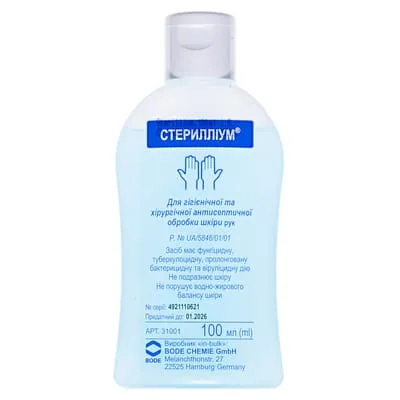
Instructions for Use
INSTRUCTIONS FOR MEDICAL USE OF THE MEDICINAL PRODUCT STEGERILLUM® (STERILLIUM®)
Composition:
Active substances: 100 g of solution contains: 2-propanol – 45 g, 1-propanol – 30 g, mecetronium ethylsulfate – 0.2 g;
Excipients: myristyl alcohol, glycerol (85%), flavoring agent "Oraniy PH 799867", patented blue dye V (85%) E 131, purified water.
Pharmaceutical form.
Topical solution.
Main physicochemical properties: clear, light-blue solution with a fresh alcoholic odor; density at 20 °C — 0.847–0.855 g/cm³; refractive index n20/D — 1.376–1.381.
Pharmacotherapeutic group.
Antiseptics and disinfectants.
ATC code D08AX53.
Pharmacological properties.
Pharmacodynamics.
The product is intended for topical use.
Mechanism of action.
Sterillium® alters the permeability of the cytoplasmic membrane in microorganisms, causes protein coagulation, and inactivates enzymes.
Microbiological efficacy.
In vitro and in vivo studies have shown that Sterillium® is active against a range of common bacteria and fungal pathogens, and has virucidal activity against enveloped viruses (including human immunodeficiency virus [HIV], hepatitis B and C viruses [HBV, HCV]), as well as a limited spectrum of virucidal activity (adeno-, noro-, and rotaviruses). Within 30 seconds, Sterillium® reduces transient skin flora by more than 99.99% (hygienic hand antisepsis), and within 1.5 minutes also reduces resident skin flora (surgical hand antisepsis).
Information on microbiological efficacy
| Application and antimicrobial activity |
Application time (minimum) |
| Hygienic hand antisepsis (EN 1500; VAH) |
30 seconds |
| Surgical hand antisepsis (EN 12791; VAH) |
1.5 minutes |
| Antisepsis of skin with low sebaceous gland activity (according to DGHM method [German Society for Hygiene and Microbiology]): |
|
| before puncture and injection |
15 seconds |
| before joint, body cavity and hollow organ punctures, as well as surgical procedures |
1 minute |
| Antisepsis of skin with high sebaceous gland activity (according to DGHM method): |
|
| before puncture and injection |
10 minutes |
| before joint, body cavity and hollow organ punctures, as well as surgical procedures |
10 minutes |
| Bactericidal activity (EN 1040) |
30 seconds |
| Fungicidal activity (EN 1275) |
30 seconds |
| Mycobactericidal activity (EN 14348) |
30 seconds |
| Virucidal activity against enveloped viruses (EN 14476) |
30 seconds |
| Limited virucidal activity (EN 14476) |
1 minute |
Pharmacokinetics.
The skin absorption of all components of the medicinal product Sterillum® has not been studied. Recent studies in rats have shown negligible skin absorption of ethylsulfate mecidonium.
Clinical characteristics
Indications.
Hygienic and surgical antiseptic treatment of hands. Antiseptic treatment of the skin prior to injections, punctures, blood collection, and vaccinations.
Contraindications. Hypersensitivity to the components of the product.
Do not use for antiseptic treatment of mucous membranes, open wounds, or areas around the eyes.
Interaction with other medicinal products and other forms of interaction. Not established.
Special precautions for use.
Avoid contact with eyes.
In case of contact with eyes, rinse thoroughly by holding the eyelids open for several minutes under gently running water.
If contact lenses are worn, remove them if this can be done easily. Continue rinsing eyes with copious amounts of water, including under the eyelids, for at least 10 minutes. If irritation persists, seek medical advice.
Do not transfer Sterillium® from one bottle to another, as this may lead to contamination of the product. If transfer cannot be avoided, the procedure must be performed under sterile conditions (e.g., using sterile containers under a laminar flow hood).
Do not use electrical appliances until the skin treated with the medicinal product is completely dry.
Avoid contact with open flames.
Do not use near sources of ignition. The product is flammable — flash point is 23 °C. Observe safety precautions when handling alcohol-containing preparations.
When used according to recommendations, fire or explosion is unlikely.
In case of spillage, take the following measures: immediately collect the spilled liquid, dilute with large amounts of water, ventilate the area, and eliminate sources of ignition. Do not smoke.
In case of fire, extinguish using water, fire extinguishers (dry powder, foam, or carbon dioxide).
Use during pregnancy or breastfeeding.
The risks associated with using the medicinal product during pregnancy or breastfeeding are unknown.
Ability to affect reaction speed when driving or operating machinery.
No warnings apply.
Method of administration and dosage.
For external use only, applied by rubbing into dry skin. Can be used anywhere, even in the absence of sinks or water. It is recommended to dispense Sterillium® using a dosing device. Available dispensing systems allow for contact-free dispensing of Sterillium®. Dispensers can be installed independently of the presence of sinks or washbasins, in any location where hygienic antiseptic treatment of the hands is required. Sterillium® should be used undiluted.
Hygienic antiseptic treatment of the skin of the hands is directed against transient microflora of the hands without disrupting resident microflora.
Procedure for hygienic antiseptic treatment of the skin of the hands
|
|
|
|
Take at least 3 ml (2 × 1.5 ml) of Sterillium® antiseptic directly from the plastic bottle or using a dispenser by pressing the lever with the elbow into the hollow of the dry palm. Thoroughly distribute it over the entire surface of the skin of hands and wrists. Rub in the antiseptic vigorously for 30 seconds according to the standard method (see Figure 1). |
|
|
Ensure that hands remain moist with the product throughout the entire application time; add a new portion of Sterillium® antiseptic if necessary. Do not rinse off. |


- In case of minor contamination of hands – thoroughly remove contamination with a single-use wipe moistened with Sterillium® solution, then treat hands with the antiseptic agent Sterillium® according to the standard procedure (see Figure 1).
- In case of heavy contamination of hands with secretions, discharges, or blood – first wash hands with water, then with regular soap or antimicrobial soap, avoiding splashing and contamination of clothing (e.g., in case of blood contamination). Dry hands thoroughly using a lint-free disposable towel. Afterwards, treat hands with an antiseptic according to the standard procedure (see Figure 1). If necessary, disinfect the contaminated area and put on clean protective clothing.
The sequence of stages for antiseptic application during hygienic hand disinfection, according to the European standard EN 1500, is shown in Figure 1.
Figure 1.
Standard method of antiseptic application for hygienic hand disinfection according to EN 1500.
|
|
|
|
|
|
|
|
The final portion of antiseptic must be rubbed in until the skin is dry. The entire procedure requires at least 6 ml (2 × 3 ml) of the product. Do not rinse off. |
| CAUTION! Do not wear gloves on hands still wet with antiseptic; wait until the skin is completely dry. |


Skin antisepsis. Perform skin antisepsis prior to injections, body cavity punctures, hollow organ punctures, and surgical procedures.
Antisepsis of skin with low sebaceous gland density (according to DGHM method):
- before puncture and injection — 15 seconds;
- before joint, body cavity, and hollow organ punctures, as well as surgical procedures — 1 minute.
Antisepsis of skin with high sebaceous gland density (according to DGHM method):
- before puncture and injection — 10 minutes;
- before joint, body cavity, and hollow organ punctures, as well as surgical procedures — 10 minutes.
Children.
No studies are available regarding use in children. The medicinal product must not be used in children.
Overdose.
In case of accidental ingestion, the main symptoms of intoxication are similar to those following ethanol ingestion. There is a risk of respiratory arrest.
At 3–4‰ and above: elimination of secondary symptoms of poisoning by hemodialysis.
Side effects.
Rarely, mild dryness or irritation of the skin may occur. In such cases, enhanced general skin care is recommended. The frequency of allergic reactions is rare.
If accidentally ingested, alcohol poisoning is possible — rinse the mouth with drinking water and have the person drink several glasses of water. If the product gets into the eyes, irritation of the eye mucous membrane may occur — rinse eyes thoroughly with running water for several minutes and seek immediate medical attention.
In case of any adverse effects, consult a physician or pharmacist.
Reporting of adverse reactions after drug registration is highly important. It enables continuous monitoring of the benefit-risk balance of the medicinal product. Medical and pharmaceutical professionals, as well as patients or their legal representatives, should report all suspected adverse reactions and lack of efficacy via the Automated Pharmacovigilance Information System at: https://aisf.dec.gov.ua.
Shelf life. 5 years.
Storage conditions.
Store at temperatures not exceeding 25 °C. Keep out of reach of children.
Incompatibility.
Sterillium® dissolves acrylic glass and similar materials.
Packaging.
100 ml, 500 ml, 1000 ml in bottles; 5 L in canisters.
Availability. Over-the-counter.
Manufacturer/Applicant.
Bode Chemie GmbH, Germany.
www.bode-chemie.com.
Address of manufacturer and location of its business activity/applicant's address.
Melanchthonstrasse 27, 22525 Hamburg, Germany.
Exclusive importer of Bode Chemie GmbH (Germany) products into Ukraine – LLC "NVP "VILAN", 03151, Kyiv, Aerodromna St., 12-A,
tel. (044) 249-04-40, fax: (044) 246-17-43.
Frequently Asked Questions
What is Sterillium indicated for?
The product is used for hygienic and surgical antiseptic treatment of the skin of the hands, as well as for antiseptic treatment of the skin before injections, punctures, blood sampling, or vaccinations.
How to correctly use Sterillium for hand treatment?
The product is applied to dry skin and rubbed in. For hygienic hand treatment, at least 3 ml of the solution must be taken and rubbed in vigorously for 30 seconds. For surgical hand treatment, at least 6 ml of the product must be used and rubbed in for 1.5 minutes.
Are there any contraindications?
The product must not be used in case of hypersensitivity to its components. It is also prohibited to apply it to mucous membranes, open wounds, and areas around the eyes.
What are the possible side effects of Sterillium?
Irritation or slight skin dryness, as well as rare allergic reactions, may occur infrequently. If contact with eyes occurs, irritation of the mucous membrane is possible.
What should be done if the product gets into the eyes or is swallowed?
If contact with the eyes occurs, they should be rinsed with running water for several minutes (if wearing contact lenses, remove them) and a doctor should be consulted. If the product is accidentally swallowed, the oral cavity should be rinsed with water and several glasses of water should be drunk due to the risk of alcohol poisoning.
Can this product be used by children?
Studies regarding the use of the product in children are unavailable; therefore, its use in children is not recommended.
Similar Medications
-
Hospisept
Form: solution, topical
Active substance Dosage 1-propanol 55 g ethanol 15 g Manufacturer: A.F.P. Antiseptica Forschung und Produktionsgesellschaft GmbH, Germany under license from Lysophorm Dr. Hans Rosemann GmbH
-
Sterillium
Form: solution, topical
Active substance Dosage 2-propanol 45 g/100 g 1-propanol 30 g/100 g mecetronium ethylsulfate 0.2 g/100 g Manufacturer: VILAN LLC (packaging of 'in bulk' from BODE Chemie GmbH, Germany)
This page has been machine-translated and may contain inaccuracies. The original data is available in the manufacturing country's language.
Last data check: July 21, 2026 · Data source: Державний реєстр лікарських засобів України