Rotarix vaccine for prophylaxis of rotavirus infection
Ukraine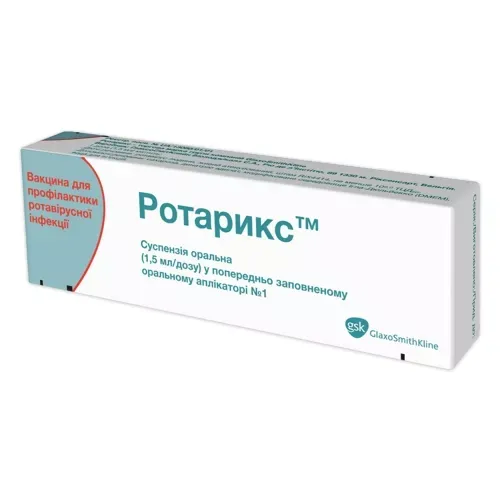
Table of Contents
INSTRUCTION FOR MEDICINAL USE OF THE MEDICINAL PRODUCT ROTARIX VACCINE FOR THE PREVENTION OF ROTAVIRUS INFECTION
Composition:
Active substance: 1 dose (1.5 ml) contains not less than 10^6.0 TCID50 of human rotavirus, live attenuated strain RIX4414*;
Excipients: sucrose (1.073 g), disodium adipate (132.74 mg), modified Eagle's medium (DMEM) (2.26 mg), water for injections (up to 1.5 ml).
* Grown on Vero cell culture.
Medicinal form. Oral suspension.
Main physicochemical properties: the vaccine is a clear, colorless liquid.
ROTARIX is a monovalent vaccine for the prevention of rotavirus gastroenteritis, containing live attenuated virus derived from the human rotavirus strain.
ROTARIX complies with the requirements of the World Health Organization (WHO) for biological substances and for vaccines against rotavirus infection.
Pharmacotherapeutic group. Vaccines. Antiviral vaccines. Vaccine for the prevention of rotavirus infection, live attenuated. ATC code J07B N01.
Immunological and biological properties.
Pharmacodynamics
Protective efficacy of the ROTARIX vaccine in the form of a lyophilisate for the preparation of an oral suspension
Clinical studies have demonstrated efficacy against gastroenteritis caused by rotavirus of the most common genotypes G1P[8], G2P[4], G3P[8], G4P[8], and G9P[8], as well as against less common rotavirus genotypes G8P[4] (severe gastroenteritis) and G12P[6] (any gastroenteritis). All these strains circulate worldwide.
Clinical trials assessing the protective efficacy of the ROTARIX vaccine against any, including severe, rotavirus gastroenteritis were conducted in Europe and Latin America, Africa, and Asia.
Severity of gastroenteritis was defined by two different criteria:
- the 20-point Vesikari scale, which evaluates the full clinical picture of rotavirus gastroenteritis, including the severity and duration of diarrhea and vomiting, severity of fever and dehydration, and the need for medical treatment
- or by criteria of the World Health Organization (WHO).
Clinical protection was assessed in the according-to-protocol (ATP) cohort for efficacy, which included all patients from the ATP cohort for safety who were included in the appropriate follow-up period for efficacy assessment.
Protective efficacy of the vaccine based on results of studies conducted in Europe
In a clinical trial conducted in Europe, the efficacy of the ROTARIX vaccine was evaluated using schedules approved in various European countries (2, 3 months; 2, 4 months; 3, 4 months; 3, 5 months) in 4000 patients.
After administration of 2 doses of ROTARIX vaccine, protective efficacy was maintained during the first and second years of life, as shown in the table below.
| 1st year of life ROTARIX N = 2572 Placebo N = 1302 |
2nd year of life ROTARIX N = 2554 Placebo N = 1294 |
|||
| Vaccine efficacy (%) against any and severe rotavirus gastroenteritis [95% CI] |
||||
| Genotype |
Rotavirus gastroenteritis of any severity |
Severe rotavirus gastroenteritis: |
Rotavirus gastroenteritis of any severity |
Severe rotavirus gastroenteritis: |
| G1P[8] |
95.6 [87.9; 98.8] |
96.4 [85.7; 99.6] |
82.7 [67.8; 91.3] |
96.5 [86.2; 99.6] |
| G2P[4] |
62.0* [< 0.0; 94.4] |
74.7* [< 0.0; 99.6] |
57.1 [< 0.0; 82.6] |
89.9 [9.4; 99.8] |
| G3P[8] |
89.9 [9.5; 99.8] |
100 [44.8; 100] |
79.7 [< 0.0; 98.1] |
83.1* [< 0.0; 99.7] |
| G4P[8] |
88.3 [57.5; 97.9] |
100 [64.9; 100] |
69.6* [< 0.0; 95.3] |
87.3 [< 0.0; 99.7] |
| G9P[8] |
75.6 [51.1; 88.5] |
94.7 [77.9; 99.4] |
70.5 [50.7; 82.8] |
76.8 [50.8; 89.7] |
| Strains |
88.2 |
96.5 |
75.7 |
87.5 |
| of genotype P[8] |
[80.8; 93.0] |
[90.6; 99.1] |
[65.0; 83.4] |
[77.8; 93.4] |
| circulating |
87.1 |
95.8 |
71.9 |
85.6 |
| rotavirus strains |
[79.6; 92.1] |
[89.6; 98.7] |
[61.2; 79.8] |
[75.8; 91.9] |
| Vaccine efficacy (%) against rotavirus gastroenteritis requiring medical care [95% CI] |
||||
| circulating |
91.8 |
76.2 |
||
| rotavirus strains |
[84.0; 96.3] |
[63.0; 85.0] |
||
| Vaccine efficacy (%) based on hospitalization rates for rotavirus gastroenteritis [95% CI] |
||||
| circulating |
100 |
92.2 |
||
| rotavirus strains |
[81.8; 100] |
[65.6; 99.1] |
||
† A case of gastroenteritis was considered severe when scored ≥11 on the Vesikari scale.
* Not statistically significant (p ≥ 0.05). These data should be interpreted with caution.
The vaccine efficacy during the first year of life was directly proportional to the increase in disease severity, reaching 100% (95% CI: 84.7; 100) for scores ≥17 on the Vesikari scale.
Vaccine protective efficacy based on studies conducted in Latin America
During a clinical study conducted in Latin America, more than 20,000 patients participated in the evaluation of the ROTARIX vaccine efficacy. The severity of gastroenteritis (GE) was defined according to WHO criteria. Data on vaccine protective efficacy against severe rotavirus (RV) gastroenteritis requiring hospitalization and/or rehydration therapy in healthcare settings, as well as genotype-specific efficacy after administration of 2 doses of Rotarix vaccine, are presented in the table below.
| Genotype |
Severe rotavirus gastroenteritis† (1st year of life) ROTARIX N = 9009 Placebo N = 8,858 |
Severe rotavirus gastroenteritis† (2nd year of life) ROTARIX N = 7175 Placebo N = 7062 |
| Efficacy (%) [95 % CI ] |
Efficacy (%) [95 % CI ] |
|
| All RVGE |
84.7 [71.7; 92.4] |
79.0 [66.4; 87.4] |
| G1P[8]
|
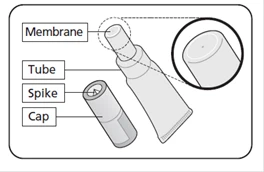
| B Prepare the tube for use
|
|
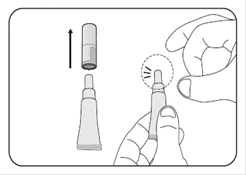
|
|
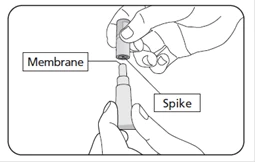
|
|
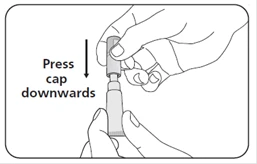
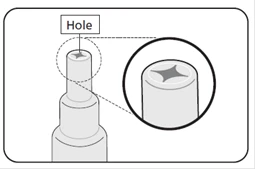
| C Check that the tube is properly opened
|
|
| D Administer the vaccine
If you notice anything unusual, do not use the vaccine.
|
|
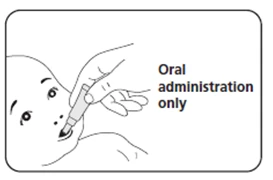
Dispose of the empty tube and protective cap according to local requirements.
Overdose.
There have been some reports of overdose. Overall, the reported adverse reactions were similar to those observed after administration of the recommended dose of ROTARIX vaccine.
Children
ROTARIX vaccine should not be used in children older than 24 weeks of age.
Adverse Reactions
The safety profile described below is based on data from clinical trials conducted with both the lyophilized formulation of ROTARIX vaccine and the ready-to-use oral suspension.
Overall, in 4 clinical studies of the ROTARIX suspension formulation, approximately 1900 infants received about 3800 doses of the vaccine. Data from these studies demonstrated that the safety profile of the vaccine in suspension form is comparable to that of the lyophilized powder formulation.
In total, approximately 106,000 doses of ROTARIX vaccine (in lyophilized powder or suspension form) were administered to approximately 51,000 infants across 23 clinical studies.
In three placebo-controlled clinical trials conducted in Finland, India, and Bangladesh, where ROTARIX was administered alone (with other routine pediatric vaccines administered according to schedule), the frequency and severity of expected symptoms (recorded within 8 days after vaccination)—such as diarrhea, vomiting, loss of appetite, fever, irritability, and cough/runny nose—did not differ significantly between the ROTARIX-vaccinated group and the placebo group. No increase in the frequency or severity of these reactions was observed after administration of the second dose.
Based on a pooled analysis of 17 placebo-controlled clinical trials conducted in Europe, North America, Latin America, Asia, and Africa, including studies where ROTARIX was administered concomitantly with other pediatric vaccines (see section "Interaction with other medicinal products and other forms of interaction"), the following adverse reactions (recorded within 31 days after vaccination) were considered possibly related to vaccination.
Adverse reactions are listed in the table below
According to their frequency of occurrence, adverse reactions are categorized as follows:
Very common (≥ 1/10)
Common (≥ 1/100 to < 1/10)
Uncommon (≥ 1/1,000 to < 1/100)
Rare (≥ 1/10,000 to < 1/1,000)
Very rare (< 1/10,000)
| Organ system class |
Frequency |
Adverse reactions |
| Gastrointestinal system |
Common |
Diarrhea |
| Uncommon |
Abdominal pain, flatulence |
|
| Very rare |
Intussusception (see section "Special warnings and precautions for use") |
|
| Unknown* |
Bloody stools |
|
| Unknown* |
Gastroenteritis with vaccine virus shedding in infants with severe combined immunodeficiency (SCID) |
|
| Skin and subcutaneous tissue |
Uncommon |
Dermatitis |
| Very rare |
Urticaria |
|
| General disorders and administration site conditions |
Common |
Irritability |
| Respiratory, thoracic and mediastinal disorders |
Unknown* |
Apnoea in preterm infants (born ≤ 28 weeks of gestation) (see section "Special warnings and precautions for use") |
* As these events were reported spontaneously, it is not possible to reliably estimate their frequency.
Description of selected adverse reactions
Intussusception
Data from observational safety studies conducted in several countries indicate that rotavirus vaccines are associated with an increased risk of intussusception, predominantly within 7 days following vaccination. In these countries, up to 6 additional cases per 100,000 infants were observed, against a background incidence of 25 to 101 per 100,000 infants (under one year of age) per year, respectively. There is limited evidence of a smaller increased risk after the second dose. It remains unclear whether rotavirus vaccines affect the overall incidence of intussusception over a longer observation period (see section "Special warnings and precautions for use").
Other special population groups
Safety in preterm infants
In a clinical trial, 670 preterm infants with a gestational age from 27 to 36 weeks received ROTARIX as a lyophilisate for oral suspension, and 339 received placebo. The first dose was administered at 6 weeks of age. Serious adverse reactions were observed in 5.1% of patients who received ROTARIX compared to 6.8% of patients who received placebo. Rates of other adverse reactions were similar between patients who received ROTARIX and those who received placebo. No cases of intussusception were reported.
Safety in infants infected with human immunodeficiency virus (HIV)
In a clinical study, 100 HIV-infected infants received ROTARIX as a lyophilisate for oral suspension or placebo. The safety profile was similar between ROTARIX and placebo.
Reporting of suspected adverse reactions
Reporting suspected adverse reactions after a medicinal product is authorized is important. It allows continued monitoring of the benefit-risk balance of the medicinal product. Healthcare and pharmaceutical professionals, as well as patients or their legal representatives, should report all suspected adverse reactions and lack of efficacy through the Automated Pharmacovigilance Information System at the following link: https://aisf.dec.gov.ua.
Additionally, all suspected adverse reactions and lack of efficacy may be reported to GSK Ukraine LLC via the 24-hour hotline (044) 585-51-85 or by email at [email protected].
Shelf life
3 years.
The expiry date of the vaccine is indicated on the label and on the packaging.
Storage conditions
The vaccine should be stored at a temperature of 2 to 8 °C (in a refrigerator). Do not freeze. Store in the original packaging to protect from light. Keep out of the reach of children.
Incompatibilities
When administered, ROTARIX vaccine should not be mixed with other medicinal products.
Packaging
1 dose (1.5 mL) of vaccine in a pre-filled oral applicator made of Type I glass (Ph. Eur.) with protective cap or in a plastic tube with cap.
The oral applicator or tube, together with the package leaflet, is placed in a cardboard box. Pack sizes: 1 or 5 pre-filled oral applicators or tubes per cardboard box.
Prescription category: Prescription only.
Manufacturer: GlaxoSmithKline Biologicals S.A., Belgium / GlaxoSmithKline Biologicals S.A., Belgium.
Manufacturer's address and location of its operations:
Rue de l’Institut, 89, 1330 Rixensart, Belgium / Rue de l’Institut, 89, 1330 Rixensart, Belgium.