Methyluracil with miramistin
Ukraine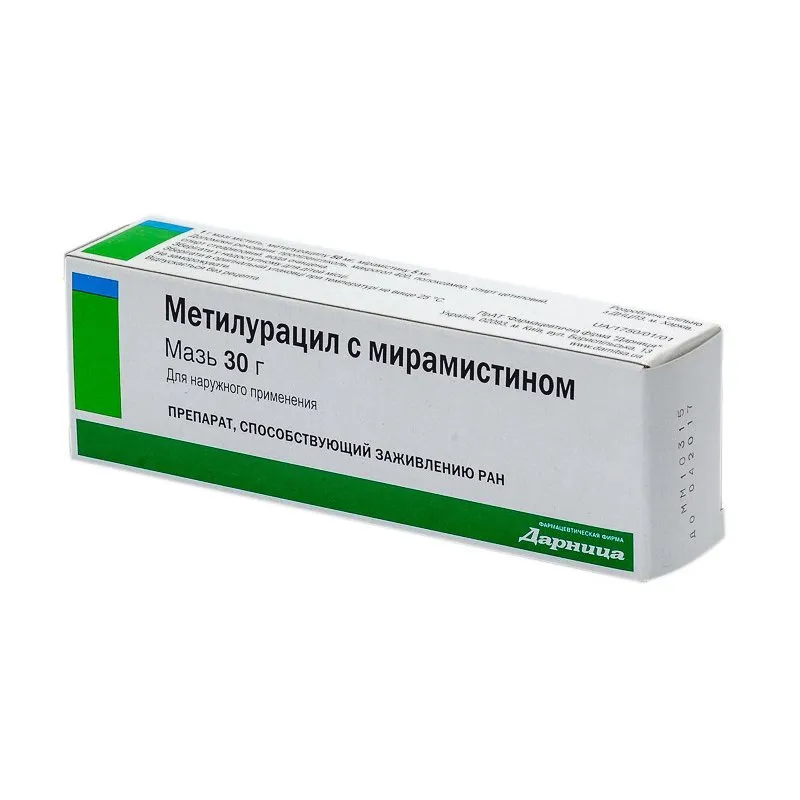
Instructions for Use
INSTRUCTIONS FOR MEDICAL USE OF THE MEDICINAL PRODUCT Methyluracil & Myramistin (Methyluracil & Myramistin)
Composition:
Active substances: methyluracil, myramistin;
1 g of ointment contains: methyluracil 50 mg, myramistin 5 mg;
Excipients: propylene glycol, macrogol 400, poloxamer, cetyl alcohol, stearyl alcohol, purified water.
Pharmaceutical form. Ointment.
Main physicochemical properties: homogeneous white ointment.
Pharmacotherapeutic group.
Medicinal products for the treatment of wounds and ulcers. ATC code D03A X.
Pharmacological properties.
Pharmacodynamics.
The medicinal product contains methyluracil, which stimulates metabolic processes, and miramistin – a cationic antiseptic.
Methyluracil accelerates regeneration, wound healing, stimulates cellular and humoral immunity, and exerts anti-inflammatory effects.
Miramistin has a broad spectrum of antimicrobial activity, including hospital strains resistant to antibiotics. It exerts pronounced antimicrobial activity against Gram-positive (Staphylococcus spp., Streptococcus spp., Streptococcus pneumoniae) and Gram-negative (Pseudomonas aeruginosa, Escherichia coli, Klebsiella spp.), aerobic and anaerobic, spore-forming and non-spore-forming bacteria, both as monocultures and microbial associations, including hospital strains with multidrug resistance to antibiotics. It shows antifungal activity against ascomycetes (genus Aspergillus and genus Penicillium), yeasts (Rhodotorula rubra, Torulopsis gabrata), and yeast-like fungi Candida albicans, Candida tropicalis, Candida krusei, Pityrosporum orbiculare (Malassezia furfur), dermatophytes (Trichophyton rubrum, Trichophyton mentagrophytes, Trichophyton verrucosum, Trichophyton schoenleini, Trichophyton violaceum, Epidermophyton Kaufman-Wolf, Epidermophyton floccosum, Microsporum gypseum, Microsporum canis), as well as other pathogenic fungi, both as monocultures and microbial associations, including fungal microflora resistant to chemotherapeutic agents. Under the influence of miramistin, microbial resistance to antibiotics decreases.
At the site of application, it stimulates protective responses and activates regenerative processes.
Due to its broad antimicrobial spectrum, miramistin effectively prevents infection of wounds and burns. The medicinal product has moderate or low osmotic activity, thereby suppressing wound and perifocal inflammation, absorbing purulent exudate, and selectively dehydrating necrotic tissues, promoting wound cleansing and drying. At the same time, the ointment does not damage granulations or viable skin cells, nor does it inhibit marginal epithelialization.
Pharmacokinetics.
Due to the properties of the ointment base to retain the active substances on the surface of the application site, they are not significantly absorbed into the systemic circulation and usually do not cause systemic effects.
Clinical characteristics.
Indications.
Complicated, poorly healing wounds;
radiation and trophic ulcers (including in patients with diabetic angiopathy, debilitated patients with significant immunosuppression);
burns and other skin injuries.
The medicinal product exerts a photoprotective effect in patients with photodermatoses.
Contraindications.
Hypersensitivity to the active substances or to any other components of the medicinal product;
acute and chronic forms of leukemia; lymphogranulomatosis; malignant diseases of the bone marrow.
Interaction with other medicinal products and other forms of interaction.
When miramistin is used simultaneously with anionic surfactants (surface-active agents) (soap solutions), it becomes inactivated.
When miramistin is used concurrently with systemic or topical antibiotics, decreased microbial resistance to the latter is observed.
When methyluracil is used concomitantly with strophanthin, antibiotics, or sulfonamide drugs, their efficacy is increased, whereas concomitant use with pentoxyl leads to enhanced toxic effects.
When the medicinal product is used simultaneously with topical glucocorticosteroids, its efficacy is reduced.
Special precautions for use.
The medicinal product should be used with caution in patients with neoplasms undergoing radiation therapy or chemotherapy.
The efficacy of the medicinal product increases if it is applied to a wound surface previously cleaned with an antiseptic solution. The presence of purulent-necrotic material in the wound may require additional amounts of the ointment.
In cases of deep infection localization in soft tissues, the medicinal product may be used in combination with systemic antibiotics.
Propylene glycol may cause skin irritation.
Cetyl alcohol and stearyl alcohol may cause local skin reactions (e.g., contact dermatitis).
Use during pregnancy or breastfeeding.
Due to the lack of controlled studies on the safety and efficacy of the medicinal product, it should not be used during pregnancy or breastfeeding.
Ability to affect reaction speed when driving vehicles or operating machinery.
There are no data available regarding the ability of the medicinal product to affect reaction speed when driving vehicles or operating machinery.
Method of Administration and Dosage.
Apply the medicinal product topically. After standard wound and burn treatment, apply the ointment directly to the affected area, then cover with a sterile gauze dressing, or apply the ointment onto the dressing material and then place it on the wound.
Alternatively, use swabs soaked with the medicinal product to carefully fill the cavities of purulent wounds after surgical treatment, or use gauze tampons impregnated with the ointment, inserted into fistulous tracts.
Apply the medicinal product once every 1–2 days. The dosage depends on the size of the wound surface and the degree of purulent exudation. The duration of treatment is determined by the dynamics of wound cleansing and healing. Discontinue treatment with the medicinal product when granulation tissue appears and wounds are cleared of exudate.
Children.
Due to insufficient experience of use, the medicinal product should not be prescribed in pediatric practice.
Overdose.
Cases of overdose have not been observed. However, when applying the medicinal product to large areas of damaged skin, partial entry of the active components of the ointment into the systemic circulation cannot be excluded, although in quantities insufficient to cause acute poisoning. Systemic effects of methyluracil may include headache, dizziness, and hypersensitivity reactions. Miramistin acts as a cationic detergent and may prolong bleeding time. In cases of overdose caused by prolonged application of large amounts of the ointment, changes in blood composition may occur due to the effect of methyluracil on hematopoietic processes.
Treatment: reduce the dose or discontinue the medicinal product, provide symptomatic therapy.
Side effects.
Immune system, skin and subcutaneous tissue disorders: hypersensitivity reactions, including hyperemia, itching, mild burning sensation, rash, urticaria; skin dryness, dermatitis, skin oozing and irritation due to the presence of propylene glycol in the medicinal product.
If any adverse reactions occur, discontinue use of the medicinal product and consult a physician.
Shelf life. 2 years.
Storage conditions.
Keep out of reach of children. Store in the original packaging at a temperature not exceeding 25 °C. Do not freeze.
Packaging.
15 g or 30 g in a tube; 1 tube per carton.
Supply category.
Over-the-counter (without prescription).
Manufacturer.
JSC "Pharmaceutical Company "Darnytsia".
Manufacturer's address and place of business.
13, Boryspylska Street, Kyiv, 02093, Ukraine.
Frequently Asked Questions
What is Methyluracil with miramistin prescribed for?
The ointment is used to treat burns, skin injuries, as well as complex or severe wounds that heal poorly. The drug is also prescribed for radiation and trophic ulcers.
How should Methyluracil with miramistin be used correctly?
The ointment is applied directly to the affected area after it has been treated, followed by the application of a sterile dressing. Ointment-soaked tampons or gauze rolls can also be used to fill wound cavities. The product should be applied once every 1–2 days. Treatment is discontinued once the wound is cleared and begins to heal.
What are the possible side effects of Methyluracil with miramistin?
Hypersensitivity reactions may occur: itching, redness, rash, urticaria, or a burning sensation. Due to the composition of the ointment, irritation, dry skin, or dermatitis may also occur.
Who should not use this drug?
The product should not be used in case of hypersensitivity to its components, as well as in acute or chronic forms of leukemia, lymphogranulomatosis, and malignant diseases of the bone marrow.
Can the ointment be combined with other medicines?
The efficacy of the ointment is reduced when used simultaneously and locally with soap solutions or glucocorticosteroids. When used with antibiotics, miramistin may reduce their stability against microbes, whereas methyluracil, conversely, may increase the efficacy of certain antibiotics and sulfonamides.
Can the product be used by pregnant women or children?
Due to the lack of sufficient studies, it is not recommended to use the drug during pregnancy, breastfeeding, or in pediatric practice (for children).
Similar Medications
-
Acerbin
Form: ointment
Active substance Dosage malic acid 7.0 mg benzoic acid 0.5 mg salicylic acid 0.13 mg Manufacturer: Pharmazeutische Fabrik Montavit GmbH
-
Altanova ointment
Form: ointment
Active substance Dosage altan 20 mg dimethyl sulfoxide 30 mg Manufacturer: PJSC "Scientific and Production Center "Borshchahivskyy Chemical and Pharmaceutical Plant"
-
Calendula ointment
Form: ointment
Active substance Dosage calendula tincture 100 mg Manufacturer: DKP "Pharmaceutical Factory" LLC
-
Calendula ointment
Form: ointment
Active substance Dosage calendula tincture 100 mg Manufacturer: JSC "Lubnipharm"
-
Calendula ointment
Form: ointment
Active substance Dosage calendula tincture 0.1 g Manufacturer: PJSC Pharmaceutical Factory "Viola"
-
Calendula ointment
Form: ointment
Active substance Dosage calendula tincture 0.1 g Manufacturer: PJSC "Fitofarm" (responsible for manufacturing, primary packaging, quality control and batch release)
-
Calendula ointment
Form: ointment
Active substance Dosage calendula tincture 100 mg Manufacturer: Ternofarm LLC
-
Dalmaxin
Form: ointment
Active substance Dosage thiotriazolin 20 mg/g Manufacturer: PJSC "HIMFARMZAVOD "CHERVONA ZIRKA"
-
Levomekol
Form: ointment
Active substance Dosage chloramphenicol 7.5 mg metiluracil 40 mg Manufacturer: PJSC Pharmaceutical Factory "Viola"
-
Levomekol
Form: ointment
Active substance Dosage chloramphenicol 7.5 mg metiluracil 40 mg Manufacturer: Farmak JSC
-
Levomekol
Form: ointment
Active substance Dosage chloramphenicol 7.5 mg metiluracil 40 mg Manufacturer: JSC "Lubnipharm"
-
Levomekol
Form: ointment
Active substance Dosage chloramphenicol 7.5 mg/g metiluracil 40 mg/g Manufacturer: PJSC "Scientific and Production Center "Borshchahivskyy Chemical and Pharmaceutical Plant"
This page has been machine-translated and may contain inaccuracies. The original data is available in the manufacturing country's language.
Last data check: July 21, 2026 · Data source: Державний реєстр лікарських засобів України