Levemir® flexpen®
Ukraine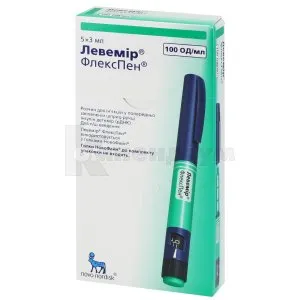
Table of Contents
I N S T R U C T I O N for medical use of the medicinal product LEVEMIR® FLEXPEN® (LEVEMIR® FLEXPEN®)
Composition:
Active substance: 1 ml of injection solution contains 100 IU (≈ 14.2 mg) of insulin detemir (rDNA)*;
1 pre-filled pen contains 3 ml, equivalent to 300 IU;
1 unit (IU) of insulin detemir corresponds to 1 IU of human insulin;
Excipients: glycerol; phenol; m-cresol; zinc acetate dihydrate; sodium dihydrogen phosphate dihydrate; sodium chloride; hydrochloric acid diluted, sodium hydroxide, water for injections.
* Produced using rDNA technology in Saccharomyces cerevisiae.
Pharmaceutical form. Injection solution.
Main physicochemical properties: clear, colorless, neutral solution.
Pharmacotherapeutic group. Drugs used in diabetes. Insulins and analogues for injection, long-acting.
ATC code A10AE05.
Pharmacological properties.
Pharmacodynamics.
Levemir® FlexPen® is a soluble basal insulin analog with a prolonged duration of action, used as basal insulin.
The glucose-lowering effect of the drug results from promoting glucose uptake by tissues following insulin binding to receptors on muscle and fat cells, as well as simultaneous inhibition of glucose release from the liver.
The time-action profile of Levemir® FlexPen® is statistically significantly less variable than that of neutral protamine Hagedorn (NPH) insulin.
The prolonged action of the drug is due to tight binding of detemir insulin molecules at injection sites and their attachment to albumin via a fatty acid side chain. Compared to NPH insulin, detemir insulin is more slowly distributed into peripheral target tissues. This combined mechanism of prolonged action results in more predictable absorption and a more consistent pharmacological profile of Levemir® FlexPen® compared to NPH insulin.

| Preparing the Levemir® FlexPen® pen-injector for injection Check the label name and colour to ensure that the pen contains the correct type of insulin. This is especially important if you are using more than one type of insulin. If you inject the wrong type of insulin, your blood sugar level may rise or fall significantly. |
|
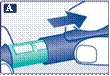
| Fig. A. Remove the cap from the pen-injector. |
|
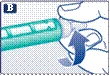
| Fig. B. Remove the protective label from the new disposable needle. Screw the needle tightly onto the FlexPen® pen-injector. |
|
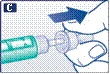
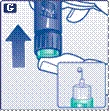
| Fig. C. Remove the large outer needle cap. Do not discard it. |
|
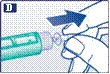
| Fig. D. Remove the inner needle cap and discard it. Never attempt to re-cover the inner needle cap once removed, as you may injure yourself with the needle. |
|
| Always use a new needle for each injection. This reduces the risk of contamination, infection, insulin leakage, needle blockage, and inaccurate dosing. Do not bend or damage the needle before use. |
|
| Checking insulin flow When using the pen-injector, a small amount of air may accumulate in the cartridge. To prevent injecting air and to ensure delivery of the correct dose, perform the following steps: |
|
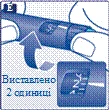
| Fig. E. Set the dose selector to 2 units. |
|
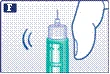
| Fig. F. Holding the FlexPen® vertically with the needle pointing upward, gently tap the cartridge several times with your finger to collect air bubbles at the top of the cartridge. |
|
| Fig. G. While holding the pen-injector vertically with the needle pointing upward, press the injection button. The dose selector will return to zero. A drop of insulin should appear at the needle tip. If it does not, replace the needle and repeat this procedure no more than 6 times. If no drop of insulin appears, this indicates that the pen-injector is defective and a new pen-injector should be used. |
|
| Before each injection, always confirm that a drop of insulin appears at the needle tip. This confirms that insulin is flowing through the needle. If no drop appears, you will not deliver insulin, even if the dose selector moves. This indicates that the needle is blocked or damaged. Always check insulin flow through the needle before injection. Failure to do so may result in receiving too little insulin or no insulin at all, which may lead to significantly elevated blood sugar levels. |
|
| Setting the dose Ensure that the dose selector is set to "0". |
|
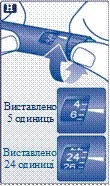
| Fig. H. Turn the dose selector to select the required number of units for injection. The selected dose can be adjusted up or down by turning the dose selector in the appropriate direction. When turning the selector to reduce the dose, ensure that you do not accidentally press the injection button, as this may cause insulin leakage. You cannot set a dose exceeding the number of units remaining in the cartridge. |
|
| Always use the dose selector and dose pointer to verify how many units you have selected before insulin injection. Do not count the clicks of the pen-injector to determine the insulin dose. If you select and inject an incorrect insulin dose, your blood sugar level may rise or fall significantly. Do not use the insulin remaining scale, as it only approximately indicates how much insulin remains in your pen-injector. |
|
| Injecting insulin Insert the needle under the skin. Follow the injection technique taught by your doctor or nurse. |
|
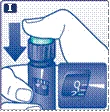
| Fig. I. Inject the dose by pressing the injection button fully until "0" aligns with the dose pointer. During injection, press only the injection button. Turning the dose selector will not deliver insulin. |
|
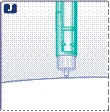
| Fig. J. While keeping the injection button fully pressed, hold the needle under the skin for at least 6 seconds. This ensures complete delivery of the medication. Remove the needle from the skin and release the injection button. Always ensure that the dose pointer returns to "0" after injection. If the dose pointer stops before returning to "0", the full dose was not delivered, which may lead to significantly elevated blood sugar levels. |
|
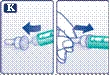
| Fig. K. Cover the needle with the large outer cap without touching it. When the needle is fully covered by the large outer cap, carefully press the cap on and then unscrew the needle. |
|
| Remove the needle after each injection and store the FlexPen® pen-injector without a needle attached. This reduces the risk of contamination, infection, insulin leakage, needle blockage, and incorrect dosing. Additional important information Healthcare providers, family members, and other individuals assisting the patient must be extremely careful with used needles to reduce the risk of accidental needlestick injury and cross-infection. Dispose of the used pen-injector without the needle. Never give your pen-injector or needle to another person. This may lead to cross-infection. Never give your pen-injector to another person. Your medication may be dangerous to their health. Store your pen-injector and needles in places inaccessible to others, especially children. Storage and care of the pen-injector The FlexPen® pen-injector is designed for accurate and safe operation. Handle it with care. If it has been dropped, damaged, or deformed, there is a risk of insulin leakage. This may lead to incorrect dosing, resulting in elevated or reduced blood sugar levels. All unused or damaged medicinal products must be disposed of in accordance with local requirements. The surface of the FlexPen® pen-injector can be cleaned by wiping it with cotton. Do not immerse the pen-injector, wash it, or lubricate it, as this may damage it. Do not refill the FlexPen® pen-injector. Do not use this medicinal product if the solution is not clear, cloudy, or non-aqueous. |
|
Children.
The medicinal product can be used in children aged 1 year and older (see section "Dosage and administration").
Overdose.
Although a specific definition of overdose for insulin is not established, administration of doses exceeding the patient's insulin requirements may lead to the following sequential stages of hypoglycemia:
- mild hypoglycemia, which can be treated by oral intake of glucose or sugary products; therefore, diabetic patients are advised to always carry sugary products with them;
- severe hypoglycemia, when the patient is unconscious. In such a case, individuals who have received appropriate instruction should administer glucagon subcutaneously or intramuscularly (0.5 to 1.0 mg). A healthcare professional may administer glucose intravenously. Glucose should also be administered intravenously if the patient does not respond to glucagon within 10–15 minutes.
After the patient regains consciousness, oral carbohydrates should be administered to prevent recurrence.
Adverse Reactions
Adverse reactions observed in patients receiving Levemir® FlexPen® are manifestations of the pharmacological action of insulin. The overall expected frequency of adverse reactions in patients using this product is 12%.
The most common adverse effect during insulin therapy is hypoglycemia. Clinical studies have shown that severe hypoglycemia requiring medical assistance from another person occurs in approximately 6% of patients treated with Levemir® FlexPen®.
Injection site reactions occur somewhat more frequently with Levemir® FlexPen® than with human insulin products. These include pain, erythema, urticaria, inflammation, bruising, swelling, and pruritus at the injection sites. These reactions usually resolve quickly within a few days or weeks with continued treatment.
At the beginning of insulin therapy, transient refractive disturbances and edema may occur. Rapid improvement in blood glucose control may lead to a condition known as "acute painful neuropathy," which is usually reversible. A rapid improvement in glycemic control due to intensification of insulin therapy may be accompanied by a temporary worsening of diabetic retinopathy, whereas long-term, well-maintained glycemic control reduces the risk of progression of diabetic retinopathy.
The adverse reactions listed below were observed during clinical trials and are classified according to MedDRA organ system classes. The frequency of reactions is categorized as very common (≥ 1/10); common (≥ 1/100, < 1/10); uncommon (≥ 1/1,000, < 1/100); rare (≥ 1/10,000, < 1/1,000); very rare (< 1/10,000); and reactions with unknown frequency (frequency cannot be estimated from available data).
Immune system disorders
Uncommon – allergic reactions, potentially allergic reactions, urticaria, rash, pruritus. Very rare – anaphylactic reactions.
Metabolism and nutrition disorders
Very common – hypoglycemia.
Nervous system disorders
Rare – peripheral neuropathies (painful neuropathy).
Eye disorders
Uncommon – refractive disorders. Uncommon – diabetic retinopathy.
Skin and subcutaneous tissue disorders
Uncommon – lipodystrophy. Frequency unknown – skin amyloidosis*†.
General disorders and administration site conditions
Common – injection site reactions. Uncommon – edema.
Skin reactions (erythema, swelling, pruritus) may occur at injection sites following insulin administration and usually resolve with continued treatment.
*See section "Description of selected adverse reactions".
† Post-marketing adverse reactions are described in the section "Description of selected adverse reactions".
Description of selected adverse reactions
Allergic reactions, potentially allergic reactions, urticaria, rash
Allergic reactions, potentially allergic reactions, urticaria, and rash have been reported uncommonly during treatment with Levemir® FlexPen® when used as basal-bolus therapy. However, in three clinical trials using Levemir® FlexPen® in combination with oral antidiabetic agents, these events occurred commonly (allergic and potentially allergic reactions were observed in 2.2% of cases).
Anaphylactic reactions
Generalized hypersensitivity reactions (including generalized skin rash, pruritus, increased sweating, gastrointestinal disturbances, angioedema, dyspnea, tachycardia, and decreased blood pressure) occur very rarely but may be life-threatening.
Hypoglycemia
Hypoglycemia is the most common adverse event. It may occur if the insulin dose greatly exceeds the patient's insulin requirement. Severe hypoglycemia can lead to loss of consciousness and/or seizures, resulting in temporary or permanent impairment of brain function and even death. Symptoms of hypoglycemia usually appear suddenly and may include cold sweat, pallor and cold skin, fatigue, nervousness or tremor, anxiety, unusual feelings of tiredness or weakness, disorientation, difficulty concentrating, drowsiness, increased hunger, visual disturbances, headache, nausea, and tachycardia.
Disorders of the skin and subcutaneous tissue
Lipodystrophy is an uncommon event. Lipodystrophy (including lipohypertrophy and lipoatrophy) and cutaneous amyloidosis may develop at injection sites and delay insulin absorption from the injection site. Regular rotation of injection sites within a given area may reduce the occurrence or prevent the development of these reactions.
Pediatric population
Based on post-marketing surveillance and clinical trial data, the frequency, type, and severity of adverse reactions in children are not different from those observed in the general population.
Other special patient groups
Based on post-marketing surveillance and clinical trial data, the frequency, type, and severity of adverse reactions in elderly patients and in patients with renal or hepatic impairment are not different from those observed in the general population.
Reporting of suspected adverse reactions and lack of efficacy
Reporting of suspected adverse reactions after drug authorization is important. It allows continued monitoring of the benefit-risk balance of the medicinal product. Healthcare professionals, pharmacists, patients, and their legal representatives should report all suspected adverse reactions and lack of efficacy via the Automated Information System for Pharmacovigilance at https://aisf.dec.gov.ua/.
Shelf life. 2.5 years.
Storage conditions.
The Levemir® FlexPen® pen device should be stored in its original packaging.
Before first use: store in a refrigerator (at 2–8 °C), protected from the freezer compartment.
Do not freeze. Protect from light.
During use or when carrying the pen as a spare: store at a temperature not exceeding 30 °C. Storage in the refrigerator (at 2–8 °C) is also acceptable. Use within 6 weeks. Do not freeze.
To protect from light, store the pen with the cap on when not in use.
Keep out of the reach and sight of children.
Never use insulin after the expiry date stated on the packaging.
Incompatibility.
Medicinal products added to detemir insulin may cause its degradation, for example, products containing thiols or sulfites. Levemir® FlexPen® must not be added to infusion solutions.
Levemir® FlexPen® must not be mixed with other medicinal products.
Packaging.
The pre-filled multi-dose disposable pen contains a 3 mL cartridge made of glass (type 1), sealed at one end with a plunger made of bromobutyl rubber and at the other end with a stopper made of bromobutyl/polysoprene rubber. The pen is made of plastic. Packs of 1 or 5 pens in a cardboard box.
Prescription status.
Prescription only.
Manufacturers.
A/T Novo Nordisk / Novo Nordisk A/S.
Novo Nordisk Production SAS (France) / Novo Nordisk Production SAS (France).
Manufacturers' addresses.
Novo Allé, Bagsværd, 2880, Denmark / Novo Allé, Bagsvaerd, 2880 Denmark.
45, avenue d’Orléans, 28000, Chartres, France / 45 avenue d’Orleans, 28000 Chartres, France.