Baralgine®
Ukraine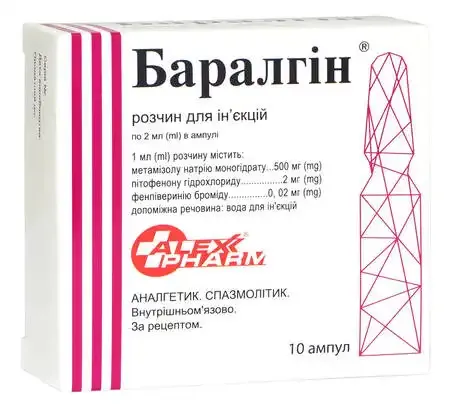
Instructions for Use
INSTRUCTIONS FOR MEDICAL USE OF THE MEDICINAL PRODUCT BERALGIN®
Composition:
Active substances: metamizole sodium, pitofenone hydrochloride; phenpiverine bromide;
1 ml of solution contains: sodium metamizole monohydrate 500 mg; pitofenone hydrochloride 2 mg; phenpiverine bromide 0.02 mg;
Excipient: water for injections.
Pharmaceutical form. Injection solution.
Main physicochemical properties: clear, colorless or slightly colored liquid.
Pharmacotherapeutic group.
Spasmolytic agents in combination with analgesics.
ATC code A03D A02.
Pharmacological properties.
Pharmacodynamics.
BARELGIN® is a combined medicinal product with pronounced spasmolytic and analgesic activity.
Metamizole has pronounced analgesic and antipyretic effects combined with weaker anti-inflammatory and spasmolytic activity. Its effects result from inhibition of prostaglandin and endogenous algogen synthesis, increased excitability threshold in the thalamus, effects on the hypothalamus, and inhibition of endogenous pyrogen formation.
Phenpiverine has moderately expressed ganglion-blocking and anticholinergic (cholinolytic) effects. It reduces the tone and motility of smooth muscles of the stomach, intestine, biliary and urinary tracts.
Pitofenone hydrochloride has a papaverine-like effect with pronounced spasmolytic activity on smooth muscles.
Pharmacokinetics.
Absorption: after intramuscular administration, it is rapidly absorbed. Systemic bioavailability of metamizole is approximately 85%.
Distribution: metamizole is 50–60% bound to plasma proteins. It penetrates through the blood-brain and placental barriers. The volume of distribution is approximately 0.7 L/kg.
Metabolism: metamizole undergoes intensive biotransformation in the liver. Its main metabolite, 4-methyl-amino-antipyrine (MAA), is further metabolized in the liver to produce other metabolites, including 4-amino-antipyrine (AA), which is pharmacologically active. Maximum plasma concentrations (for all metabolites) are reached approximately within 30–90 minutes.
Excretion: it is excreted by the kidneys in the form of metabolites, with only 3% of the excreted amount of metamizole being eliminated unchanged. The elimination half-life is approximately 10 hours.
Patients with hepatic impairment: the elimination half-life of the active metabolite MAA is prolonged by approximately threefold in patients with impaired liver function. Such patients should be treated with lower doses of metamizole.
Patients with renal impairment: reduced excretion of some metabolites is observed in patients with impaired renal function. Such patients should be treated with lower doses of metamizole.
Clinical characteristics.
Indications.
For short-term symptomatic treatment of pain associated with smooth muscle spasms of internal organs:
- Gastrointestinal colic;
- Renal colic in nephrolithiasis;
- Spastic biliary tract dyskinesia;
- Dysmenorrhea.
Contraindications.
- Hypersensitivity to active substances, to pyrazolone derivatives, or to other nonsteroidal anti-inflammatory drugs (NSAIDs).
- History of agranulocytosis induced by metamizole, other pyrazolones, or pyrazolidines.
- Severe impairment of liver or kidney function.
- Acute hepatic porphyria.
- Glucose-6-phosphate dehydrogenase deficiency.
- Intestinal obstruction and megacolon.
- Bone marrow dysfunction or hematopoietic system disorders (e.g., following cytostatic therapy).
- Hematopoietic system diseases (agranulocytosis, leukopenia, anemia of any etiology, including aplastic anemia, infectious neutropenia).
- Prostate adenoma grade II and III.
- Atony of gallbladder and urinary bladder.
- Suspicion of surgical pathology.
- Hypotensive conditions and hemodynamic instability.
- Collapse-like states.
- Tachyarrhythmia.
- Closed-angle glaucoma.
- Bronchial asthma.
Interaction with other medicinal products and other forms of interaction.
Combining BARALGIN® with other medicinal products requires special caution due to the presence of metamizole, which is a hepatic enzyme inducer.
Sodium metamizole may induce metabolic pathway enzymes, including CYP2B6 and CYP3A4. Concomitant use of sodium metamizole with bupropion, efavirenz, methadone, valproate, cyclosporine, tacrolimus, and sertraline may lead to reduced plasma concentrations of these drugs, potentially resulting in diminished therapeutic effect. Therefore, caution is recommended when co-administering sodium metamizole with other medicinal products; clinical response and/or plasma drug levels should be monitored as necessary.
Alcohol consumption should be avoided during treatment, as there is a possibility of mutual potentiation of effects.
Coumarin anticoagulants. When used concomitantly, metamizole may reduce the activity of coumarin anticoagulants due to induction of hepatic enzymes.
Chlorpromazine and other phenothiazine derivatives. Concurrent use with metamizole carries a risk of developing severe hypothermia.
Cyclosporine. Metamizole reduces plasma levels of cyclosporine when used concomitantly.
Chloramphenicol and other myelotoxic agents. Concurrent use with metamizole increases the risk of bone marrow suppression.
Enzyme inducers (barbiturates, glutethimide, phenylbutazone) may weaken the effect of metamizole.
Metamizole significantly increases peak plasma concentrations of chloroquine.
CNS depressants, when combined with metamizole, enhance its analgesic effect.
Tricyclic antidepressants (psychophorin, amitriptyline), oral contraceptives, analgesics, allopurinol, and alcohol slow down the metabolism of metamizole, potentiate its effects when used concomitantly, and increase its toxicity.
Concurrent use with other analgesics and NSAIDs increases the risk of hypersensitivity reactions and other adverse effects.
Sedatives and tranquilizers enhance the analgesic effect of the drug.
Concomitant use of BARALGIN® with quinine preparations may potentiate the anticholinergic effect.
BARALGIN® may be combined with hyoscine butylbromide, furosemide, glyburide.
It is known for the class of pyrazolone derivatives that they may interact with captopril, lithium, methotrexate, and triamterene, as well as alter the efficacy of antihypertensive agents and diuretics. The extent to which metamizole causes these interactions is unknown.
Since metamizole may reduce the effect of certain drugs, BARALGIN® should be used with caution in combination with the following medicinal products:
- Bupropion – used for treatment of depression or as an aid to smoking cessation;
- Efavirenz – used for treatment of HIV/AIDS;
- Methadone – used for treatment of addiction to controlled substances (so-called opioids);
- Valproate – used for treatment of epilepsy or bipolar disorder;
- Tacrolimus – used to prevent organ rejection in transplant patients;
- Sertraline – used for treatment of depression.
Special precautions for use.
| Agranulocytosis Treatment with metamizole may cause the development of agranulocytosis, which can be fatal (see section "Adverse reactions"). Metamizole-induced agranulocytosis may occur even in patients who previously used metamizole without complications. Agranulocytosis caused by metamizole is an idiosyncratic adverse reaction. Metamizole-induced agranulocyt游戏副本
Method of Administration and Dosage.BARRALGIN®, solution for injection, is for intramuscular use only! Use only for short-term treatment! The injection solution should be administered under strict medical supervision due to the risk of anaphylactic shock in patients hypersensitive to metamizole or pyrazolone derivatives. Adults and children aged 15 years and older. For adults and children aged 15 years and older (with body weight above 53 kg), administer 2 to 5 mL of the injection solution intramuscularly. The dose may be repeated, if necessary, every 6–8 hours. The maximum daily dose should not exceed 6 mL of the injection solution (equivalent to 3 g of sodium metamizole). The duration of treatment is 2–3 days. After achieving therapeutic effect, treatment may be switched to oral analgesics and spasmolytics. If no therapeutic effect is observed, discontinue treatment with the drug. Patients aged 65 years and older. Dosage reduction is usually not required. However, in patients with age-related hepatic or renal impairment, dosage reduction may be necessary due to a possible prolonged elimination half-life of metamizole metabolites. Patients with renal impairment. Metamizole is excreted in the urine as metabolites. In patients with mild to moderate renal impairment, it is recommended to use ½ of the adult dose. Patients with hepatic impairment. In such patients, the elimination half-life of active metamizole metabolites is prolonged. High doses should be avoided in patients with hepatic impairment. For short-term use, dosage adjustment is not required. There is insufficient experience with prolonged use in patients with renal or hepatic impairment. Children. The drug should not be used for the treatment of children under 15 years of age. Overdose. Symptoms: Predominantly symptoms of metamizole intoxication combined with anticholinergic effects. The most common manifestations include toxic-allergic syndrome, hematotoxicity, gastrointestinal disturbances, and central nervous system effects, including hypothermia, marked decrease in arterial blood pressure, palpitations, dyspnea, tinnitus, nausea, vomiting, gastralgia, weakness, oliguria, anuria, drowsiness, delirium, disturbances of consciousness, tachycardia, and convulsive syndrome. Acute agranulocytosis, hemorrhagic syndrome, acute renal and hepatic failure, and respiratory muscle paralysis may also develop. Treatment: Discontinue the drug and take measures to promote its rapid elimination from the body (forced diuresis, infusion of fluid and electrolyte solutions, hemodialysis if necessary). Administer symptomatic therapy. There is no specific antidote. Adverse reactions.The adverse reactions listed below are mainly caused by metamizole, which is a component of the medicinal product. Blood and lymphatic system disorders: leucopenia; agranulocytosis, thrombocytopenia, anaemia (haemolytic anaemia, aplastic anaemia). The risk of developing agranulocytosis cannot be predicted. Agranulocytosis may occur even in patients who have previously used metamizole without experiencing such adverse reactions. Immune system disorders: anaphylactic shock, anaphylactic or anaphylactoid reactions, especially after parenteral administration. Such reactions may occur during or immediately after the end of administration, but may also appear several hours later. They usually occur within the first hour after injection. Milder reactions manifest as typical skin and mucous membrane reactions (such as itching, burning, redness, urticaria, swelling – local or general), dyspnoea, and rarely gastrointestinal complaints. Mild reactions may progress to more severe forms with generalized urticaria, severe angioedema (including laryngeal), severe bronchospasm, cardiac arrhythmias, and decreased blood pressure (sometimes preceded by increased blood pressure). Therefore, if any hypersensitivity skin reaction, symptoms of impaired renal function, or haematotoxic reactions occur, the drug must be discontinued immediately. Asthmatic attack (in patients with analgesic-induced asthma), circulatory shock. Shock may be accompanied by cold sweat, dizziness, drowsiness, altered consciousness, pallor, chest tightness, shallow breathing or tachypnoea, tachycardia, cold extremities, and severe drop in blood pressure. If any early signs of shock occur, treatment must be discontinued immediately and appropriate emergency measures must be taken. Skin and subcutaneous tissue disorders: fixed drug eruption; maculopapular and other types of rashes; angioneurotic oedema, decreased sweating. Severe skin reactions have been reported, including Stevens-Johnson syndrome, toxic epidermal necrolysis, and (with unknown frequency) drug-induced eosinophilia with systemic symptoms (DRESS) associated with the use of metamizole (see section "Special precautions for use"). If any skin reaction occurs, the use of metamizole must be discontinued immediately. Nervous system disorders: dizziness, headache. Sensory organ disorders (vision): visual disturbances, accommodation disorders. Cardiovascular system disorders: palpitations, tachycardia, cardiac arrhythmias, cyanosis, arterial hypotension; hyperaemia. Hypotensive reactions may rarely occur during or after administration. They may occur with or without other symptoms of anaphylactoid or anaphylactic reactions. Rarely, such reactions may result from a sudden drop in blood pressure. Rapid intravenous injection increases the risk of hypotensive reactions. Critical drop in blood pressure without other signs of hypersensitivity is dose-dependent and may occur in hyperpyrexia. Gastrointestinal disorders: dry mouth, nausea, vomiting, abdominal pain and discomfort, constipation, exacerbation of gastritis and peptic ulcer disease; in rare cases vomiting with blood and intestinal bleeding, ulcerations, burning sensation in the epigastric area. Liver and biliary system disorders: drug-induced liver injury, including acute hepatitis, jaundice, increased levels of liver enzymes (see section "Special precautions for use"). Renal and urinary system disorders: proteinuria, oliguria, anuria, polyuria, interstitial nephritis, red discoloration of urine; urinary retention, difficult urination, impaired kidney function. Respiratory system disorders: bronchospasm. General disorders and administration site conditions: following parenteral administration – asthenia, pain at injection site and local reactions. Reporting of suspected adverse reactions. Reporting of suspected adverse reactions after authorization of the medicinal product is important. It allows continued monitoring of the benefit-risk balance of the medicinal product. Healthcare professionals are required to report any suspected adverse reactions through the national reporting system. Shelf life. 3 years. Storage conditions. Store in the original packaging, protected from light, at a temperature not exceeding 25 °C. Keep out of reach and sight of children. Incompatibilities. The drug must not be mixed with other medicinal products in the same syringe. Packaging. 2 ml or 5 ml in an ampoule. 5 ampoules per blister, 1 or 2 blisters per cardboard pack. Prescription status. Prescription only. Manufacturer. SC Balkan Pharmaceuticals SRL. Manufacturer's address. MD-2091, Republic of Moldova, Chisinau municipality, Singera, str. Industriala, 7/A. Marketing Authorisation Holder. ALEXPHARM GMBH LTD Address of the Marketing Authorisation Holder. 13 John Princes Street, 2nd Floor, London, England W1G 0JR, United Kingdom |
Frequently Asked Questions
What is Baralgine® prescribed for?
The drug is used for the short-term relief of pain caused by spasms of internal organs, for example, in gastric, intestinal, or renal colic, biliary tract spasms, and menstrual pain.
How to take Baralgine® correctly?
The drug is intended for intramuscular administration only under medical supervision. Adults and children aged 15 and older (weighing over 53 kg) are administered 2 to 5 ml of the solution. If necessary, the dose may be repeated after 6-8 hours, but the total daily dose must not exceed 6 ml. Treatment should be short-term (2-3 days).
Who should not use this drug?
Use is contraindicated in cases of hypersensitivity to the components, a history of agranulocytosis, severe hepatic or renal impairment, acute hepatic porphyria, glucose-6-phosphate dehydrogenase deficiency, intestinal obstruction, blood disorders, prostatic adenoma, glaucoma, bronchial asthma, and states of low blood pressure.
What are the possible side effects of Baralgine®?
Possible allergic reactions (ranging from rash to anaphylactic shock), serious blood disorders (e.g., agranulocytosis), skin reactions (Stevens-Johnson syndrome), dizziness, visual disturbances, palpitations, decreased blood pressure, nausea, vomiting, constipation or abdominal pain, as well as possible liver damage.
Can the drug be combined with alcohol or other medicines?
Alcohol consumption should be avoided as it may enhance the effect of the drug. Baralgine® requires special caution when combined with other medicines, as it may reduce the effectiveness of certain agents (e.g., anticoagulants, cyclosporine, antidepressants) or increase their toxicity. Do not mix the drug with other medicines in the same syringe.
Can the drug be used by pregnant or breastfeeding women?
Use during pregnancy is contraindicated. The drug is not recommended during breastfeeding; if its use cannot be avoided, breastfeeding must be discontinued for 48 hours after administration.
Does the drug affect the ability to drive a vehicle?
Yes, the drug may cause dizziness, visual disturbances, and reduce attention and reaction speed; therefore, driving vehicles during treatment is not recommended.
Similar Medications
-
Neospasyl®
Form: solution for injection
Active substance Dosage ketorolac 15 mg/ml pitozol 5 mg/ml phenoperidine 0.05 mg/ml Manufacturer: PJSC «Pharmaceutical Company «Darnitsa»
-
Renalgan®
Form: solution for injection
Active substance Dosage sodium metamizole 500 mg/ml phenoperidine bromide 0.02 mg/ml pitolisant hydrochloride 2 mg/ml Manufacturer: PJSC "Lekhim - Kharkiv"
-
Spasmalgone®
Form: solution for injection
Active substance Dosage sodium metamizole 500 mg/ml pitozol 2 mg/ml phenoperidine 0.02 mg/ml Manufacturer: JSC "Sofarma"
This page has been machine-translated and may contain inaccuracies. The original data is available in the manufacturing country's language.
Last data check: July 21, 2026 · Data source: Державний реєстр лікарських засобів України