Alcarinit
Ukraine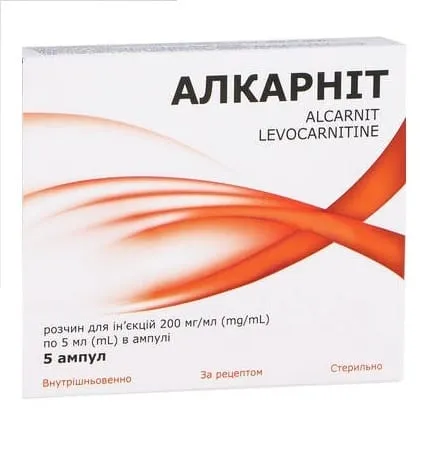
Instructions for Use
INSTRUCTIONS FOR MEDICAL USE OF THE MEDICINAL PRODUCT ALKARNIT (ALCARNIT)
Composition:
active substance: levocarnitine;
1 ml of solution contains levocarnitine calculated as 100 % substance – 200 mg;
excipients: hydrochloric acid or sodium hydroxide, water for injections.
Pharmaceutical form. Injection solution.
Main physicochemical properties: clear, colorless or slightly yellowish solution.
Pharmacotherapeutic group. Amino acids and their derivatives. Levocarnitine.
ATC code A16AA01.
Pharmacological Properties.
Pharmacodynamics.
Levocarnitine is a naturally occurring substance essential for the energy metabolism of mammals. It has been demonstrated that this substance facilitates the entry of long-chain fatty acids into cellular mitochondria, thereby delivering substrate for oxidation and subsequent energy production. Fatty acids are used as an energy substrate in all tissues except the brain. In skeletal and cardiac muscle, fatty acids are the primary substrate for energy production.
Primary systemic carnitine deficiency is characterized by low concentrations of levocarnitine in blood plasma, erythrocytes, and/or tissues. It has not been possible to determine which symptoms are related to carnitine deficiency and which are due to the underlying organic acidemia, as administration of levocarnitine may exacerbate symptoms of both conditions. According to literature data, carnitine is capable of promoting the elimination of excess organic or fatty acids in patients with disorders of fatty acid metabolism and/or specific organic acidopathies that bioaccumulate acyl-CoA esters.
Secondary carnitine deficiency may result from inborn errors of metabolism or iatrogenic factors such as hemodialysis. Levocarnitine may alleviate metabolic disturbances in patients with congenital defects leading to accumulation of toxic organic acids. This effect has been demonstrated in conditions such as glutaric aciduria type II, methylmalonic aciduria, propionic acidemia, and medium-chain acyl-CoA dehydrogenase deficiency. In these patients, autointoxication occurs due to accumulation of acyl-CoA compounds, which disrupt intermediary metabolism. Subsequent hydrolysis of acyl-CoA to its free acid form leads to acidosis, which may be life-threatening. Levocarnitine eliminates acyl-CoA by forming acylcarnitine, which is rapidly excreted from the body. Carnitine deficiency is biochemically defined as abnormally low levels of free carnitine in blood plasma—less than 20 μmol/L one week after birth—and may be associated with low tissue and/or urinary concentrations. Additionally, this condition may be associated with an increased plasma ratio of acylcarnitine to levocarnitine (greater than 0.4) or abnormally elevated urinary acylcarnitine concentration. In preterm infants and newborns, secondary deficiency is defined by plasma levocarnitine concentrations below age-specific normal ranges.
In patients with end-stage renal disease (ESRD) undergoing maintenance hemodialysis, low plasma carnitine concentrations and elevated acylcarnitine/carnitine ratios may occur due to reduced intake of meat and dairy products, impaired synthesis in the kidneys, and loss into dialysate fluid. Some clinical symptoms commonly observed in hemodialysis patients—such as malaise, muscle weakness, cardiomyopathy, and cardiac arrhythmias—may be related to impaired carnitine metabolism.
Studies using levocarnitine have shown that its administration to hemodialysis patients with ESRD leads to increased plasma levocarnitine concentrations.
Pharmacokinetics.
Plasma concentration profiles of levocarnitine following a slow 3-minute intravenous bolus administration of a 20 mg/kg dose were described using a two-compartment model. After a single intravenous dose, approximately 76% of the administered levocarnitine was excreted in urine within 0–24 hours. Using plasma concentrations uncorrected for endogenous levocarnitine, the mean distribution half-life was 0.585 hours, and the mean apparent terminal elimination half-life was 17.4 hours.
Total clearance of levocarnitine (dose/area under the plasma concentration-time curve [AUC], including endogenous background concentrations) averaged 4.00 L/hour.
Levocarnitine was not bound to plasma proteins or albumin in studies at any concentrations or in any species, including humans.
Although the efficacy of ALKARNIT in increasing carnitine concentrations in dialysis patients with ESRD has been demonstrated, the impact of supplemental carnitine administration on signs and symptoms of carnitine deficiency and on clinical outcomes in this population has not been established.
Clinical characteristics.
Indications.
For emergency and long-term treatment of patients with congenital metabolic disorders leading to secondary carnitine deficiency.
For prevention and treatment of carnitine deficiency in patients with end-stage renal disease undergoing dialysis.
Contraindications.
Hypersensitivity to any component of the medicinal product.
Interaction with other medicinal products and other forms of interaction.
Concomitant use of glucocorticoids leads to accumulation of levocarnitine in body tissues (except liver). Other anabolic agents enhance the effect of the drug.
In patients receiving levocarnitine concomitantly with coumarin-derived anticoagulants (see sections "Special precautions" and "Adverse reactions"), very rare cases of increased international normalized ratio (INR) have been observed. INR or another appropriate coagulation test should be performed weekly until values become stable, and monthly thereafter in patients taking such anticoagulants together with levocarnitine.
Special precautions for use.
General
The safety and efficacy of oral levocarnitine have been evaluated in patients with renal insufficiency. Long-term administration of high oral doses of levocarnitine to patients with severe renal function impairment or to patients on dialysis may lead to accumulation of potentially toxic metabolites, trimethylamine (TMA) and trimethylamine-N-oxide (TMAO), since these metabolites are normally excreted in urine.
Levocarnitine improves glucose utilization; therefore, administration of the medicinal product to patients with diabetes mellitus who are receiving antidiabetic therapy may result in hypoglycemia. Plasma glucose levels should be monitored regularly in such patients to allow timely adjustment of therapy.
Very rare cases of increased INR have been reported in patients who were concurrently taking levocarnitine and coumarin-derived anticoagulants (see sections "Interaction with other medicinal products and other forms of interaction" and "Side effects").
Sodium
This medicinal product contains less than 1 mmol (23 mg)/dose of sodium, i.e. it is practically sodium-free.
Use during pregnancy or breastfeeding.
Pregnancy
Reproductive studies conducted in rats and rabbits with doses up to 3.8 times the human dose based on body surface area showed no evidence of impaired fertility or fetal harm due to ALKARNIT administration.
Since animal reproductive studies do not always predict human response, the drug should be used during pregnancy only if clearly needed. However, adequate and well-controlled studies in pregnant women have not been conducted.
Breastfeeding period
The use of levocarnitine during breastfeeding has not been specifically studied. Levocarnitine is a normal component of human breast milk.
Considering the serious consequences of carnitine deficiency for the pregnant woman, the risk of interrupting levocarnitine treatment for the mother is considered greater than the theoretical risk to the infant if treatment is continued.
Ability to influence reaction rate when driving vehicles or operating machinery.
Unknown.
Method of Administration and Dosage
ALCARNIT is administered by slow intravenous injection over 2–3 minutes.
Metabolic Disorders
The recommended dose is 50 mg/kg as a slow bolus injection over 2–3 minutes or by infusion. Frequently, patients with severe metabolic crisis receive a loading dose, followed by equivalent doses over the subsequent 24 hours. The drug should be administered by infusion or intravenous injection every 3 or 4 hours and in no case less frequently than every 6 hours. It is recommended that all subsequent daily doses remain at 50 mg/kg or adjusted according to therapeutic requirements. The maximum recommended dose is 300 mg/kg.
It is recommended that plasma carnitine concentration be measured prior to initiating this parenteral therapy. Weekly and monthly monitoring is also recommended. This monitoring should include biochemical blood analysis, vital signs,
plasma carnitine concentration levels (free carnitine concentration in plasma should range between 35 and 60 µmol/L), and overall clinical condition.
Patients with ESRD on Hemodialysis
The recommended initial dose is 10–20 mg/kg body weight as a slow 2–3-minute bolus injection into the venous blood circuit immediately after each dialysis session. Initiation of therapy may be based on pre-dialysis plasma levocarnitine concentrations below normal (40–50 µmol/L). Dose adjustments should be based on pre-dialysis levocarnitine plasma levels. Dose reduction (e.g., to 5 mg/kg post-dialysis) may be considered starting in the third or fourth week of therapy.
Hemodialysis – Maintenance Therapy
After a loading course of intravenous administration, maintenance therapy should be administered orally at a dose of 1 g levocarnitine per day. On dialysis days, levocarnitine should be administered intravenously at a dose of 1 g immediately after completion of the dialysis session.
ALCARNIT is compatible and stable when mixed with parenteral solutions of 0.9% sodium chloride or Ringer's lactate at concentrations ranging from 250 mg/500 mL (0.5 mg/mL) to 4200 mg/500 mL (8.0 mg/mL).
Children
The drug may be administered to children from the first day of life, including preterm infants.
Overdose
There are no confirmed reports of levocarnitine toxicity in overdose. High doses of the drug may cause diarrhea.
Treatment: Measures should be taken to remove the drug from the gastrointestinal tract in cases of oral ingestion. Provide symptomatic and supportive treatment. Levocarnitine is readily removed from plasma by dialysis. There have been no reports of life-threatening overdose cases.
Side effects
All of the adverse reactions listed below occur very rarely.
Gastrointestinal system
Various mild gastrointestinal disturbances have been observed during prolonged oral administration of levocarnitine, including transient nausea and vomiting, abdominal pain, and diarrhea. A peculiar body odor has also been reported in some patients. Reducing the dose often diminishes or eliminates gastrointestinal symptoms and the occurrence of unusual body odor.
Blood and lymphatic system
In very rare cases, increased INR has been observed in patients (see sections "Interaction with other medicinal products and other forms of interaction" and "Special warnings and precautions for use").
Neurological reactions
Seizures have been reported in patients with or without prior seizure activity following both oral and intravenous administration of levocarnitine. In patients with pre-existing seizure disorders, an increase in the frequency and/or severity of seizures has been observed.
Hypersensitivity reactions
There have been official reports of serious hypersensitivity reactions, including anaphylaxis, laryngeal edema, and bronchospasm, following administration of levocarnitine, primarily in patients with end-stage renal disease undergoing dialysis. Some of these reactions occurred within minutes after intravenous administration of levocarnitine.
If a severe hypersensitivity reaction occurs, treatment with ALKARNIT should be discontinued immediately and appropriate medical therapy initiated. The risks and benefits of re-administering ALKARNIT should be carefully evaluated in individual patients after a severe reaction. If a decision is made to re-administer the drug, patients must be closely monitored for signs and symptoms of hypersensitivity.
Tolerance should be carefully monitored during the first week of treatment and after any dose increase. Intravenous administration of levocarnitine is generally well tolerated.
Shelf life.
2 years.
Storage conditions.
Store in the original packaging at a temperature not exceeding 25 °C. Keep out of reach of children.
Incompatibility.
Do not mix with other medicinal products in the same container.
Packaging.
5 ml in an ampoule, 5 ampoules in a blister, 1 or 2 blisters per carton, or 100 ampoules per carton.
Prescription status.
Prescription only.
Manufacturer.
Private Joint-Stock Company "Lekhym-Kharkiv".
Manufacturer's address and location of operations.
36 Severina Pototskogo Street, Kharkiv, Kharkiv Region, 61115, Ukraine.
Frequently Asked Questions
What is Alcarinit prescribed for?
The drug is used for the emergency and long-term treatment of patients with congenital metabolic disorders that cause carnitine deficiency. It is also prescribed for the prevention and treatment of carnitine deficiency in patients with end-stage renal disease undergoing dialysis.
How should Alcarinit be taken correctly?
The drug is administered intravenously slowly over 2–3 minutes. The dosage depends on the patient's condition: for metabolic disorders, the recommended dose is 50 mg/kg, and for patients on hemodialysis, 10-20 mg/kg after each session. Oral administration is also possible in certain cases upon a doctor's recommendation.
What side effects can Alcarinit cause?
Side effects are rare. Possible gastrointestinal disorders (nausea, vomiting, abdominal pain, diarrhea), a specific body odor, seizures, or serious allergic reactions (laryngeal edema, bronchospasm, anaphylaxis) may occur.
Who should not use this drug?
The drug is contraindicated in individuals with hypersensitivity to any of its components.
Can the drug be taken with other medicines?
When used simultaneously with glucocorticoids, levocarnitine may accumulate in the tissues. If you are taking coumarin-type anticoagulants, it is necessary to monitor blood clotting parameters weekly (and then monthly). Anabolic agents may enhance the effect of the drug.
Does the drug affect blood sugar levels?
Yes, since levocarnitine improves glucose uptake, patients with diabetes mellitus who are taking glucose-lowering medications need to monitor their blood sugar levels regularly to avoid a sudden drop (hypoglycemia).
Can the drug be used by pregnant or breastfeeding women?
Studies in pregnant women are insufficient; therefore, use is only possible in cases of acute necessity. During breastfeeding, the risk of interrupting treatment for the mother is considered greater than the theoretical risk to the child.
Similar Medications
-
Almiba
Form: solution for injection
Active substance Dosage levocarnitine 1 g/5 ml Manufacturer: Mefar Ilac San A.S.
-
Cardonat l-carnitine
Form: solution for injection
Active substance Dosage levocarnitine 1 g/5 ml Manufacturer: WORLD MEDICINE ILAC SAN. VE TIC. A.S.
-
Carnelius
Form: solution for injection
Active substance Dosage levocarnitine 200 mg/ml Manufacturer: HELP S.A.
-
Carnivit
Form: solution for injection
Active substance Dosage levocarnitine 200 mg/ml Manufacturer: Yuria-Pharm LLC
-
Carnivit® extra
Form: solution for injection
Active substance Dosage levocarnitine 200 mg/ml Manufacturer: Yuria-Pharm LLC
-
Cartan
Form: solution for injection
Active substance Dosage levocarnitine 200 mg/ml Manufacturer: DEMO SA Pharmaceutical Industry
-
Lecarnita
Form: solution for injection
Active substance Dosage levocarnitine 200 mg/ml Manufacturer: HELP S.A.
-
Levocarnitine
Form: solution for injection
Active substance Dosage levocarnitine 1000 mg Manufacturer: JSC "Lubnipharm"
-
Likartin-n
Form: solution for injection
Active substance Dosage levocarnitine 200 mg/ml Manufacturer: Farmasel LLC
-
Likartin-n
Form: solution for injection
Active substance Dosage levocarnitine 400 mg/ml Manufacturer: Farmasel LLC
-
Metacartin
Form: solution for injection
Active substance Dosage levocarnitine 1 g/5 ml or 200 mg/ml Manufacturer: WORLD MEDICINE ILAC SAN. VE TIC. A.S.
-
Steatel
Form: solution for injection
Active substance Dosage levocarnitine 200 mg/ml Manufacturer: HELP S.A.
This page has been machine-translated and may contain inaccuracies. The original data is available in the manufacturing country's language.
Last data check: July 21, 2026 · Data source: Державний реєстр лікарських засобів України