Lecarnita
Ukraine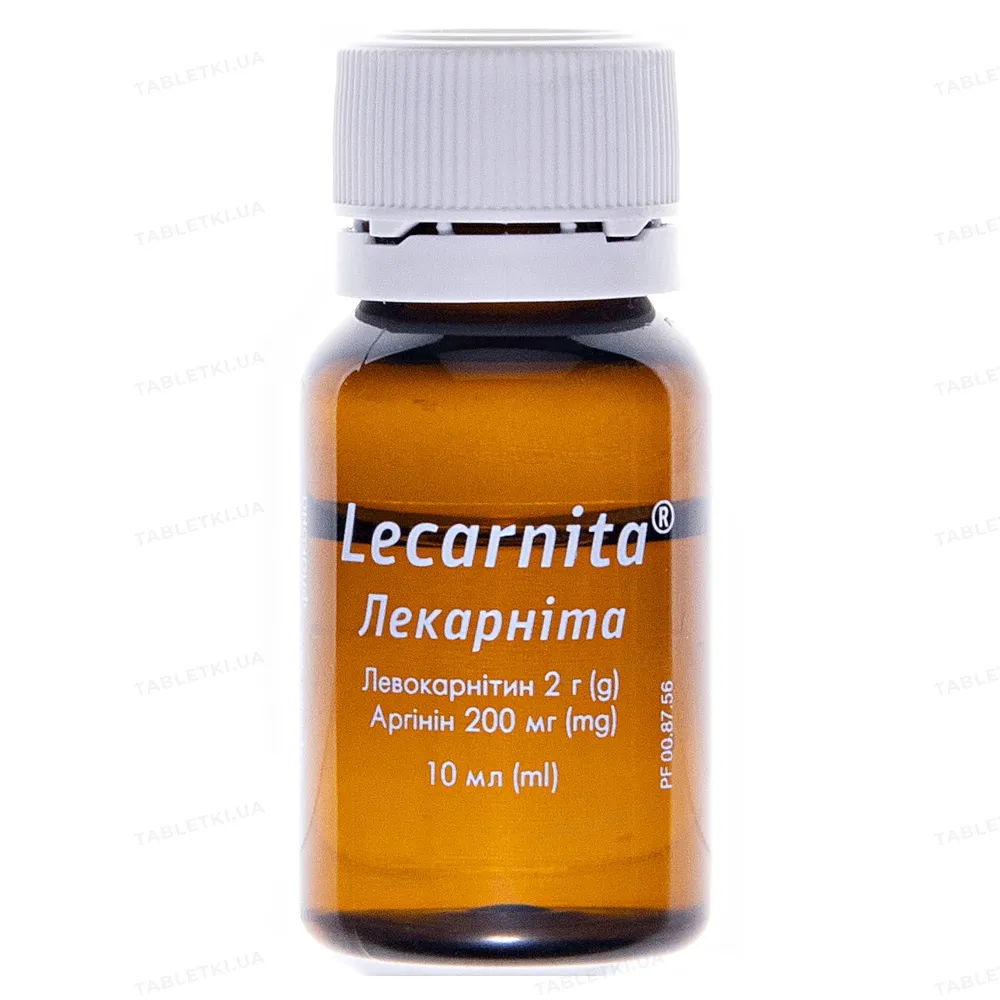
Table of Contents
INSTRUCTIONS FOR MEDICAL USE OF THE MEDICINAL PRODUCT LECARNITA LECARNITA®
Composition:
Active substance: levocarnitine;
1 ml of solution contains 200 mg of levocarnitine;
Excipients: hydrochloric acid diluted, water for injections.
Pharmaceutical form. Solution for injection.
Main physicochemical properties: clear solution ranging from colorless to yellowish.
Pharmacotherapeutic group. Amino acids and their derivatives. ATC code A16AA01.
Pharmacological Properties.
Pharmacodynamics.
Levocarnitine is a naturally occurring component in animal tissues, microorganisms, and plants. In humans, physiological requirements for carnitine are met through dietary intake of carnitine-containing foods (primarily meat products) and by endogenous synthesis in the liver from trimethyllysine. Only the L-isomer is biologically active. Levocarnitine plays an essential role in lipid metabolism as well as in the metabolism of ketone bodies. Levocarnitine is necessary for the transport of long-chain fatty acids into mitochondria for subsequent beta-oxidation. By releasing coenzyme A from complex thioesters, levocarnitine also enhances carbohydrate oxidation in the tricarboxylic acid (Krebs) cycle, stimulates the activity of the key glycolytic enzyme pyruvate dehydrogenase, and, in skeletal muscles, promotes the oxidation of branched-chain amino acids. Thus, levocarnitine directly or indirectly participates in most energy-producing processes; its presence is essential for the oxidation of fatty acids, amino acids, carbohydrates, and ketone bodies. The highest concentrations of levocarnitine are found in muscle tissue, myocardium, and liver. Levocarnitine plays a significant role in cardiac metabolism, as fatty acid oxidation depends on the availability of sufficient amounts of this substance. Experimental studies have shown that under certain conditions such as stress, acute ischemia, and myocarditis, a reduction in levocarnitine levels in myocardial tissue may occur. Numerous animal studies have confirmed the beneficial effects of levocarnitine in various induced cardiac disorders: acute and chronic ischemia, cardiac decompensation, heart failure due to myocarditis, and drug-induced cardiotoxicity (taxanes, adriamycin).
Pharmacokinetics.
Absorption
Levocarnitine is absorbed by the epithelial cells of the small intestine mucosa and enters the bloodstream relatively slowly; absorption is likely associated with an active trans-luminal mechanism. Oral absorption is limited (<0%) and variable.
Distribution
Absorbed levocarnitine is transported via blood to various organs; it is believed that erythrocyte transport systems are involved in this process.
Excretion
Levocarnitine is primarily excreted in urine. The rate of excretion is directly proportional to the concentration of carnitine in the blood.
Metabolism
Levocarnitine is almost not metabolized in the body.
Clinical characteristics.
Indications.
Primary and secondary carnitine deficiency in adults and children, including newborns and infants.
Secondary carnitine deficiency in patients undergoing hemodialysis.
Suspected secondary carnitine deficiency in patients undergoing hemodialysis in the following cases:
- severe and persistent muscle cramps and/or hypotensive episodes during dialysis;
- energy deficit leading to significant negative impact on quality of life;
- muscle weakness and/or myopathy;
- cardiomyopathy;
- anemia unresponsive to erythropoietin treatment or requiring high doses of erythropoietin;
- loss of muscle mass.
Contraindications.
Hypersensitivity to the components of the drug.
Interaction with other medicinal products and other forms of interaction.
Concomitant use of glucocorticoids leads to accumulation of levocarnitine in body tissues (except liver). Other anabolic agents enhance the effect of the drug.
Rare cases of increased international normalized ratio (INR) have been observed in patients concurrently receiving levocarnitine and coumarin derivatives (acenocoumarol and warfarin). Patients taking levocarnitine together with coumarin anticoagulants should have INR measured weekly until stabilized, and then monthly thereafter.
Special precautions.
Levocarnitine improves glucose uptake; therefore, administration of Le carnita in patients with diabetes mellitus who are receiving antidiabetic medications may lead to hypoglycemia. Plasma glucose levels should be monitored regularly in such cases to allow timely adjustment of therapy.
Rare cases of increased MCV have been observed in patients concurrently receiving levocarnitine and coumarin derivatives.
Use during pregnancy or breastfeeding.
Teratogenic effects of the drug were not observed in preclinical studies. When the highest studied dose of 600 mg/kg body weight was administered to animals, a statistically insignificant increase in the frequency of post-implantation fetal loss in early pregnancy was noted. The significance of these findings for humans is unknown.
Considering the serious consequences of carnitine deficiency for the pregnant woman, the risk of discontinuing treatment for the mother is considered greater than the theoretical risk to the fetus if treatment is continued.
Levocarnitine is a normal component of breast milk. However, the use of levocarnitine in breastfeeding mothers has not been studied.
Ability to affect reaction rate while driving or operating machinery.
Unknown.
Administration and Dosage
The injection solution is administered by slow intravenous injection (2-3 minutes) or by infusion.
Use in congenital metabolic disorders
During therapy, it is advisable to monitor levels of carnitine and acylcarnitine both in blood plasma and urine.
The required dose depends on the specific type of congenital metabolic disorder and the severity of disease manifestations.
In cases of acute decompensation, the recommended dose may reach up to 100 mg/kg per day, divided into 3–4 doses. Higher doses may be used if necessary, although this may intensify adverse effects, particularly diarrhea.
Secondary carnitine deficiency in patients undergoing hemodialysis
Prior to initiating therapy with Lecarnita, it is advisable to measure plasma carnitine levels. Secondary carnitine deficiency is diagnosed when the ratio of acylcarnitine to free carnitine in plasma exceeds 0.4 and/or when the concentration of free carnitine is less than 20 µmol/L.
A dose of 2 g should be administered intravenously as a bolus at the end of each dialysis session. The overall response should be assessed by monitoring plasma levels of acylcarnitine and free carnitine, as well as evaluating the patient's clinical condition. Normalization of carnitine content in muscle tissue and cardiomyocytes occurs approximately 3 months after achieving normal plasma carnitine concentration. If carnitine administration is discontinued, its levels will inevitably begin to decrease again. The need for repeated loading courses of treatment is determined by periodic quantitative measurement of plasma carnitine levels and monitoring of the patient's clinical status.
Hemodialysis – maintenance therapy
After completing the intravenous loading course of levocarnitine, a maintenance dose of 1 g levocarnitine per day should be administered orally. On dialysis days, Lecarnita should be administered intravenously at a dose of 1 g immediately after completion of the dialysis session.
Children
The drug may be used in children from the first day of life, including preterm infants.
Overdose
No reports of levocarnitine toxicity due to overdose have been reported. High doses of the drug may cause diarrhea. Levocarnitine is readily removed from plasma by dialysis. Treatment: measures to remove the drug from the gastrointestinal tract should be taken in case of oral ingestion; symptomatic and supportive therapy should be provided. No life-threatening cases of overdose have been reported.
Adverse Reactions.
Various mild gastrointestinal disturbances have been observed during prolonged oral administration of levocarnitine, including transient nausea and vomiting, abdominal pain, and diarrhea. Among general disorders and administration site reactions, rare cases of a peculiar body odor may occur. Reducing the dose often diminishes or eliminates the body odor associated with the medicinal product, or gastrointestinal symptoms (when present). Tolerance to the drug should be carefully monitored during the first week of treatment and after any dose increase. Intravenous administration of Lecarnita is generally well tolerated. Rare cases of increased INR have also been observed in patients concurrently receiving levocarnitine and coumarin derivatives (acenocoumarol and warfarin).
Shelf life. 3 years.
Storage conditions.
Store in the original packaging at a temperature not exceeding 25 °C, in a place inaccessible to children.
Incompatibilities.
Do not mix with other medicinal products.
Packaging.
5 ml in amber glass ampoules, 5 ampoules per cardboard pack.
Prescription status. Prescription only.
Manufacturer.
HELP S.A.
Manufacturer's address and location of its business operations.
Pedinion Ioanninon, Ioannina, 45500, Greece.
Marketing Authorization Holder.
Perrieri Farmaceutiche SRL.
Address and location of the Marketing Authorization Holder.
Corso San Lorenzo 1, 37026, Pescantina, Verona, Italy.