Tetrabenazine Sun
Italy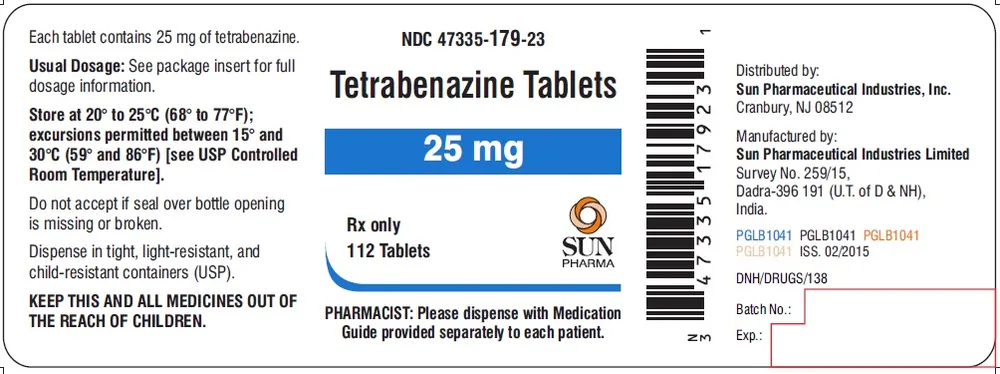
Table of Contents
- Package leaflet: Information for the patient
- Tetrabenazina SUN 12.5 mg tablets, 25 mg tablets
- 1. What is Tetrabenazine SUN and what is it used for?
- 2. What you need to know before taking Tetrabenazine SUN
- 3. How to take Tetrabenazina SUN
- 4. Possible side effects
- 5. How to store Tetrabenazina SUN
- 6. Contents of the pack and other information
Package leaflet: Information for the patient
Tetrabenazina SUN 12.5 mg tablets, 25 mg tablets
Tetrabenazine
Equivalent medicine (only for the 25 mg strength)
Please read this leaflet carefully before taking this medicine because it contains important information for you.
- Keep this leaflet. You may need to read it again.
- If you have any questions, ask your doctor or pharmacist.
- This medicine has been prescribed for you only. Do not give it to other people, even if their symptoms are the same as yours, because it may be harmful.
- If you experience any side effect, including those not listed in this leaflet, contact your doctor or pharmacist. See section 4.
Contents of this leaflet:
- What Tetrabenazina SUN is and what it is used for
- What you need to know before taking Tetrabenazina SUN
- How to take Tetrabenazina SUN
- Possible side effects
- How to store Tetrabenazina SUN
- Contents of the pack and other information
1. What is Tetrabenazine SUN and what is it used for?
Tetrabenazine SUN belongs to a group of medicines used in the treatment of disorders of the nervous system.
Tetrabenazine SUN is used in the treatment of disorders causing involuntary, spasmodic, irregular movements (hyperkinetic movement disorders associated with Huntington's chorea).
2. What you need to know before taking Tetrabenazine SUN
Do not take Tetrabenazine SUN
- if you are allergic (hypersensitive) to tetrabenazine or to any of the other ingredients of this medicine (listed in section 6);
- if you are taking reserpine (a medicine used to control high blood pressure and to treat psychotic states);
- if you are using monoamine oxidase inhibitors (MAO inhibitors) (medicines used to treat depression);
- if you have been diagnosed with parkinsonism or akinetic-rigid syndrome. Symptoms of parkinsonism include hand tremors or sudden jerky movements of the arms and legs;
- if you have been diagnosed with depression that has not been treated or has been difficult to treat;
- if you have suicidal impulses (suicidal tendencies);
- if you are breastfeeding;
- if you have liver problems;
- if you have been diagnosed with phaeochromocytoma (a tumor of the adrenal gland);
- if you have prolactin-dependent tumors, such as breast or pituitary cancer.
Warnings and precautions
Talk to your doctor or pharmacist before taking Tetrabenazine SUN:
- if you know you have reduced or intermediate activity of an enzyme called CYP2D6, as your doctor may prescribe you a different dose;
- if you suffer from mild to severe liver problems;
- if you have a heart condition known as congenital long QT syndrome or if you have or have had cardiac arrhythmias;
- if you have recently experienced chest pain or heart disease;
- if you have ever had hand tremors or sudden jerky movements of the arms and legs, known as parkinsonism. If you begin to experience mental changes such as confusion or hallucinations, or develop muscle stiffness and fever, you may be developing a condition called Neuroleptic Malignant Syndrome. If you experience these symptoms, contact your doctor immediately;
- if you have been diagnosed with depression or have thought about or attempted suicide;
- if you have ever suffered from depression;
- if you start to display angry or aggressive behaviors;
- if you feel restless, agitated, or have difficulty staying still;
- if you experience drowsiness or fatigue;
- if you feel dizzy or lightheaded when standing up; a drop in blood pressure may occur under certain conditions in patients treated with tetrabenazine (e.g., when rising from a lying position). Inform your doctor if you have been told you have low blood pressure (associated with symptoms such as dizziness, headache, rapid heartbeat, or fainting);
- if you suffer from hyperprolactinaemia (higher than normal blood levels of the hormone prolactin, the hormone responsible for lactation);
- if you start to have difficulty swallowing;
- if you develop a reaction involving worm-like movements of the tongue or other uncontrolled movements of the mouth, tongue, cheeks, or jaw, which may progress to the arms and legs (tardive dyskinesia);
- if you start to experience mental changes such as confusion or hallucinations, or develop muscle rigidity and fever, you may develop a condition called Neuroleptic Malignant Syndrome. If you experience these symptoms, please contact your doctor immediately;
- if you have problems digesting certain sugars, such as galactose.
Tetrabenazine and its metabolites can bind to melanin-containing tissues, where they accumulate over time. Therefore, tetrabenazine may cause damage to these tissues with long-term use.
Although there are no specific recommendations for regular ophthalmological examinations, prescribing physicians should be aware of the potential long-term effects of tetrabenazine on the eyes.
In clinical studies with tetrabenazine, no clinically significant changes in laboratory parameters were reported. In controlled clinical trials, tetrabenazine caused a slight increase in ALT and AST values compared to placebo.
Other medicines and Tetrabenazine SUN
Inform your doctor or pharmacist if you are taking, have recently taken, or might take any other medicines.
Taking other medicines
Do not take Tetrabenazine SUN with reserpine.
Treatment with MAO inhibitors must be discontinued 14 days before starting treatment with Tetrabenazine SUN, and MAO inhibitors must not be used until 14 days after stopping treatment with Tetrabenazine SUN.
Talk to your doctor or pharmacist before taking Tetrabenazine SUN together with:
- levodopa (a medicine used to treat Parkinson's disease);
- certain antidepressants, opioids, beta-blockers, antihypertensive medicines (medicines used to treat high blood pressure), hypnotics, and neuroleptics (medicines used to treat psychotic disorders);
- CYP2D6 inhibitors (e.g., fluoxetine, paroxetine, duloxetine, terbinafine, moclobemide, quinidine, amiodarone, or sertraline). Using these with tetrabenazine may increase plasma concentrations of the active metabolite dihydrotetrabenazine; therefore, they should be used with caution. A reduction in the tetrabenazine dose may be necessary;
- medicines known to prolong the QTc interval on ECG, including certain medicines used to treat mental health conditions (neuroleptics), certain antibiotics (e.g., gatifloxacin, moxifloxacin), and certain medicines used to treat heart rhythm problems (e.g., quinidine, procainamide, amiodarone, sotalol).
Tetrabenazine SUN and alcohol
Drinking alcohol while taking Tetrabenazine SUN may result in abnormal sedative effects.
Pregnancy, breastfeeding, and fertility
If you are pregnant, think you may be pregnant, planning to become pregnant, or breastfeeding, consult your doctor or pharmacist before taking this medicine.
Your doctor will decide, after evaluating all risks and benefits, whether you can take Tetrabenazine SUN during pregnancy.
Tetrabenazine SUN must not be taken during breastfeeding. If treatment with tetrabenazine is necessary, breastfeeding must be discontinued.
Animal studies with tetrabenazine have not shown effects on pregnancy or intrauterine survival. Female menstrual cycles were prolonged, and delayed fertility was observed.
Driving and using machines
Tetrabenazine SUN may affect your ability to drive or use machinery, as it may cause drowsiness.
Tetrabenazine SUN contains lactose
This medicine contains lactose. If you have been diagnosed with an intolerance to certain sugars, contact your doctor before taking this medicine.
Tetrabenazine SUN contains sodium
This medicine contains less than 1 mmol (23 mg) of sodium per tablet, i.e., essentially 'sodium-free'.
3. How to take Tetrabenazina SUN
Take this medicine exactly as instructed by your doctor or pharmacist. If you have any doubts, consult your doctor or pharmacist.
Adults
The recommended starting dose is 12.5 mg one to three times daily. This dose may be increased by 12.5 mg every three to four days, depending on the response to treatment.
The maximum daily dose is eight 25 mg tablets or sixteen 12.5 mg tablets (totaling 200 mg).
If you have taken the maximum dose for a period of seven days and your condition has not improved, it is unlikely that the medicine will benefit you.
Take the tablets with water or another non-alcoholic drink.
Use in elderly patients
The standard dosage has been administered to elderly patients without apparent adverse effects. Parkinson-like reactions are quite common in these patients.
Use in children
Treatment is not recommended in children.
Patients with liver disorders
Patients with mild to moderate hepatic impairment should start therapy with 12.5 mg per day. Additional caution is required in patients with severe hepatic impairment.
Patients with renal impairment
The use of Tetrabenazina SUN is not recommended in this patient group.
If you take more Tetrabenazina SUN than you should
If you take too many tablets or if someone accidentally takes your medicine, contact your doctor, pharmacist, or nearest hospital immediately. Symptoms of overdose include uncontrollable muscle spasms affecting the eyes, head, neck, and body, uncontrolled eye movements, excessive blinking, nausea, vomiting, diarrhoea, sweating, dizziness, feeling cold, confusion, hallucinations, drowsiness, flushing/inflammation, and tremor.
If you forget to take Tetrabenazina SUN
Do not take a double dose to make up for the missed dose. Continue treatment with the next scheduled dose as usual.
If you stop taking Tetrabenazina SUN
Do not stop taking Tetrabenazina SUN without first consulting your doctor. A Neuroleptic Malignant Syndrome (NMS) has been reported after abrupt discontinuation of tetrabenazine (see section 4, Possible side effects, “Rare”).
If you have any questions about the use of this medicine, ask your doctor or pharmacist.
4. Possible side effects
Like all medicines, this medicine can cause side effects, although not everyone will experience them.
Serious side effects
Contact your doctor or go immediately to the nearest hospital emergency department if you experience any of the following side effects:
Very common (may affect more than 1 in 10 people)
- Tetrabenazine SUN may cause depression, which in some people can lead to suicidal thoughts. If you feel low or very sad, you may be becoming depressed and should inform your doctor of this change.
- if you develop tremors or uncontrollable movements in your hands, arms, legs, or head, drool, have difficulty swallowing, or experience balance problems, you may have a condition called parkinsonism. If you experience any of these problems, contact your doctor.
Rare (may affect up to 1 in 1,000 people)
- if you begin to experience mental disturbances such as confusion or hallucinations, or develop muscle stiffness and fever, you may be developing a condition called neuroleptic malignant syndrome. If you experience these symptoms, contact your doctor immediately;
Very rare (may affect up to 1 in 10,000 people)
- if you have attempted suicide
- if you have harmed yourself intentionally or have started thinking about intentionally harming yourself
Frequency not known (cannot be estimated from the available data)
- if you have a severe increase in blood pressure (hypertensive crisis).
- If you feel restless and unable to stay still, you may have a condition called akathisia. If you feel this way, contact your doctor.
Other side effects
Very common (may affect more than 1 in 10 people)
- drowsiness (with high doses)
- tremor
- excessive salivation
Common (may affect up to 1 in 10 people)
- confusion
- anxiety
- insomnia
- agitation
- decreased appetite
Very rare (may affect up to 1 in 10,000 people)
- pneumonia
- leucopenia
- rage
- aggression
- dehydration
- uncontrollable muscle spasms affecting the eyes
- sensitivity to sunlight
- rash
- itching
- hives
- weight loss
- falls
Frequency not known (frequency cannot be estimated from the available data)
- disorientation
- nervousness
- nervous restlessness
- sleep disorders
- clumsiness and lack of coordination affecting balance, gait, limb or eye movements, and/or speech (ataxia)
- uncontrollable and sometimes painful muscle spasms (dystonia)
- dizziness
- memory loss
- slowing of the heartbeat (bradycardia)
- low blood pressure
- sudden dizziness and fainting when standing up (postural hypotension)
- dysphagia (difficulty swallowing)
- nausea
- vomiting
- diarrhoea
- constipation
- stomach pain
- dry mouth
- excessive sweating (hyperhidrosis)
- irregular menstrual cycle
- fatigue
- weakness
- low body temperature (hypothermia)
- increased appetite
- weight gain
Reporting of side effects
If you experience any side effect, including those not listed in this leaflet, tell your doctor, pharmacist, or nurse.
You can also report side effects directly via the national reporting system at: https://www.aifa.gov.it/content/segnalazioni-reazioni-avverse.
By reporting side effects, you can help provide more information on the safety of this medicine.
5. How to store Tetrabenazina SUN
Keep this medicine out of the sight and reach of children.
Do not use this medicine after the expiry date stated on the label after Exp. The expiry date refers to the last day of that month.
This medicine does not require any special storage conditions.
Do not dispose of medicines via wastewater or household waste. Ask your pharmacist how to dispose of medicines you no longer use. This will help protect the environment.
6. Contents of the pack and other information
What Tetrabenazina SUN contains
Tetrabenazina SUN 12.5 mg tablets
- The active substance is tetrabenazine. Each tablet contains 12.5 mg of tetrabenazine.
- The other components are: anhydrous lactose, maize starch, sodium starch glycolate, talc, anhydrous colloidal silica and magnesium stearate.
Tetrabenazina SUN 25 mg tablets
- The active substance is tetrabenazine. Each tablet contains 25 mg of tetrabenazine.
- The other components are: anhydrous lactose, maize starch, sodium starch glycolate, yellow iron oxide (E172), talc, anhydrous colloidal silica and magnesium stearate.
Description of the appearance of Tetrabenazina SUN and contents of the pack
Tetrabenazina SUN 12.5 mg tablets: This medicine is presented as white to off-white, round, flat tablets with bevelled edges, uncoated, engraved with "1" on one side and smooth on the other side.
Tetrabenazina SUN 25 mg tablets: This medicine is presented as yellow, round, flat tablets with bevelled edges, uncoated, engraved with "179" on one side and a score line on the other side. The tablet can be divided into equal parts.
Tetrabenazina SUN is available in a plastic container containing 112 tablets.
Marketing Authorisation Holder and Manufacturer
Sun Pharmaceutical Industries Europe B.V.
Polarisavenue 87
2132 JH - Hoofddorp
The Netherlands
Local representative:
Sun Pharma Italia S.r.l.
Viale Giulio Richard, 3
20143 Milano, Italy
This medicinal product is authorised in the European Economic Area (EEA) Member States and in the United Kingdom (Northern Ireland) under the following names:
Germany: Tetrabenazin-neuraxpharm 12.5 mg / 25 mg Tabletten
Italy: Tetrabenazina SUN 12.5 mg / 25 mg compresse
Netherlands: Tetrabenazine SUN 12.5 mg / 25 mg tabletten
Spain: Tetrabenazina SUN 25 mg comprimidos EFG
United Kingdom (Northern Ireland): Tetrabenazine 12.5 mg / 25 mg tablets