Tamsulosin Eg Stada
Italy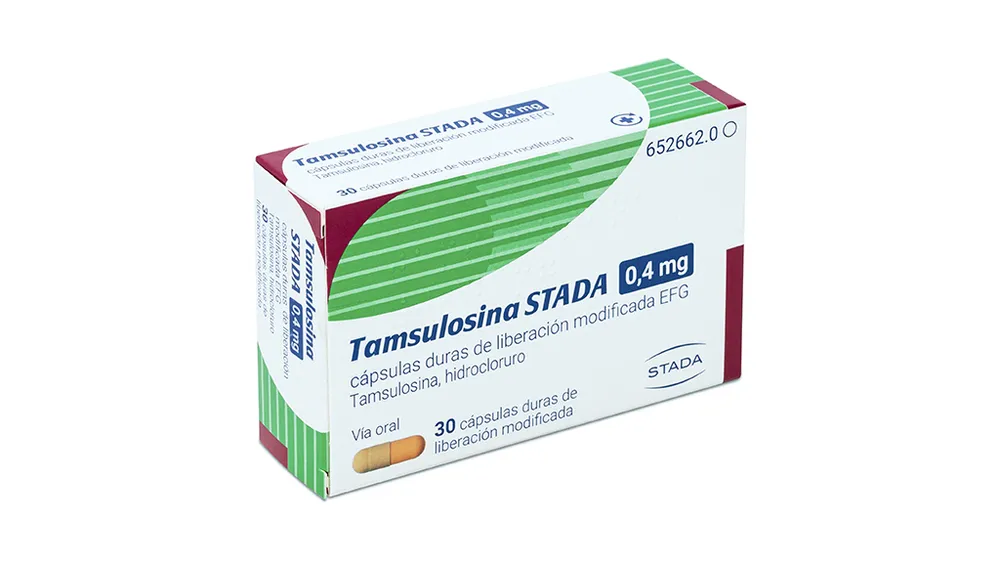
Table of Contents
- Package leaflet: Information for the patient
- Tamsulosin EG Stada 0.4 mg modified-release hard capsules
- 1. What Tamsulosina EG Stada is and what it is used for
- 2. What you need to know before taking Tamsulosina EG Stada
- 3. How to take Tamsulosin EG Stada
- 4. Possible side effects
- 5. How to store Tamsulosina EG Stada
- 6. Package contents and other information
Package leaflet: Information for the patient
Tamsulosin EG Stada 0.4 mg modified-release hard capsules
Generic medicine
Please read all of this leaflet carefully before you start taking this medicine because it contains important information for you.
- Keep this leaflet. You may need to read it again.
- If you have any questions, ask your doctor or pharmacist.
- This medicine has been prescribed for you only. Do not give it to others, even if their symptoms are the same as yours, as it may be harmful.
- If you experience any side effects, including those not listed in this leaflet, tell your doctor or pharmacist. See section 4.
Contents of this leaflet
- What Tamsulosin EG Stada is and what it is used for
- What you need to know before taking Tamsulosin EG Stada
- How to take Tamsulosin EG Stada
- Possible side effects
- How to store Tamsulosin EG Stada
- Contents of the pack and other information
1. What Tamsulosina EG Stada is and what it is used for
The active substance of Tamsulosina EG Stada is tamsulosin. It is a selective antagonist of α₁A/α₁D-adrenergic receptors. It reduces the tone of the smooth muscle in the prostate and urethra, allowing urine to pass more easily through the urethra and facilitating urination. It also reduces the sensation of urinary urgency.
Tamsulosina EG Stada is used in men for the treatment of lower urinary tract symptoms associated with an enlarged prostate gland (benign prostatic hyperplasia). These symptoms may include difficulty urinating (weak stream), urine leakage, urgency, and the need to urinate frequently during both day and night.
2. What you need to know before taking Tamsulosina EG Stada
Do not take Tamsulosina EG Stada
- if you are allergic to tamsulosin or to any of the other ingredients of this medicine (listed in section 6). Hypersensitivity may present as sudden local swelling of soft tissues of the body (e.g., throat or tongue), difficulty in breathing and/or itching and skin rash (angioedema).
- if you have severe liver problems.
- if you suffer from fainting due to reduced blood pressure when changing posture (e.g., sitting up after lying down or standing up).
Warnings and precautions
Talk to your doctor or pharmacist before taking Tamsulosina EG Stada.
- Periodic medical check-ups are necessary to monitor the condition for which you are being treated.
- Fainting may rarely occur during treatment with Tamsulosina EG Stada, as with other medicines of this type.
- If you experience the first symptoms of dizziness or weakness, sit or lie down until symptoms disappear.
- Inform your doctor if you have severe kidney problems.
- If you are undergoing or have scheduled eye surgery due to lens opacity (cataract) or increased pressure inside the eye (glaucoma), inform your ophthalmologist that you have previously used, are currently using, or plan to use Tamsulosina EG Stada. This will allow the specialist to take appropriate precautions regarding medications and surgical techniques. Ask your doctor whether it may be possible to delay or temporarily interrupt treatment when undergoing eye surgery due to lens opacity (cataract) or increased intraocular pressure (glaucoma).
Children and adolescents
Do not administer this medicine to children or adolescents under 18 years of age, as it is not effective
in this population.
Other medicines and Tamsulosina EG Stada
Inform your doctor or pharmacist if you are taking, have recently taken, or might take any
other medicine.
Taking Tamsulosina EG Stada together with other medicines belonging to the same class (α₁-adrenergic receptor antagonists) may cause an undesirable drop in blood pressure.
It is particularly important to inform your doctor if you are taking concomitantly medicines that
may reduce the elimination of Tamsulosina EG Stada from the body (e.g., ketoconazole,
erythromycin).
Tamsulosina EG Stada with food and drinks
Tamsulosina EG Stada should be taken after breakfast or after the first meal of the day.
Pregnancy, breastfeeding and fertility
This section is not applicable, as Tamsulosina EG Stada is intended exclusively for male patients.
In men, abnormal ejaculation (ejaculation disorder) has been reported. This means that semen does not exit the body through the urethra but enters the bladder (retrograde ejaculation), or that the volume of ejaculate is reduced or absent (absence of ejaculation). This phenomenon is harmless.
Driving and using machines
There are no reasons to believe that Tamsulosina EG Stada may affect the ability to drive vehicles or
use machines or equipment. However, you should bear in mind that dizziness may occur; in such a case, activities requiring attention should not be performed.
3. How to take Tamsulosin EG Stada
Take this medicine exactly as your doctor or pharmacist has told you. If you are unsure, consult your doctor or pharmacist.
The recommended dose is 1 capsule per day, to be taken after breakfast or after the first meal of the day.
The capsule must be swallowed whole and must not be crushed or chewed. Usually, Tamsulosin EG Stada is prescribed for a long period of time. The effects on the bladder and urination are maintained during long-term treatment with Tamsulosin EG Stada.
If you take more Tamsulosin EG Stada than you should
Taking too much Tamsulosin EG Stada may cause an unwanted drop in blood pressure and an increased heart rate, with feelings of fainting. If you have taken an excessive amount of Tamsulosin EG Stada, contact your doctor immediately.
If you forget to take Tamsulosin EG Stada
If you have forgotten to take your daily recommended dose, you may take Tamsulosin EG Stada later on the same day. If the day has already passed, simply continue taking your daily capsule as prescribed.
Do not take a double dose to make up for the forgotten capsule.
If you stop taking Tamsulosin EG Stada
If treatment with Tamsulosin EG Stada is stopped prematurely, the initial symptoms may return. Therefore, take Tamsulosin EG Stada for the full duration prescribed by your doctor, even if your symptoms have already improved. If you are considering stopping the treatment, always consult your doctor first.
If you have any doubts about how to use this medicine, consult your doctor or pharmacist.
4. Possible side effects
Like all medicines, this medicine can cause side effects, although not everyone experiences them.
Stop taking the medicine and contact your doctor immediately if you experience any of the following allergic reactions:
- difficulty breathing;
- swelling of the face, tongue or throat (angioedema);
- itching and skin rash.
Common (may affect up to 1 in 10 people)
- dizziness;
- abnormal ejaculation (ejaculation disorders). This means that semen does not leave the body through the urethra, but instead enters the bladder;
- retrograde ejaculation;
- or that the volume of ejaculate is reduced or absent (absence of ejaculation). This phenomenon is harmless.
Uncommon (may affect up to 1 in 100 people)
- headache;
- irregular or rapid heartbeat;
- dizziness, especially when standing up (orthostatic hypotension);
- runny or blocked nose;
- constipation;
- diarrhoea;
- nausea (feeling sick);
- vomiting;
- skin rash;
- itching and hives;
- feeling weak.
Rare (may affect up to 1 in 1,000 people)
- fainting.
Very rare (may affect up to 1 in 10,000 people)
- painful, prolonged, involuntary erection (priapism);
- a severe inflammatory rash of the skin and/or mucous membranes of the lips, eyes, mouth, nasal passages or genitals, which is an allergic reaction to medicines or other substances known as Stevens-Johnson syndrome.
Not known (frequency cannot be estimated from the available data)
- nosebleed;
- blurred vision, visual disturbance;
- dry mouth;
- severe skin rashes (erythema multiforme, exfoliative dermatitis).
If you are about to undergo eye surgery due to clouding of the lens (cataract) or increased intraocular pressure (glaucoma) and you are currently taking or have previously taken tamsulosin hydrochloride, the pupil may not dilate fully and the iris (the coloured circular part of the eye) may become floppy during the procedure (see section 2 “Warnings and precautions”).
In addition to the side effects listed above, the following have also been reported:
- very rapid and uncoordinated contractions of the heart;
- irregular heart rhythm;
- abnormally fast heartbeat; and
- breathing difficulties.
These side effects have been reported in association with the use of tamsulosin hydrochloride. Since these adverse reactions have been reported spontaneously in the context of post-marketing experience worldwide, their frequency and the role of tamsulosin hydrochloride in their occurrence cannot be determined with certainty.
Reporting of side effects
If you experience any side effect, including those not listed in this leaflet, talk to your doctor or pharmacist. You can also report side effects directly via the national reporting system at https://www.aifa.gov.it/content/segnalazioni-reazioni-avverse.
By reporting side effects, you can help provide more information on the safety of this medicine.
5. How to store Tamsulosina EG Stada
Keep this medicine out of the sight and reach of children.
This medicine does not require any special storage conditions.
Do not use this medicine after the expiry date stated on the blister, bottle and carton after "Exp.". The expiry date refers to the last day of that month.
Do not dispose of any medicine via wastewater or household waste. Ask your pharmacist how to dispose of medicines you no longer use. This will help protect the environment.
6. Package contents and other information
What Tamsulosina EG Stada contains
Each capsule contains 0.4 mg of tamsulosin hydrochloride.
The other components are:
Granules: methacrylic acid-ethyl acrylate copolymer (1:1) dispersion 30 percent *, microcrystalline cellulose, dibutyl sebacate, polysorbate 80 (E433).
Coating layer: methacrylic acid-ethyl acrylate copolymer (1:1) dispersion 30 percent *, dibutyl sebacate, polysorbate 80 (E433), hydrated colloidal silica, calcium stearate.
Hard gelatin capsule: red iron oxide (E172), titanium dioxide (E171), yellow iron oxide (E172), black iron oxide (E172), indigotine – FD&C Blue 2 (E132), gelatin.
*The dispersion contains 0.7% sodium lauryl sulfate Ph. Eur./NF and 2.3% polysorbate 80 Ph. Eur./NF on the solid substance, as emulsifiers.
Description of the appearance of Tamsulosina EG Stada and package contents
Tamsulosina EG Stada is supplied as hard capsules approximately 15.6–16.2 mm in size, opaque, with an orange body and olive-green cap. Tamsulosina EG Stada is available in PVC/PVdC-Al blister packs or in HDPE bottles, both contained in a cardboard carton.
PVC/PVDC-aluminum blister packs contain 10, 20, 30, 50, 90 or 100 capsules.
Unit-dose divisible PVC/PVDC-aluminum blisters contain 10 x 1, 20 x 1, 30 x 1, 50 x 1, 90 or 100 x 1 capsules. HDPE bottles contain 30, 35, 50, 60, 90, 100, 112 or 200 capsules.
Not all pack sizes may be marketed.
Marketing Authorization Holder
EG S.p.A., via Pavia 6, 20136 Milano, Italy
Manufacturers
Laboratorios Liconsa S.A., Avda. Miralcampo 7, Pol. Ind. Miralcampo, Azuqueca de Henares (Guadalajara) 19200 - Spain
STADA Arzneimittel AG, Stadastrasse 2-18, Bad Vilbel 61118 – Germany
This medicinal product is authorized in the European Economic Area countries under the following names:
AT Tamsulosin STADA 0.4 mg modified release hard capsules
BE Tamsulosine Eurogenerics 0.4 mg capsules with prolonged release, hard
HU Tamsulosin Stada Arzneimittel 0.4 mg modified release hard capsule
IT Tamsulosina EG STADA
LU Tamsulosine Eurogenerics 0.4 mg gélules à libération modifiée