Sciomir
Italy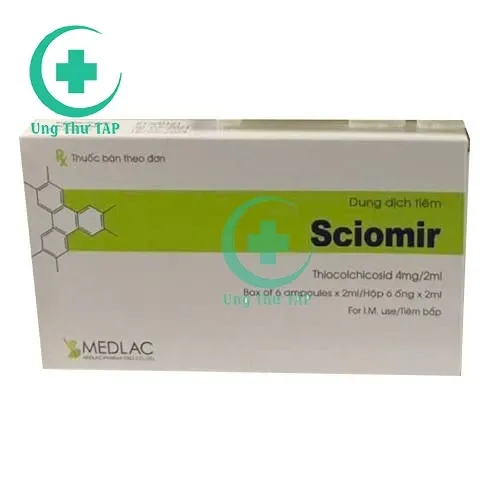
Instructions for Use
Package leaflet: Information for the patient
Sciomir 2 mg/ml injectable solution
Tiocolchicoside
Generic medicine
Please read this leaflet carefully before using this medicine because it contains
important information for you.
- Keep this leaflet. You may need to read it again.
- If you have any questions, ask your doctor, pharmacist or nurse.
- This medicine has been prescribed for you only. Do not give it to other people, even if their symptoms are the same as yours, as it may be harmful.
- If you experience any side effects, including those not listed in this leaflet, tell your doctor, pharmacist or nurse. See section 4.
Contents of this leaflet:
- What Sciomir is and what it is used for
- What you need to know before using Sciomir
- How to use Sciomir
- Possible side effects
- How to store Sciomir
- Contents of the pack and other information
1. What Sciomir is and what it is used for
Sciomir contains the active substance tiocolchicoside. This medicine belongs to a group of
medicines called centrally-acting muscle relaxants (i.e. those acting directly on the Central
Nervous System – CNS).
Sciomir is used as an adjunctive treatment for painful muscular spasms associated with acute
spinal disorders in adults and adolescents from 16 years of age.
2. What you need to know before using Sciomir
Do not use Sciomir
- if you are allergic to tiocolchicoside or to any of the other ingredients of this medicine (listed in section 6);
- if you are pregnant, suspect you may be pregnant, or are planning a pregnancy (see "Pregnancy, breastfeeding and fertility");
- if you are breastfeeding (see "Pregnancy, breastfeeding and fertility");
- if you are a woman of childbearing potential and you do not use effective contraceptive measures (during treatment and for one month after the end of treatment);
- if you are a man who does not use effective contraceptive measures (during treatment and for three months after the end of treatment);
- if you have flaccid paralysis (progressive muscle paralysis) or muscular hypotonia (reduced muscle tone);
- if you have coagulation disorders (your body is unable to stop bleeding spontaneously);
- if you are being treated with blood-thinning medicines (anticoagulants) (see "Other medicines and Sciomir");
- if you are a child or adolescent under 16 years of age (see "Children and adolescents").
Warnings and precautions
Talk to your doctor, pharmacist or nurse before using Sciomir.
Your doctor will inform you about the need to use effective contraception and the potential risks in case of pregnancy (see "Do not use Sciomir" and "Pregnancy, breastfeeding and fertility").
Avoid taking higher doses than recommended or using Sciomir for prolonged periods (see "How to use Sciomir").
Patients should be informed to stop treatment and contact their doctor if they develop signs and symptoms of liver damage.
The use of this medicine at doses higher than the recommended dose or long-term use should be avoided.
At the beginning of treatment, you must be thoroughly informed about the potential risk of pregnancy and the need to use effective contraceptive measures.
Be especially careful with Sciomir:
- if you suffer from epilepsy or are at risk of seizures, as Sciomir may trigger epileptic seizures in these patients;
- if you have impaired kidney and/or liver function (renal and/or hepatic insufficiency).
If you experience symptoms that may indicate liver damage during treatment with Sciomir (e.g., loss of appetite, nausea, vomiting, abdominal pain, fatigue, dark urine, jaundice, itching), you must stop taking/using Sciomir and contact your doctor immediately if any of these symptoms occur.
If the medicine is administered intramuscularly (into the muscle), you should be monitored due to episodes of vasovagal syncope (temporary loss of consciousness) (see "Possible side effects").
Children and adolescents
Do not administer this medicine to children and adolescents under 16 years of age due to safety concerns (see "Do not use Sciomir").
Other medicines and Sciomir
Inform your doctor or pharmacist if you are taking, have recently taken, or might take any other medicines.
Do not use Sciomir if you are taking medicines that thin the blood (anticoagulants) (see "Do not use Sciomir").
Pregnancy, breastfeeding and fertility
If you are pregnant, suspect you may be pregnant, plan to become pregnant, or are breastfeeding, consult your doctor or pharmacist before using this medicine.
Pregnancy, breastfeeding and fertility
Do not use this medicine if:
- you are pregnant, suspect you are pregnant, or may become pregnant (see "Do not use Sciomir");
- you are breastfeeding, as the medicine passes into breast milk (see "Do not use Sciomir");
- you are a woman of childbearing potential and do not use effective contraceptive measures, or you are a man who does not use effective contraceptive measures (see "Do not use Sciomir").
This medicine may harm the unborn baby.
Contraception in women and men
Women of childbearing potential must use effective contraceptive measures during treatment with Sciomir and for 1 month after completion of treatment.
Sciomir and its metabolites may harm the fetus if used during pregnancy. If you become pregnant or suspect you are pregnant during treatment with Sciomir, contact your doctor immediately.
Men must use effective contraception and be advised not to father a child during treatment with Sciomir and for 3 months after stopping treatment (see "Do not use Sciomir").
Sodium
This medicine contains less than 1 mmol (23 mg) of sodium per vial, i.e. essentially "sodium-free".
Driving and using machines
No studies on the ability to drive vehicles or use machinery have been conducted.
Since drowsiness is a common occurrence, this should be taken into account when driving or operating machinery.
3. How to use Sciomir
Use this medicine exactly as instructed by your doctor or pharmacist. If you have
any doubts, consult your doctor or pharmacist.
The recommended maximum dose is 1 vial (4 mg) every 12 hours (i.e. 8 mg per day). The duration of
treatment must not exceed 5 consecutive days.
Do not exceed the recommended doses or the recommended duration of treatment.
This medicine must not be used for long periods of time (see “Warnings and
precautions”).
Method of administration
Sciomir is administered by intramuscular injection (into the muscle).
Use in children and adolescents
Sciomir must not be used in children and adolescents under 16 years of age due to
safety concerns.
If you use more Sciomir than you should
In case of accidental overdose, contact your doctor immediately or go to the nearest hospital.
If you forget to use Sciomir
Do not use a double dose to make up for a forgotten dose.
If you have any doubts about how to use this medicine, consult your doctor, pharmacist or
nurse.
4. Possible side effects
Like all medicines, this medicine can cause side effects, although not everybody gets them.
The following side effects may occur:
After intramuscular administration, rare cases of malaise have been reported, sometimes associated or not with low blood pressure (hypotension) and/or loss of consciousness. Rarely, a state of agitation or temporary loss of sensory and intellectual functions (transient obnubilation) has also been reported after parenteral (injection) administration. Drowsiness is a common occurrence. Infrequent cases of rash and cutaneous erythema are known.
Common (may affect up to 1 in 10 people):
- drowsiness
Uncommon (may affect up to 1 in 100 people):
- pruritus
- allergic skin reactions
Rare (may affect up to 1 in 1,000 people):
- urticaria
- angioedema
- rash (skin eruption)
- skin redness (cutaneous erythema)
- agitation and temporary loss of sensory and intellectual functions (transient obnubilation)
- malaise, with or without fainting (vasovagal syncope), within minutes following intramuscular administration
Very rare (may affect up to 1 in 10,000 people):
- low blood pressure (hypotension) and anaphylactic shock after intramuscular administration
Not known (frequency cannot be estimated from the available data):
- seizures
- drug-induced liver injury
Following the instructions provided in this leaflet reduces the risk of side effects.
Reporting of side effects
If you experience any side effect, including those not listed in this leaflet, talk to your doctor, pharmacist, or nurse. You can also report side effects directly via the national reporting system at www.aifa.gov.it/content/segnalazioni-reazioni-avverse.
By reporting side effects, you can help provide more information on the safety of this medicine.
5. How to store Sciomir
Keep this medicine out of the sight and reach of children.
Do not use this medicine after the expiry date stated on the packaging after "exp". The expiry date refers to the last day of that month. The expiry date applies to the product in its original, unopened packaging and properly stored.
Do not dispose of any medicine via wastewater or household waste. Ask your pharmacist how to dispose of medicines you no longer use. This will help protect the environment.
6. Package contents and other information
What Sciomir contains
- The active substance is tiocolchicoside. Each 2 ml vial contains 4 mg of tiocolchicoside.
- The other components are: sodium chloride, water for injections.
Description of the appearance of Sciomir and contents of the pack
Sciomir is a solution for injection.
The pack contains 6 glass vials for the 4 mg/2 ml dose.
Marketing Authorization Holder
Laboratorio Farmaceutico C.T. S.r.l. – Via Dante Alighieri, 71 – 18038 Sanremo (IM)
Manufacturer
Laboratorio Farmaceutico C.T. S.r.l. - Via Dante Alighieri, 71 - 18038 Sanremo (IM)
Similar Medications
-
Decontril
Form: solution for injection
Active substance Dosage TIOCOLCHICOSIDE — Manufacturer: S.F. GROUP S.R.L.
-
Miorexil
Form: solution for injection
Active substance Dosage TIOCOLCHICOSIDE — Manufacturer: SPA SOCIETA' PRODOTTI ANTIBIOTICI S.P.A.
-
Miotens
Form: solution for injection
Active substance Dosage TIOCOLCHICOSIDE — Manufacturer: DOMPE' FARMACEUTICI S.P.A.
-
Muscoflex
Form: solution for injection
Active substance Dosage TIOCOLCHICOSIDE — Manufacturer: EPIFARMA S.R.L
-
Muscoril
Form: solution for injection
Active substance Dosage TIOCOLCHICOSIDE — Manufacturer: DOC GENERICI SRL
-
Strialisin
Form: solution for injection
Active substance Dosage TIOCOLCHICOSIDE — Manufacturer: NEOPHARMED GENTILI S.P.A.
-
Tiocolchicoside Doc Generici
Form: solution for injection
Active substance Dosage TIOCOLCHICOSIDE — Manufacturer: DOC GENERICI SRL
-
Tiocolchicoside Eg
Form: solution for injection
Active substance Dosage TIOCOLCHICOSIDE — Manufacturer: EG S.P.A.
-
Tiocolchicoside Mylan Generics
Form: solution for injection
Active substance Dosage TIOCOLCHICOSIDE — Manufacturer: MYLAN S.P.A.
This page has been machine-translated and may contain inaccuracies. The original data is available in the manufacturing country's language.
Last data check: May 11, 2026 · Data source: Agenzia Italiana del Farmaco (AIFA)