Miotens
Italy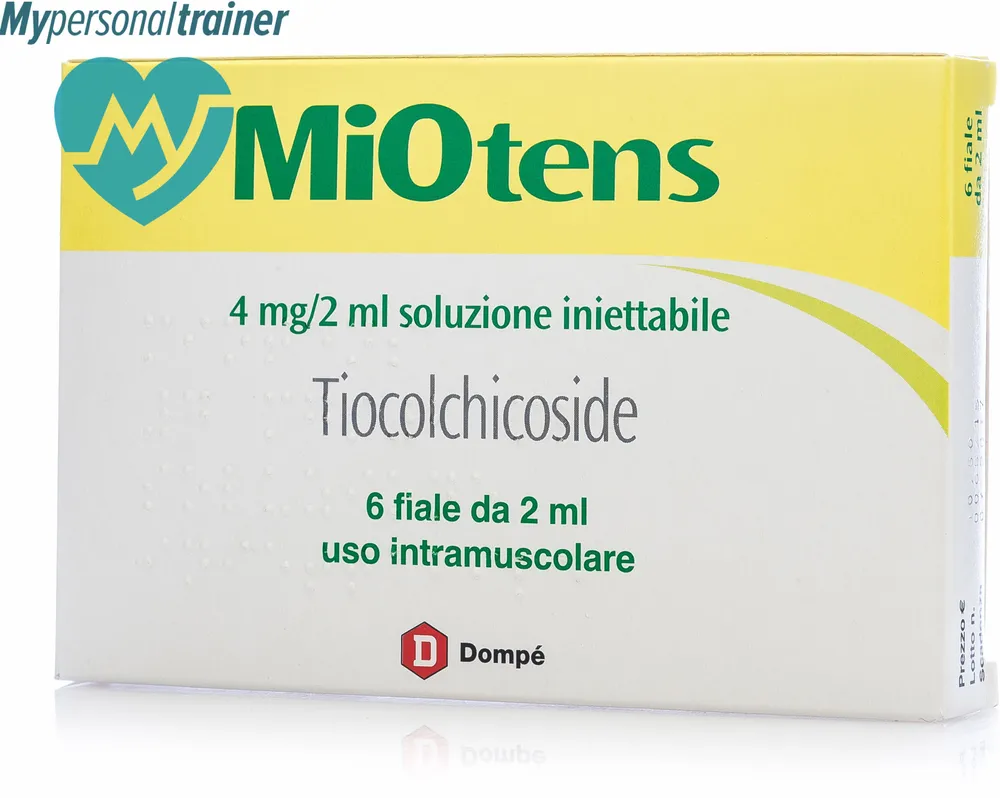
Table of Contents
- Package leaflet: Information for the patient
- Miotens 4 mg/2 ml injectable solution for intramuscular use
- 1. What Miotens is and what it is used for
- 2. What you need to know before using Miotens
- 3. How to use Miotens
- 4. Possible side effects
- 5. How to store Miotens
- 6. Package contents and other information
Package leaflet: Information for the patient
Miotens 4 mg/2 ml injectable solution for intramuscular use
tiocolchicoside
Please read this leaflet carefully before using this medicine because it contains important information for you.
- Keep this leaflet. You may need to read it again.
- If you have any questions, consult your doctor, pharmacist, or nurse.
- This medicine has been prescribed for you only. Do not give it to other people, even if their symptoms are the same as yours, as it may be harmful.
- If you experience any side effects, including those not listed in this leaflet, consult your doctor or pharmacist. See section 4.
Contents of this leaflet:
- What Miotens is and what it is used for
- What you need to know before using Miotens
- How to use Miotens
- Possible side effects
- How to store Miotens
- Contents of the pack and other information
1. What Miotens is and what it is used for
Miotens is a centrally-acting muscle relaxant (it acts directly on the Central Nervous System – CNS) containing the active substance tiocolchicoside.
This medicine is administered by intramuscular injection for the adjunctive treatment of painful muscle spasms associated with acute spinal disorders, in adults and adolescents from the age of 16 years.
2. What you need to know before using Miotens
Do not use Miotens
- if you are allergic to tiocolchicoside or to any of the other ingredients of this medicine (listed in section 6);
- if you suffer from flaccid paralysis (progressive paralysis affecting the muscles) or muscular hypotonia (reduced muscle tone);
- if you are pregnant, suspect you may be pregnant, are planning a pregnancy, or are breastfeeding (see subsection “Pregnancy, breastfeeding and fertility”);
- if you are a woman of childbearing potential who is not using effective contraceptive methods (during treatment and for one month after stopping treatment);
- if you are a man who is not using effective contraceptive measures (during treatment and for three months after stopping treatment).
Warnings and precautions
Talk to your doctor or pharmacist before using Miotens.
Before starting treatment with Miotens, your doctor or pharmacist will inform you about the potential risks related to a possible pregnancy and the need to use effective contraception.
Tiocolchicoside (the active substance in Miotens) may trigger epileptic seizures in patients with epilepsy or those at risk of seizures. Inform your doctor if you experience any of the following symptoms: epileptic seizures.
If you experience any adverse effects, consult your doctor, as it may be necessary to reduce the dose of the medicine (see section 4 “Possible side effects”).
Strictly follow the dosage and duration of treatment indicated in section 3 “How to use Miotens”.
Do not use higher doses than recommended and do not use Miotens for prolonged periods.
If you notice symptoms that may indicate liver damage during treatment with Miotens (e.g., loss of appetite, nausea, vomiting, abdominal pain, fatigue, dark urine, jaundice, itching), stop using Miotens and contact your doctor immediately if any of these symptoms occur.
Special warnings
Preclinical studies have shown that one of the metabolites of tiocolchicoside (SL59.0955) induced aneuploidy (an abnormal number of chromosomes in dividing cells) at concentrations close to human exposure observed with oral doses of 8 mg twice daily. Aneuploidy is considered a risk factor for teratogenicity (potential to cause fetal malformations or abnormal development), embryo/fetal toxicity, spontaneous abortion, impaired male fertility, and as a potential risk factor for cancer. As a precautionary measure, the use of this medicine at doses higher than recommended or long-term use should be avoided (see section 3 “How to use Miotens”).
Children and adolescents
Miotens must not be administered to children and adolescents under 16 years of age due to safety concerns (see “Use in children and adolescents”).
Other medicines and Miotens
Tell your doctor, pharmacist, or nurse if you are taking, have recently taken, or might take any other medicines. No interactions with other medicines are known.
Pregnancy, breastfeeding and fertility
If you are pregnant, suspect you may be pregnant, planning a pregnancy, or breastfeeding, consult your doctor, pharmacist, or nurse before using this medicine.
Pregnancy
Data on the use of tiocolchicoside in pregnant women are limited. Therefore, the potential risks to the embryo and fetus are unknown. Animal studies have shown teratogenic effects. Miotens is contraindicated during pregnancy (see section 2 “What you need to know before using Miotens”).
Breastfeeding
The use of tiocolchicoside is contraindicated during breastfeeding because it is excreted in breast milk (see section 2 “What you need to know before using Miotens”).
Fertility
In a fertility study conducted in rats, no impairment of fertility was observed at doses up to 12 mg/kg, i.e., at dose levels that do not induce any clinical effects. Tiocolchicoside and its metabolites exhibit aneugenic activity (inducing aneuploidy, i.e., an abnormal number of chromosomes) at various concentration levels, which represents a risk factor for impaired human fertility. If you are a woman of childbearing potential not using effective contraception or a man not using effective contraceptive measures (see section 2 “What you need to know before using Miotens”).
Contraception in women and men
Women who are able to become pregnant must use an effective contraceptive method during treatment with Miotens and for 1 month after the end of treatment. Miotens and its metabolites may cause harm to the unborn child if used during pregnancy. If you become pregnant or suspect pregnancy during treatment with Miotens, consult your doctor immediately.
Men must use effective contraceptive measures and must be advised not to father a child during treatment with Miotens and for 3 months after stopping treatment (see section 2 “What you need to know before using Miotens”).
Driving and use of machines
This medicine may cause drowsiness (see section 4 “Possible side effects”).
Miotens contains sodium
This medicine contains less than 1 mmol (23 mg) of sodium per vial, i.e., it is practically 'sodium-free'.
3. How to use Miotens
Use this medicine exactly as instructed by your doctor or pharmacist. If you have any doubts, consult your doctor or pharmacist.
The recommended dose is 1 vial (4 mg) every 12 hours. The maximum daily dose is 2 vials (8 mg).
The duration of treatment must not exceed 5 consecutive days.
Warning: Do not exceed the recommended doses. Use Miotens only for short-term treatment periods (see section “Warnings and precautions”).
Instructions for administration of the injectable solution:
- open the vial along the dotted line;
- draw up the solution from each vial into a syringe and inject the contents intramuscularly.
Use in children and adolescents
Miotens must not be used in children and adolescents under 16 years of age due to safety concerns (see section “Children and adolescents”).
If you use more Miotens than you should
No cases of overdose have been reported.
In case of accidental ingestion of an excessive dose of Miotens, inform your doctor immediately or go to the nearest hospital.
If you forget to use Miotens
Do not use a double dose to make up for the missed dose.
If you have any doubts about the use of this medicine, consult your doctor or pharmacist.
4. Possible side effects
Like all medicines, this medicine can cause side effects, although not everyone gets them.
The following side effects, with frequency not known (cannot be estimated from the available data), are important and require immediate attention if they occur. Stop treatment
with this medicine and contact your doctor immediately if you experience any of the following:
- difficulty breathing or swallowing, swelling of the face, hands and feet, eyes, lips and/or tongue (angioedema);
- severe allergic reactions. Skin irritation, difficulty breathing, nausea, vomiting or diarrhoea, dizziness or loss of consciousness: these may be symptoms of a severe allergic reaction (anaphylactic shock).
Common (may affect up to 1 in 10 people)
- Drowsiness;
- diarrhoea;
- gastralgia (stomach ache).
Uncommon (may affect up to 1 in 100 people)
- Itching;
- nausea;
- vomiting;
- allergic skin reactions.
Rare (may affect up to 1 in 1,000 people)
- restlessness;
- transient mental confusion (temporary loss of sensory and intellectual functions);
- urticaria (allergic skin reaction characterised by raised, itchy rashes);
- pyrosis (burning sensation in the stomach).
Very rare (may affect up to 1 in 10,000 people)
- hypotension (low blood pressure).
Frequency not known (frequency cannot be estimated from the available data)
- swelling of the limbs, face, lips, throat and/or tongue (angioedema), severe allergic reactions (anaphylactic shock);
- malaise, with or without vasovagal syncope (fainting), occurring in the minutes following intramuscular administration, seizures (see section 2);
- liver inflammation (hepatitis) (see section 2);
- injection site reactions, including pain, redness, swelling, itching, spots. These reactions may worsen with darkening and death of the skin and underlying tissues surrounding the injection site, followed by healing with scarring; this condition is also known as Nicolau syndrome.
Reporting of side effects
If you experience any side effect, including those not listed in this leaflet, talk to your doctor or pharmacist. You can also report side effects directly via the national reporting system at https://www.aifa.gov.it/content/segnalazioni-reazioni-avverse.
By reporting side effects, you can help provide more information on the safety of this medicine.
5. How to store Miotens
This medicine does not require any special storage conditions.
Keep this medicine out of the sight and reach of children.
Do not use this medicine after the expiry date stated on the packaging after "Exp". The expiry date refers to the last day of that month. The indicated expiry date applies to the product in its original, unopened packaging stored correctly.
Do not dispose of any medicine via wastewater or household waste. Ask your pharmacist how to dispose of medicines no longer in use. This will help protect the environment.
6. Package contents and other information
What Miotens contains
- The active substance is tiocolchicoside. Each 2 ml vial contains 4 mg of tiocolchicoside.
- The other components are: sodium chloride, sodium monobasic phosphate monohydrate, sodium dibasic phosphate dodecahydrate, water for injections.
Description of the appearance of Miotens and package contents
Miotens is a solution for intramuscular injection.
The package contains 6 glass vials of 2 ml each.
Marketing Authorization Holder
Dompé farmaceutici S.p.A. - Via San Martino 12 - 20122 Milan
Manufacturers
Abiogen Pharma S.p.A. – via Meucci 36 – 56014 Ospedaletto (PI)
Alfasigma S.p.A. – Via Enrico Fermi, 1 - Alanno (PE)