Methylthioninium chloride Bioindustria L.I.M.
Italy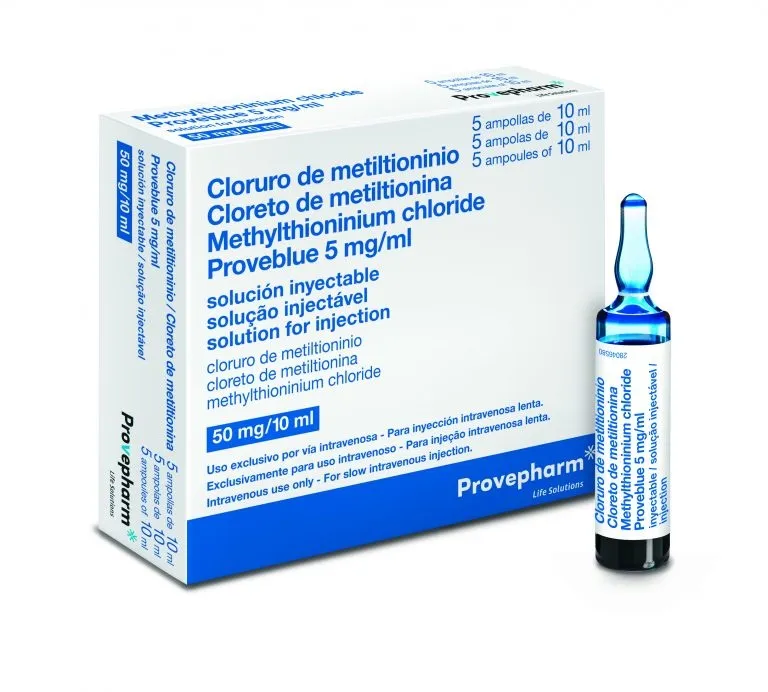
Instructions for Use
Table of Contents
- METHYLENE BLUE Bioindustria L.I.M. 50 mg/5 ml solution for injection for
- 1. What METILTIONINIO CLORURO Bioindustria L.I.M. is and what it is used for
- 2. What you need to know before using METHYLENE BLUE Bioindustria L.I.M.
- 3. How to use METHYLENE BLUE BIOINDUSTRIA L.I.M.
- 4. Possible side effects
- 5. How to store METHYLENE BLUE Bioindustria L.I.M.
- 6. Package contents and other information
- Package leaflet: Information for the doctor
- METHYLENE BLUE Bioindustria L.I.M. 50 mg/5 ml solution for injection for intravenous use
Package leaflet: Information for the user
METHYLENE BLUE Bioindustria L.I.M. 50 mg/5 ml solution for injection for
intravenous use
METHYLENE BLUE Bioindustria L.I.M. 100 mg/10 ml solution for injection for
intravenous use
Methylene Blue
Generic medicine
Please read all of this leaflet carefully before you start using this medicine because it contains important information for you.
- Keep this leaflet. You may need to read it again.
- If you have any questions, ask your doctor, pharmacist or nurse.
- If you get any side effects, talk to your doctor, pharmacist or nurse. This includes any side effects not listed in this leaflet. See section 4.
Contents of this leaflet:
- What METHYLENE BLUE Bioindustria L.I.M. is and what it is used for
- What you need to know before using METHYLENE BLUE Bioindustria L.I.M.
- How to use METHYLENE BLUE Bioindustria L.I.M.
- Possible side effects
- How to store METHYLENE BLUE Bioindustria L.I.M.
- Contents of the pack and other information
1. What METILTIONINIO CLORURO Bioindustria L.I.M. is and what it is used for
METILTIONINIO CLORURO Bioindustria L.I.M. contains the active substance methylenethionine chloride, also known as methylene blue, which belongs to a group of medicines called antidotes – substances that counteract poisoning.
This medicine is used:
- as a diagnostic agent to assess kidney function for calculating the glomerular filtration rate (the rate at which the kidneys filter blood), as it imparts a blue color to the urine;
- in the treatment of conditions caused by poor oxygenation of the body due to accumulation of methaemoglobin in the blood (methaemoglobinaemia), induced by medicines or other chemical agents. The medicine helps restore haemoglobin levels in the blood to normal and re-establish oxygen transport in the blood.
2. What you need to know before using METHYLENE BLUE Bioindustria L.I.M.
Do not use METHYLENE BLUE Bioindustria L.I.M.
- if you are allergic to methylene blue, to other similar compounds (thiazine dyes), or to any of the other ingredients of this medicine (listed in section 6);
- if your body does not produce enough of the enzyme glucose-6-phosphate dehydrogenase (G6PD), as this may increase the risk of haemolytic anaemia, a condition characterized by a low number of red blood cells in the blood;
- if the blood disorder (methaemoglobinaemia) has been caused by sodium nitrite or chlorate poisoning;
- if your body does not produce enough of the enzyme NADPH reductase;
- if you have severe kidney problems;
- if you are pregnant or breastfeeding (See section “Pregnancy and breastfeeding”).
Warnings and precautions
Talk to your doctor, pharmacist, or nurse before using METHYLENE BLUE Bioindustria L.I.M.
Methylene blue must be injected very slowly over a 5-minute period to avoid high local concentrations of the medicine causing further methaemoglobin formation. Methylene blue must not be administered subcutaneously as it may cause tissue damage at the injection site; it must not be administered intrathecally as it may cause brain damage (neuronal damage).
This medicine causes a blue-green discoloration of urine and faeces and a blue skin colouration, which may interfere with the diagnosis of cyanosis, a condition caused by poor oxygenation of the body that results in bluish skin discolouration.
Use this medicine with particular caution in the following cases:
- if the condition is caused by a substance called aniline, in which case symptoms may worsen (Heinz bodies, haemolytic anaemia), because lower doses may be required and the total cumulative dose must not exceed 4 mg/kg;
- if you have a low number of red blood cells in the blood (haemolytic anaemia) due to the use of dapsone, a medicine used to treat leprosy, as your condition may worsen. In this case, it is recommended not to exceed a dose of 4 mg/kg;
- if you have high blood glucose levels (hyperglycaemia) or suffer from diabetes mellitus, due to the presence of glucose in the product.
During and after treatment with this medicine, you will undergo tests to monitor blood oxygenation and cardiac parameters (blood pressure and ECG), as hypotension (low blood pressure) and changes in heart rate (cardiac arrhythmia) may occur (see section “Possible side effects”).
If this medicine is not effective, you may have a deficiency of a specific enzyme called cytochrome-b5-reductase, or of glucose-6-phosphate dehydrogenase, or may have blood disorders such as sulfhaemoglobinaemia. In such cases, another medicine should be used.
METHYLENE BLUE Bioindustria L.I.M. must not be administered if you have a blood disorder called methaemoglobinaemia caused by treatment with nitrates, as it may cause serious blood problems.
Children
In infants and neonates under 3 months of age, caution is recommended and lower doses of the medicine should be used (See section “Use in children under 3 months of age and neonates”).
Other medicines and METHYLENE BLUE Bioindustria L.I.M.
Tell your doctor or pharmacist if you are taking, have recently taken, or might take any other medicines, including those without a prescription.
Avoid using this medicine if you are being treated with certain medicines for depression or anxiety that act on serotonin function, a substance that primarily regulates mood. These medicines include:
- selective serotonin reuptake inhibitors (SSRIs);
- bupropion;
- buspirone;
- clomipramine;
- mirtazapine;
- venlafaxine. However, if it is not possible to avoid using METHYLENE BLUE Bioindustria L.I.M. in patients treated with the above-mentioned medicines, the lowest possible dose should be administered and the patient should be monitored for up to 4 hours after administration.
Pregnancy, breastfeeding and fertility
If you are pregnant, think you may be pregnant, are planning to become pregnant, or are breastfeeding, consult your doctor or pharmacist before using this medicine.
Do not use this medicine during pregnancy unless absolutely necessary (e.g. in cases of life-threatening methaemoglobinaemia).
Avoid breastfeeding for at least 6 days after treatment with METHYLENE BLUE Bioindustria L.I.M., as it is not known whether it is excreted in breast milk.
Laboratory studies have shown that methylene blue reduces human sperm motility in a dose-dependent manner.
Driving and using machines
Do not drive or operate machinery, as this medicine may cause confusion, dizziness, and in some cases visual disturbances.
METHYLENE BLUE Bioindustria L.I.M. contains glucose
This medicine contains 550 mg of glucose in every 10 ml. This should be taken into account in patients with diabetes mellitus.
3. How to use METHYLENE BLUE BIOINDUSTRIA L.I.M.
Use this medicine exactly as directed by your doctor, pharmacist, or nurse. If you have any doubts, consult your doctor, pharmacist, or nurse.
METHYLENE BLUE BIOINDUSTRIA L.I.M. will be administered intravenously (by intravenous injection) by trained healthcare personnel, very slowly over a period of 5 minutes, to avoid high local concentrations of the medicine causing further methaemoglobinaemia.
METHYLENE BLUE BIOINDUSTRIA L.I.M. must not be administered under the skin (subcutaneously) or injected directly into the brain or spinal cord (intrathecally).
Diagnosis of renal function
The usual dose is 50–100 mg.
Acute symptomatic treatment of methaemoglobinaemia
The recommended dose is 1–2 mg (corresponding to 0.1–0.2 ml of injectable solution) per kg of body weight, administered intravenously over 5 minutes. The duration of treatment usually does not exceed one day.
An additional dose of 1–2 mg/kg body weight may be given one hour after the first dose if symptoms persist or recur, or if blood values remain abnormal (elevated methaemoglobinaemia levels).
The maximum recommended cumulative dose during the course of treatment is 7 mg/kg body weight, and this must not be exceeded, as methylene blue in doses higher than the maximum may cause methaemoglobinaemia in predisposed patients.
In cases of methaemoglobinaemia induced by aniline or dapsone, the maximum cumulative dose must not exceed 4 mg/kg (see section “Warnings and precautions”).
Available data are insufficient to recommend a dose for continuous infusion.
Dose adjustment is not required for elderly patients.
Renal impairment
If you have moderate or severe kidney problems (renal impairment), you will be given a lower dose of less than 1 mg/kg body weight, since methylene blue is primarily excreted through the kidneys.
Use in children under 3 months of age and neonates
The recommended dose is 0.3–0.5 mg/kg (corresponding to 0.03–0.05 ml of injectable solution) body weight, administered over 5 minutes.
If symptoms persist or recur, or if methaemoglobin levels remain significantly above normal, an additional dose of 0.3–0.5 mg/kg body weight may be administered one hour after the first dose.
The duration of treatment usually does not exceed one day.
If you use more METHYLENE BLUE BIOINDUSTRIA L.I.M. than you should
Administration of high intravenous doses (≥ 7 mg/kg) of this medicine in individuals without methaemoglobinaemia may cause effects that generally resolve within 2–12 hours after injection, such as: nausea and vomiting, chest tightness and pain, increased heart rate (tachycardia), anxiety, excessive sweating, tremors, pupil dilation (mydriasis), green-blue discoloration of urine, blue discoloration of the skin and mucous membranes, abdominal pain, dizziness, altered sensation in the limbs (paraesthesia), headache (cephalalgia), confusion, increased blood pressure (hypertension), mild methaemoglobinaemia (up to 7%), and changes in heart rate detectable on ECG.
In individuals with methaemoglobinaemia, cumulative doses of the medicine may cause respiratory disturbances (dyspnoea and tachypnoea), chest pain, tremors, blue skin discoloration due to lack of oxygen (cyanosis), and reduced red blood cell count (haemolytic anaemia).
Haemolytic anaemia may occur following severe overdose (20–30 mg/kg) in infants and adults with methaemoglobinaemia caused by aniline or chlorates. In patients with severe blood disorders such as haemolysis, blood filtration (haemodialysis) may be required.
In infants, excessive dosing may lead to serious effects such as death or increased haemoglobin breakdown products (hyperbilirubinaemia) (following a dose of 20 mg/kg of medicine).
If an overdose of this medicine has been administered, you must remain under observation and methaemoglobin levels should be monitored.
In case of accidental ingestion/overdose of METHYLENE BLUE BIOINDUSTRIA L.I.M., contact your doctor immediately or go to the nearest hospital.
If you have any doubts about the use of METHYLENE BLUE BIOINDUSTRIA L.I.M., consult your doctor or pharmacist.
4. Possible side effects
Like all medicines, this medicine can cause side effects, although not everybody gets them.
The following side effects may occur:
Not known (frequency cannot be estimated from the available data).
- Methaemoglobinaemia (following doses greater than or equal to 7 mg/kg);
- Increased bilirubin (hyperbilirubinaemia), reported only in infants;
- Decrease in red blood cells (haemolytic anaemia);
- Severe allergic (anaphylactic) reactions;
- Confusional state, agitation and anxiety;
- Dizziness, headache (cephalaea), tremors, fever, difficulty speaking (aphasia);
- Dilatation of the pupil of the eye (mydriasis);
- Changes in heart rate such as cardiac arrhythmia and tachycardia;
- Increase or decrease in blood pressure (hypertension, hypotension);
- Breathing difficulties (dyspnoea, tachypnoea);
- Lack of oxygen in the body (hypoxia);
- Nausea, vomiting, abdominal pain;
- Change in the colour of faeces, urine (blue-green) and skin (blue);
- Sweating;
- Skin irritation with itching (urticaria);
- Chest pain;
- Injection site reactions (soft tissue necrosis);
- Decrease in haemoglobin.
Reporting of side effects
If you experience any side effect, including those not listed in this leaflet, talk to your doctor or pharmacist.
You can also report side effects directly via the national reporting system at:
http://www.agenziafarmaco.gov.it/it/responsabili . Reporting side effects can help provide more information on the safety of this medicine.
5. How to store METHYLENE BLUE Bioindustria L.I.M.
Keep this medicine out of the sight and reach of children.
Store in the original packaging to protect the medicine from light.
This medicine is intended for single use only; any unused solution must be discarded.
Do not use this medicine after the expiry date stated on the packaging after "Exp".
The expiry date refers to the last day of that month and applies to the product in intact packaging stored correctly.
Do not dispose of any medicine via wastewater or household waste. Ask your pharmacist how to dispose of medicines no longer in use. This will help protect the environment.
6. Package contents and other information
What METILTIONINIO CLORURO Bioindustria L.I.M. contains
METILTIONINIO CLORURO Bioindustria L.I.M. 50 mg/5 ml injectable solution for
intravenous use
- The active substance is metiltionio cloruro (methylene blue). Each vial contains 50 mg of metiltionio cloruro.
- The other components (excipients) are: monohydrate glucose 275 mg, water for injectable preparations q.s. to 5 ml.
METILTIONINIO CLORURO Bioindustria L.I.M. 100 mg/10 ml injectable solution for
intravenous use
- The active substance is metiltionio cloruro (methylene blue). Each vial contains 100 mg of metiltionio cloruro.
- The other components (excipients) are: monohydrate glucose 550 mg, water for injectable preparations q.s. to 10 ml.
Description of the appearance of METILTIONINIO CLORURO Bioindustria L.I.M. and contents
of the pack
Pack containing 10 vials of 5 or 10 ml of injectable solution for intravenous use.
Marketing Authorization Holder and Manufacturer
BIOINDUSTRIA Laboratorio Italiano Medicinali S.p.A.
Via De Ambrosiis, 2
15067 Novi Ligure (AL)
Italy
Package leaflet: Information for the doctor
METHYLENE BLUE Bioindustria L.I.M. 50 mg/5 ml solution for injection for intravenous use
METHYLENE BLUE Bioindustria L.I.M. 100 mg/10 ml solution for injection for intravenous use
Methylene Blue Chloride
The following information is intended exclusively for physicians or healthcare professionals
Therapeutic indications
Diagnostic agent for renal function, used to calculate glomerular filtration rate.
Acute symptomatic treatment of drug- or chemical-induced methemoglobinemia.
Special warnings and precautions for use
Methylene blue chloride may exacerbate dapsone-induced hemolytic anemia due to the formation of hydroxylamine, a reactive metabolite of dapsone that oxidizes hemoglobin. A cumulative dose exceeding 4 mg/kg is not recommended in patients with dapsone-induced methemoglobinemia.
In suspected cases of methemoglobinemia, oxygen saturation should be monitored by co-oximetry if available, since pulse oximetry may provide falsely elevated estimates of oxygen saturation during methylene blue chloride administration.
Anesthesiologists should assess for the presence of methemoglobinemia in patients undergoing dapsone therapy, and be aware of the interference of methylene blue chloride with the BIS (bispectral index) monitoring.
Incompatibilities
This medicinal product must not be mixed with 0.9% sodium chloride injection solution, as chloride has been shown to reduce the solubility of methylene blue chloride.
For further information, please refer to the Summary of Product Characteristics.
Similar Medications
-
Methylthioninium chloride Proveblue
Form: solution for injection
Active substance Dosage METHYLTHIONINIUM CHLORIDE — Manufacturer: PROVEPHARM S.A.S.
This page has been machine-translated and may contain inaccuracies. The original data is available in the manufacturing country's language.
Last data check: May 11, 2026 · Data source: Agenzia Italiana del Farmaco (AIFA)