Methylthioninium chloride Proveblue
Italy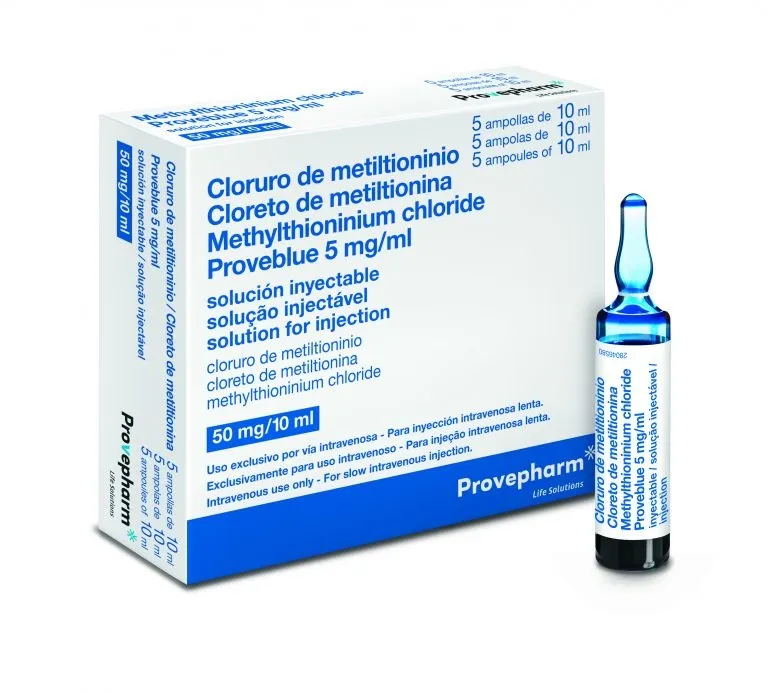
Table of Contents
- Package leaflet: Information for the user
- Methylene blue chloride Proveblue 5 mg/ml injection solution
- 1. What Metiltioninio cloruro Proveblue is and what it is used for
- 2. What you need to know before using Metiltioninio cloruro Proveblue
- 3. How to take Methylthioninium Chloride Proveblue
- 4. Possible side effects
- 5. How to store Metiltionio cloruro Proveblue
- 6. Package contents and other information
Package leaflet: Information for the user
Methylene blue chloride Proveblue 5 mg/ml injection solution
methylene blue chloride
Please read all of this leaflet carefully before you are given this medicine because it contains important information for you.
- Keep this leaflet. You may need to read it again.
- If you have any questions, ask your doctor or nurse.
- If you get any side effects, talk to your doctor or nurse. This includes any possible side effects not listed in this leaflet. See section 4.
Contents of this leaflet:
- What Metiltionio chloride Proveblue is and what it is used for
- What you need to know before being given Metiltionio chloride Proveblue
- How Metiltionio chloride Proveblue is given
- Possible side effects
- How to store Metiltionio chloride Proveblue
- Contents of the pack and other information
1. What Metiltioninio cloruro Proveblue is and what it is used for
Methylthioninium chloride (also known as methylene blue) belongs to a group of medicines called antidotes.
Metiltioninio cloruro Proveblue will be administered to you or to the child (0–17 years of age) to treat blood disorders resulting from exposure to certain medications or chemical agents that can cause a condition known as methaemoglobinaemia.
Methaemoglobinaemia is characterised by a pathological accumulation in the blood of methaemoglobin (an altered form of haemoglobin that is unable to effectively carry oxygen to the tissues). This medicine will help restore haemoglobin to normal levels and re-establish oxygen transport in the blood.
2. What you need to know before using Metiltioninio cloruro Proveblue
Do not take Metiltioninio cloruro Proveblue
- If you are allergic to methylene blue or to other thiazine dyes
- If you have glucose-6-phosphate dehydrogenase (G6PD) enzyme deficiency
- If you have nicotinamide adenine dinucleotide phosphate (NADPH) reductase enzyme deficiency
- If the blood disorder is caused by nitrite during treatment of cyanide poisoning
- If the blood disorder is caused by chlorate poisoning.
Warnings and precautions
Talk to your doctor or nurse before using Metiltioninio cloruro Proveblue
- If you have moderate or severe kidney disease; a lower single dose is required (maximum 1 to 2 mg/kg)
- If the blood disorder is caused by a chemical called aniline, found in dyes; lower doses may be needed and the total cumulative dose must not exceed 4 mg/kg (see section 3 of this leaflet)
- If the blood disorder is caused by a medicine called dapsone (used to treat leprosy and other skin conditions); lower doses may be needed and the total cumulative dose must not exceed 4 mg/kg (see section 3)
- If you have hyperglycemia or diabetes mellitus, as these conditions may be worsened by the glucose solution used to dilute the medicine
- Your urine and feces may turn blue-green; your skin may turn blue during treatment with Metiltioninio cloruro Proveblue. This color change is expected and will disappear at the end of treatment. If any of the above situations apply to you, consult your doctor.
Photosensitivity
Methylene blue may cause a skin reaction known as photosensitivity (similar to sunburn) when the skin is exposed to strong light sources, such as phototherapy, operating room lights, or pulse oximeters.
Protective measures against light exposure must be taken.
Monitoring tests
You will undergo monitoring tests during and after treatment with Metiltioninio cloruro Proveblue.
Children
Exercise particular caution with Metiltioninio cloruro Proveblue:
- Lower doses are recommended in neonates and infants aged 3 months or younger (see section 3 of this leaflet).
Other medicines and Metiltioninio cloruro Proveblue
Inform your doctor, pharmacist, or nurse if you are taking, have recently taken, or might take any other medicines.
You must not take methylene blue at the same time as certain medicines used to treat depression or anxiety that affect a brain chemical called serotonin. When used together with these medicines, methylene blue may cause serotonin syndrome, which can be potentially fatal. These medicines include:
- Selective serotonin reuptake inhibitors (SSRIs) such as citalopram, escitalopram, fluoxetine, fluvoxamine, paroxetine, sertraline, and zimelidine
- bupropion
- buspirone
- clomipramine
- mirtazapine
- venlafaxine
- monoamine oxidase inhibitors.
Opioids such as tramadol, fentanyl, pethidine, and dextromethorphan may also increase the risk of developing serotonin syndrome when used in combination with methylene blue.
However, if intravenous use of methylene blue cannot be avoided, the lowest possible dose should be administered and the patient must be closely monitored for up to 4 hours after administration.
If you have any doubts about whether you should take this medicine, consult your doctor.
Pregnancy and breastfeeding
If you are pregnant, think you may be pregnant, planning a pregnancy, or are breastfeeding, ask your doctor for advice before taking this medicine.
The use of Metiltioninio cloruro Proveblue during pregnancy is not recommended unless absolutely necessary, for example in life-threatening situations.
Due to lack of data on whether methylene blue is excreted in breast milk, breastfeeding must be discontinued for 8 days after treatment with this medicine.
Driving and using machines
Do not drive or operate tools or machinery, as methylene blue may moderately affect your ability to drive or use machines.
3. How to take Methylthioninium Chloride Proveblue
The doctor will slowly inject this medicine into a vein (intravenously) over a period of 5 minutes.
Adults, children over 3 months of age, and elderly patients
The usual dose is 1–2 mg per kilogram of body weight, i.e. 0.2–0.4 ml per kilogram of body weight, administered over 5 minutes. A second dose may be given after one hour if necessary.
The maximum recommended cumulative dose for the duration of treatment is 7 mg/kg.
If the blood disorder is caused by aniline or dapsone, the total cumulative dose must not exceed 4 mg/kg (see section 2).
The duration of treatment usually does not exceed one day.
Renal impairment
In infants over 3 months of age, children, adolescents, and adults, the recommended dose in patients with moderate renal impairment (eGFR 30–59 ml/min/1.73 m²) is 1–2 mg/kg body weight. If a dose of 1 mg/kg is administered, a repeated dose of 1 mg/kg may be given one hour later if symptoms persist or recur, or if methemoglobin levels remain significantly above the normal clinical range. The maximum recommended cumulative dose for the treatment cycle is 2 mg/kg.
In infants over 3 months of age, children, adolescents, and adults, the recommended dose in patients with severe renal impairment (eGFR 15–29 ml/min/1.73 m²) is a single dose of 1 mg/kg body weight. The maximum recommended cumulative dose for the treatment cycle is 1 mg/kg.
Methylthioninium chloride should be used with caution in children aged 3 months or younger and in neonates with moderate to severe renal impairment (eGFR 15–59 ml/min/1.73 m²), as there are no available data and methylthioninium chloride is predominantly eliminated via the kidneys. Lower maximum cumulative doses may be considered (<0.5 mg/kg body weight).
No dose adjustment is recommended in patients with mild renal impairment (eGFR 60–89 ml/min/1.73 m²).
Infants aged 3 months or younger
The recommended dose is 0.3–0.5 mg/kg body weight, i.e. 0.06–0.1 ml/kg, administered over 5 minutes.
If persistent or recurrent symptoms occur, a repeat dose (0.3–0.5 mg/kg body weight, i.e. 0.06–0.1 ml/kg) may be administered. The duration of treatment usually does not exceed one day.
This medicine may be diluted in 50 ml of 50 mg/ml (5%) glucose for injection solution to avoid local pain, especially in children.
If you take more Methylthioninium Chloride Proveblue than you should
Since this medicine is administered during hospitalization, it is unlikely that you will receive too much or too little. However, if you notice any of the following adverse reactions, inform your doctor immediately:
- nausea,
- stomach discomfort,
- chest pain,
- dizziness,
- headache,
- sweating,
- confusion,
- increased methemoglobin (a modified form of hemoglobin in the blood),
- hypertension,
- shortness of breath,
- abnormally rapid heartbeat,
- tremors,
- skin discoloration (skin may turn blue),
- reduced number of red blood cells, leading to paleness, shortness of breath, and weakness,
- jaundice (yellowing of the skin and eyes); this has been reported only in infants.
If you have any doubts about how to use this medicine, consult your doctor or pharmacist.
4. Possible side effects
Like all medicines, this medicine can cause side effects, although not everybody will experience them.
These side effects are the same in adults and children, except for jaundice, which has only been reported in infants.
The frequency of these side effects is not known (cannot be estimated from the available data):
- Very common side effects (may affect more than 1 in 10 people)
- pain in extremities
- dizziness
- sweating
- skin discoloration, which may turn blue
- blue or green urine
- numbness and tingling
- altered taste
- nausea
- Common side effects (may affect up to 1 in 10 people):
- stomach ache
- chest pain
- headache
- anxiety
- injection site pain
- vomiting
- Not known (frequency cannot be estimated from available data):
- serotonin syndrome when Methylthioninium chloride Proveblue has been taken together with certain medicines used to treat depression or anxiety; see section 2
- blood tests may show reduced haemoglobin levels (the protein in red blood cells that carries oxygen in the blood)
- reduction in red blood cells, which may cause pale skin and lead to weakness and shortness of breath
- local tissue damage at the injection site
- jaundice (yellowing of the skin and eyes); this has only been reported in infants
- difficulty with speech
- high or low blood pressure
- agitation
- lack of oxygen
- irregular heartbeat, including heartbeat that is too slow or too fast
- severe allergic reactions (so-called anaphylactic reaction which may cause swelling of the throat or face, breathing difficulties, or severe rash)
- increased methaemoglobin (a modified form of haemoglobin in the blood)
- shortness of breath
- confusion
- tremor
- hives
- fever
- rapid breathing
- dilated pupils
- change in stool colour, which may become green or blue
- increased skin sensitivity to light (photosensitivity).
Reporting of side effects
If you experience any side effect, including those not listed in this leaflet, talk to your doctor, pharmacist, or nurse. You can also report side effects directly via the national reporting system detailed in Annex V.
By reporting side effects, you can help provide more information on the safety of this medicine.
5. How to store Metiltionio cloruro Proveblue
Keep this medicine out of the sight and reach of children.
Do not use this medicine after the expiry date stated on the carton and on the labels of the vials after "Exp.". The expiry date refers to the last day of the month. Before administering the injectable solution, the doctor or nurse must check that the expiry date on the label has not already passed.
Do not refrigerate or freeze. Store the vial in the original packaging to protect it from light.
The medicine must be used immediately after opening or dilution.
Do not use Metiltionio cloruro Proveblue if there is any change in colour, turbidity, or presence of particles or precipitate.
Any unused medicine and waste material derived from this medicine must be disposed of in accordance with local regulations.
6. Package contents and other information
What Metiltionio cloruro Proveblue contains
- The active substance is methylene blue (metiltionio cloruro). Each ml of solution contains 5 mg of methylene blue.
Each 10 ml vial contains 50 mg of methylene blue.
Each 2 ml vial contains 10 mg of methylene blue.
- The other component is water for injections.
Description of the appearance of Metiltionio cloruro Proveblue and contents of the pack
Metiltionio cloruro Proveblue is a clear, dark blue injectable solution supplied in transparent glass vials.
Each carton contains a tray with 5 vials of 10 ml.
Each carton contains a tray with 5 vials of 2 ml.
Each carton contains a tray with 20 vials of 2 ml.
Marketing Authorisation Holder
Provepharm SAS
22 rue Marc Donadille, 13013 Marseille, France
Manufacturer
Cenexi
52, Rue Marcel et Jacques Gaucher, 94120 Fontenay-sous-Bois, France
For further information about this medicinal product, please contact the local representative of the Marketing Authorisation Holder:
België/Belgique/Belgien Lietuva
Pharmanovia Benelux B.V. Provepharm SAS
Tél/Tel: + 31 (0) 76-5600030 Tel: +33 (0)4 91 08 69 30
България Luxembourg/Luxemburg
Provepharm SAS Pharmanovia Benelux B.V.
Teл.: + 33 (0)4 91 08 69 30 Tél/Tel: + 31 (0) 76-5600030
Česká republika Magyarország
LERAM pharmaceuticals s.r.o Mediwings Pharma Kft.
Tel: +420 737 657 454 Tel.: + 36 28 410 463
Danmark Malta
Pharmanovia A/S Provepharm SAS
Tlf: + 45 33 33 76 33 Tel: + 33 (0)4 91 08 69 30
Deutschland Nederland
Dr. Franz Köhler Chemie GmbH Pharmanovia Benelux B.V.
Tel: + 49 (0) 6251-1083-0 Tel: + 31 (0) 76-5600030
Eesti Norge
Provepharm SAS Pharmanovia A/S
Tel: + 33 (0)4 91 08 69 30 Tlf: + 45 33 33 76 33
Ελλάδα Österreich
a VIPharma International AE Dr. Franz Köhler Chemie GmbH
Τηλ: + 30-210-6194170 Tel: + 49 (0) 6251-1083-0
España Polska
Fresenius Kabi España, S.A.U. Apfel Pharm Sp. z o.o.
Tel: + 34 93 225 65 65 Tel: + 48 694 775 205
France Portugal
Provepharm SAS Labesfal - Laboratórios Almiro
Tél: + 33 (0)4 91 08 69 30 Tel: + 351 232 831100
Hrvatska România
Provepharm SAS Provepharm SAS
Tel: + 33 (0)4 91 08 69 30 Tel: + 33 (0)4 91 08 69 30
Ireland Slovenija
Provepharm SAS Provepharm SAS
Tel: + 33 (0)4 91 08 69 30 Tel: + 33 (0)4 91 08 69 30
Ísland Slovenská republika
Pharmanovia A/S LERAM pharmaceuticals s.r.o
Sími: + 45 33 33 76 33 Tel: +420 737 657 454
Italia Suomi/Finland
Altais Pharma S.r.l Pharmanovia A/S
Tel: + 39 06 97 79 70 56 Puh/Tel: + 45 33 33 76 33
Κύπρος Sverige
Isangen Pharma Cyprus Ltd Pharmanovia A/S
Τηλ: + 357-24-638833 Tel: + 45 33 33 76 33
Latvija United Kingdom (Northern Ireland)
Provepharm SAS Provepharm SAS
Tel: + 33 (0)4 91 08 69 30 Tel: + 33 (0)4 91 08 69 30
More detailed information on this medicinal product is available on the website of the European Medicines Agency: http://www.ema.europa.eu/
<--------------------------------------------------------------------------------------------------------------------------
The following information is intended exclusively for healthcare professionals:
Preparation for intravenous administration
Use immediately after opening. Inject very slowly over a period of 5 minutes.
Metiltionio cloruro Proveblue is hypotonic and may be diluted in 50 ml of 50 mg/ml (5%) glucose injectable solution to avoid local pain, especially in the paediatric population.
It must not be diluted with 9 mg/ml (0.9%) sodium chloride injectable solution, as chloride has been shown to reduce the solubility of methylene blue.
Further information on the administration of Metiltionio cloruro Proveblue is provided in section 3 of the package leaflet.
Any unused medicinal product and waste materials derived from this medicinal product should be disposed of in accordance with local regulations.