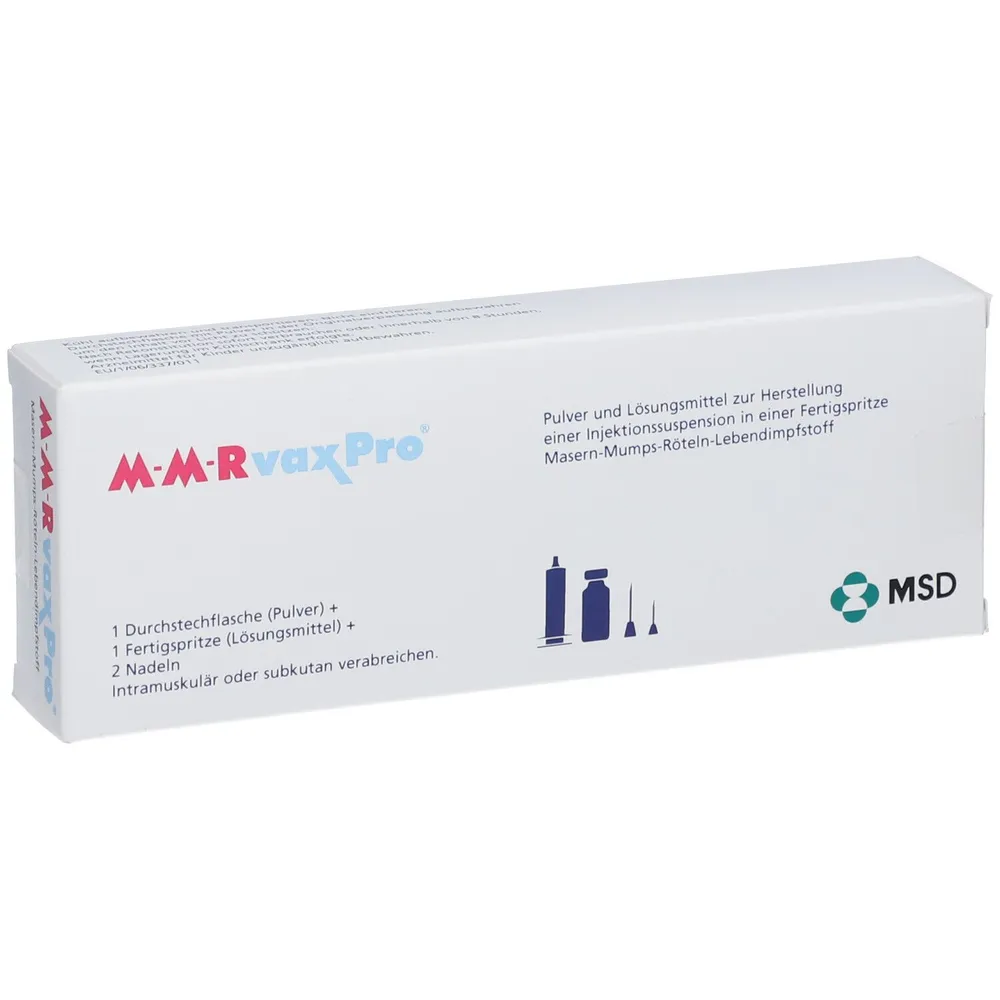
M-M-RVaxPro

Italy
Brand name M-M-RVaxPro
Form suspension for injection, powder and solvent for preparation of
Prescription type Prescription only
ATC code
Registration number 037172
M-M-RVaxPro suspension for injection, powder and solvent for preparation of

Patient Information Leaflet: Information for the User

What it is
What it is
the body) will produce antibodies against the measles virus,
exposure, or for use in
infection with mumps and rubella.
treatment for asthma or replacement therapy).
a medical history
a viral infection from the
hepatitis A during the same vaccination session, at different injection sites (e.g. the other arm or
the other leg).
some routine childhood vaccines that must
“ ”
“potassium”


in the area
arm. For intramuscular injections, the area
The interval
have been reported with the use of

FrequencyAdverse Reaction
Very common (may occur in more than 1 in 10 vaccinated individuals)
  • Fever (38.5 °C or higher). • Redness at injection site; pain at injection site; swelling at injection site.
Common (may occur in up to
  • Skin rash (including rash similar to measles).
1 in 10 vaccinated individuals)
  • Ecchymosis (bruising) at injection site.
Uncommon (may occur in up to 1 in 100 vaccinated individuals)
  • Nasal congestion and sore throat; upper respiratory tract infection or viral infection; runny nose. • Crying. • Diarrhea, vomiting. • Urticaria. • Rash at injection site.
Not known (frequency cannot be estimated from the available data)*
  • Aseptic meningitis (fever, feeling unwell, vomiting, headache, stiff neck, and sensitivity to light); swelling of the testicles; middle ear infection; inflammation of the salivary glands; atypical measles (reported in patients who received a killed measles vaccine, usually before 1975). • Swollen lymph nodes. • Increased tendency to bruise and bleed compared to normal. • Severe allergic reaction which may lead to difficulty breathing, facial swelling, localized swelling, and swelling of limbs. • Irritability. • Seizures without fever; seizures with fever in children; unsteady gait; dizziness; diseases causing inflammation of the nervous system (brain and/or spinal cord). • A condition characterized by muscle weakness, abnormal sensations, tingling in arms, legs, and upper body (Guillain-Barré syndrome). • Headache; fainting; neurological disorders that may cause weakness, tingling, or numbness; eye nerve disorders. • Eye discharge and itching sensation with crust formation on eyelids (conjunctivitis). • Inflammation of the retina (in the eye) with visual disturbances. • Deafness. • Cough; lung infection with or without fever. • Feeling unwell (nausea). • Itching sensation; inflammation of subcutaneous fat tissue; flat, pinpoint red or purplish spots under the skin; hardened, raised area of skin; severe illness with ulcers or blisters on skin, mouth, eyes, and/or genitals (Stevens-Johnson syndrome). • Joint pain and/or swelling (usually transient, rarely chronic); muscle pain. • Burning and/or stinging pain at injection site, short-lived; blisters and/or hives at injection site. • Feeling unwell (malaise); swelling; irritation. • Inflammation of blood vessels. • Skin granuloma (clusters of inflammatory cells).

have been reported with the
following use after marketing authorization
not reported in the
expiry refers to the last
 – 
the outer packaging
Do not dispose of any vaccine via wastewater or household waste. Ask your pharmacist how
to dispose of vaccines no longer required. This will help protect the environment.
Description of the appearance of
Marketing Authorization Holder
of the Authorization
България
Merck Sharp & Dohme Bulgaria EOOD
Tel.: +359 2 819 3737
Česká republika
Merck Sharp & Dohme s.r.o.
Tel.:
Ελλάδα
MSD A.E.E.
Tel: +30 210 98 97 300
Κύπρος
Tel
Other sources of information
are available on the website of the Agency
to prevent transmission of infectious agents from one individual to another.
a new separate needle and syringe for injection.
Withdraw the entire
for injection. Inject the entire contents of the syringe into the vial containing the powder. Shake
the appearance of the solvent, powder or reconstituted vaccine differs from that described above.
withdraw the entire contents of the reconstituted vaccine from the vial, change the needle, and
inject the entire volume
illustrative: information for the user
What is
What is
organism) will produce antibodies against measles, mumps and rubella viruses. The
exposure, or for use in
infection with mumps and rubella.
therapy for asthma or replacement therapy).
a family history of congenital immunodeficiency
an infection with irus of
hepatitis A during the same vaccination session, at different injection sites (e.g. the other arm or
the other leg).
some routine childhood vaccines that should
“ ”
“ potassium”


in the outer area of the thigh or in the
upper arm. For intramuscular injections, the thigh area is generally preferred in younger children
should be administered according to the physician's recommendations. The interval between 2
have been reported with the use of

FrequencyAdverse reaction
Very common (may occur in more than 1 in 10 vaccinated subjects)
  • Fever (38.5°C or higher). •Redness at injection site; pain at injection site; swelling at injection site.
Common (may occur in up to 1 in 10 vaccinated subjects)
  • Skin rash (including measles-like rash). •Bruising at injection site.
Uncommon (may occur in up to 1 in 100 vaccinated subjects)
  • Nasal congestion and sore throat; upper respiratory tract infection or viral infection; runny nose. •Crying. •Diarrhea, vomiting. •Hives. •Rash at injection site.
Not known (frequency cannot be estimated from the available data)*
  • Aseptic meningitis (fever, feeling unwell, vomiting, headache, stiff neck, and light sensitivity); swelling of the testicles; middle ear infection; inflammation of the salivary glands; atypical measles (reported in patients who received a killed measles vaccine, generally before 1975). •Swollen lymph nodes. •Increased tendency to bruise and bleed. •Severe allergic reaction which may cause difficulty breathing, facial swelling, localized swelling, and limb swelling. •Irritability. •Seizures without fever; seizures with fever in children; unsteady gait; dizziness; diseases causing inflammation of the nervous system (brain and/or spinal cord). •A condition characterized by muscle weakness, abnormal sensations, tingling in arms, legs, and upper body (Guillain-Barré syndrome). •Headache; fainting; nerve disorders that may cause weakness, tingling, or numbness; eye nerve disorders. •Eye discharge and itching with crusting on eyelids (conjunctivitis). •Inflammation of the retina (in the eye) with visual disturbances. •Deafness. •Cough; lung infection with or without fever. •Feeling unwell (nausea). •Itching sensation; inflammation of fatty tissue under the skin; tiny flat red or purple spots under the skin; hardened, raised area of skin; serious illness with ulcers or blisters on skin, mouth, eyes, and/or genitals (Stevens-Johnson syndrome). •Joint pain and/or swelling (usually transient and rarely chronic); muscle pain. •Brief burning and/or stinging pain at injection site; blisters and/or hives at injection site. •Feeling unwell (malaise); swelling; irritation. •Inflammation of blood vessels. •Skin granuloma (collection of inflammatory cells).

have been reported with
prior to use following marketing authorization
the national reporting system outlined in section
expiry refers to the last day of that month.
 – 
’packaging
in the water of
which you no longer use. This will help protect the environment
Description of the appearance of
Marketing Authorization Holder
of the Marketing Authorization
България
Merck Sharp & Dohme Bulgaria EOOD
Tel.: +359 2 819 3737
Česká republika
Merck Sharp & Dohme s.r.o.
Tel.:
Ελλάδα
MSD A.E.E.
Tel: +30 210 98 97 300
Κύπρος
Tel
Other sources of information
are available on the website of the Agency
to prevent transmission of infectious agents from one individual to another.
for reconstitution and a separate new needle for injection.
For administration, the needle must be firmly placed on the tip of the syringe and secured
Inject the entire contents of the solvent syringe into the
the appearance of the solvent, powder or reconstituted vaccine differs from that described above.
withdraw the entire vaccine content from the vial, change the needle and
inject the entire volume