Ideos
Italy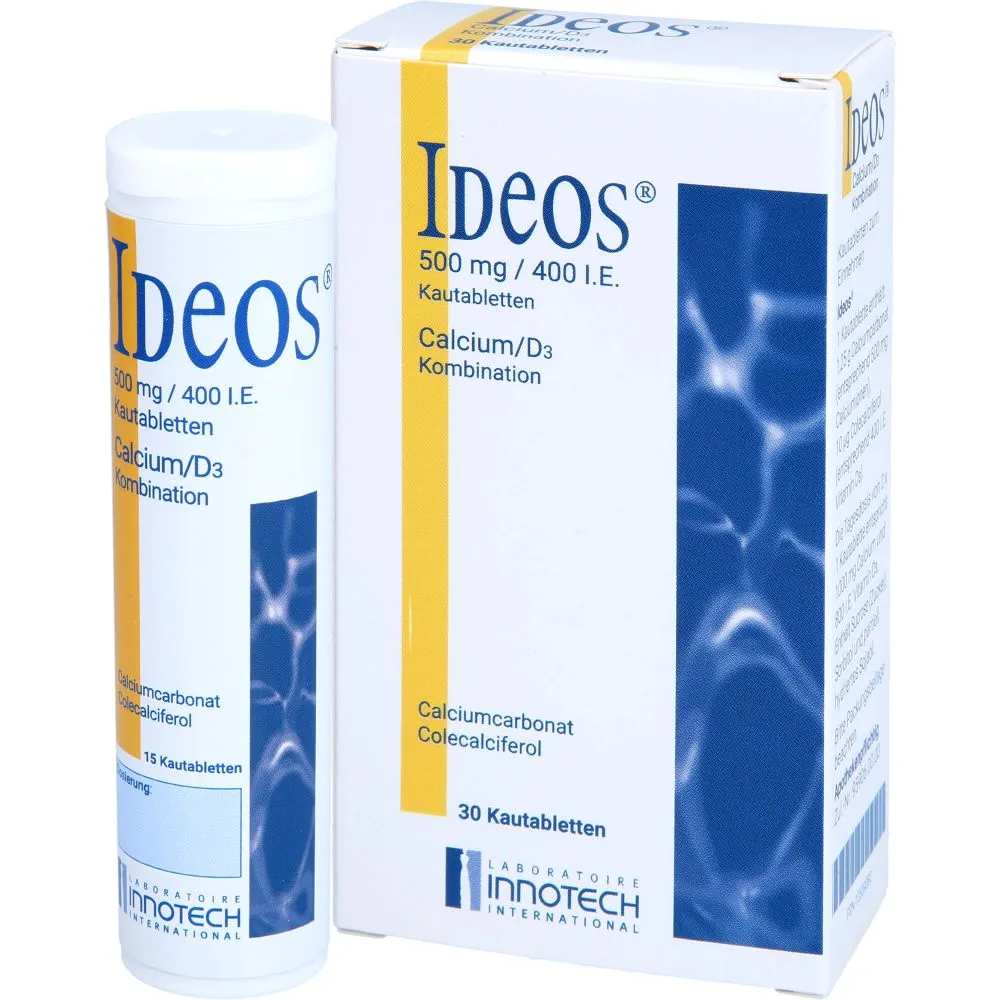
Instructions for Use
PACKAGE LEAFLET: INFORMATION FOR THE USER
IDEOS 500 mg/400 IU, chewable tablets
Calcium, vitamin D3
Equivalent medicine
Please read this leaflet carefully before taking this medicine because it contains important information for you:
- Keep this leaflet. You may need to read it again.
- If you have any questions, ask your doctor or pharmacist.
- This medicine has been prescribed for you only. Do not give it to other people, even if their symptoms are the same as yours, because it could be harmful.
- If you experience any of the side effects, including those not listed in this leaflet, contact your doctor or pharmacist. See section 4.
Contents of this leaflet:
- What Ideos is and what it is used for
- What you need to know before taking Ideos
- How to take Ideos
- Possible side effects
- How to store Ideos
- Contents of the pack and other information
1. WHAT IDEOS IS AND WHAT IT IS USED FOR
IDEOS contains two active substances: calcium and vitamin D3 (also known as colecalciferol). It belongs to a
group of medicines called calcium, combinations with vitamin D and/or other drugs.
This medicine is used:
- in cases of vitamin D and calcium deficiency in the elderly;
- in combination with certain osteoporosis treatments (a condition in which bone mass decreases and bone fragility increases), when there is a deficiency or risk of deficiency of vitamin D and calcium. This medicine is indicated only for adults.
2. WHAT YOU NEED TO KNOW BEFORE TAKING IDEOS
Do not take IDEOS:
- if you are allergic (hypersensitive) to calcium, vitamin D, or any of the other ingredients of this medicine (listed in section 6);
- if you are allergic (hypersensitive) to peanuts or soya, due to the presence of hydrogenated soya oil;
- if you have abnormally high levels of calcium in your blood (hypercalcaemia);
- if you have high levels of calcium excreted in your urine (hypercalciuria);
- if you have a condition leading to hypercalcaemia and/or hypercalciuria (e.g. overactive parathyroid glands, a bone marrow disorder (myeloma), malignant bone tumours (bone metastases));
- if you suffer from kidney stones (calcium lithiasis) or have calcium deposits in the kidneys (nephrocalcinosis);
- if you have severe kidney disease (renal failure);
- if you have excessive intake of vitamin D (hypervitaminosis D).
Warnings and precautions
Talk to your doctor or pharmacist before taking IDEOS:
- if you suffer from sarcoidosis, a disease whose most common symptoms are fatigue, enlarged lymph nodes, and inflammation of the lungs and other organs;
- if you have kidney disease (renal failure);
- if you are already taking additional calcium (e.g. dietary supplements or calcium-fortified foods) and are simultaneously using medicinal products containing carbonate (e.g. so-called antacids), the calcium levels in your blood and urine should be monitored;
- if you have been immobile for a prolonged period and have high calcium levels in your blood and/or urine. Your doctor will allow you to take this medicine once you have resumed walking;
- if you are undergoing long-term treatment, you must have regular blood and urine tests to monitor calcium levels. Monitoring is particularly important in elderly patients and when treatment is taken in combination with cardiac glycosides (e.g. digoxin) or diuretics. Based on the results, your doctor may decide to reduce or even discontinue treatment;
- if you are taking other medicines or products containing calcium and/or vitamin D. High levels of calcium and vitamin D can be harmful to your health.
If in doubt, consult your doctor or pharmacist.
Children and adolescents
Do not administer this medicine to children or adolescents, as there is no indicated use of IDEOS in the paediatric population.
Other medicines and IDEOS
Inform your doctor or pharmacist if you are taking, have recently taken, or might take any other medicines.
- Digoxin (a medicine used to treat heart problems), as it may cause more side effects;
- Bisphosphonates or medicines containing strontium (used for osteoporosis);
- Antibiotics (medicines used to treat bacterial infections): oral tetracyclines, rifampicin, and some fluoroquinolones (ciprofloxacin and norfloxacin);
- Dolutegravir (a medicine used to treat HIV infection);
- Medicines or supplements containing iron or zinc;
- Estramustine (a medicine used to treat certain prostate tumours);
- Thyroid hormones, used in thyroid disorders;
- Carbamazepine, fosphenytoin, phenobarbital, phenytoin, primidone: medicines used to treat epileptic seizures;
- Orlistat (a medicine used to treat obesity), as it may reduce the amount of vitamin D3 absorbed;
- Thiazide diuretics (medicines used to treat high blood pressure or oedema), as they may increase the amount of calcium in the blood.
You must wait:
- between 30 minutes and 2 hours between taking IDEOS and bisphosphonates;
- more than 2 hours between taking IDEOS and the following medicines: medicines containing strontium, iron, or zinc, estramustine, thyroid hormones, some fluoroquinolones (ciprofloxacin, norfloxacin), tetracycline antibiotics;
- it is recommended to take IDEOS at least 2 hours after or 6 hours before taking dolutegravir.
IDEOS with food and drink
Possible interactions with food. You should take IDEOS before or after meals containing:
- oxalic acid (spinach, rhubarb, sorrel, cocoa, tea...);
- phosphate (pork, ham, sausages, processed cheese, pudding, cola-containing beverages...);
- phytic acid (whole grains, dried legumes, oilseeds, chocolate...).
Pregnancy, breastfeeding and fertility
IDEOS is not recommended during pregnancy and breastfeeding.
If you are pregnant or breastfeeding, suspect you may be pregnant, or are planning to become pregnant, consult your doctor or pharmacist before taking this medicine.
Driving and using machines
Not applicable.
IDEOS contains sorbitol, sucrose, and hydrogenated soya oil.
IDEOS contains 475 mg of sorbitol in each chewable tablet. Sorbitol is a source of fructose. If your doctor has diagnosed you with intolerance to certain sugars or hereditary fructose intolerance (HFI), a rare genetic disorder in which a person cannot break down fructose, speak with your doctor before taking or receiving this medicine.
IDEOS contains sucrose (sucrose is present in small amounts in concentrated colecalciferol). If your doctor has diagnosed you with intolerance to certain sugars, contact your doctor before taking this medicine. Due to the presence of sucrose, long-term use of IDEOS (e.g. for two weeks or more) may also be harmful to teeth.
IDEOS contains hydrogenated soya oil. If you are allergic to peanuts or soya, do not take this medicine (see Do not take IDEOS).
3. HOW TO TAKE IDEOS
Take this medicine exactly as directed by your doctor or pharmacist. If you have
any doubts, consult your doctor or pharmacist.
The recommended dose, for adults only, is one tablet twice daily.
If you take more IDEOS than you should
The following symptoms may occur: loss of appetite, excessive thirst, feeling unwell
(nausea), vomiting, constipation, abdominal pain, muscle weakness, fatigue, mental health
problems, increased urinary excretion, bone pain, kidney stones, and hypertension.
These symptoms may be part of the milk-alkali syndrome, which can occur, for example, when large amounts of calcium- and carbonate-containing medicines (so-called antacids) are taken simultaneously (see “Warnings and precautions”).
In such cases, stop taking IDEOS and contact your doctor immediately (who will carry out the necessary procedures).
If you take a high dose of IDEOS for a prolonged period, calcium deposits may develop in blood vessels or body tissues.
If you forget to take IDEOS
Do not take a double dose to make up for the forgotten dose.
If you have further questions about the use of this medicine, consult your doctor or pharmacist.
4. POSSIBLE ADVERSE REACTIONS
Like all medicines, this medicine can cause adverse reactions, although not everyone experiences them.
Uncommon (may affect up to 1 in 100 people):
- elevated levels of calcium in the blood or urine.
Rare (may affect up to 1 in 1,000 people):
- constipation, flatulence, feeling unwell (nausea), abdominal pain, diarrhoea,
- itching, skin rashes and urticaria.
Not known (frequency cannot be estimated from the available data):
- Milk-alkali syndrome associated with high calcium concentration in the blood (hypercalcaemia), high blood pH (alkalosis), and renal failure, which may occur with high doses (see "Warnings and precautions" and "If you take more IDEOS than you should");
- severe allergic reactions (hypersensitivity) such as swelling of the face, lips, tongue or throat, which may cause breathing difficulties (angioedema or laryngeal edema).
Reporting of adverse reactions
If you experience any adverse reaction, including those not listed in this leaflet, talk to your doctor or pharmacist.
You can also report adverse reactions directly via the national reporting system at https://www.aifa.gov.it/content/segnalazioni-reazioni-avverse.
By reporting adverse reactions, you can help provide more information on the safety of this medicine.
5. HOW TO STORE IDEOS
Keep this medicine out of the sight and reach of children.
The cap contains small silica gel granules to keep the tablets dry. Keep the cap out of the sight and reach of children. Do not ingest the silica gel granules.
Do not use this medicine after the expiry date stated on the tube and packaging. The expiry date refers to the last day of that month.
Do not store above 25°C.
Do not dispose of any medicine via wastewater or household waste. Ask your pharmacist how to dispose of medicines you no longer use. This will help protect the environment.
6. PACKAGING CONTENTS AND OTHER INFORMATION
What IDEOS contains
The active substances are calcium and colecalciferol (vitamin D3).
Each chewable tablet contains 500 mg of calcium as 1,250 mg of calcium carbonate and 400 IU of
colecalciferol (vitamin D3) as 4 mg of concentrated colecalciferol powder.
The other components of the tablet are:
xylitol, sorbitol (E420), povidone, magnesium stearate, lemon flavour (flavouring preparations, natural flavouring substances, maltodextrin, acacia gum, sodium citrate, citric acid, butylhydroxyanisole).
Excipients of concentrated colecalciferol powder: alpha-tocopherol, hydrogenated soybean oil, gelatin,
sucrose, maize starch.
Description of the appearance of IDEOS and packaging contents
This medicine is a white, square chewable tablet.
Each package contains either 2, 5 or 10 tubes with 10 tablets each, or 2, 4, or 6 tubes containing 15 tablets each.
Not all pack sizes may be marketed.
Marketing Authorisation Holder and Manufacturer
Marketing Authorisation Holder:
Laboratoire Innotech International
22 avenue Aristide Briand – 94 110 Arcueil - FRANCE
Manufacturer:
INNOTHERA CHOUZY
Rue René Chantereau, Chouzy-Sur-Cisse
41150 Valloire-Sur-Cisse – FRANCE
Concessionaire for sale:
Pharmaday Pharmaceutical S.r.l. Unipersonale
Via Vistarino 14/F – 27010 Copiano (PV) – ITALY
Similar Medications
-
Metocal vitamin D3
Form: tablets, chewable
Active substance Dosage CALCIUM — CHOLECALCIFEROL — Manufacturer: Viatris Healthcare Limited
-
Natecal D3
Form: tablets, chewable
Active substance Dosage CALCIUM CARBONATE — CHOLECALCIFEROL — Manufacturer: ITALFARMACO S.P.A.
-
Tonacal D3
Form: tablets, chewable
Active substance Dosage CALCIUM — CHOLECALCIFEROL — Manufacturer: S.F. GROUP S.R.L.
This page has been machine-translated and may contain inaccuracies. The original data is available in the manufacturing country's language.
Last data check: May 11, 2026 · Data source: Agenzia Italiana del Farmaco (AIFA)