Natecal D3
Italy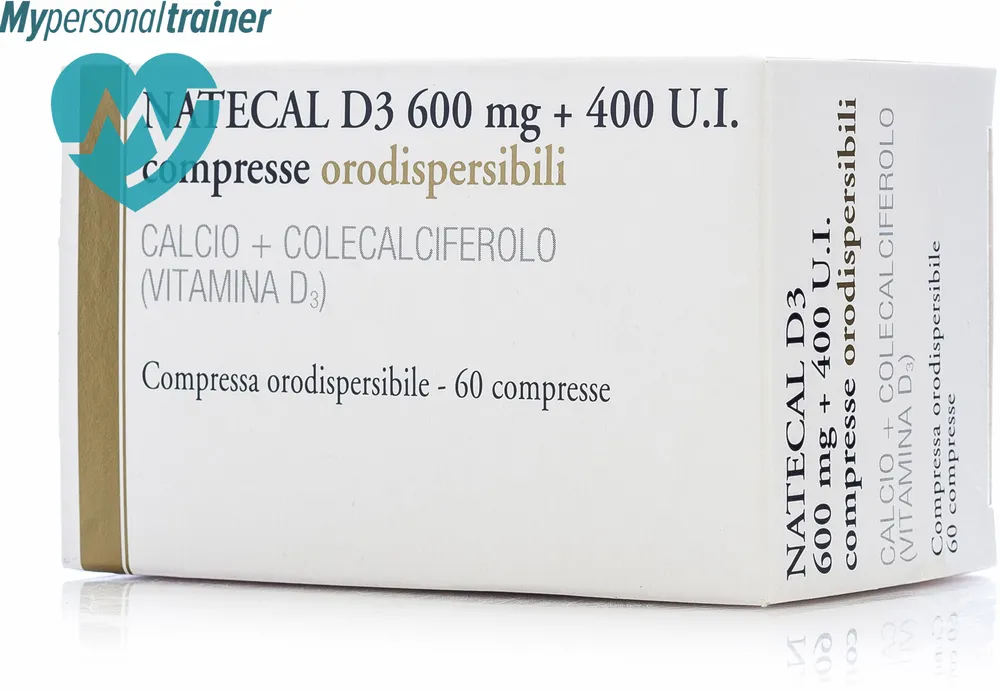
Table of Contents
Patient Information Leaflet
NATECAL D3 600 mg + 400 U.I. chewable tablets
calcium + colecalciferol
Please read this entire leaflet carefully before taking this medicine, as it contains important information for you.
- Keep this leaflet. You may need to read it again.
- If you have any questions, ask your doctor, pharmacist, or nurse.
- This medicine is intended for use in adults only.
- This medicine has been prescribed for you only. Do not give it to others, even if their symptoms are the same as yours, as it could be harmful.
- If you experience any side effects, including those not listed in this leaflet, contact your doctor, pharmacist, or nurse. See section 4.
Contents of this leaflet:
- What Natecal D3 is and what it is used for
- What you need to know before taking Natecal D3
- How to take Natecal D3
- Possible side effects
- How to store Natecal D3
- Contents of the pack and other information
1. What Natecal D3 is and what it is used for
Natecal D3 chewable tablets contain two active substances, calcium carbonate and colecalciferol (vitamin D), which are normally obtained through diet; in addition, vitamin D is produced in the skin following exposure to sunlight.
Natecal D3 chewable tablets may be prescribed by a doctor for the treatment and prevention of vitamin D and calcium deficiencies.
Natecal D3 is used:
- to correct calcium and vitamin D deficiency in the elderly.
- in combination with osteoporosis treatment when calcium and vitamin D levels are too low or when there is a high risk of them becoming too low.
2. What you need to know before taking NATECAL D3
Do not take Natecal D3
- if you are allergic to calcium, vitamin D, or any of the excipients in Natecal D3 (especially soybean oil);
- if you have high levels of calcium in your blood (hypercalcemia) or in your urine (hypercalciuria);
- if you have severe kidney problems;
- if you have kidney stones;
- if you have high levels of vitamin D in your blood (hypervitaminosis D).
Warnings and precautions
Talk to your doctor or pharmacist before taking Natecal D3.
- If you have had kidney stones or other kidney problems (your doctor will closely monitor treatment with Natecal D3 if your kidneys are not functioning properly, to prevent blood calcium levels from becoming too high);
- if you are bedridden for a prolonged period (months) and have osteoporosis (bone fragility), as you may develop high levels of calcium in your blood;
- if you are taking other medicines containing calcium or vitamin D (your doctor or pharmacist will advise you accordingly); if you have sarcoidosis (your doctor will advise you accordingly).
Other medicines and Natecal D3
Inform your doctor or pharmacist if you are taking:
- any other medicine containing vitamin D;
- the following heart medications: digitalis or other cardiac glycosides;
- antibiotics of the tetracycline or fluoroquinolone type; it is recommended to wait at least 3 hours after taking these before taking Natecal D3 chewable tablets;
- thiazide diuretics;
- if you are using other medicines for bone diseases, such as bisphosphonates or sodium fluoride, it is recommended to wait at least 3 hours after taking them before taking Natecal D3 chewable tablets;
- phenytoin (a medicine for epilepsy) and barbiturates (medicines used for epilepsy or to promote sleep), as they reduce the effect of vitamin D;
- rifampicin, as it reduces the effectiveness of vitamin D;
- orlistat (a medicine for obesity), cholestyramine, laxatives such as paraffin oil, as they may reduce the absorption of vitamin D;
- estramustine (a medicine used in chemotherapy), thyroid hormones, or medicines containing iron, zinc, or strontium ranelate, as their absorption may be reduced. These medicines should be taken at least 2 hours before or after taking Natecal D3.
Natecal D3 with food and drinks
This medicine may interact with certain foods, such as those containing oxalic acid (e.g. spinach, rhubarb, sorrel, cocoa, tea, etc.), phosphate (e.g. ham, sauces, processed cheese, etc.), or phytic acid (e.g. legumes, whole grains, chocolate, etc.). Therefore, it is recommended to take Natecal D3 at least two hours before or after a meal containing these foods.
Pregnancy and breastfeeding
Natecal D3 chewable tablets should be used during pregnancy and breastfeeding only if recommended by your doctor.
Excipients
This medicine contains: sorbitol (E 420), aspartame (E 951), lactose, hydrogenated soybean oil, sucrose, sodium saccharin (E 954), and sodium croscarmellose (E 468).
This medicine contains sorbitol. Sorbitol is a source of fructose. If your doctor has told you that you have an intolerance to certain sugars, or if you have been diagnosed with hereditary fructose intolerance, a rare genetic disorder in which patients cannot properly metabolize fructose, consult your doctor before taking this medicine.
This medicine contains 5 mg of aspartame per chewable tablet, equivalent to 0.007 mg/kg. Aspartame is a source of phenylalanine. It may be harmful if you have phenylketonuria, a rare genetic disorder causing phenylalanine to accumulate because the body cannot eliminate it properly.
This medicine contains lactose and sucrose. If your doctor has diagnosed you with an intolerance to certain sugars, contact your doctor before taking this medicine. Sucrose may be harmful to teeth.
This medicine contains hydrogenated soybean oil. If you are allergic to peanuts or soy, do not take this medicine.
This medicine contains less than 1 mmol of sodium (23 mg) per tablet, i.e., essentially "sodium-free".
3. How to take NATECAL D3
Always take Natecal D3 exactly as directed by your doctor. If you have any doubts, you should consult your doctor.
The recommended dose for adults and elderly patients is one chewable tablet twice daily (e.g. one in the morning and one in the evening), preferably taken after meals.
The tablets should be chewed or allowed to dissolve in the mouth and must not be swallowed whole.
If you take more Natecal D3 than you should
Contact your doctor. If you are unable to do so, go to the nearest emergency room, taking with you the remaining tablets and the pack.
If you forget to take Natecal D3
Take the tablet as soon as possible. Afterwards, take your next dose at the usual time.
However, if it is almost time for your next dose, do not take the missed dose and continue as usual.
Never take a double dose to make up for a forgotten dose.
4. Possible side effects
Like all medicines, Natecal D3 can cause side effects, although not everyone experiences them.
The following side effects are uncommon (occurring in 1-10 patients out of 1,000):
- hypercalcemia (excessively high levels of calcium in the blood) – symptoms include nausea, vomiting, loss of appetite, constipation, stomach pain, bone pain, excessive thirst, increased need to urinate, muscle weakness, drowsiness, and confusion;
- hypercalciuria (excessively high levels of calcium in the urine);
The following side effects are rare (occurring in 1-10 patients out of 10,000):
- nausea;
- stomach pain;
- constipation;
- diarrhoea;
- flatulence;
- itching;
- rash;
- urticaria.
The frequency of the following side effects is unknown (cannot be estimated from the available data):
- severe allergic reactions (hypersensitivity) such as, for example, swelling of the face, lips, or tongue.
Special populations
Patients with renal impairment: there is a potential risk of hyperphosphataemia, nephrolithiasis, and nephrocalcinosis.
Reporting of side effects
If you experience any side effect, including those not listed in this leaflet, talk to your doctor or pharmacist. You may also report side effects directly via the national reporting system at the following website: https://www.aifa.gov.it/content/segnalazioni-reazioni-avverse.
By reporting side effects, you can help provide more information on the safety of this medicine.
5. How to store NATECAL D3
- Keep Natecal D3 out of the sight and reach of children.
- Store in the original container to protect the product from moisture.
- Do not use Natecal D3 after the expiry date stated on the packaging after the abbreviation “Exp.”. The expiry date refers to the last day of the month.
- Medicines must not be disposed of via wastewater or household waste. Ask your pharmacist how to dispose of medicines you no longer use. This will help protect the environment.
6. Package contents and other information
What Natecal D3 contains
- Each tablet contains the active substances: calcium carbonate (1500 mg, equivalent to 600 mg of calcium) and colecalciferol (vitamin D) (400 IU, equivalent to 0.01 mg).
- The excipients are: sorbitol (E 420), maltodextrins, sodium croscarmellose (E 468), aspartame (E 951), sodium saccharin (E 954), monohydrate lactose, anise flavour, mint flavour, molasses flavour, magnesium stearate, DL-α-tocopherol (E 307), hydrogenated soybean oil, gelatin, sucrose, maize starch.
Description of the appearance of Natecal D3 and contents of the pack
The tablets are circular in shape with bevelled edges, white or almost white in colour, with the inscription “D” on one side only.
Bottle containing 12 or 60 chewable tablets.
Marketing Authorisation Holder and Manufacturer
ITALFARMACO S.p.A. – Viale F. Testi, 330 – 20126 Milan, Italy.
Tel. +39 02 64431 Fax. +39 02 644346
e-mail: [email protected]