Fentanyl Hameln
Italy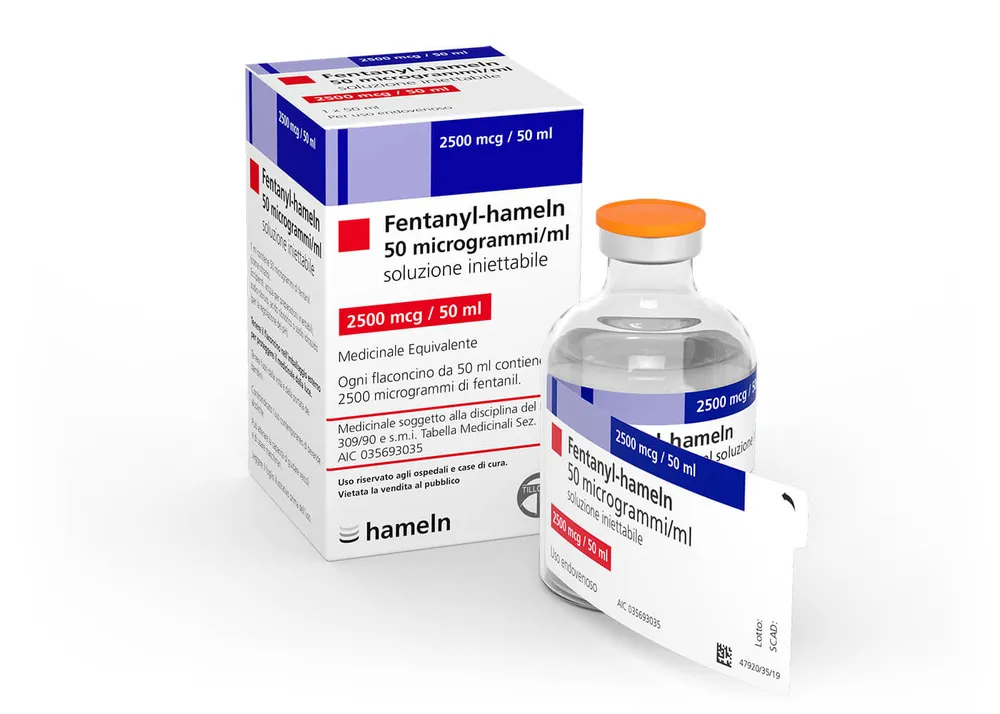
Instructions for Use
Patient Information Leaflet
Fentanyl-hameln 50 micrograms/ml injection solution
fentanyl
Equivalent Medicinal Product
Please read all of this leaflet carefully before you take this medicine, because it contains important information for you.
- Keep this leaflet. You may need to read it again.
- If you have any questions, ask your doctor or pharmacist.
- This medicine has been prescribed for you only. Do not pass it on to other people, even if they have the same symptoms as you, because it could be harmful.
- If you experience any side effects, including those not listed in this leaflet, tell your doctor or pharmacist. See section 4.
The full name of the medicine is Fentanyl-hameln; it will be referred to throughout this leaflet as Fentanyl.
Contents of this leaflet:
- What Fentanyl-hameln is and what it is used for
- What you need to know before you take Fentanyl-hameln
- How to use Fentanyl-hameln
- Possible side effects
- How to store Fentanyl-hameln
- Contents of the pack and other information
1. What Fentanyl-hameln is and what it is used for
Fentanyl belongs to a group of strong painkillers called opioids.
At low doses, Fentanyl is used to control pain during short surgical procedures.
In addition to providing analgesia, higher doses of Fentanyl are used to reduce the natural respiratory rate when the patient is being mechanically ventilated.
During major surgical procedures, Fentanyl is used in combination with a sedative called a neuroleptic, to induce anaesthesia in the patient.
2. What you need to know before taking Fentanyl-hameln
Fentanyl-hameln must NOT be administered to you if:
- you are allergic to fentanyl, to other medicines similar to morphine, or to any of the other ingredients of this medicine (listed in section 6). An allergic reaction may manifest as skin rash, itching, swelling of the face or lips, or shortness of breath.
- you suffer from a disease causing breathing difficulties, e.g. asthma or chronic bronchitis. Make sure to discuss this with your doctor before the procedure.
- you are currently taking or have recently taken antidepressants belonging to the class of monoamine oxidase inhibitors (MAOIs) – see also Other medicines and Fentanyl-hameln below regarding serotonin syndrome and the use of fentanyl with MAOIs and serotonergic medicines such as SSRIs and SNRIs.
- you suffer from increased intracranial pressure or have a brain or skull injury.
- you suffer from low blood pressure or reduced blood volume (hypovolemia).
- you suffer from myasthenia gravis, a disease causing muscle fatigue and weakness.
Warnings and precautions
- Fentanyl-hameln must be administered exclusively by an experienced anaesthesiologist within a hospital or other facility equipped with equipment for intubation and assisted ventilation.
- As with all strong opioid analgesics of this type, effective pain relief is associated with a reduction in respiratory rate, which may persist until recovery or re-emergence during this phase. This effect may be prolonged, especially in elderly patients. In newborns, this effect may occur even after small doses. Your breathing will be closely monitored until it returns to normal. Your doctor will have access to specific instruments and medications capable of treating any involuntary reduction in respiratory rate.
- Patients with epilepsy, or with thyroid, cardiac, pulmonary, intestinal, hepatic, or renal disorders, as well as those with a history of alcoholism, will receive a dose adjusted to their specific needs, and their response to therapy will be closely monitored.
- Continued use or prior abuse of this type of medicine may reduce its effectiveness, thus requiring higher doses.
- There is a possibility that newborns may develop withdrawal syndrome after therapy lasting more than 5 days or beyond a certain cumulative dose. See section “Pregnancy and breastfeeding” below.
- Rapid injections of Fentanyl-hameln must be avoided.
- Fentanyl may cause low blood pressure, especially if you have low blood volume.
- Fentanyl may lead to biliary spasms.
Talk to your doctor before using Fentanyl-hameln:
- If you or someone in your family has ever abused or been dependent on alcohol, prescription medicines, or illegal substances (“addiction”).
- If you are a smoker.
- If you have ever had problems with your mood (depression, anxiety, or a personality disorder) or have ever received treatment from a psychiatrist for a mental illness.
- If you are pregnant, could become pregnant, or are breastfeeding. For further information, see section “Pregnancy and breastfeeding” below.
- If you experience pain or increased sensitivity to pain (hyperalgesia) that does not respond to higher doses of the medicine as prescribed by your doctor. Your doctor will decide whether to adjust the dose or discontinue use of this medicine.
Long-term, repeated use of opioid analgesics may make the medicine less effective
(tolerance develops). It may also lead to dependence and abuse, which can result in a
potentially life-threatening overdose. If you are concerned about becoming dependent on Fentanyl,
it is important to consult your doctor.
If treatment is stopped, withdrawal symptoms may occur. Inform your doctor or
nurse if you think this is happening to you (also see section 4. Possible side effects).
Other medicines and Fentanyl-hameln
Concomitant use of Fentanyl-hameln with sedative medicines such as benzodiazepines or related drugs increases the risk of drowsiness, breathing difficulties (respiratory depression), coma, and may be life-threatening. For this reason, concomitant use should only be considered when no other treatment options are available.
However, if your doctor prescribes Fentanyl together with sedative medicines, the dose and duration of concomitant treatment must be limited by your doctor.
Inform your doctor about all sedative medicines you are taking and follow your doctor’s dosage recommendations carefully. It may be helpful to inform friends or relatives to watch for the signs and symptoms listed above. Contact your doctor if you experience such symptoms.
Inform your doctor or pharmacist if you are taking, have recently taken, or might take any other medicine.
Inform your doctor if you are taking any of the following medicines:
- analgesics
- sleeping tablets
- tranquilizers
- medicines for epilepsy
- diazepam
- thiopental
- midazolam
- droperidol
- cimetidine
- clonidine
- vecuronium
- atracurium
- baclofen
- etomidate
- nitrous oxide
- ritonavir
- medicines used to treat fungal infections (e.g. itraconazole, fluconazole, voriconazole)
- Certain nerve pain medications (gabapentin and pregabalin).
Serotonin syndrome
In particular, do not take this medicine and inform your doctor or pharmacist if you have taken
medicines for depression called "monoamine oxidase inhibitors (MAOIs)" within the past
two weeks. If this applies to you, do not take Fentanyl-. It is also important that
you inform your doctor or pharmacist if you are taking other serotonergic medicines, including
antidepressants such as "selective serotonin reuptake inhibitors" (SSRIs) or
"serotonin-norepinephrine reuptake inhibitors" (SNRIs). This is because these
medicines may increase the risk of serotonin syndrome, a potentially life-threatening condition. Symptoms of this condition may include agitation,
hallucinations, coma, rapid heart rate, changes in blood pressure, fever,
hyperreflexia, lack of coordination, muscle rigidity, nausea, vomiting, and diarrhea.
Pregnancy and breastfeeding
If you are pregnant, suspect you may be pregnant, are planning a pregnancy, or are breastfeeding,
consult your doctor before using this medicine.
It is recommended not to take this medicine during labour, as fentanyl crosses the placenta
and may affect the newborn's breathing. If you receive Fentanyl during pregnancy, there is
a risk that the baby may develop neonatal drug withdrawal syndrome after birth, which may require treatment. However, if your doctor decides it is necessary, treatment is available to manage any potential adverse effects.
Fentanyl may pass into breast milk; therefore, breastfeeding is not recommended for at least
24 hours after treatment.
Driving and using machines
Do not drive or operate any tools or machinery, as fentanyl may reduce your level of alertness and concentration for a considerable period after administration.
Ask your doctor when you may resume these activities.
You must be accompanied home and must not drink alcohol.
Fentanyl-hameln contains sodium
This medicine contains 3.5 mg of sodium (the main component of table salt) per
millilitre of solution. This corresponds to 0.2% of the maximum daily recommended dietary intake for an adult.
For athletes: using this medicine without a therapeutic need constitutes doping
and may lead to a positive result in anti-doping tests.
3. How to use Fentanyl-hameln
Fentanyl-hameln will be injected into a vein by a doctor just before you enter the operating room. It will help put you to sleep and prevent you from feeling pain during the surgery. Fentanyl will only be administered in an environment where airways can be managed, and it will be given by medical personnel who are able to monitor you.
The initial dose should be reduced in elderly and debilitated patients. Your doctor will decide how much Fentanyl to administer. The dose will depend on your age, body weight, physical condition, other medications you are taking concomitantly, as well as on the type of surgical procedure and anesthesia.
4. Possible side effects
Like all medicines, this medicine can cause side effects, although not everyone experiences them.
If you start experiencing breathing difficulties, dizziness, or symptoms of low blood pressure and slowed heartbeat, inform your doctor immediately or seek medical assistance.
The following side effects have been reported:
Very common (may affect more than 1 in 10 people):
- feeling unwell (nausea)
- malaise (vomiting)
- muscle stiffness (which may affect the chest muscles, possibly leading to impaired breathing)
Common (may affect up to 1 in 10 people):
- dizziness or sensation of spinning ("dizziness")
- excessive tiredness (sedation)
- vision problems
- agitation
- fast or slow heartbeat
- low or high blood pressure
- pain in the veins
- confusion after surgery
- skin rash
- temporary cessation of breathing (apnea)
- breathing difficulties or labored breathing
- spasms of the throat or lung muscles
Uncommon (may affect up to 1 in 100 people):
- excessive feeling of happiness (euphoria)
- headache
- changes in blood pressure
- swelling and clotting in a vein
- abnormally rapid breathing
- marked decrease in body temperature beyond normal
- chills
- hiccups
- agitation after surgery
Not known (frequency cannot be estimated from available data):
- severe allergic reaction causing breathing difficulties or dizziness
- seizures
- loss of consciousness
- muscle spasms
- cardiac arrest (the doctor has medicines available to reverse this effect)
- severe breathing difficulties or labored breathing
- hiccups
- Delirium (symptoms may include a combination of agitation, restlessness, disorientation, confusion, fear, seeing or hearing things that are not there, sleep disturbances, nightmares)
- a condition causing lack of oxygen in the blood, which may lead to headache, nausea, restlessness, and increased heart rate (methemoglobinemia)
- dependence on the medicine may occur (reduced effectiveness of the drug due to continued use)
- pharmacological dependence may develop
- difficulty standing upright (dizziness)
- Horner’s syndrome (drooping of the upper eyelid or elevation of the lower eyelid, appearance of sunken eye, pupil constriction)
- loss of pharyngeal reflex or ability to swallow
- fluid accumulation in the lungs
- spasms of the gallbladder
- abnormal sweating
- difficulty urinating
- withdrawal symptoms (may occur with the onset of the following side effects: nausea, vomiting, diarrhea, anxiety, chills, tremor, and sweating)
Reporting of side effects
If you experience any side effect, including those not listed in this leaflet, talk to your doctor or pharmacist. You can also report side effects directly via the website: http://www.aifa.gov.it/content/segnalazioni-reazioni-avverse. By reporting side effects, you can help provide more information on the safety of this medicine.
5. How to store Fentanyl-hameln
Keep this medicine out of sight and reach of children.
Do not use this medicine after the expiry date stated on the label and packaging following the word "Exp". The expiry date refers to the last day of that month.
Store the vials in the outer packaging to protect the medicine from light.
Validity after dilution: The chemical and physical stability during use of the diluted solutions has been demonstrated for 24 hours at 25°C. From a microbiological standpoint, diluted solutions should be used immediately. If the medicine is not used immediately, the user is responsible for the in-use storage duration and conditions prior to use, which generally should not exceed 24 hours at 2–8°C, unless the dilution was carried out under controlled and aseptic conditions.
Do not use this medicine if the solution appears cloudy or discoloured.
Do not dispose of any medicine via wastewater or household waste. Ask your pharmacist how to dispose of medicines no longer required. This will help protect the environment.
6. Package Contents and Other Information
What Fentanyl-hameln Contains
The active substance is fentanyl (as citrate).
1 ml of injectable solution contains:
fentanyl citrate 78.5 mcg
equivalent to fentanyl 50 mcg.
1 vial of 2 ml of injectable solution contains:
fentanyl citrate 157 mcg
equivalent to fentanyl 100 mcg.
1 vial of 10 ml of injectable solution contains:
fentanyl citrate 785 mcg
equivalent to fentanyl 500 mcg.
1 50-ml vial of injectable solution contains:
fentanyl citrate 3925 mcg
equivalent to fentanyl 2500 mcg.
The other components are water for injections, sodium chloride, hydrochloric acid or
sodium hydroxide (to adjust pH).
Description of the Appearance of Fentanyl-hameln and Contents of the Package
Fentanyl is a clear, colourless injectable solution.
Clear type I glass vials of 2 ml or 10 ml
Boxes of 5 vials of 2 ml or 10 ml
Boxes of 10 vials of 2 ml or 10 ml
Clear type I glass vial of 50 ml with bromobutyl rubber stopper
Boxes of 1 vial of 50 ml
Boxes of 5 vials of 50 ml
Boxes of 10 vials of 50 ml
Not all pack sizes may be marketed.
Marketing Authorization Holder
hameln pharma gmbh
Inselstraße 1
31787 Hameln
Germany
Exclusive distributor for sale in Italy: Tillomed Italia S.r.l., viale Richard 1°, 20143,
Milan, Italy
Manufacturer:
Siegfried Hameln GmbH
Langes Feld 13
31789 Hameln
Germany
hameln rds s.r.o.
Horná 36, 900 01 Modra
Slovakia
HBM Pharma s.r.o.
Sklabinská 30, 03680 Martin
Slovakia
This medicinal product is authorized in the Member States of the European Economic Area under the following names:
AT: Fentanyl-hameln 50 Microgramm/ml Injektionslösung
DK: Fentanyl "Hameln", injektionsvæske, opløsning
FI: Fentanyl Hameln 50 mikrog/ml injektioneste, liuos
DE: Fentanyl-hameln 50 Mikrogramm/ml Injektionslösung
IT: Fentanyl-hameln
LU: Fentanyl Hameln 50 Mikrogramm/ml Injektionslösung
NL: Fentanyl hameln 50 microgram/ml, oplossing voor injectie
NO: Fentanyl Hameln 50 mikrog/ml injeksjonsvæske, oppløsning
The following information is intended exclusively for physicians or healthcare professionals:
PREPARATION INSTRUCTIONS FOR:
Fentanyl-hameln 50 micrograms/ml injectable solution
This is a summary of information regarding the preparation, storage, and administration of Fentanyl-hameln 50 micrograms/ml injectable solution.
It is important that you read the entire content of this guide before preparing this medicinal product.
Nature and Contents of the Container
5 (10) colourless type I glass vials containing 2 ml or 10 ml of solution.
1 (5, 10) colourless type I glass vials containing 50 ml of solution, with bromobutyl rubber stopper.
Not all pack sizes may be marketed.
Incompatibilities
This medicinal product must not be mixed with other products except those mentioned below.
Check the compatibility of fentanyl before administration if it is to be mixed with other medicinal products.
Fentanyl citrate has been found to be physiologically incompatible with sodium pentobarbital, methohexital sodium, sodium thiopental, and nafcillin.
Dilution
The product may be used undiluted or diluted. The tested dilution ranges with 0.9% sodium chloride solution and 5% glucose solution are 1:1 and 1:25. Therefore, the maximum dilution must not exceed 1 part Fentanyl-hameln with 25 parts of 0.9% sodium chloride solution or 5% glucose solution.
Storage
Store vials/vials in their carton to protect from light.
Dosage and Method of Administration
Dosage
Fentanyl-hameln must be administered only in a setting where airway control is possible and by personnel capable of managing the airway.
The dosage of Fentanyl-hameln must be individually adjusted according to age, body weight, physical condition, underlying pathological condition, concomitant medications, as well as type of surgical procedure and type of anaesthesia.
Adults
The usual therapeutic regimen in adults for intravenous injection is as follows:
Initial dose Supplemental dose
Spontaneous
50–200* micrograms 50 micrograms
respiration
Assisted
300–3,500 micrograms 100–200 micrograms
ventilation (up to 50 micrograms/kg)
*Doses exceeding 200 micrograms lead to significant respiratory depression and should therefore be used only under anaesthesia.
Fentanyl-hameln 50 micrograms/ml solution for injection can also be administered by continuous infusion.
In ventilated patients, a loading dose of 1 microgram/kg/min for the first 10 minutes is followed by an infusion rate of approximately 0.1 microgram/kg/min.
Alternatively, the loading dose may be administered as a bolus. Infusion rates must be titrated according to individual patient response; infusion rates of up to 3 micrograms/kg/min have been used in cardiac surgery. The infusion should be discontinued approximately 40 minutes before the end of surgery, unless mechanical ventilation is to continue in the postoperative period.
For patients breathing spontaneously, lower infusion rates of 0.05–0.08 microgram/kg/min are required.
Neuroleptanalgesia and Neuroleptanaesthesia
For neuroleptanalgesia, adults usually require an initial dose of 50–100 micrograms (0.7–1.4 micrograms/kg) of fentanyl administered slowly intravenously in combination with a neuroleptic (preferably droperidol). A second dose of 50–100 micrograms (0.7–1.4 micrograms/kg) of fentanyl may be administered 30 to 45 minutes after the initial dose, if needed.
For neuroleptanaesthesia under assisted ventilation, adults usually require an initial dose of 200–600 micrograms (2.8–8.4 micrograms/kg) of fentanyl administered slowly intravenously in combination with a neuroleptic (preferably droperidol). The dose depends on the duration and severity of the surgical procedure, as well as on the agent used to induce general anaesthesia. To maintain anaesthesia, additional doses of 50–100 micrograms (0.7–1.4 micrograms/kg) of fentanyl may be administered every 30–45 minutes. The timing and dosage of supplemental administrations should be adjusted according to the progress of the surgical procedure.
Treatment of Pain in Intensive Care Units
For use in the treatment of pain in ventilated patients in intensive care units, the fentanyl dose must be individually adjusted depending on the course of pain and concomitant use of other medications. Initial doses are usually in the range of 50–100 micrograms intravenously (0.7–1.4 micrograms/kg), but higher doses may be used if necessary. The initial dose is usually followed by repeated injections, up to a total of 25–125 micrograms of fentanyl per hour (0.35–1.8 micrograms/kg/hour).
Dosage in the Paediatric Population
For children aged 12 to 17 years, the adult dosing regimen should be followed.
For children aged 2 to 11 years, the following usual dosing regimen is recommended:
| Age in years | Initial dose in micrograms/kg of body weight | Supplemental dose in micrograms/kg of body weight | |
| Spontaneous respiration | 2-11 | 1-3 | 1-1.25 |
| Assisted ventilation | 2-11 | 1-3 | 1-1.25 |
Pediatric use
Analgesia during a surgical procedure, enhancement of anesthesia with spontaneous respiration:
Techniques involving analgesia in a child who is breathing spontaneously should be used only as part of an anesthetic or sedation/analgesia technique administered by experienced personnel in a setting where sudden thoracic wall rigidity requiring intubation or apnea requiring respiratory support can be managed.
Dosage in elderly and debilitated patients
As with other opioids, the initial dose should be reduced in elderly (over 65 years of age) and debilitated patients. The effects of the initial dose should be taken into account when determining supplemental doses.
Obese patients
In obese patients, there may be a risk of overdose if the dose is calculated based on total body weight. Obese patients should receive a dose calculated according to estimated lean body mass.
Renal impairment
In patients with impaired renal function, a reduced dose of Fentanyl-hameln should be considered; these patients should be closely monitored for signs of fentanyl toxicity.
Dosing in patients on chronic opioid therapy
In patients receiving chronic opioid therapy or with a known history of opioid abuse, a higher dose of fentanyl may be required.
Dosing in patients with other diseases
In patients affected by any of the following conditions, the dose should be carefully titrated:
- Uncompensated hypothyroidism
- Pulmonary diseases, particularly those causing reduced vital capacity
- Alcohol abuse
- Impaired hepatic function
Additionally, caution is required when administering Fentanyl-hameln to patients with renal insufficiency, prostatic hypertrophy, porphyria, or bradyarrhythmia.
In all these conditions, except alcohol abuse, a dose reduction may be necessary.
In case of alcohol abuse, the dose may need to be either reduced or increased.
In such patients, a prolonged postoperative monitoring period is recommended.
Method and duration of administration
Intravenous administration as bolus injection or by infusion.
For instructions on dilution of the medicinal product prior to administration, see above.
To prevent bradycardia, it is recommended to administer a small intravenous dose of an anticholinergic agent just before induction of anesthesia.
For intravenous injection, Fentanyl-hameln must be administered slowly over 1–2 minutes (see section 4.4. of the Summary of Product Characteristics), if applicable, in combination with a neuroleptic (preferably droperidol).
In anesthesia, the duration of administration depends on the length of the surgical procedure. In the treatment of pain in intensive care unit patients, the physician must determine the duration of administration based on the intensity and duration of pain.
Marketing Authorization Holder
hameln pharma gmbh
Inselstraße 1
31787 Hameln
Germany
Similar Medications
-
Fentanest
Form: solution for injection
Active substance Dosage FENTANYL CITRATE — Manufacturer: PIRAMAL CRITICAL CARE ITALIA S.P.A.
-
Fentanyl Ethypharm
Form: solution for injection
Active substance Dosage FENTANYL CITRATE — Manufacturer: ETHYPHARM
-
Fentanyl Kalceks
Form: solution for injection
Active substance Dosage FENTANYL CITRATE — Manufacturer: AS KALCEKS
This page has been machine-translated and may contain inaccuracies. The original data is available in the manufacturing country's language.
Last data check: May 11, 2026 · Data source: Agenzia Italiana del Farmaco (AIFA)