Bisoprolol Normon 10 mg film-coated tablets EFG
Spain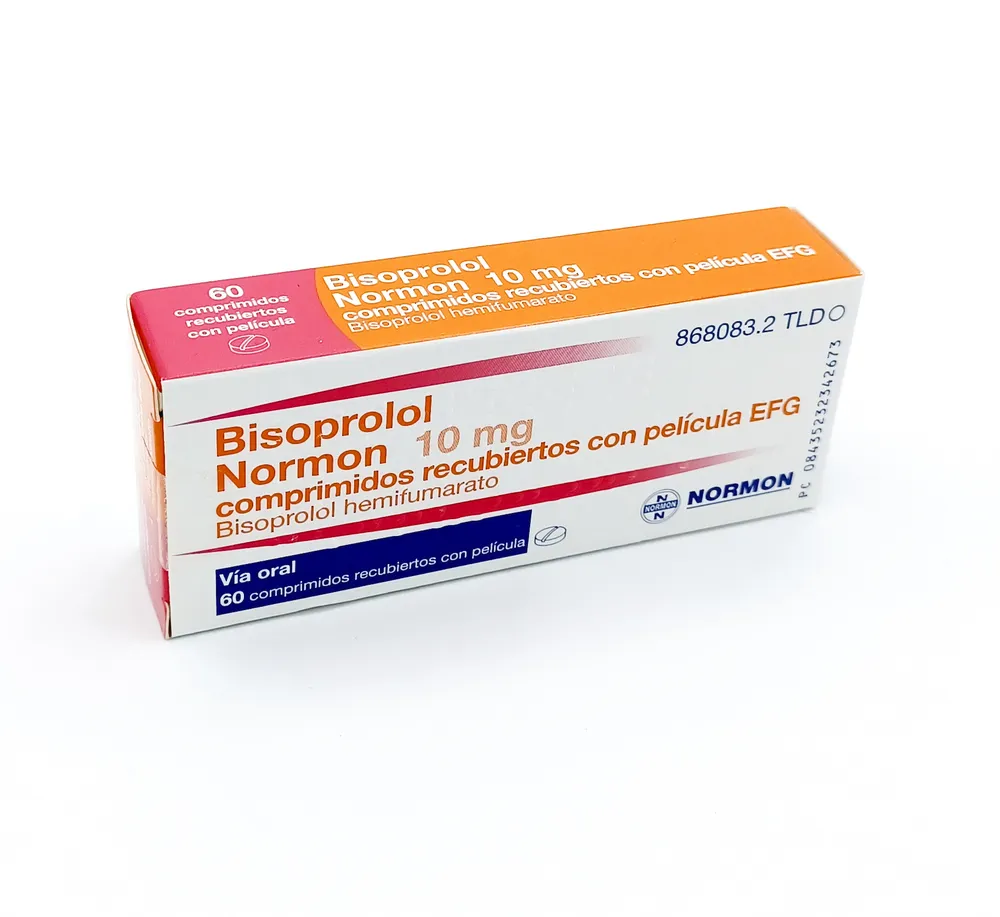
Instructions for Use
Package leaflet: Information for the user
Introduction
Package leaflet: information for the user
Bisoprolol NORMON 10 mg film-coated tablets EFG
bisoprolol hemifumarate
Read the entire leaflet carefully before you start taking this medicine, because it contains important information for you.
- Keep this leaflet, as you may need to read it again.
- If you have any questions, ask your doctor or pharmacist.
- This medicine has been prescribed for you and must not be given to other people, even if they have the same symptoms, as it may harm them.
- If you experience any adverse effects, consult your doctor or pharmacist, even if they are effects not listed in this leaflet. See section 4.
Leaflet contents
- What Bisoprolol NORMON is and what it is used for
- What you need to know before taking Bisoprolol NORMON
- How to take Bisoprolol NORMON
- Possible adverse effects
- How to store Bisoprolol NORMON
- Contents of the pack and other information
1. What Bisoprolol NORMON is and what it is used for
Bisoprolol belongs to a group of medicines called beta-blockers. These medicines work by affecting the body's response to certain nerve impulses, particularly in the heart. As a result, bisoprolol slows the heartbeat and makes the heart more efficient at pumping blood throughout the body.
Bisoprolol is used to:
- Treat high blood pressure (hypertension).
- Treat chronic stable angina pectoris caused by insufficient oxygen supply to the heart muscle.
- Treat chronic stable heart failure. It is used in combination with other medicines. Heart failure is the inability of the heart to pump enough blood to meet the body's needs.
2. What you need to know before taking Bisoprolol NORMON
-
Do not take Bisoprolol NORMON if you have any of the following conditions:
-
Allergy (hypersensitivity) to bisoprolol or to any of the other components of this medicine (listed in section 6).
-
Severe asthma or severe chronic lung disease.
-
Severe circulatory problems in the limbs (such as Raynaud's syndrome), which may cause tingling in the fingers and toes or make them pale or blue.
-
Untreated phaeochromocytoma, which is a rare tumour of the adrenal gland.
-
Metabolic acidosis, a condition that occurs when there is too much acid in the blood.
-
Do not take Bisoprolol NORMON if you have any of the following heart problems:
-
Acute heart failure.
-
Worsening heart failure requiring intravenous injection of medicines that increase the force of the heart's contraction.
-
Slow heart rate.
-
Low blood pressure.
-
Certain heart conditions causing very slow heart rate or irregular pulse.
-
Cardiogenic shock, a serious and acute heart condition causing low blood pressure and circulatory failure.
-
Warnings and precautions
If you have any of the following conditions, inform your doctor before taking Bisoprolol NORMON; your doctor may want to take special precautions (for example, provide additional treatment or perform more frequent check-ups):
- Diabetes.
- Strict fasting.
- Certain heart conditions such as heart rhythm disorders or severe chest pain at rest (Prinzmetal's angina).
- Kidney or liver problems.
- Less severe circulatory problems in the limbs.
- Less severe asthma or chronic respiratory disease.
- History of scaly skin rash (psoriasis).
- Tumour of the adrenal gland (phaeochromocytoma).
- Thyroid disorder.
- First-degree heart block (a condition in which nerve signals to the heart are altered, possibly causing occasional missed beats or irregular heartbeat).
In addition, inform your doctor if you are undergoing:
-
Desensitisation treatment (for example, to prevent hay fever), because Bisoprolol NORMON may make allergic reactions more likely or more severe.
-
Anaesthesia (for example, for surgery), because Bisoprolol NORMON may affect how your body responds to this situation.
-
Children and adolescents
The administration of Bisoprolol NORMON is not recommended in children and adolescents.
Consult your doctor or pharmacist before starting to take Bisoprolol NORMON.
- Taking Bisoprolol NORMON with other medicines:
Inform your doctor or pharmacist if you are taking, have recently taken, or might need to take any other medicines.
Do not take the following medicines with Bisoprolol NORMON without special advice from your doctor:
- Certain medicines used to treat irregular or abnormal heartbeat (Class I antiarrhythmic medicines such as quinidine, disopyramide, lidocaine, phenytoin; flecainide, propafenone).
- Certain medicines used to treat high blood pressure, angina, or irregular heartbeat (calcium antagonists such as verapamil and diltiazem).
- Certain medicines used to treat high blood pressure such as clonidine, methyldopa, moxonidine, rilmenidine. However, do not stop taking these medicines without first consulting your doctor.
Consult your doctor before taking the following medicines with Bisoprolol NORMON; your doctor may need to monitor your condition more frequently:
-
Certain medicines used to treat high blood pressure or angina (calcium antagonists of the dihydropyridine type such as felodipine and amlodipine).
-
Certain medicines used to treat irregular or abnormal heartbeat (Class III antiarrhythmic medicines such as amiodarone).
-
Topically applied beta-blockers (such as timolol eye drops for the treatment of glaucoma).
-
Certain medicines used, for example, in Alzheimer's disease or for the treatment of glaucoma (parasympathomimetics such as tacrine or carbacol), or medicines used to treat acute heart problems (sympathomimetics such as isoprenaline and dobutamine).
-
Antidiabetic medicines including insulin.
-
Anaesthetic agents (for example, during surgery).
-
Digitalis, used to treat heart failure.
-
Non-steroidal anti-inflammatory drugs (NSAIDs) used to treat arthritis, pain, or inflammation (for example, ibuprofen or diclofenac).
-
Epinephrine, a medicine used to treat severe allergic reactions and cardiac arrest.
-
Any medicine that may lower blood pressure as a desired or undesired effect, such as antihypertensives, certain medicines for depression (tricyclic antidepressants such as imipramine or amitriptyline), certain medicines used to treat epilepsy or during anaesthesia (barbiturates such as phenobarbital), or certain medicines used to treat mental illnesses characterised by loss of contact with reality (phenothiazines such as levomepromazine).
-
Mefloquine, used for the prevention or treatment of malaria.
-
Medicines for the treatment of depression called monoamine oxidase inhibitors (except MAO-B inhibitors) such as moclobemide.
-
Pregnancy and breastfeeding:
If you are pregnant or breastfeeding, think you may be pregnant, or plan to become pregnant, consult your doctor or pharmacist before using this medicine.
There is a risk that using Bisoprolol NORMON during pregnancy may harm the baby. If you are pregnant or plan to become pregnant, inform your doctor. Your doctor will decide whether you can take Bisoprolol NORMON during pregnancy.
It is unknown whether bisoprolol passes into human breast milk. Therefore, breastfeeding is not recommended during treatment with Bisoprolol NORMON.
- Driving and using machines:
Your ability to drive or use machinery may be affected depending on how well you tolerate the medicine. Be especially cautious at the beginning of treatment, when the dose is increased, when medication is changed, and also when combined with alcohol.
- Important information for athletes
Athletes are advised that this medicine contains a component that may result in a positive analytical finding in doping controls.
- Bisoprolol Normon contains sodium
This medicine contains less than 23 mg of sodium (1 mmol) per tablet; this is essentially "sodium-free".
3. How to take Bisoprolol NORMON
Follow exactly the instructions for use of this medicine as given by your doctor. If in doubt, consult your doctor or pharmacist.
Treatment with Bisoprolol NORMON requires regular monitoring by your doctor. This is particularly necessary at the beginning of treatment and during dose increases.
Take the tablet with some water in the morning, with or without food. Do not crush or chew the tablet.
Treatment with Bisoprolol NORMON is usually long-term.
Adults:
For the treatment of hypertension and angina pectoris:
- The initial dose is 5 mg once daily.
- Your doctor may increase the dose in small increments (usually every few weeks) to 10 mg or up to a maximum of 20 mg if necessary.
Treatment must never be stopped abruptly; the dose should be gradually reduced over a period of 1–2 weeks.
For the treatment of stable chronic heart failure:
Treatment with bisoprolol should be initiated at a low dose and gradually increased. Your doctor will decide how to increase the dose, and this is usually done as follows:
- 1.25 mg of bisoprolol once daily for one week.
- 2.5 mg of bisoprolol once daily for one week.
- 3.75 mg of bisoprolol once daily for one week.
- 5 mg of bisoprolol once daily for four weeks.
- 7.5 mg of bisoprolol once daily for four weeks.
- 10 mg of bisoprolol once daily as maintenance therapy (ongoing).
The maximum recommended daily dose is 10 mg of bisoprolol.
Depending on how well you tolerate the medicine, your doctor may decide to prolong the time between dose increases. If your condition worsens or you no longer tolerate the medicine, it may be necessary to reduce the dose again or discontinue treatment. In some patients, a maintenance dose lower than 10 mg of bisoprolol may be sufficient.
Your doctor will advise you what to do.
Normally, if you have to stop treatment completely, your doctor will advise you to reduce the dose gradually, as otherwise your condition may worsen.
Renal or hepatic impairment
In patients with mild to moderate hepatic or renal disorders, dose adjustment is usually not necessary. In patients with end-stage renal failure and in patients with severe hepatic impairment, the daily dose should not exceed 10 mg.
Experience with bisoprolol in dialysed patients is limited; however, so far there is no evidence that the dosing regimen needs to be modified in these patients.
Elderly
Dose adjustment is not required.
Paediatric population
There is no paediatric experience with bisoprolol, therefore its use is not recommended in paediatric patients.
??If you take more Bisoprolol NORMON than you should
If you have taken more Bisoprolol NORMON tablets than you should, inform your doctor immediately. Your doctor will decide which measures are necessary.
Symptoms of overdose may include a reduced heart rate, severe breathing difficulties, dizziness, or tremors (due to low blood sugar).
In case of overdose or accidental ingestion, contact the Toxicology Information Service (Tel. 91 562 04 20), indicating the product and the amount ingested.
??If you forget to take Bisoprolol NORMON
Do not take a double dose to make up for forgotten doses. Take your usual dose the next morning.
??If you stop taking Bisoprolol NORMON
Never stop taking Bisoprolol NORMON unless advised by your doctor. Otherwise, your condition could worsen significantly.
If you have any further questions about the use of this medicine, ask your doctor or pharmacist.
4. Possible adverse effects
Like all medicines, Bisoprolol NORMON may cause adverse effects, although not everyone experiences them.
To prevent serious reactions, speak with a doctor immediately if an adverse effect is severe, occurs suddenly, or worsens rapidly.
The most serious adverse effects are related to cardiac function:
- Slowing of the heart rate (affects more than 1 in 10 people).
- Worsening of heart failure (affects less than 1 in 10 people).
- Slow or irregular heartbeats (affects less than 1 in 100 people).
If you feel dizzy or weak, or have difficulty breathing, contact your doctor as soon as possible.
Other adverse effects, listed below according to their frequency of occurrence:
Frequent (affects less than 1 in 10 people):
- Fatigue, weakness, dizziness, headache.
- Cold sensation or numbness in hands or feet.
- Low blood pressure.
- Stomach or intestinal problems such as nausea, vomiting, diarrhea, or constipation.
Uncommon (affects less than 1 in 100 people):
- Sleep disturbances.
- Depression.
- Dizziness upon standing.
- Breathing problems in patients with asthma or chronic respiratory disease.
- Muscle weakness, muscle cramps.
Rare (affects less than 1 in 1,000 people):
- Hearing problems.
- Allergic nasal congestion.
- Decreased tear production.
- Liver inflammation that may cause yellowing of the skin or whites of the eyes; elevated liver enzymes (laboratory tests: ALAT or ASAT).
- Abnormal blood test results for liver function or fat levels.
- Allergy-like reactions such as itching, redness, skin rash.
- Erectile dysfunction.
- Nightmares, hallucinations.
- Fainting.
Very rare (affects less than 1 in 10,000 people):
- Eye irritation and redness (conjunctivitis).
- Hair loss.
- Onset or worsening of scaly skin rash (psoriasis); psoriasis-like rash.
Inform your doctor or pharmacist if you notice any of the adverse effects listed above or any other undesired or unexpected effects.
Reporting of adverse effects
If you experience any type of adverse effect, consult your doctor or pharmacist, even if it is an effect not listed in this leaflet. You may also report them directly via the Spanish Pharmacovigilance System for Human Medicinal Products: www.notificaRAM.es. By reporting adverse effects, you can help provide more information on the safety of this medicine.
5. Storage of Bisoprolol NORMON
Keep out of sight and reach of children.
Do not store above 30 °C.
Do not use this medicine after the expiry date stated on the packaging after EXP. The expiry date is the last day of the month indicated.
Medicines must not be disposed of via wastewater or household waste. Dispose of packaging and unused medicines at a SIGRE collection point at your pharmacy. If you are unsure, please ask your pharmacist how to dispose of unused packaging and medicines. This will help protect the environment.
6. Contents of the container and other information
Composition of Bisoprolol NORMON.
The active substance is bisoprolol hemifumarate. Each tablet contains 10 mg of bisoprolol hemifumarate.
The other components are: microcrystalline cellulose, corn starch, colloidal silica, hypromellose, sodium hydrogen phosphate, magnesium stearate, sodium croscarmellose, titanium dioxide (E-171), macrogol 6000 and yellow iron oxide (E-172).
Appearance of the product and contents of the container
Bisoprolol NORMON are yellow, round, biconvex, film-coated tablets with a break line.
Available in packs of 28, 30, 60 or 500 tablets.
Not all pack sizes may be marketed.
Marketing Authorisation Holder and Manufacturer
LABORATORIOS NORMON, S.A.
Ronda de Valdecarrizo, 6 – 28760 Tres Cantos – Madrid (SPAIN)
Other presentations
BISOPROLOL NORMON 2.5 mg FILM-COATED TABLETS EFG
BISOPROLOL NORMON 5 mg FILM-COATED TABLETS EFG
Date of the most recent review of this leaflet
July-2014
Detailed and up-to-date information on this medicinal product is available on the website of the Spanish Agency for Medicines and Health Products (AEMPS) http://www.aemps.gob.es/
You can access detailed and up-to-date information about this medicine by scanning with your mobile phone (smartphone) the QR code included in the package leaflet and carton. You can also access this information at the following internet address: https://cima.aemps.es/cima/dochtml/p/65074/P_65074.html
Similar Medications
-
Bisoprolol Aurovitas 10 mg film-coated tablets EFG
Form: tablets, film-coated
Active substance Dosage BISOPROLOL FUMARATE 10 mg Manufacturer: Aurovitas Spain, S.A.U.
-
Bisoprolol Aurovitas 2.5 mg film-coated tablets EFG
Form: tablets, film-coated
Active substance Dosage BISOPROLOL FUMARATE 2,50 mg Manufacturer: Aurovitas Spain, S.A.U.
-
Bisoprolol Aurovitas 5 mg film-coated tablets EFG
Form: tablets, film-coated
Active substance Dosage BISOPROLOL FUMARATE 5 mg Manufacturer: Aurovitas Spain, S.A.U.
-
Bisoprolol Cor Sandoz 10 mg film-coated tablets EFG
Form: tablets, film-coated
Active substance Dosage BISOPROLOL FUMARATE 10,0 mg Manufacturer: Sandoz Farmaceutica S.A.
-
Bisoprolol Cor Sandoz 2.5 mg film-coated tablets EFG
Form: tablets, film-coated
Active substance Dosage BISOPROLOL FUMARATE 2,5 mg Manufacturer: Sandoz Farmaceutica S.A.
-
Bisoprolol Cor Sandoz 5 mg film-coated tablets EFG
Form: tablets, film-coated
Active substance Dosage BISOPROLOL FUMARATE 5,0 mg Manufacturer: Sandoz Farmaceutica S.A.
-
Bisoprolol Cor Viatris 10 mg film-coated tablets EFG
Form: tablets, film-coated
Active substance Dosage BISOPROLOL FUMARATE 10 mg Manufacturer: Viatris Limited
-
Bisoprolol Cor Viatris 2.5 mg film-coated tablets EFG
Form: tablets, film-coated
Active substance Dosage BISOPROLOL FUMARATE 2,5 mg Manufacturer: Viatris Limited
-
Bisoprolol Cor Viatris 5 mg film-coated tablets EFG
Form: tablets, film-coated
Active substance Dosage BISOPROLOL FUMARATE 5 mg Manufacturer: Viatris Limited
-
Bisoprolol Krka 10 mg film-coated tablets EFG
Form: tablets, film-coated
Active substance Dosage BISOPROLOL FUMARATE 10,00 mg Manufacturer: Krka D.D. Novo Mesto
-
Bisoprolol Krka 2.5 mg film-coated tablets EFG
Form: tablets, film-coated
Active substance Dosage BISOPROLOL FUMARATE 2,50 mg Manufacturer: Krka D.D. Novo Mesto
-
Bisoprolol Krka 5 mg film-coated tablets EFG
Form: tablets, film-coated
Active substance Dosage BISOPROLOL FUMARATE 5,00 mg Manufacturer: Krka D.D. Novo Mesto
This page has been machine-translated and may contain inaccuracies. The original data is available in the manufacturing country's language.
Last data check: May 18, 2026 · Data source: CIMA — AEMPS