Bisoprolol Cor Viatris 5 mg film-coated tablets EFG
Spain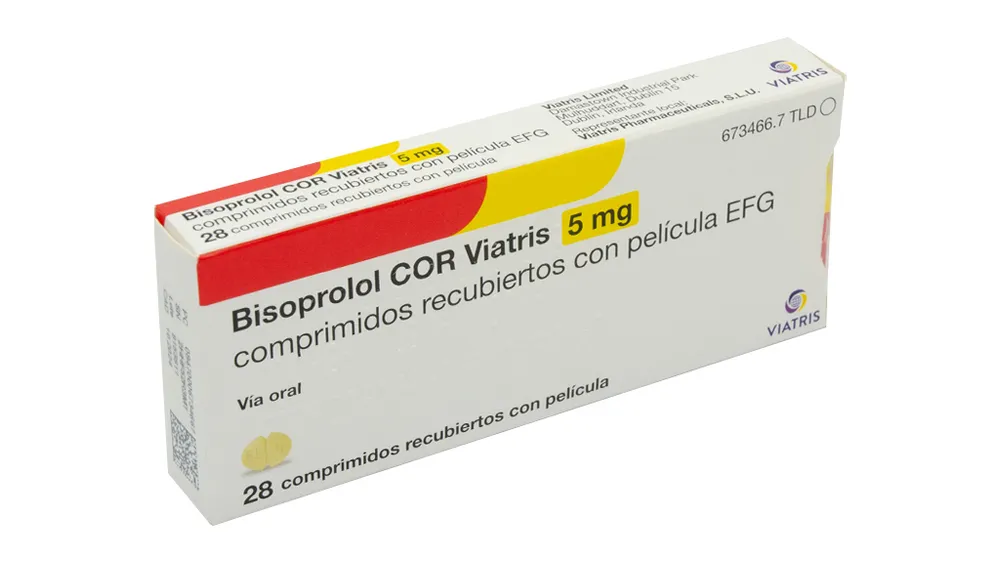
Table of Contents
- Package Leaflet: Information for the User
- Introduction
- 1. What Bisoprolol COR Viatris is and what it is used for
- 2. What you need to know before taking Bisoprolol COR Viatris
- 3. How to take Bisoprolol COR Viatris
- 4. Possible side effects
- 5. Storage of Bisoprolol COR Viatris
- 6. Contents of the pack and other information
Package Leaflet: Information for the User
Introduction
Package Leaflet: Information for the Patient
Bisoprolol COR Viatris 5 mg Film-coated Tablets EFG
Bisoprolol fumarate
Read the entire leaflet carefully before you start taking this medicine, because it contains important information for you.
- Keep this leaflet, as you may need to read it again.
- If you have any questions, ask your doctor or pharmacist.
- This medicine has been prescribed for you only and must not be given to other people, even if they have the same symptoms as you, because it may harm them.
- If you experience any adverse effects, consult your doctor or pharmacist, even if they are effects not listed in this leaflet. See section 4.
Leaflet Contents:
- What Bisoprolol COR Viatris is and what it is used for
- What you need to know before taking Bisoprolol COR Viatris
- How to take Bisoprolol COR Viatris
- Possible side effects
- How to store Bisoprolol COR Viatris
- Contents of the pack and other information
1. What Bisoprolol COR Viatris is and what it is used for
This medicine contains the active substance bisoprolol fumarate, which belongs to a family of medicines called beta-blockers. Bisoprolol is used in combination with other medicines to treat stable heart failure.
Heart failure occurs when the heart muscle is too weak to pump blood properly around the body. This results in breathlessness and swelling.
Bisoprolol slows down the heartbeat and makes the heart more effective at pumping blood around the body.
2. What you need to know before taking Bisoprolol COR Viatris
Do not take Bisoprolol COR Viatris if:
- You are allergic to bisoprolol or to any of the other ingredients of this medicine (listed in section 6).
- You have severe asthma.
- You have a slow or irregular heartbeat. Consult your doctor if you are unsure.
- You have very low blood pressure.
- You have severe circulation problems in the limbs (which may cause tingling in the fingers and toes or make them pale or blue).
- You have heart failure that suddenly worsens and/or may require hospital treatment.
- You have excess acid in the blood, a condition known as metabolic acidosis.
- You have untreated phaeochromocytoma, a rare tumour of the adrenal gland.
Warnings and precautions
Talk to your doctor or pharmacist before taking this medicine if:
- You have asthma or chronic lung disease.
- You have diabetes. Bisoprolol may mask the symptoms of low blood sugar.
- You are fasting from solid foods.
- You have heart problems.
- You have liver or kidney problems.
- You have circulation problems in the limbs.
- You are taking verapamil or diltiazem, medicines used to treat heart conditions. Concomitant use is not recommended; see also “Bisoprolol COR Viatris and other medicines”.
- You have (or have had) psoriasis (a recurring skin rash).
- You have phaeochromocytoma (a rare tumour of the adrenal gland). Your doctor will need to treat this first before prescribing bisoprolol.
- You have a thyroid problem. The tablets may mask symptoms of hyperthyroidism.
During treatment
Talk to your doctor or pharmacist if:
- You are going to receive general anaesthesia during surgery – tell your doctor that you are taking bisoprolol.
- You are receiving treatment for hypersensitivity reactions (allergy). Bisoprolol may worsen your allergy or make it harder to treat.
- You have chronic lung disease or less severe asthma, and you begin to experience difficulty breathing, coughing, wheezing during exercise, etc., while taking bisoprolol – inform your doctor immediately.
- There is a worsening of symptoms caused by blockage of the main blood vessels to the legs, especially at the start of treatment.
Children and adolescents
There is no information available on the use of this medicine in children.
Bisoprolol COR Viatris and other medicines
Tell your doctor or pharmacist if you are taking or using any of the following medicines, as they may interact with bisoprolol:
- Medicines to control blood pressure or medicines for heart problems (such as amiodarone, amlodipine, clonidine, digitalis glycosides, diltiazem, disopyramide, felodipine, flecainide, lidocaine, methyldopa, moxonidine, phenytoin, propafenone, quinidine, rilmenidine, verapamil).
- Medicines for depression, e.g., imipramine, amitriptyline, moclobemide.
- Medicines used to treat mental illnesses, e.g., phenothiazines such as levomepromazine.
- Medicines used for anaesthesia during surgery (see also "Warnings and precautions").
- Medicines used to treat epilepsy, e.g., barbiturates such as phenobarbital.
- Some painkillers (e.g., acetylsalicylic acid, diclofenac, indomethacin, ibuprofen, naproxen).
- Medicines for asthma or medicines used to decongest the nose.
- Medicines used for certain eye disorders such as glaucoma (increased pressure in the eye) or used to dilate the pupil of the eye.
- Some medicines used to treat clinical shock (e.g., adrenaline, dobutamine, noradrenaline).
- Mefloquine, a medicine for malaria.
- Any other medicines that, like bisoprolol, may affect blood pressure and/or heart function.
Tell your doctor or pharmacist if you are taking, have recently taken, or might need to take any other medicine.
Fertility, pregnancy and breastfeeding
Bisoprolol may be harmful during pregnancy and/or to the child (increased risk of premature birth, miscarriage, growth retardation, low blood sugar, and reduced heart rate in the child).
Therefore, do not use this medicine during pregnancy.
It is not known whether bisoprolol is excreted in breast milk. Breastfeeding during treatment with this medicine is not recommended.
There is no available information on the effects of bisoprolol on fertility.
If you are pregnant or breastfeeding, think you may be pregnant, or plan to become pregnant, consult your doctor or pharmacist before using this medicine.
Driving and using machines
Bisoprolol may occasionally cause dizziness or fatigue (see "Possible side effects"). If you experience any of these side effects, do not drive or operate machinery. These side effects are most likely to occur at the beginning of treatment or after a change in your bisoprolol dose.
Bisoprolol COR Viatris contains sunset yellow FCF
This medicine may cause adverse reactions because it contains sunset yellow FCF (E-110).
Bisoprolol COR Viatris contains sodium
This medicine contains less than 23 mg of sodium (1 mmol) per tablet, which is essentially “sodium-free”.
3. How to take Bisoprolol COR Viatris
Before starting Bisoprolol COR Viatris, you should already be taking other medications for heart failure, including an ACE inhibitor, a diuretic, and (as an additional option) a cardiac glycoside.
Follow exactly the instructions given by your doctor for taking this medicine. If in doubt, consult your doctor again.
Adults
Treatment with bisoprolol should be started at a low dose and gradually increased. Your doctor will decide how to increase the dose, usually as follows:
- 1.25 mg of bisoprolol once daily for one week.
- 2.5 mg of bisoprolol once daily for one week.
- 3.75 mg of bisoprolol once daily for one week.
- 5 mg of bisoprolol once daily for four weeks.
- 7.5 mg of bisoprolol once daily for four weeks.
- 10 mg of bisoprolol once daily as maintenance therapy (ongoing treatment).
The maximum recommended daily dose is 10 mg of bisoprolol.
Depending on how well you tolerate the medicine, your doctor may decide to extend the time between dose increases. If your condition worsens or you no longer tolerate the medicine, it may be necessary to reduce the dose again or discontinue treatment. In some patients, a maintenance dose lower than 10 mg of bisoprolol may be sufficient.
Your doctor will advise you what to do.
Patients with liver or kidney problems
Your doctor will take special care when adjusting the dose of bisoprolol.
Use in children and adolescents
Bisoprolol is not recommended, as there is insufficient experience with the use of this medicine in children and adolescents.
Elderly patients
In general, dose adjustment is not necessary. It is recommended to start with the lowest possible dose.
If you feel that the dose of bisoprolol is too strong or not effective enough, consult your doctor or pharmacist.
Route and/or method of administration
- The tablets should be taken in the morning.
- Swallow the tablets with a glass of water.
- The tablets must not be chewed.
- The tablets can be divided into equal doses.
If you take more Bisoprolol COR Viatris than you should
If you take more Bisoprolol COR Viatris than you should, contact your doctor or pharmacist immediately or call the Toxicology Information Service at telephone number 91 562 04 20, stating the medication and the amount taken. Take the packaging and any remaining tablets with you.
If you forget to take Bisoprolol COR Viatris
Do not take a double dose to make up for forgotten doses. Take the next dose at the scheduled time. If you miss several doses, consult your doctor.
If you stop taking Bisoprolol COR Viatris
If you stop treatment with Bisoprolol COR Viatris, you may experience adverse effects. Your doctor will gradually reduce your dose over a period of 2 weeks.
If you have any further questions about the use of this medicine, ask your doctor or pharmacist.
4. Possible side effects
Like all medicines, this medicine can cause side effects, although not everyone will experience them.
The following side effects are important and will require immediate action if you experience them. You must stop taking bisoprolol and contact your doctor immediately if any of the following symptoms occur:
Very common side effects (may affect more than 1 in 10 people):
- Slow heartbeat.
Common side effects (may affect up to 1 in 10 people):
- Worsening of heart failure, causing increased difficulty in breathing and/or fluid retention.
Uncommon side effects (may affect up to 1 in 100 people):
- Worsening of irregular heartbeats.
- Depression.
- Breathing problems in patients with asthma or chronic lung disease.
Rare side effects (may affect up to 1 in 1,000 people):
- Inflammation of the liver (hepatitis), causing abdominal pain, loss of appetite and, sometimes, jaundice with yellowing of the whites of the eyes and skin, and darkening of the urine.
- Allergic reactions such as itching, redness and skin rashes. Serious allergic reactions may include swelling of the face, neck, tongue or throat, or breathing difficulties.
If you feel dizzy or weak, or if you have difficulty breathing, contact your doctor as soon as possible.
The following side effects have also been reported:
Common side effects (may affect up to 1 in 10 people):
- Coldness of hands and/or feet.
- Numbness of hands and/or feet.
- Low blood pressure.
- Nausea, vomiting, diarrhoea, constipation.
- Tiredness.
- Headache.
Uncommon side effects (may affect up to 1 in 100 people):
- Sleep disorders.
- Dizziness upon standing.
- Muscle weakness, muscle cramps.
Rare side effects (may affect up to 1 in 1,000 people):
- Changes in blood test results.
- Decreased tear flow (may be a problem if you wear contact lenses).
- Hearing disorders.
- Nasal congestion.
- Decreased sexual appetite.
- Inability to achieve or maintain an erection (erectile dysfunction).
- Nightmares.
- Hallucinations (seeing or imagining things).
- Fainting.
Very rare side effects (may affect up to 1 in 10,000 people):
- Inflammation of the eye (conjunctivitis).
- Worsening of psoriasis or development of a similar dry, scaly rash.
- Hair loss.
Reporting of side effects
If you experience any type of side effect, talk to your doctor or pharmacist, even if it is a possible side effect not listed in this leaflet. You can also report them directly via the Spanish Pharmacovigilance System for Human Medicines: https://www.notificaram.es. By reporting side effects, you can help provide more information on the safety of this medicine.
5. Storage of Bisoprolol COR Viatris
Keep this medicine out of the sight and reach of children.
Do not use this medicine after the expiry date stated on the packaging after EXP. The expiry date refers to the last day of the month indicated.
Blister: Store below 30°C.
Bottle: This medicine does not require any special storage conditions.
Medicines must not be disposed of via wastewater or household waste. Return unused medicines and their packaging to the SIGRE point at your pharmacy. If you have any questions, ask your pharmacist how to dispose of medicines and packaging that you no longer need. This will help protect the environment.
6. Contents of the pack and other information
Composition of Bisoprolol COR Viatris
The active substance is bisoprolol fumarate. Each film-coated tablet contains 5 mg of bisoprolol fumarate.
The other components are:
Tablet: microcrystalline cellulose, butylhydroxyanisole, colloidal anhydrous silica, magnesium stearate, sodium lauryl sulfate, sodium croscarmellose (see section 2, “Bisoprolol fumarate contains sodium”), iron oxide yellow (E-172).
Coating: titanium dioxide (E-171), polydextrose (E-1200), hypromellose (E-464), quinoline yellow (E104), macrogol, indigo carmine (E-132), orange yellow S (E-110) (see section 2 “Bisoprolol COR Viatris contains orange yellow”).
Appearance of the product and contents of the pack
Pale yellow, oval, biconvex, film-coated tablets with lateral notches, marked with “BL” and “4” on either side of the breakline on one side of the tablet and “M” on the other.
Bisoprolol COR Viatris is packaged in blisters containing 10, 20, 28, 30, 50, 56, 84, 98 and 100 film-coated tablets. Bisoprolol COR Viatris is also packaged in bottles containing 10, 28, 30, 50, 56, 84, 98, 100, 500 and 1,000 film-coated tablets. Only some pack sizes may be commercially available.
Marketing Authorization Holder and Manufacturer
Marketing Authorization Holder:
Viatris Limited
Damastown Industrial Park
Mulhuddart, Dublin 15
Dublin
Ireland
Manufacturer:
McDermott Laboratories trading as Gerard Laboratories
35/36 Baldoyle Industrial Estate, Grange Road, Dublin 13
Ireland
or
Generics (UK) Ltd
Station Close, Hertfordshire, EN6 1TL
United Kingdom
or
Mylan Hungary Kft.
H-2900, Komárom
Mylan útca.1
Hungary
For more information about this medicine, contact the local representative of the Marketing Authorization Holder:
Viatris Pharmaceuticals, S.L.
C/ General Aranaz, 86
28027 - Madrid
Spain
This medicine is authorized in the Member States of the European Economic Area (EEA) under the following names:
Spain: Bisoprolol COR Viatris 5 mg film-coated tablets EFG
Ireland: Bisoprolol Mylan 5 mg film-coated tablets
United Kingdom: Bisoprolol fumarate 5 mg film-coated tablets (Northern Ireland)
Sweden: Bisomyl 5 mg filmdragerade tabletter
Date of the most recent revision of this leaflet: July 2021
Detailed and up-to-date information on this medicine is available on the website of the Spanish Agency of Medicines and Health Products (AEMPS): http://www.aemps.gob.es/