Zyplor plus
Ukraine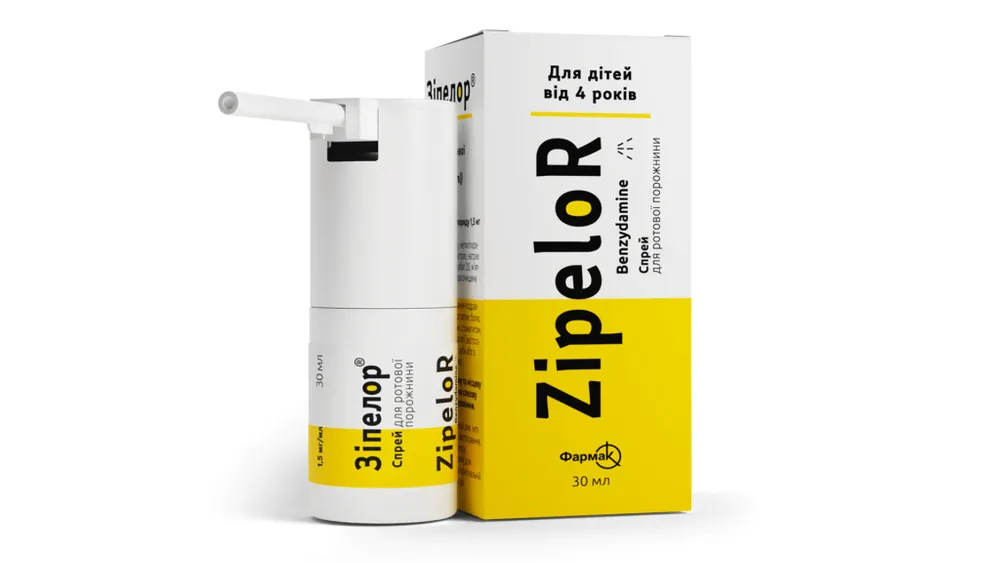
Table of Contents
INSTRUCTIONS FOR MEDICAL USE OF THE MEDICINAL PRODUCT ZIPELOR® PLUS (ZIPELOR PLUS)
Composition:
Active substances: benzydamine, cetylpyridinium chloride;
1 ml of solution contains: benzydamine hydrochloride – 1.50 mg; cetylpyridinium chloride in the form of monohydrate – 5.26 mg, equivalent to cetylpyridinium chloride – 5 mg;
Excipients: glycerin; sodium saccharin; polyoxyl hydrogenated castor oil; peppermint flavor; purified water.
Pharmaceutical form. Oromucosal spray, solution.
Main physicochemical properties: clear, colorless liquid.
Pharmacotherapeutic group. Throat preparations. Antiseptics. ATC code R02A A20.
Pharmacological Properties
Pharmacodynamics
Benzydamine is a non-steroidal anti-inflammatory agent with analgesic and anti-exudative properties. Its mechanism of action is probably related to inhibition of prostaglandin synthesis, thereby reducing signs of inflammation (such as pain, redness, swelling, and heat). Benzydamine hydrochloride also exerts a moderate local anesthetic effect.
Benzydamine is primarily used for the treatment of diseases of the oral cavity and pharynx.
Cetylpyridinium chloride is a cationic antiseptic agent belonging to the group of quaternary ammonium salts. It is active against Gram-positive bacteria and less active against Gram-negative bacteria, thus providing excellent antiseptic and bactericidal activity. Cetylpyridinium chloride also exhibits antifungal properties.
Pharmacokinetics
Absorption
Of the two active substances, cetylpyridinium and benzydamine, only benzydamine is absorbed. Therefore, cetylpyridinium does not cause systemic pharmacokinetic interactions with benzydamine.
Due to absorption of benzydamine through the oral and pharyngeal mucosa, measurable amounts of the active substance are detected in human plasma. However, this is insufficient to produce any systemic pharmacological effect.
Distribution
The volume of distribution is similar for all dosage forms.
Elimination
Elimination occurs mainly via urine, primarily in the form of inactive metabolites. The elimination half-life and systemic clearance have been found to be similar for all dosage forms.
Preclinical Safety Data
During the evaluation of the feasibility of combining the two active substances, it was established that the preparation is well tolerated and non-toxic.
Animal studies demonstrated that administration of benzydamine hydrochloride in combination with cetylpyridinium chloride is associated with a good tolerability profile.
The interaction of benzydamine hydrochloride and cetylpyridinium chloride did not cause changes in intestinal bacterial flora.
Clinical characteristics.
Indications.
Symptomatic treatment of diseases characterized by irritation of the throat, oral mucosa, and gums, in gingivitis, pharyngitis, and laryngitis. In dentistry, it is used after tooth extraction or for prophylactic purposes.
Contraindications.
Hypersensitivity to the active substances or to other components of the medicinal product. Children under 6 years of age.
Interaction with other medicinal products and other forms of interaction.
Avoid simultaneous use with other antiseptic agents.
Special precautions for use.
Do not use the medicinal product for more than 10 days. If no noticeable improvement occurs, consult a physician.
The use of topical medicinal products, especially over prolonged periods, may lead to sensitization phenomena. In such cases, treatment should be discontinued and appropriate therapy initiated.
Since Zipelor® Plus in the form of a spray cannot be used together with anionic compounds present, for example, in toothpastes, it is not recommended to use the medicinal product immediately before or after tooth brushing.
Avoid direct contact of Zipelor® Plus spray with eyes; the spray should not be inhaled.
Use during pregnancy or breastfeeding.
During pregnancy and breastfeeding, the medicinal product Zipelor® Plus should be used only under medical supervision.
Effect on the ability to drive vehicles or operate machinery.
When used at recommended doses, the medicinal product does not affect the ability to drive vehicles or operate machinery.
Method of Administration and Dosage
Adults (including elderly patients) and children aged 12 years and older:
1-2 sprays 3-5 times daily.
The medicinal product is contraindicated in children under 6 years of age.
For children aged 6 to 12 years, use only as prescribed by a physician.
Minimum interval between administrations: 2 hours.
To achieve optimal effect, the medicinal product should not be used immediately before or after tooth brushing.
Do not use simultaneously with other antiseptics.
Do not exceed the recommended dose.
Method of Administration
Turn the nozzle of the bottle and press the dosing button 1-2 times.
When using the product for the first time, prime the pump by pressing the dosing button several times to ensure even spray distribution. The medication is precisely dosed via a metering valve: one spray (100 μl of solution) contains 0.15 mg of benzidamine hydrochloride and 0.5 mg of cetylpyridinium chloride.
Children
The medicinal product is contraindicated in children under 6 years of age.
For children aged 6 to 12 years, use only as prescribed by a physician.
Overdose
Toxic manifestations of benzidamine overdose may include symptoms such as excessive excitation, seizures, increased sweating, ataxia, tremor, and vomiting. As there is no specific antidote for this type of poisoning, treatment of acute benzidamine intoxication is exclusively symptomatic.
Signs and symptoms of intoxication following ingestion of a large amount of cetylpyridinium chloride include nausea, vomiting, dyspnea, cyanosis, asphyxia due to paralysis of respiratory muscles, central nervous system depression, hypotension, and coma. The lethal dose for humans is approximately 1–3 grams. Treatment of cetylpyridinium overdose is also purely symptomatic.
In case of overdose, seek medical advice immediately.
Side effects.
After local application of benzydamine in the oral cavity and throat, complaints of burning sensation and numbness of the oral mucosa have been reported; hypersensitivity reactions, including urticaria, photosensitivity, and bronchospasm, may rarely occur.
With cetylpyridinium use, very rarely irritation or mild burning sensation in the oral cavity may be observed.
Shelf life. 2 years.
Shelf life after first opening of the bottle – 6 months.
Do not use the medicinal product after the expiry date stated on the packaging.
Storage conditions. No special storage conditions required.
Keep out of reach of children.
Packaging. 30 ml in a polyethylene or transparent glass bottle. 1 bottle per carton.
Classification. Over-the-counter (without prescription).
Manufacturer: JSC "Farmak".
Manufacturer's address and place of business.
74, Kyrylivska Street, Kyiv, 04080, Ukraine.