Zerkalin®
Ukraine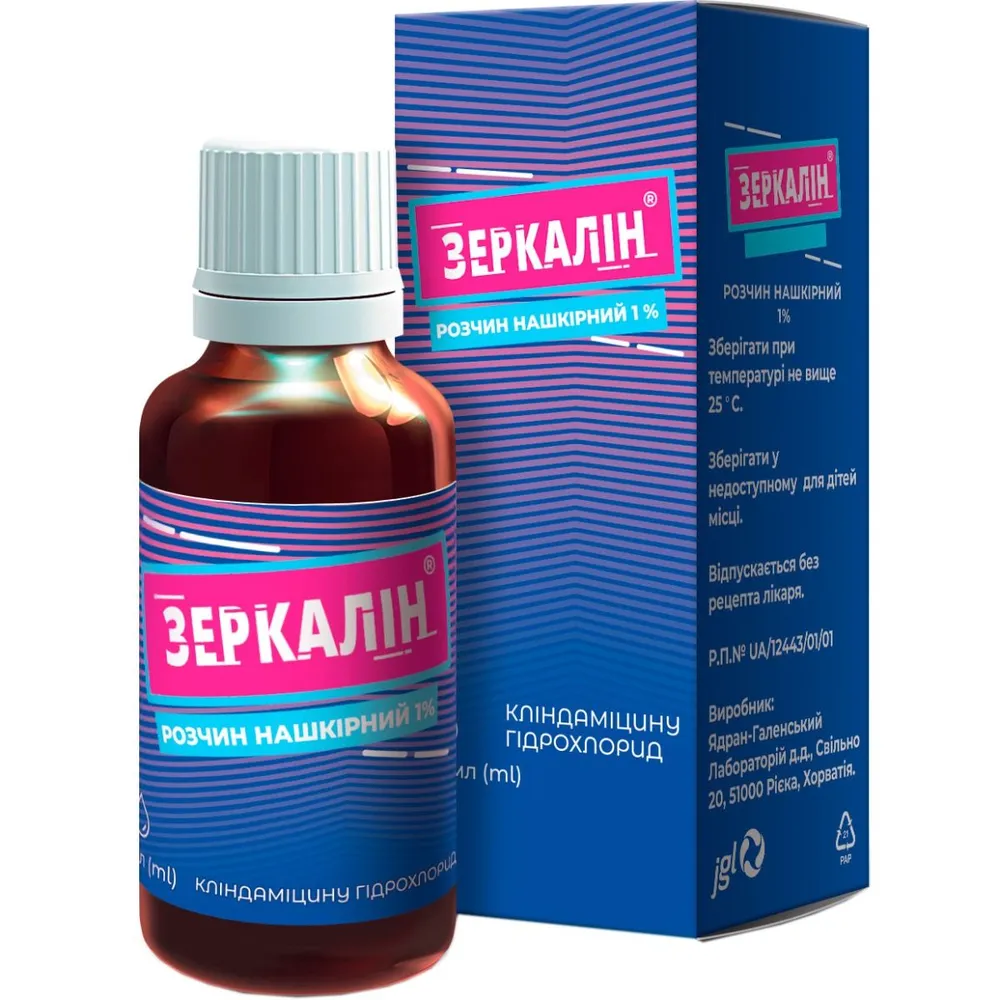
Table of Contents
INSTRUCTIONS FOR MEDICAL USE OF THE MEDICINAL PRODUCT ZERKALIN® (ZERKALIN®)
Composition:
Active substance: clindamycin;
1 ml of solution contains clindamycin - 10 mg, in the form of clindamycin hydrochloride;
Excipients: ethanol 96%, propylene glycol, purified water.
Pharmaceutical form. Topical solution.
Main physicochemical properties: colorless clear liquid with the smell of ethanol.
Pharmacotherapeutic group. Antimicrobial agents for the treatment of acne. Clindamycin.
ATC code: D10AF01.
Pharmacological Properties
Pharmacodynamics
Clindamycin is a semi-synthetic derivative of lincomycin, an antibiotic derived from the culture of Streptomyces lincolensis. It exhibits both bacteriostatic and bactericidal properties, depending on the concentration at the site of action and the susceptibility of microorganisms. Clindamycin inhibits protein synthesis in susceptible bacteria by binding to the 50S subunit of bacterial ribosomes, thereby interrupting early stages of protein synthesis.
It is known that the spectrum of clindamycin activity in vitro and in vivo includes most Gram-positive bacteria, most anaerobic pathogens, and protozoa. The drug is ineffective against Enterobacteriaceae, fungi, and viruses.
After topical application to the skin, a 1% clindamycin hydrochloride solution suppresses the growth of susceptible bacteria, particularly the anaerobe Propionibacterium acnes, which resides in sebaceous glands and follicles. Additionally, the concentration of free fatty acids (FFA) in sebum is reduced. This reduction in FFA concentration results either indirectly from inhibition of lipase-producing microorganisms necessary for the conversion of triglycerides into FFA, or directly from decreased microbial lipase production.
Besides lipases, Propionibacterium acnes produces proteases, hyaluronidases, and chemotactic factors, which, together with comedogenic FFA, contribute to the development of inflammatory lesions (i.e., papules, pustules, nodules, cysts) in acne. Therefore, both the antibacterial and anti-inflammatory effects are important for the therapeutic action of topical clindamycin in patients with acne (with inhibition of leukocyte chemotaxis playing a significant role).
Pharmacokinetics
It is known that in a specially designed in vitro human skin model, approximately 10% of the dose of radiolabeled clindamycin hydrochloride is absorbed by the stratum corneum after application. Clindamycin penetrates well into inflammatory lesions following topical administration. The bioavailability of clindamycin after topical application to the skin is approximately 7.5%.
Clinical characteristics.
Indications.
Treatment of common acne.
Contraindications.
Contraindicated in patients with a history of hypersensitivity to products containing clindamycin or lincomycin, to excipients included in the medicinal product, Crohn's disease, ulcerative colitis, or antibiotic-associated colitis.
Interaction with other medicinal products and other forms of interaction.
Concomitant use of Zerkalin® topical solution with other acne treatments containing substances that cause exfoliation, softening, or abrasion of the skin (e.g., benzoyl peroxide, tretinoin, resorcinol, salicylic acid, sulfur) is not recommended due to the potential for cumulative skin irritation.
Since clindamycin and erythromycin may compete for binding at the 50S ribosomal subunit, their concomitant use should be avoided.
Clindamycin, when administered systemically, has demonstrated neuromuscular blocking properties that may enhance the activity of other neuromuscular blocking agents. Therefore, clindamycin should be used with caution in patients receiving neuromuscular blocking agents.
Vitamin K antagonists
Increased coagulation test parameters (PT [prothrombin time] / INR [international normalized ratio]) and/or bleeding have been reported in patients receiving clindamycin in combination with vitamin K antagonists (e.g., warfarin, acenocoumarol, and phenindione). Therefore, coagulation tests should be performed frequently in patients taking vitamin K antagonists.
Special precautions for use
Clindamycin topical solution should be used with caution in individuals with a predisposition to atopy.
The possibility of systemic absorption and gastrointestinal side effects, particularly the risk of pseudomembranous colitis, is very low with topical application. Nevertheless, patients should be advised to discontinue use and inform their physician if symptoms such as diarrhea occur during topical treatment.
Symptoms indicating pseudomembranous colitis may develop during or after antimicrobial therapy. Pseudomembranous colitis, which may range from mild to life-threatening, has been observed with the use of nearly all antibacterial agents, including clindamycin. This should be considered if diarrhea develops in a patient following or during antibacterial therapy. Improvement may occur in mild cases after discontinuation of the drug.
If pseudomembranous colitis occurs, treatment with clindamycin must be discontinued and appropriate antibacterial therapy initiated. In such cases, antiperistaltic agents are contraindicated.
Topical use of clindamycin may lead to overgrowth of resistant microorganisms. Therefore, if superinfection develops during treatment with clindamycin, the drug should be discontinued and appropriate therapy initiated.
Patients should be advised to exercise caution when applying the solution near the mouth, other mucous membranes, or damaged skin due to possible irritant effects. If the solution comes into contact with these areas, they should be rinsed thoroughly with cold water. Zerkalin® topical solution contains propylene glycol, which may cause skin irritation.
Use during pregnancy or breastfeeding
Pregnancy. There are no adequate and well-controlled studies in pregnant women during the first trimester of pregnancy. Zerkalin® should be used during pregnancy only if clearly needed.
Breastfeeding period. It is not known whether clindamycin passes into human milk following topical application. However, clindamycin has been reported to be present in human milk after oral and parenteral administration. Given the potential for serious adverse reactions in nursing infants, a decision should be made whether to discontinue the drug or to discontinue breastfeeding, taking into account the importance of the drug to the mother.
Ability to affect reaction speed when driving or operating machinery
Clindamycin has no effect or has a negligible effect on the ability to drive vehicles or operate machinery.
Method of administration and dosage.
A thin layer of Zerkalin® solution should be applied to the affected area of cleaned skin twice daily. The duration of use is determined individually by a physician.
Children.
The safety and efficacy of the drug in children under 12 years of age have not been studied.
Overdose.
Overdose following topical application of clindamycin has not been reported.
When applied topically, clindamycin may be absorbed in sufficient amounts to produce systemic effects. In case of overdose, general symptomatic and supportive measures should be initiated immediately.
Unintentional oral ingestion may lead to effects comparable to those of therapeutically administered oral clindamycin.
Side effects.
The frequency of adverse effects is defined according to the following categories: very common (> 1/10), common (> 1/100 and < 1/10), uncommon (> 1/1,000 and < 1/100), rare (> 1/10,000 and < 1/1,000), very rare (< 1/10,000), and frequency not known (cannot be estimated from the available data).
General disorders and administration site reactions
Common: dry skin.
Uncommon: redness, local skin irritation, skin peeling, oily skin, itching and burning of the skin.
Rare: gram-negative folliculitis.
Gastrointestinal disorders
Uncommon: nausea, vomiting, diarrhea, abdominal pain, cramps.
Very rare: pseudomembranous colitis.
Immune system disorders
Uncommon: hypersensitivity reactions including contact dermatitis, skin itching.
Nervous system disorders
Very rare: neuromuscular blockade.
Reporting of adverse reactions after drug registration is important. It allows continuous monitoring of the benefit-risk balance of the medicinal product. Healthcare and pharmaceutical professionals, as well as patients or their legal representatives, should report all suspected adverse reactions and lack of efficacy of the medicinal product via the Automated Pharmacovigilance Information System at: https://aisf.dec.gov.ua/.
Shelf life. 3 years.
Do not use after the expiry date stated on the packaging.
Storage conditions.
Store at a temperature not exceeding 25 °C. Keep out of the reach and sight of children.
Packaging.
30 ml of solution in a glass vial; 1 glass vial in a cardboard box.
Supply category. Over-the-counter (without prescription).
Manufacturer. Jadran-Galenski Laboratorij d.d.
Manufacturer's address and place of business.
Svilno 20, 51000 Rijeka, Croatia.