Zerocalin® intensive
Ukraine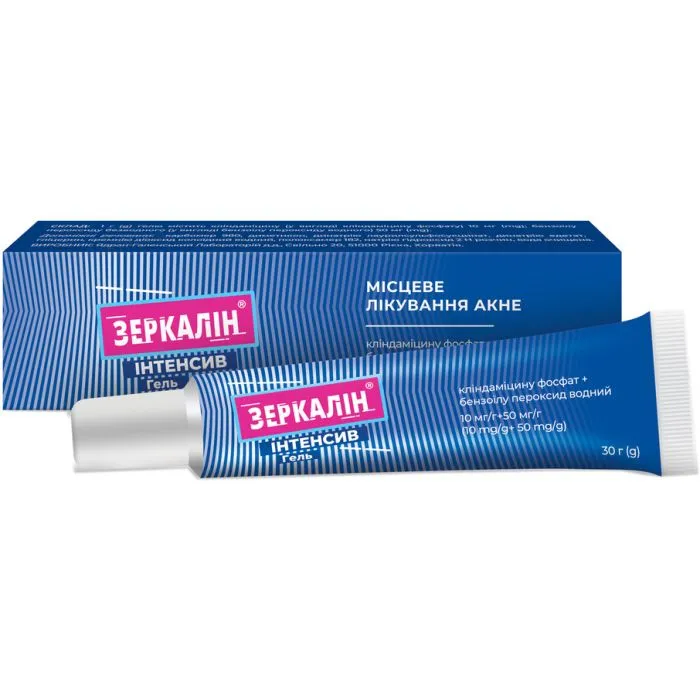
Table of Contents
INSTRUCTIONS FOR MEDICAL USE OF THE MEDICINAL PRODUCT ZERKALIN® INTENSIVE (ZERKALIN® INTENSIVE)
Composition:
Active substances: clindamycin (as clindamycin phosphate); benzoyl peroxide anhydrous (as aqueous benzoyl peroxide);
1 g of gel contains clindamycin (as clindamycin phosphate) 10 mg; benzoyl peroxide anhydrous (as aqueous benzoyl peroxide) 50 mg;
Excipients: carbomer 980, dimethicone, disodium lauryl sulfosuccinate, disodium edetate, glycerin, colloidal aqueous silicon dioxide, poloxamer 182, sodium hydroxide 2 N solution, purified water.
Pharmaceutical form. Gel.
Main physicochemical characteristics: homogeneous white or slightly yellowish gel with visible fine particles.
Pharmacotherapeutic group. Dermatologicals. Topical agents for the treatment of acne. ATC code D10AF51.
Pharmacological properties.
Pharmacodynamics
Clindamycin is a lincosamide antibiotic with bacteriostatic activity against gram-positive aerobic microorganisms and a broad spectrum of anaerobic bacteria. Lincosamides, such as clindamycin, bind to the 23S subunit of the bacterial ribosome and inhibit early stages of protein synthesis. The action of clindamycin is primarily bacteriostatic, although high concentrations may exert a slow bactericidal effect against susceptible strains.
Although clindamycin phosphate is inactive in vitro, rapid hydrolysis in vivo converts this compound into the bacterially active clindamycin. The antibacterial activity of clindamycin has been demonstrated clinically in the treatment of comedones in patients with acne at concentrations sufficient to be effective against most strains of Propionibacterium acnes. Clindamycin in vivo inhibits all tested strains of Propionibacterium acnes (MIC - 0.4 μg/mL). Following application of clindamycin, the percentage of free fatty acids on the skin surface decreased from approximately 14% to 2%.
Benzoyl peroxide exerts a mild keratolytic effect on comedones at all stages of their development. It is an oxidizing agent with bactericidal activity against Propionibacterium acnes, a microorganism implicated in the development of acne vulgaris. In addition, it acts as a sebostatic agent, counteracting excessive sebum production associated with acne.
The addition of benzoyl peroxide reduces the potential for development of microorganisms resistant to clindamycin.
Pharmacokinetics
Percutaneous absorption of clindamycin is minimal. The presence of benzoyl peroxide in the medicinal product does not affect the absorption of clindamycin through the skin. Radiolabeling studies have shown that percutaneous absorption of benzoyl peroxide is possible only after its conversion to benzoic acid. Benzoic acid is predominantly conjugated to form hippuric acid, which is excreted by the kidneys.
Clinical characteristics.
Indications.
For local treatment of acne (acne vulgaris) of mild to moderate severity, predominantly inflammatory lesions, in adults and children aged 12 years and older.
Contraindications.
Hypersensitivity to the components of the drug and to lincomycin. Regional enteritis, ulcerative colitis, or antibiotic-associated colitis (including pseudomembranous colitis), or a history thereof. Pediatric age under 12 years.
Interaction with other medicinal products and other forms of interaction.
No studies on drug interactions have been conducted.
Clindamycin/benzoyl peroxide should not be used in combination with products containing erythromycin due to possible antagonism with clindamycin.
Clindamycin has been shown to have neuromuscular blocking properties, which may enhance the effect of other neuromuscular blockers. Therefore, clindamycin/benzoyl peroxide should be used with caution in patients receiving such agents.
Concomitant use of clindamycin/benzoyl peroxide with tretinoin, isotretinoin, and tazarotene should be avoided, as benzoyl peroxide may reduce their efficacy and increase irritation. If combination therapy is necessary, the products should be applied at different times of the day (e.g., one in the morning, the other in the evening).
Concurrent use of benzoyl peroxide-containing products and topical preparations containing sulfonamides may cause temporary discoloration of the skin and hair (yellow/orange).
When topical antibiotics are used concomitantly with medicinal, regular, or abrasive soaps and cosmetic products with drying effects, as well as products with high alcohol concentration and/or astringent agents, a cumulative irritant effect is possible.
Special precautions for use
Avoid contact with eyes, mouth, lips, other mucous membranes, and areas of irritated or damaged skin. In case of accidental contact, rinse thoroughly with water.
During the first few weeks of treatment, increased skin scaling and redness may occur in most patients. Depending on the severity of these adverse effects, patients may apply a moisturizer, temporarily reduce the frequency of application of clindamycin/benzoyl peroxide, or temporarily discontinue treatment. However, efficacy of application less frequently than once daily has not been established.
Concomitant use of other topical acne treatments should be performed with caution due to the potential for cumulative irritant effects, which may sometimes be severe, particularly when desquamating or abrasive ingredients are used.
If severe local irritation occurs (e.g., severe erythema, dryness or itching, intense stinging/burning), treatment with clindamycin/benzoyl peroxide should be discontinued.
Benzoyl peroxide may cause increased sensitivity to sunlight. Therefore, avoid use of ultraviolet lamps and avoid or minimize exposure to sunlight. If strong sunlight exposure cannot be avoided, patients should be advised to use sun protection products and wear protective clothing.
If a patient has sunburn, it should be treated before initiating clindamycin/benzoyl peroxide therapy.
The product may bleach hair and colored or dyed materials. Avoid contact with hair, fabrics, furniture, or carpeting.
Pseudomembranous colitis
Cases of pseudomembranous colitis have been reported with nearly all antibacterial agents, including clindamycin, with severity ranging from mild to life-threatening, and onset occurring even several weeks after discontinuation of treatment. Although this is highly unlikely with topical use of clindamycin/benzoyl peroxide, if a patient develops persistent and significant diarrhea or abdominal cramps, treatment should be immediately discontinued and further evaluation initiated, as these symptoms may indicate antibiotic-associated colitis.
Clindamycin resistance
Benzoyl peroxide reduces the potential emergence of clindamycin-resistant microorganisms. However, patients with a recent history of systemic or topical use of clindamycin or erythromycin may already harbor clindamycin-resistant strains of Propionibacterium acnes and resistant commensal flora.
Cross-resistance
Cross-resistance between clindamycin and lincomycin has been demonstrated.
Resistance to clindamycin is often associated with inducible resistance to erythromycin (see section "Interaction with other medicinal products and other forms of interaction").
Use during pregnancy or breastfeeding
Fertility
There are no data on the effects of topical clindamycin or benzoyl peroxide on human fertility.
Pregnancy
There are insufficient data on the use of the gel in pregnant women. Reproductive toxicity and embryofetal developmental studies in animals have not been conducted with the gel or with benzoyl peroxide alone. Limited data are available on the use of clindamycin or benzoyl peroxide alone during pregnancy. Observational data from a limited number of pregnancies exposed during the first trimester suggest no adverse effects of clindamycin on pregnancy or on fetal/neonatal health.
Animal studies on reproductive toxicity following oral and subcutaneous administration of clindamycin did not reveal any impairment of fertility or harmful effects on the fetus.
The safety of using the gel in pregnant women has not been established.
Therefore, during pregnancy, the physician may prescribe the product only if the expected benefit to the mother outweighs the potential risk to the fetus.
Breastfeeding
Clinical studies on the topical use of clindamycin/benzoyl peroxide during breastfeeding have not been conducted. However, percutaneous absorption of clindamycin/benzoyl peroxide is low; it is not known whether clindamycin or benzoyl peroxide is excreted in breast milk following topical application. Nevertheless, clindamycin has been reported to be present in breast milk after oral and parenteral administration.
Therefore, during breastfeeding, the physician may prescribe the product only if the expected benefit to the mother outweighs the potential risk to the infant.
To avoid accidental ingestion of Zerkalin® Intensive gel by infants when used by the mother during lactation, the gel should not be applied to the breast area.
Ability to affect reaction speed when driving or operating machinery
No studies on this effect have been conducted. Given the product's adverse reaction profile, a negative effect is not expected.
Method of Administration and Dosage
For external use only.
Adults and children aged 12 years and older.
Zerkalin® Intensive should be applied once daily in the evening to affected areas after thorough cleansing, washing the skin with water, and drying. If the gel does not spread easily on the skin, this indicates an excessive amount has been applied.
Hands should be washed after applying the gel. The patient may use a moisturizer if necessary.
If excessive dryness or skin peeling occurs, the frequency of application should be reduced or treatment should be temporarily discontinued. Efficacy has not been established when used less frequently than once daily. Do not apply the gel more than once a day.
Patients should be advised that increasing the amount of gel applied does not enhance therapeutic effectiveness but increases the risk of skin irritation.
Therapeutic effect may take 2 to 5 weeks of treatment. The maximum duration of treatment is 12 weeks.
Children
Not recommended for children under 12 years of age.
Overdose
Excessive topical application of clindamycin/benzoyl peroxide may cause severe skin irritation. In such cases, treatment should be discontinued and healing of irritation awaited.
When applied topically, benzoyl peroxide is generally not absorbed in amounts sufficient to cause systemic effects.
Excessive topical application of clindamycin may result in its absorption in amounts sufficient to produce systemic effects.
In case of accidental oral ingestion, adverse reactions from the gastrointestinal tract similar to those observed with systemic administration of clindamycin may occur.
In case of excessive topical application, appropriate symptomatic measures should be taken to reduce irritation symptoms. In case of accidental oral ingestion, appropriate clinical management should be provided.
Adverse reactions.
Table 1 summarizes the adverse reactions observed during the use of the combination and active ingredients of the medicinal product – benzoyl peroxide and clindamycin – separately. Adverse reactions are presented according to the MedDRA classification system and by frequency (see Table 1). Frequency is defined as follows: very common (≥ 1/10); common (≥ 1/100 and < 1/10); uncommon (≥ 1/1000 and < 1/100); rare (≥ 1/10000 and < 1/1000); and not known (cannot be estimated from available data).
Table 1. Adverse reactions associated with the use of the active substances of the medicinal product – benzoyl peroxide and clindamycin.
| MedDRA System Organ Class |
Very common |
Common |
Uncommon |
Unknown** |
| Immune system disorders |
Allergic reactions, including hypersensitivity and anaphylaxis |
|||
| Nervous system disorders* |
Paresthesia |
|||
| Gastrointestinal disorders |
Colitis (including pseudomembranous colitis), haemorrhagic diarrhoea, diarrhoea, abdominal pain |
|||
| Skin and subcutaneous tissue disorders* |
Erythema, desquamation, dryness (mainly reported as mild to moderate in intensity) |
Burning sensation |
Contact dermatitis, pruritus, erythematous rash, acne flare |
Urticaria |
| General disorders and administration site conditions |
Application site reactions, including discolouration |
* At the site of application.
** Based on post-marketing surveillance data. Since these observations involve populations of unknown size and include mixed factors, it is not possible to reliably estimate their frequency; however, systemic reactions were observed rarely.
In addition to the adverse reactions listed in Table 1, in the main clinical study using topical clindamycin 1% / benzoyl peroxide 3% gel, local photosensitivity reactions were frequently observed at the site of application.
Local tolerability
According to data from 5 clinical studies, all patients were classified according to the degree of erythema, desquamation, burning sensation, and dryness using the following scale: 0 – absent, 1 – mild, 2 – moderate, 3 – severe. The percentage of patients exhibiting symptoms before and during treatment is presented in Table 2.
Table 2. Local tolerability of once-daily application of the gel in patients (n = 397) participating in a phase 3 clinical trial.
Adverse reactions |
Prior to treatment |
During treatment |
||||
| Mild degree |
Moderate degree |
Severe degree |
Mild degree |
Moderate degree |
Severe degree |
|
| Erythema |
28 % |
3 % |
0 |
26 % |
5 % |
0 |
| Desquamation |
6 % |
< 1 % |
0 |
17 % |
2 % |
0 |
| Burning sensation |
3 % |
< 1 % |
0 |
5 % |
< 1 % |
0 |
| Dryness |
6 % |
< 1 % |
0 |
15 % |
1 % |
0 |
Reporting of adverse reactions after registration of the medicinal product is of great importance. It enables monitoring of the benefit-risk balance of this medicinal product. Medical and pharmaceutical professionals, as well as patients or their legal representatives, should report all cases of suspected adverse reactions and lack of efficacy of the medicinal product via the Automated Information System for Pharmacovigilance at the following link: https://aisf.dec.gov.ua/.
Shelf life.
2 years.
Shelf life after first opening of the tube – 2 months.
Storage conditions.
Store in the refrigerator at 2–8 ºC. After first opening of the packaging, store at a temperature not exceeding 25 °C. Keep out of reach and sight of children.
Packaging.
25 g, 30 g, 50 g or 60 g of gel in a tube, 1 tube per cardboard box.
Supply category. Over-the-counter.
Manufacturer.
Jadran-Galenski Laboratorij d.d.
Manufacturer's address and location of its business operations.
Svilno 20, 51000 Rijeka, Croatia.