Zentel
Ukraine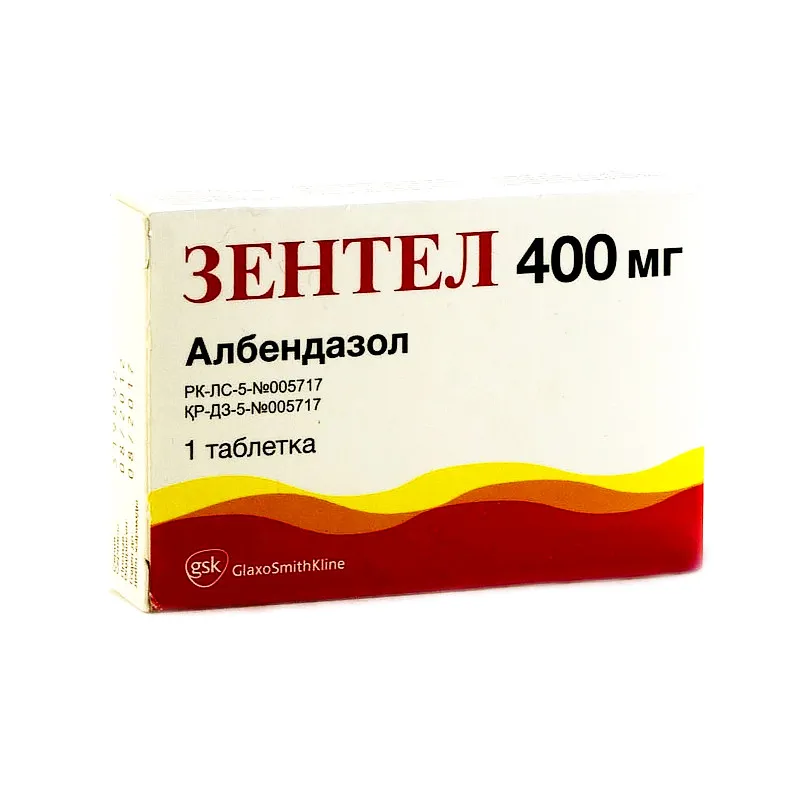
Table of Contents
INSTRUCTION FOR MEDICAL USE OF THE MEDICINAL PRODUCT ZENTEL (ZENTEL)
Composition:
Active substance: albendazole;
1 tablet contains 400 mg of albendazole;
Excipients: lactose monohydrate; corn starch; povidone; sodium lauryl sulfate; sodium croscarmellose; microcrystalline cellulose; sodium saccharin; magnesium stearate; FD&C Yellow #6 Aluminium Lake 20-24% FDA; vanilla flavor; orange flavor; passion fruit flavor.
Pharmaceutical form. Tablets.
Main physicochemical properties: speckled, dull orange-colored, rounded, elongated, biconvex tablets with a characteristic fruity odor, having a dividing line on one side of the tablet and the imprint ALB400 on the other side.
Pharmacotherapeutic group. Antihelminthic agents. Agents used in nematode infections. Benzimidazole derivatives. ATC code P02CA03.
Pharmacological Properties
Pharmacodynamics
Albendazole is an antiprotozoal and anthelmintic agent belonging to the benzimidazole carbamate group. The drug is effective against both intestinal and tissue parasites in the form of eggs, larvae, and adult helminths. The anthelmintic action of albendazole is due to inhibition of tubulin polymerization, leading to disruption of metabolism and subsequent death of helminths.
Albendazole is active against the following intestinal parasites:
Nematodes – Ascaris lumbricoides, Trichuris trichiura, Enterobius vermicularis, Ancylostoma duodenale, Necator americanus, Strongyloides stercoralis, Cutaneous Larva Migrans;
Cestodes – Hymenolepis nana, Taenia solium, Taenia saginata;
Trematodes – Opisthorchis viverrini, Clonorchis sinensis;
Protozoa – Giardia lamblia (intestinalis or duodenalis).
Albendazole is active against tissue parasites, including cystic and alveolar echinococcosis caused by Echinococcus granulosus and Echinococcus multilocularis, respectively. Albendazole is an effective treatment for neurocysticercosis caused by larval infection with Taenia solium, capillariasis caused by Capillaria philippinensis, and gnathostomiasis caused by Gnathostoma spinigerum.
Albendazole destroys cysts or significantly reduces their size (by up to 80%) in patients with granular echinococcosis. After treatment with albendazole, the proportion of non-viable cysts increases to 90%, compared to 10% in untreated patients. Following albendazole treatment for cysts caused by Echinococcus multilocularis, complete recovery has been observed in a minority of patients, while most experience improvement or stabilization of disease.
Pharmacokinetics
After oral administration, albendazole is poorly absorbed (less than 5%). Systemic exposure increases when the drug is administered with fatty food, which enhances absorption by fivefold. Albendazole undergoes rapid hepatic metabolism during first-pass passage. The primary metabolite, albendazole sulfoxide, is the main active compound responsible for efficacy in tissue infections. The elimination half-life is 8.5 hours. Albendazole sulfoxide and its metabolites are excreted predominantly in bile, with only a small fraction eliminated in urine. It has been established that with prolonged high-dose treatment, elimination of the drug from cysts continues for several weeks.
Elderly Patients
Although pharmacokinetic studies of albendazole have not been conducted specifically in elderly patients, data from treatment of 26 patients up to 79 years of age suggest that the pharmacokinetic profile in this age group is similar to that in young healthy volunteers.
Renal Impairment
The pharmacokinetics of albendazole have not been studied in patients with renal impairment.
Hepatic Impairment
The pharmacokinetics of albendazole have not been studied in patients with hepatic impairment.
Clinical characteristics.
Indications.
Intestinal forms of helminthiases and cutaneous syndrome Larva Migrans (short-term treatment with low doses): enterobiasis, ancylostomiasis and necatoriasis, hymenolepiasis, teniasis, strongyloidiasis, ascariasis, trichocephalosis, clonorchiasis, opisthorchiasis, cutaneous syndrome Larva Migrans, giardiasis in children.
Systemic helminthic infections (long-term treatment with high doses):
cystic echinococcosis (caused by Echinococcus granulosus):
- when surgical intervention is impossible;
- prior to surgery;
- after surgery, if preoperative treatment was short, if widespread helminthic infection is observed, or if live forms were found during surgery;
- after percutaneous drainage of cysts for diagnostic or therapeutic purposes;
alveolar echinococcosis (caused by Echinococcus multilocularis):
- in inoperable disease, particularly in cases of local or distant metastases;
- after palliative surgical intervention;
- after radical surgical intervention or liver transplantation;
neurocysticercosis (caused by larvae of Taenia solium):
- in the presence of single or multiple cysts or granulomatous brain lesions;
- in arachnoid or intraventricular cysts;
- in racemose cysts;
capillariasis (caused by Capillaria philippinensis), gnathostomiasis (caused by Gnathostoma spinigerum and related species), trichinellosis (caused by Trichinella spiralis and T. pseudospiralis), toxocariasis (caused by Toxocara canis and related species).
Contraindications.
Hypersensitivity to albendazole or to any component of the drug.
Pregnancy and breastfeeding.
Women who plan to become pregnant. Women of reproductive age should use effective non-hormonal contraceptive methods during and for 1 month after treatment with the drug.
Interaction with other medicinal products and other types of interactions.
Albendazole induces enzymes of the cytochrome P450 system.
Medicinal products that may slightly reduce the efficacy of albendazole: anticonvulsants (e.g., phenytoin, fosphenytoin, carbamazepine, phenobarbital, primidone), levamisole, ritonavir. Efficacy of treatment in patients should be monitored; alternative dosing regimens or therapy may be required.
Cimetidine, praziquantel, and dexamethasone increase plasma levels of the albendazole metabolite responsible for systemic activity, which in turn may lead to an increased incidence of adverse reactions.
Grapefruit juice also increases plasma levels of albendazole sulfoxide.
Due to the potential effect on cytochrome P450 activity, there is a theoretical risk of interaction with the following drugs: oral contraceptives, anticoagulants, oral hypoglycemic agents, theophylline.
Special precautions for use.
Treatment of intestinal helminth infections and cutaneous larva migrans syndrome
To prevent inadvertent administration of Zentel during early pregnancy, women of childbearing potential should be treated only during the first week of the menstrual cycle or after a negative pregnancy test. Reliable contraception is required during treatment.
Treatment with albendazole may unmask pre-existing neurocysticercosis, particularly in areas with a high prevalence of Taenia solium infection. Patients may develop neurological symptoms such as seizures, increased intracranial pressure, and focal neurological signs due to inflammatory reactions caused by the death of parasites in the brain. These symptoms may appear rapidly after initiation of treatment; therefore, prompt appropriate therapy with corticosteroids and anticonvulsants should be started immediately.
Treatment of systemic helminthic infections
Albendazole treatment may be associated with mild to moderate elevations in liver enzymes, which usually return to normal after discontinuation of therapy. Cases of hepatitis have been reported. Therefore, liver enzyme levels should be assessed before starting each treatment course and at least every 2 weeks during treatment. If liver enzyme levels increase significantly (more than twice the upper limit of normal), albendazole treatment should be discontinued. Treatment may be resumed after normalization of enzyme levels, but the patient must be closely monitored.
Albendazole may cause bone marrow suppression; therefore, blood counts should be performed at the beginning of treatment and every 2 weeks during a 28-day treatment cycle. Patients with liver disease, including hepatic echinococcosis, are more susceptible to bone marrow suppression, which may result in pancytopenia, aplastic anemia, agranulocytosis, and leukemia, necessitating careful monitoring of blood parameters. If significant hematological abnormalities occur, treatment should be discontinued (see sections "Dosage and administration" and "Adverse reactions").
To prevent inadvertent administration of Zentel during early pregnancy, women of childbearing potential should:
- begin treatment only after a negative pregnancy test;
- be advised to use effective contraceptive methods during treatment and for at least one month after discontinuation of the drug.
In patients with neurocysticercosis treated with albendazole, symptoms (e.g., seizures, increased intracranial pressure, focal neurological signs) related to inflammatory reactions caused by parasite death may occur. Such adverse reactions should be managed with corticosteroids and anticonvulsant therapy. To prevent episodes of increased cerebral pressure during the first week of treatment, oral or intravenous corticosteroids are recommended.
Treatment with albendazole may also unmask pre-existing neurocysticercosis, especially in regions with high prevalence of Taenia solium infection. Neurological symptoms such as seizures, increased intracranial pressure, and focal neurological signs due to inflammatory reactions from parasite death in the brain may occur rapidly after treatment initiation. Therefore, prompt appropriate therapy with corticosteroids and anticonvulsants should be initiated immediately.
Since the drug contains lactose, patients with rare hereditary conditions such as galactose intolerance, Lapp lactase deficiency, or glucose-galactose malabsorption should not take this medication.
The drug contains sodium saccharin, which should be taken into consideration in patients with diabetes mellitus.
Use during pregnancy or breastfeeding
The drug is contraindicated during pregnancy and breastfeeding, as well as for treatment of women who are planning to become pregnant (see section "Contraindications").
Effect on ability to drive or operate machinery
Given the potential for adverse reactions such as dizziness, it is recommended that patients refrain from driving or operating machinery during treatment with albendazole.
Method of administration and dosage.
Intestinal infections and cutaneous syndrome Larva Migrans
The medication should be taken with food. It is advisable to take it at the same time each day. If recovery does not occur within 3 weeks, the physician should prescribe a second course of treatment.
In some patients, especially children, difficulty swallowing the whole tablet may occur; in such cases, the tablet may be chewed with a small amount of water or crushed.
For use in adults and children aged 3 years and older.
| Infection |
Age |
Dosage and duration of intake |
| Enterobiasis, ancylostomiasis, necatoriasis, ascariasis, trichuriasis |
Adults and children aged 3 years and older* |
400 mg once daily (1 tablet) as a single dose. |
| Strongyloidiasis, taeniasis, hymenolepiasis |
Adults and children aged 3 years and older* |
400 mg once daily (1 tablet) for 3 days. For hymenolepiasis, a repeat course of treatment is recommended between the 10th and 21st day after the previous course. |
| Clonorchiasis, opisthorchiasis |
Adults and children aged 3 years and older* |
400 mg (1 tablet) twice daily for 3 days. |
| Cutaneous larva migrans syndrome |
Adults and children aged 3 years and older* |
400 mg (1 tablet) once daily for 1–3 days. |
| Giardiasis |
Children aged 3 to 12 years only* |
400 mg (1 tablet) once daily for 5 days. |
* For children aged 2 to 3 years, another dosage form should be used – oral suspension.
Elderly Patients
Experience with the use of the drug in elderly patients is limited. Dose adjustment is not required; however, albendazole should be used with caution in elderly patients with impaired liver function.
Renal Impairment
Since albendazole is excreted by the kidneys in very small amounts, dose adjustment is not required for this patient group. However, patients with signs of renal impairment should be closely monitored.
Hepatic Impairment
Since albendazole is actively metabolized in the liver to its pharmacologically active metabolite, impaired liver function may significantly affect its pharmacokinetics. Therefore, patients with altered liver function parameters (elevated transaminase levels) should be closely monitored at the beginning of albendazole treatment.
Systemic Helminthic Infections
(prolonged treatment with high doses).
Take the drug with food.
Administer to adults and children aged 6 years and older.
Administration of high doses of the drug is not recommended for children under 6 years of age. The dosage regimen should be determined individually by a physician based on age, body weight, and severity of infection.
The dose for patients with body weight over 60 kg is 400 mg (1 tablet) twice daily. For patients with body weight less than 60 kg, the dosage is 15 mg/kg/day, divided into two doses. Maximum daily dose – 800 mg.
| Infection |
Duration of treatment |
|
| Cystic echinococcosis |
28 days. A 28-day cycle may be repeated (up to 3 times in total) after a 14-day break. |
|
|
Up to 3 cycles of 28 days for treatment of hepatic, pulmonary, and peritoneal cysts. Longer treatment may be required for cysts at other sites (in bones or brain). |
|
|
Two 28-day cycles are recommended before surgery. If surgery must be performed before completing these cycles, treatment should be continued as long as possible prior to surgery. |
|
|
If a short course of treatment (less than 14 days) was administered before surgery, or in case of emergency surgery, two 28-day treatment cycles separated by a 14-day drug-free interval should be given after surgery. Similarly, if viable cysts are found or parasite dissemination occurs, two full treatment cycles should be administered. |
|
| Alveolar echinococcosis |
28 days. A second 28-day course should be repeated after a two-week drug-free interval. Treatment may be prolonged over several months or years. |
|
| Neurocysticercosis** |
Treatment duration ranges from 7 to 30 days. A second course may be repeated after a two-week drug-free interval. |
|
|
Usual treatment duration is from 7 days (minimum) to 28 days. |
|
|
The usual treatment course is 28 days. |
|
|
The usual treatment course is 28 days, but may last longer. Duration of treatment is determined by clinical and radiological response. |
** When treating patients with neurocysticercosis, appropriate corticosteroid and anticonvulsant therapy should be prescribed. Oral and intravenous corticosteroids are recommended to prevent the occurrence of cerebral hypertension during the first week of treatment.
| Infection |
Dosage and duration of administration |
| Capillariasis |
400 mg once daily for 10 days***. |
| Gnathostomiasis |
400 mg once daily for 10–20 days***. |
| Trichinellosis, toxocariasis |
400 mg twice daily for 5–10 days***. |
***Usually one course of treatment is required, but further courses may be necessary if parasitological test results remain positive.
Elderly patients
Experience with the use of the drug in elderly patients is limited. Dose adjustment is not required; however, albendazole should be used with caution in elderly patients with impaired liver function.
Renal impairment
Since albendazole is excreted by the kidneys in very small amounts, dose adjustment is not required for this patient group. However, patients with signs of renal impairment should be closely monitored.
Hepatic impairment
Since albendazole is actively metabolized in the liver to a pharmacologically active metabolite, impaired liver function may significantly affect its pharmacokinetics. Therefore, patients with altered liver function tests (elevated transaminase levels) at the start of albendazole therapy should be carefully evaluated. Treatment should be discontinued if there is a significant increase in transaminase levels or a clinically significant decrease in blood parameters (see sections "Special precautions" and "Adverse reactions").
Children.
The drug is intended for use in children aged 3 years and older. For treatment of children aged 2 to 3 years, another dosage form is recommended – oral suspension.
Administer to children according to the information specified in the section "Dosage and administration".
Overdose.
Symptoms, depending on the dose ingested, may include diarrhea, nausea, vomiting, tachycardia, and elevated transaminase levels. In case of overdose, treatment is symptomatic and based on the clinical condition.
Adverse Reactions
Adverse reactions have been classified according to their frequency of occurrence. The following frequency classification is used: very common (≥ 1/10); common (≥ 1/100 and < 1/10); uncommon (≥ 1/1000 and < 1/100); rare (≥ 1/10000 and < 1/1000); and very rare (< 1/10000).
Adverse effects occurring during short-term treatment of intestinal infections and cutaneous Larva Migrans syndrome.
Immune system.
Rare: hypersensitivity reactions, including rash, pruritus, and urticaria.
Nervous system.
Uncommon: headache and dizziness.
Gastrointestinal tract.
Uncommon: gastrointestinal symptoms from the upper gastrointestinal tract (e.g., epigastric pain, nausea, vomiting) and diarrhea.
Hepatobiliary system.
Rare: increased levels of liver enzymes.
Skin and subcutaneous tissue.
Very rare: erythema multiforme, Stevens-Johnson syndrome.
Adverse effects occurring during long-term treatment of systemic helminthic infections.
Blood and lymphatic system.
Uncommon: leukopenia.
Very rare: pancytopenia, aplastic anemia, agranulocytosis.
Patients with liver disease, including hepatic echinococcosis, are more susceptible to bone marrow suppression (see sections "Dosage and Administration" and "Special Warnings and Precautions").
Immune system.
Uncommon: hypersensitivity reactions, including rash, pruritus, and urticaria.
Nervous system.
Very common: headache.
Common: dizziness.
Gastrointestinal tract.
Common: gastrointestinal disturbances (abdominal pain, nausea, vomiting). These events are associated with albendazole treatment in patients with echinococcosis.
Hepatobiliary system.
Very common: mild to moderate elevation of liver enzymes.
Uncommon: hepatitis.
Skin and subcutaneous tissue.
Common: reversible alopecia (thinning of hair and moderate hair loss).
Very rare: erythema multiforme, Stevens-Johnson syndrome.
General disorders.
Common: fever.
The product contains the dye FD&C Yellow #6 Aluminium Lake 20-24% FDA, which may cause allergic reactions.
Shelf life. 5 years.
Storage conditions. Store below 30 °C. Keep out of reach of children.
Packaging. 1 tablet in a blister pack made of PVC/aluminum foil, placed in a cardboard box.
Prescription category. Prescription only.
Manufacturer. Haleon South Africa (Pty) Ltd, Republic of South Africa.
Manufacturer's address and location of operations.
11 Hawkins Avenue, Epping Industria One, Cape Town, Western Cape, 7450, Republic of South Africa.