Iron saccharate - iron wine
Ukraine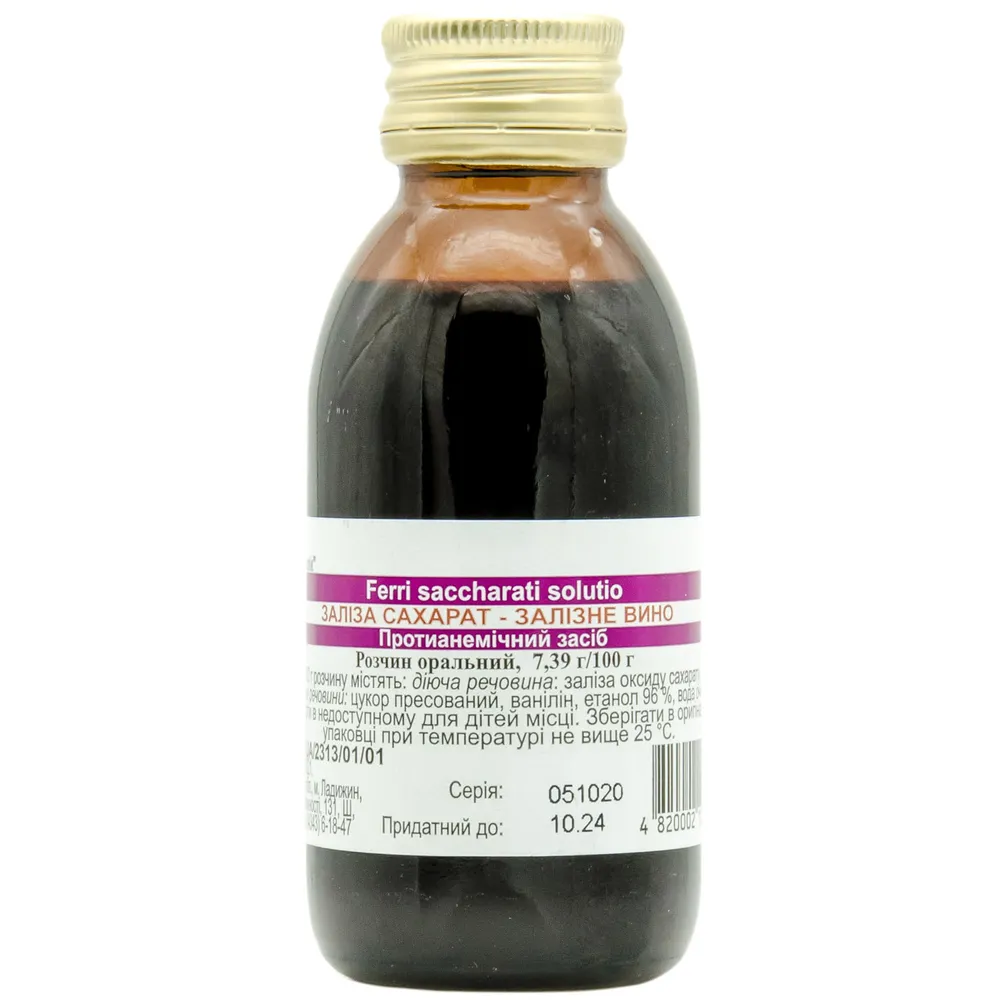
Table of Contents
INSTRUCTION FOR MEDICAL USE OF THE MEDICINAL PRODUCT IRON SACCHARATE – IRON WINE (FERRI SACCHARATI SOLUTIO)
Composition:
Active substance: iron oxide saccharate;
100 g of solution contain: iron oxide saccharate – 7.39 g;
Excipients: compressed sugar, vanillin, ethanol 96%, purified water;
1 g contains 0.098 g of ethanol (9.8%).
Pharmaceutical form. Oral solution, 7.39 g/100 g.
Main physicochemical properties: clear reddish-brown liquid with a vanilla odor.
Pharmacotherapeutic group. Trivalent iron preparations. ATC Code B03AB02.
Pharmacological Properties
Pharmacodynamics
"Iron saccharate – iron wine" is an anti-anemic agent containing trivalent iron. Iron saccharate is relatively stable and releases little iron in the form of free ions.
Trivalent iron is an essential component of the human diet, necessary for the synthesis of hemoglobin, myoglobin, and respiratory enzymes. Normally, a person loses 1 to 2 mg of iron per day through feces and urine, which is replenished through food. With an iron-balanced diet, iron deficiency does not develop. However, in cases of increased iron loss or pathologies accompanied by impaired iron absorption in the upper segments of the small intestine, iron deficiency may develop, potentially manifesting as iron-deficiency anemia. In women, heavy menstrual bleeding often contributes to the development of iron-deficiency anemia. Administration of the "Iron saccharate – iron wine" preparation helps reduce iron deficiency in the body in cases of iron-deficiency anemia.
Following oral administration, absorption of the iron complex occurs in the duodenum and upper parts of the small intestine. Its absorption is not reduced by interactions with food components. Once in the systemic circulation, iron passes from blood serum into tissues capable of storing it. In particular, it is stored in the liver in the form of a complex with ferritin. Later, in the bone marrow, it becomes incorporated into hemoglobin. Within hemoglobin, iron exists in the bivalent form, while trivalent iron stimulates globin production, thereby promoting increased blood hemoglobin levels.
The mechanism of trivalent iron absorption is active, dependent on the level of iron deficiency in the body, and operates in such a way that no more than the physiological norm of iron is absorbed in the small intestine.
Iron is excreted from the body primarily in feces and urine, mainly as metabolites of hemoglobin.
Pharmacokinetics
Not studied.
Clinical characteristics.
Indications.
Prevention and treatment of iron-deficiency conditions of various etiologies. Prevention of iron deficiency in children, women of reproductive age (especially during pregnancy). Prevention of iron deficiency in adults on a vegetarian diet and in elderly individuals. Treatment of iron-deficiency anemias.
Contraindications.
Hypersensitivity to the drug or to any of its components. Iron overload: hemosiderosis, hemochromatosis. Anemias not caused by iron deficiency (e.g., hemolytic anemia, megaloblastic anemia due to vitamin B12 deficiency, aplastic anemia); impaired iron utilization (anemia caused by lead poisoning, sideroblastic anemia, thalassemia); esophageal stricture and/or other obstructive gastrointestinal disorders; intestinal diverticulum, intestinal obstruction; regular blood transfusions, concomitant use of parenteral iron preparations. It is inappropriate to use the drug in cases of decreased serum iron concentration and in anemias caused by chronic inflammatory conditions or neoplasms.
Interaction with other medicinal products and other forms of interaction.
The efficacy of the drug increases when used concomitantly with folic acid and vitamin B12 preparations. Concurrent use with allopurinol may lead to iron accumulation in the liver. Concurrent use with tetracycline preparations reduces their efficacy. The efficacy of the drug decreases when used concomitantly with cholestyramine. It is advisable to avoid simultaneous use with oral tocopherol preparations to prevent reduction in their activity.
It should be taken into account that:
- iron absorption is reduced when antacids are taken simultaneously;
- certain food products (eggs, dairy products, black tea, coffee, bread, raw cereals) inhibit the absorption of iron salts;
- iron salts reduce the absorption of concurrently administered drugs such as penicillamine and sulfasalazine;
- vitamin C or citric acid enhances iron absorption.
Special precautions for use
Administration of the drug may cause dark discoloration of feces, which has no clinical significance. This is due to the excretion of unabsorbed iron.
The drug does not affect the results of occult blood testing; therefore, there is no need to discontinue treatment prior to performing such tests.
The use of the drug is not advisable in cases of decreased serum iron concentration and anemias caused by chronic inflammatory conditions or neoplasms, since the administered iron accumulates in the reticuloendothelial system and is utilized by the body only after recovery from the underlying disease.
Iron-containing drugs should be used with caution in patients with leukemia, chronic liver or kidney diseases, inflammatory gastrointestinal disorders, peptic ulcer of the stomach and duodenum, and intestinal diseases (enteritis, ulcerative colitis, Crohn's disease). The drug contains sugar syrup, which should be taken into account in patients with diabetes mellitus.
Use during pregnancy or breastfeeding
There are no data indicating adverse effects of the medicinal product on the mother or fetus during pregnancy.
When prescribing the drug to breastfeeding women, it should be considered that iron passes into breast milk and is present there in a complex with lactoferrin. Therefore, if the infant does not have iron deficiency, it is advisable to temporarily discontinue the use of the drug.
Ability to influence reaction rate while operating vehicles or machinery
Not observed.
Method of Administration and Dosage.
For adults, pregnant women, and children aged 12 years and older, the medication "Iron Saccharate – Iron Wine" should be taken orally, 1 tablespoon diluted in 0.5 glass of water, three times daily after meals. The solution should preferably be consumed through a straw to avoid tooth discoloration; after taking the medication, it is advisable to rinse the mouth. Blood tests and hemoglobin levels should be monitored periodically, approximately once every few weeks. Once hemoglobin levels normalize, the medication should be discontinued.
Children.
For use in children aged 12 years and older.
Overdose.
Overdose is highly unlikely, since iron absorption from this preparation occurs via active transport, and the extent of absorption depends on the body's iron deficiency level, making absorption beyond physiological needs impossible. Any excess of the drug that is not absorbed is excreted from the body with feces. Irritation of gastrointestinal mucosa due to unabsorbed excess of the drug cannot be ruled out. To alleviate such effects, mucilaginous decoctions or cytoprotective gels may be prescribed. In case of overdose, symptomatic treatment is recommended.
Adverse Reactions
Adverse effects are mostly mild and disappear promptly after discontinuation of the drug.
Adverse reactions are categorized by organ systems and frequency of occurrence (over 10% – very common; 1–10% – common; 0.1–1% – uncommon; 0.1–0.01% – rare; less than 0.01% – very rare, including isolated reports; frequency not known – cannot be estimated from available data).
From the nervous system.
Rare: headache.
From the gastrointestinal tract.
Very rare: gastrointestinal disturbances such as a feeling of heaviness and fullness in the stomach;
abdominal pain, including epigastric pain, meteorism, dyspepsia, vomiting.
Rare: nausea, constipation, diarrhea, metallic taste in the mouth.
From the skin.
Very rare: urticaria, rash, exanthema, pruritus.
Allergic reactions.
Very rare: anaphylaxis.
Rare: facial hyperemia, sensation of warmth.
General disorders.
Isolated cases: discoloration of dental enamel in children, possible darkening of stools due to excretion of unabsorbed iron (not clinically significant).
Prolonged unjustified use of iron preparations may lead to hemosiderosis.
In case of adverse effects, the drug dose should be temporarily reduced.
Shelf life. 4 years.
Do not use the drug after the expiry date stated on the packaging.
Storage conditions.
Store in the original packaging at a temperature not exceeding 25 °C. Keep out of reach of children.
Packaging.
100 g in bottles or jars.
Supply category.
Over-the-counter.
Manufacturer.
Private Joint-Stock Company "Biolyk".
Manufacturer's address and location of business activity.
131, Nezalezhnosti St., Ladijyn, Vinnytsia region, Ukraine, 24321.