Univit
Ukraine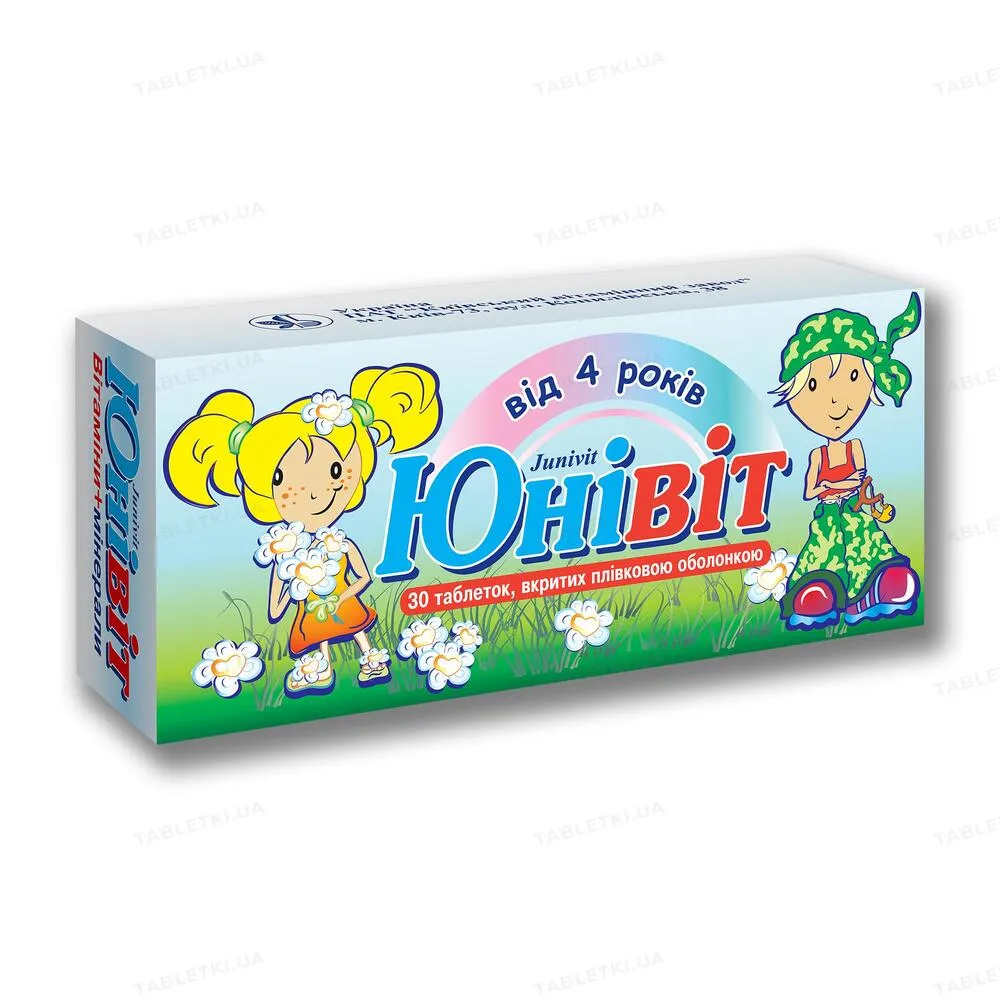
Table of Contents
INSTRUCTIONS for medical use of the medicinal product JUNIVIT (junivit)
Composition:
Active substances: each tablet contains
| vitamin A (retinol acetate) |
600 IU; |
| vitamin B1 (thiamine hydrochloride) |
0.203 mg; |
| vitamin B2 (riboflavin) |
0.3 mg; |
| vitamin B5 (calcium D-pantothenate) |
1.2 mg; |
| vitamin B6 (pyridoxine hydrochloride) |
0.3 mg; |
| vitamin B12 (cyanocobalamin) |
0.0002 mg; |
| vitamin C (ascorbic acid) |
10 mg; |
| vitamin D3 (cholecalciferol) |
80 IU; |
| vitamin PP (nicotinamide) |
3 mg; |
| folic acid |
0.04 mg; |
| calcium |
12.5 mg; |
| phosphorus |
10 mg; |
Excipients: microcrystalline cellulose; lactose monohydrate; sucrose; corn starch; sorbitol (E 420); aspartame (E 951); orange flavoring; anhydrous citric acid; magnesium stearate; coating: Opadry II Orange film-coating mixture: aluminum lakes of the colorants Sunset Yellow FCF (E 110) and Indigo Carmine (E 132), hypromellose (hydroxypropylmethylcellulose), medium-chain triglycerides, polydextrose, maltodextrin, ferric oxide yellow (E 172), titanium dioxide (E 171), talc.
Pharmaceutical form. Film-coated tablets.
Main physicochemical properties: orange, round, biconvex film-coated tablets. A two-layer core is visible upon breaking.
Pharmacotherapeutic group. Multivitamins with minerals. ATC code: A11AA03.
Pharmacological Properties
Pharmacodynamics
The medicinal product contains a combination of vitamins with calcium and phosphorus. Vitamins are substances that participate in the regulation of many biochemical processes in the body. The action of vitamins and minerals in the body is largely physiological rather than pharmacodynamic.
Vitamin B complex (B1, B2, B6, B12, pantothenic acid, nicotinamide, and folic acid) participates in the metabolism of carbohydrates, proteins, and fats, and also plays an important role in the functioning of the nervous system.
Folic acid is necessary for the formation, regeneration, and normal functioning of blood cells.
Vitamin A is essential for the development of epithelial cells and the synthesis of visual pigment.
Vitamin D regulates calcium absorption and enables proper mineralization of bones and teeth.
Vitamin C promotes iron absorption and participates in numerous redox processes in the body.
Minerals are components of connective tissue and act as activators and integral parts of enzymes.
Calcium and phosphorus play an important role in the mineralization of bones and teeth.
Calcium ions activate many enzymes, participate in the regulation of cardiac muscle tone, in the transmission of nerve impulses, and regulate the permeability of cell membranes.
Pharmacokinetics
Water-soluble vitamins (B-complex vitamins, vitamin C, and biotin) are well absorbed in amounts corresponding to daily requirements. Excess amounts are excreted in urine and, in some cases, also in feces. These vitamins are stored in the body only in limited quantities; therefore, they must be regularly supplied through diet to maintain required tissue concentrations.
Fat-soluble vitamins A and D, when administered orally, are well absorbed in the small intestine in the presence of fats. When administered in large amounts, these vitamins are stored and deposited in the liver, making them more toxic than water-soluble vitamins.
Clinical characteristics.
Indications.
The medicinal product is intended for children:
- with reduced appetite;
- with physical and mental overloads in schoolchildren;
- with developmental delay;
- as an adjunctive agent during antibiotic therapy;
- during seasonal deficiency of fruits and vegetables in the diet.
Contraindications.
Hypersensitivity to the active substances or to any of the excipients of the medicinal product; hypervitaminosis A and D; nephrolithiasis; gout; hyperuricemia; erythremia; erythrocytosis; thrombophlebitis; thromboembolism; disorders of iron and copper metabolism; hypercalcemia; hypercalciuria; thyrotoxicosis; chronic glomerulonephritis; chronic heart failure; sarcoidosis in medical history; peptic ulcer of the stomach and duodenum (due to the possible increase in gastric juice acidity); tuberculosis.
Interaction with other medicinal products and other forms of interaction.
Due to the risk of developing hypervitaminosis A, concomitant use of this medicinal product with other medicinal products containing vitamin A or oral retinoids is not recommended. When treating with sulfonamides, high doses of vitamin C should be avoided to prevent crystalluria. Pyridoxine reduces the effectiveness of levodopa if the patient is taking levodopa alone. Riboflavin interferes with the absorption and reduces the effectiveness of antibiotics. Therefore, it should be administered at least 3 hours before the administration of an antibiotic.
Special precautions for use.
The medicinal product is not recommended for use in children under 4 years of age. Prior to concomitant use with other vitamin, vitamin-mineral and/or mineral medicinal products, consult a physician.
Use with caution in patients with liver disorders, acute nephritis, cardiac decompensation, cholelithiasis, chronic pancreatitis, allergic disorders, idiosyncrasy, or neoplastic diseases.
Discoloration of urine to a yellow color may occur due to the presence of riboflavin. This effect is harmless.
The medicinal product contains lactose and therefore should not be administered to patients with rare hereditary disorders of galactose intolerance, lactase deficiency, or glucose-galactose malabsorption syndrome.
Since the medicinal product contains sorbitol, it should not be used in patients with rare hereditary fructose intolerance.
The medicinal product contains aspartame, which is metabolized to phenylalanine in the body; therefore, it should not be administered to patients with phenylketonuria.
The medicinal product contains sugar, which should be taken into account in patients with diabetes mellitus.
Use during pregnancy or breastfeeding.
The medicinal product should be used in children.
Ability to influence reaction rate while driving or operating machinery.
There are no reports on the effect of the medicinal product on the ability to drive or operate machinery.
Method of Administration and Dosage
Take the medication after meals.
For the prevention of hypovitaminosis:
Children aged 4 to 6 years – 1 tablet 1–2 times daily;
Children aged 7 to 14 years – 1 tablet 2–3 times daily.
For the treatment of hypovitaminosis:
Children aged 4 to 6 years – 1 tablet 4 times daily;
Children aged 7 to 14 years – 1 tablet 5 times daily.
In case of decreased appetite, the medication Junivit is recommended to be taken for 2 months; for other indications – as necessary, depending on the duration and frequency of symptom occurrence, after consultation with a physician.
Children: The medication is indicated for children aged 4 years and older.
Overdose
No intoxication is expected when recommended doses are used.
Symptoms: Prolonged use (more than 1 month) of very high doses of the medication may lead to hypervitaminosis A and D. However, the possibility of overdose when using the medication is unlikely.
Treatment: symptomatic.
Adverse reactions.
Immune system disorders: possible hypersensitivity reactions to components of the medicinal product, including anaphylactic shock, bronchospasm, angioedema (Quincke's edema).
Metabolism and nutrition disorders: hypercalcemia.
Nervous system disorders: headache, dizziness, drowsiness.
Eye disorders: visual disturbances.
Gastrointestinal disorders: dyspepsia, nausea, vomiting, belching, stomach pain, constipation, diarrhea, increased gastric juice secretion.
Skin and subcutaneous tissue disorders: rash, urticaria, pruritus, erythema.
Renal and urinary disorders: change in urine color, hypercalciuria.
General disorders: hyperthermia, irritability, hyperhidrosis.
With prolonged use of high doses, the following adverse reactions may occur:
Metabolism and nutrition disorders: hyperuricemia, impaired glucose tolerance, hyperglycemia.
Nervous system disorders: paresthesia.
Cardiac disorders: arrhythmias.
Gastrointestinal disorders: gastrointestinal disturbances.
Skin and subcutaneous tissue disorders: hair loss, seborrhea.
Renal and urinary disorders: renal failure.
Laboratory findings: transient increase in aspartate aminotransferase, alkaline phosphatase, lactate dehydrogenase.
If any adverse reactions occur, discontinue use of the medicinal product and consult a physician.
Shelf life. 2 years.
Storage conditions.
Store in original packaging at a temperature not exceeding 25 °C.
Keep out of reach of children.
Packaging.
10 tablets in a blister; 3 blisters per carton.
Availability. Over-the-counter (without prescription).
Manufacturer. JSC "KYIV VITAMIN PLANT".
Manufacturer's address and location of business activity.
38, Kopilivska Street, Kyiv, 04073, Ukraine.
Web-site: www.vitamin.com.ua.
INSTRUCTION
for medical use of the medicinal product
JUNIVIT
(junivit)
Composition:
Active ingredients: 1 tablet contains
| vitamin A (retinyl acetate) |
600 IU; |
| vitamin B1 (thiamine hydrochloride) |
0.203 mg; |
| vitamin B2 (riboflavin) |
0.3 mg; |
| vitamin B5 (calcium D-pantothenate) |
1.2 mg; |
| vitamin B6 (pyridoxine hydrochloride) |
0.3 mg; |
| vitamin B12 (cyanocobalamin) |
0.0002 mg; |
| vitamin C (ascorbic acid) |
10 mg; |
| vitamin D3 (cholecalciferol) |
80 IU; |
| vitamin PP (nicotinamide) |
3 mg; |
| folic acid |
0.04 mg; |
| calcium |
12.5 mg; |
| phosphorus |
10 mg; |
Excipients: microcrystalline cellulose; lactose monohydrate; sucrose; maize starch; sorbitol (E 420); aspartame (E 951); orange flavour; anhydrous citric acid; magnesium stearate;
Coating: Opadry II Orange film-coating mixture: aluminium lakes of colouring agents sunset yellow FCF (E 110) and indigo carmine (E 132), hypromellose (hydroxypropylmethylcellulose), medium-chain triglycerides, polydextrose, maltodextrin, yellow iron oxide (E 172), titanium dioxide (E 171), talc.
Pharmaceutical form. Film-coated tablets.
Main physicochemical properties: round, biconvex film-coated tablets of orange colour. Two layers are visible upon breaking.
Pharmacotherapeutic group. Multivitamins with minerals. ATC code A11A A03.
Pharmacological properties.
Pharmacodynamics.
The medicinal product contains a combination of vitamins with calcium and phosphorus. Vitamins are substances involved in regulating numerous biochemical processes in the body. The action of vitamins and minerals in the body is primarily physiological rather than pharmacodynamic.
Vitamin B complex (B1, B2, B6, B12, pantothenic acid, nicotinamide, and folic acid) participates in the metabolism of carbohydrates, proteins, and fats, and plays an important role in nervous system function.
Folic acid is necessary for the formation, regeneration, and normal functioning of blood cells.
Vitamin A is essential for epithelial cell development and visual pigment synthesis.
Vitamin D regulates calcium absorption and enables proper mineralization of bones and teeth.
Vitamin C enhances iron absorption and participates in numerous oxidation-reduction processes in the body.
Minerals are components of connective tissue and act as activators and structural components of enzymes.
Calcium and phosphorus play a key role in the mineralization of bones and teeth.
Calcium ions activate many enzymes, participate in regulating cardiac muscle tone, nerve impulse transmission, and control cell membrane permeability.
Pharmacokinetics.
Water-soluble vitamins (B-complex vitamins, vitamin C, and biotin) are well absorbed in amounts corresponding to daily requirements. Excess amounts are excreted in urine and, in some cases, also in feces. These vitamins are stored in limited quantities in the body; therefore, they must be regularly supplied through diet to maintain adequate tissue concentrations.
Fat-soluble vitamins A and D are well absorbed in the small intestine when dietary fats are present. When administered in large amounts, these vitamins are stored and deposited in the liver, making them more toxic than water-soluble vitamins.
Clinical characteristics.
Indications.
The medicinal product is intended for children:
- with reduced appetite;
- during physical and mental strain in schoolchildren;
- with developmental delay;
- as an adjunct during antibiotic therapy;
- during seasonal deficiency of fruits and vegetables in the diet.
Contraindications.
Hypersensitivity to the active substances or to any of the excipients; hypervitaminosis A and D; nephrolithiasis; gout; hyperuricemia; erythremia; erythrocytosis; thrombophlebitis; thromboembolism; disorders of iron and copper metabolism; hypercalcemia; hypercalciuria; thyrotoxicosis; chronic glomerulonephritis; chronic heart failure; history of sarcoidosis; gastric and duodenal ulcer (due to possible increase in gastric acidity); tuberculosis.
Interaction with other medicinal products and other forms of interaction.
Due to the risk of developing hypervitaminosis A, concomitant use of this medicinal product with other vitamin A-containing products or oral retinoids is not recommended. When treating with sulfonamides, high doses of vitamin C should be avoided to prevent crystalluria. Pyridoxine reduces the efficacy of levodopa if the patient is taking levodopa alone. Riboflavin interferes with the absorption and reduces the efficacy of antibiotics. Therefore, it should be administered at least 3 hours before antibiotic administration.
Special precautions for use.
The medicinal product is not recommended for children under 4 years of age. Prior to initiating concomitant use with other vitamin, vitamin-mineral, and/or mineral medicinal products, consultation with a physician is advised.
Use with caution in patients with liver diseases, acute nephritis, cardiac decompensation, cholelithiasis, chronic pancreatitis, allergic conditions, idiosyncrasy, or neoplasms.
Yellow discoloration of urine may occur due to riboflavin content. This effect is harmless.
The medicinal product contains lactose and therefore should not be used in patients with rare hereditary conditions of galactose intolerance, lactase deficiency, or glucose-galactose malabsorption syndrome.
Since the medicinal product contains sorbitol, it should not be used in patients with rare hereditary fructose intolerance.
The medicinal product contains aspartame, which is metabolized to phenylalanine in the body; therefore, it should not be used in patients with phenylketonuria.
The medicinal product contains sucrose, which should be considered in patients with diabetes mellitus.
Use during pregnancy or breastfeeding.
The medicinal product is intended for use in children.
Effect on ability to drive and use machinery.
No reports regarding the effect of the medicinal product on the ability to drive or operate machinery.
Method of administration and dosage.
The medicinal product should be taken after meals.
For prevention of hypovitaminosis
Children aged 4 to 6 years – 1 tablet 1–2 times daily;
Children aged 7 to 14 years – 1 tablet 2–3 times daily.
For treatment of hypovitaminosis
Children aged 4 to 6 years – 1 tablet 4 times daily;
Children aged 7 to 14 years – 1 tablet 5 times daily.
For reduced appetite, the medicinal product Junivit is recommended for use for 2 months; for other indications – as needed, depending on the duration and frequency of symptom occurrence, after consultation with a physician.
Paediatric population. The medicinal product is intended for children aged 4 years and older.
Overdose.
No intoxication is expected when using the recommended doses.
Symptoms: prolonged use (more than 1 month) of very high doses of the medicinal product may lead to hypervitaminosis A and D. However, the likelihood of overdose with this medicinal product is low.
Treatment: symptomatic.
Adverse reactions.
Immune system disorders: hypersensitivity reactions to components of the medicinal product, including anaphylactic shock, bronchospasm, Quincke's edema, are possible.
Metabolism and nutrition disorders: hypercalcemia.
Nervous system disorders: headache, dizziness, drowsiness.
Eye disorders: visual disturbances.
Gastrointestinal disorders: dyspepsia, nausea, vomiting, belching, stomach pain, constipation, diarrhea, increased gastric juice secretion.
Skin and subcutaneous tissue disorders: rash, urticaria, pruritus, erythema.
Renal and urinary disorders: change in urine colour, hypercalciuria.
General disorders: hyperthermia, irritability, hyperhidrosis.
With prolonged use of high doses, the following adverse reactions may occur:
Metabolism and nutrition disorders: hyperuricemia, impaired glucose tolerance, hyperglycemia.
Nervous system disorders: paresthesia.
Cardiovascular disorders: arrhythmias.
Gastrointestinal disorders: gastrointestinal disturbances.
Skin and subcutaneous tissue disorders: hair loss, seborrhea.
Renal and urinary disorders: renal failure.
Laboratory findings: transient increases in aspartate aminotransferase, alkaline phosphatase, lactate dehydrogenase.
If any adverse reactions occur, discontinue use of the medicinal product and consult a physician.
Shelf life. 2 years.
Storage conditions.
Store in original packaging at a temperature not exceeding 25 °C.
Keep out of reach of children.
Packaging.
10 tablets in a blister; 3 blisters per carton.
Prescription status. Over-the-counter.
Manufacturer. JSC "KIEV VITAMIN PLANT".
Manufacturer's address and location of operations.
38 Kopilovska Street, Kyiv, 04073, Ukraine.
Web-site: www.vitamin.com.ua.