Unienzyme® with mps
Ukraine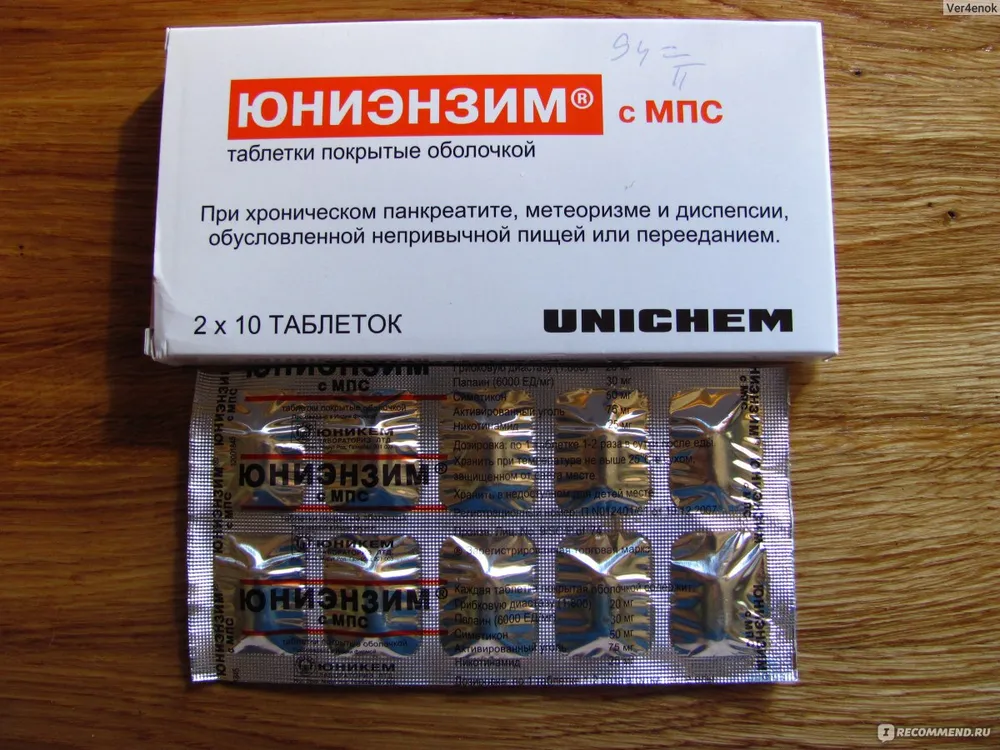
Table of Contents
INSTRUCTION FOR MEDICAL USE OF THE MEDICINAL PRODUCT UNIENZYME® WITH MPS (UNIENZYME®C MPS)
Composition:
Active substances: fungal diastase, papain, simethicone (MPS), activated charcoal, nicotinamide;
One coated tablet contains fungal diastase (1 : 800) – 20 mg, papain – 30 mg, simethicone (MPS) – 50 mg, activated charcoal – 75 mg, nicotinamide – 25 mg;
Excipients: microcrystalline cellulose, lactose monohydrate, acacia, sodium benzoate (E 211), gelatin, colloidal anhydrous silicon dioxide, talc, magnesium stearate, sodium carmellose, sucrose, castor oil, calcium carbonate, vegetable charcoal, shellac, carnauba wax, white wax.
Pharmaceutical form. Coated tablets.
Main physicochemical properties: black colored, oval-shaped tablets coated with sugar coating, with the inscription «UNICHEM» in white letters on one side of the tablet.
Pharmacotherapeutic group.
Agents enhancing digestion, including enzymes. Enzyme preparations.
ATC code A09AA.
Pharmacological properties.
Pharmacodynamics.
Unienzyme® with MPS is a combination preparation containing fungal diastase and papain, which act as enzymes, and nicotinamide, simethicone, and activated charcoal, which aid in facilitating digestion.
Enzyme preparations are used in the treatment of patients with a deficiency of any of the enzymes required for the digestion of carbohydrates, fats, and proteins. In such conditions, patients experience symptoms of dyspepsia, intestinal bloating, belching, gas accumulation, abdominal fullness, discomfort in the abdominal cavity, and bowel disturbances.
Fungal diastase is an enzyme obtained from the culture of the Aspergillus oryzae strain. It contains two types of amylase: alpha-amylase and beta-amylase. These amylases have specific activity in converting starch into dextrose and maltose. The amylolytic activity of fungal diastase in the tablets is 1 : 800. This means that 1 part of fungal diastase breaks down 800 parts of dietary cooked starch. Fungal diastase also possesses some proteolytic and lipolytic properties, indicating a certain ability to break down proteins and fats.
Papain is an enzyme or a mixture of enzymes of plant origin that break down proteins. Papain is extracted from the juice of unripe fruit of Carica papaya. The enzyme consists mainly of a mixture of papain and chymopapain, capable of breaking down proteins into peptides. Papain has proteolytic activity similar to the natural enzyme pepsin. The advantage of papain over pepsin is that it remains active over a wide pH range (from 3 to 10.5), whereas pepsin becomes inactive at pH values above 4.5. Thus, papain remains active under various pH conditions and is beneficial even in cases of achlorhydria or hyperchlorhydria. For this reason, papain is used as one of the components in enzyme preparations designed to enhance protein digestion.
Nicotinamide participates as a coenzyme in carbohydrate metabolism. Nicotinamide coenzymes (NAD and NADP) are essential for the viability of all cells. A key function of these coenzymes is their involvement in tissue respiration (the first step of the respiratory chain) and cellular energy metabolism. Deficiency of this compound usually occurs due to an unbalanced diet, particularly in elderly patients. A lack of nicotinamide may lead to reduced gastric acid secretion, thereby affecting digestive processes and intestinal absorption. Additionally, nicotinamide deficiency may result in lactose intolerance, one of the mechanisms underlying diarrhea caused by deficiency of this compound.
Simethicone (methylpolysiloxane) is a non-toxic, inert, surface-active silicon-based antifoaming agent. Simethicone reduces gas formation in the intestine by decreasing the surface tension of gas bubbles formed in the intestine during flatulence. The released gas is either absorbed or eliminated naturally. Simethicone does not affect gastric secretion or the absorption of nutrients. It reduces abdominal bloating and pain caused by excessive flatulence. Simethicone significantly improves symptoms associated with flatulence, aerophagia, and digestive, absorptive, and excretory disorders. Thus, this component serves as a beneficial addition to the enzymatic components of the preparation.
Activated charcoal is an enterosorbent. Specially processed charcoal with high surface activity, it adsorbs gases, alkaloids, endo- and exotoxins, and other chemical compounds. Activated charcoal in Unienzyme® with MPS acts as an enterosorbent and detoxifying agent, adsorbing gases and toxins produced during digestive disturbances, as well as poorly soluble substances. It reduces the volume of intestinal contents and thereby provides relief from bloating and dyspepsia, acting synergistically with the enzymatic components.
Thus, the preparation contains all necessary ingredients that help normalize the digestion of major nutrients such as carbohydrates, fats, and proteins. In addition, it also helps alleviate associated digestive disturbances such as bloating, belching, a feeling of fullness, and gas accumulation in the abdominal cavity.
Pharmacokinetics.
Not studied.
Clinical characteristics.
Indications.
Symptomatic treatment of digestive disorders such as dyspepsia, belching, feeling of discomfort and fullness in the abdominal cavity, bloating.
Contraindications.
Hypersensitivity to any component of the drug. Hepatic dysfunction, intestinal obstruction, gastric and duodenal ulcer (due to the presence of nicotinic acid in the drug).
Special precautions.
The drug contains lactose; therefore, patients with rare hereditary forms of galactose intolerance, lactase deficiency, or glucose-galactose malabsorption should not take this drug.
The drug contains sucrose, which should be taken into account in patients with diabetes mellitus.
Activated charcoal may darken fecal masses to black color.
Administration of nicotinic acid should be prescribed with caution to patients with a history of gastric and duodenal ulcer, as well as to patients with diabetes mellitus and gout.
Interaction with other medicinal products and other types of interactions.
Activated charcoal has the ability to reduce the absorption of many drugs from the gastrointestinal tract; therefore, concomitant oral therapy should be avoided. Thus, the drug should be taken 2 hours before and 1 hour after administration of another medicinal product, especially when using oral antidotes such as methionine. Nicotinic acid contained in the drug may increase the need for insulin and oral antidiabetic agents.
When administered orally at the same time, activated charcoal reduces the effect of emetic root and other substances causing vomiting.
Special precautions for use.
Use during pregnancy or breastfeeding.
The use of the drug is not recommended during pregnancy or breastfeeding.
Ability to affect reaction rate when driving or operating machinery.
The drug does not affect the ability to drive a vehicle or perform tasks requiring increased attention.
Method of Administration and Dosage.
Adults and children aged 7 years and older should take 1 tablet with plenty of water, 1 to 3 times daily, after meals.
The duration of treatment depends on the course of the patient's illness.
Children.
Not recommended for children under 7 years of age.
Overdose.
There have been no reports of intentional or accidental overdose to date.
Nicotinamide overdose may cause abdominal pain, increased peristalsis, nausea, and occasionally vomiting. In case of overdose, supportive and symptomatic therapy should be administered following gastric lavage.
Side effects.
Caused by nicotinamide:
in individual cases, allergic reactions may occur, such as skin hyperemia, rashes (petechial, macular, urticarial), sometimes itching, increased sensitivity, or idiosyncratic reactions. High doses may cause abdominal pain, exacerbation of gastric and duodenal ulcers, nausea, vomiting, diarrhea, sensation of warmth in extremities, dry skin, arterial hypotension, transient headache, arrhythmia, impaired glucose tolerance.
Caused by activated charcoal:
constipation, diarrhea, nausea, vomiting may occur; prolonged use may lead to deficiency of vitamins, hormones, fats, and proteins, requiring appropriate medical correction.
No adverse effects of fungal diastase, papain, or simethicone (MPS) have been observed.
Shelf life. 3 years.
Storage conditions.
Store in a dry, dark place, out of reach of children, at a temperature not exceeding 25 °C.
Packaging. Film-coated tablets, 2 tablets per strip, 1 strip per box; 10 tablets per strip, 2 strips per box; 10 tablets per strip, 2 strips per box, 5 boxes per package.
Availability. Over-the-counter.
Manufacturer.
Unique Laboratories Limited.
Manufacturer's address and place of business.
C-31, C-32 and D-10, Industrial Area, Meerut Road, Ghaziabad - 201 003, India.