Volutenz®
Ukraine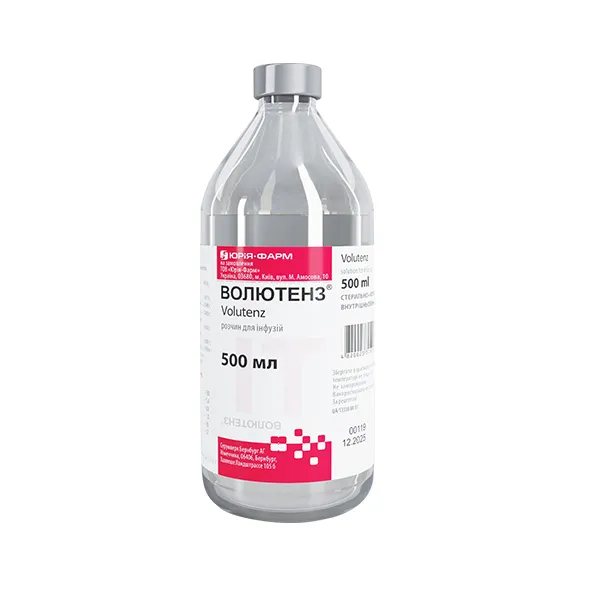
Table of Contents
INSTRUCTIONS FOR MEDICAL USE OF THE MEDICINAL PRODUCT VOLENTENZ® (VOLUTENZ)
Composition:
Active substances: 1000 ml of solution contains 40.0 g of polygeline, 3.675 g of sodium acetate trihydrate, 4.590 g of sodium chloride, 0.403 g of potassium chloride, 0.133 g of calcium chloride dihydrate, 0.203 g of magnesium chloride hexahydrate, and 0.980 g of sodium hydroxide;
Excipient: water for injections.
Pharmaceutical form. Infusion solution.
Main physicochemical properties: clear, slightly yellow solution, free from particles and fibers, does not solidify at temperatures down to 5 °C.
Ion composition of the preparation: Na⁺ – 130 mmol/l, K⁺ – 5.4 mmol/l, Ca²⁺ – 0.9 mmol/l, Mg²⁺ – 1.0 mmol/l, Cl⁻ – 85 mmol/l, CH₃COO⁻ – 27 mmol/l. Average molecular weight – 30,000 Dalton, pH – 7.1–7.7, osmolarity 216–273 mOsmol/kg, titratable acidity – 0.5 mmol/l to pH 7.4.
Pharmacotherapeutic group. Blood substitutes and perfusion solutions. Gelatin preparations. ATC code B05A A06.
Pharmacological Properties
Pharmacodynamics
Voluven® is a colloidal plasma substitute. The colloidal osmotic pressure of the solution is 34 mm Hg, corresponding to normal patient values (27 mm Hg). The increase in plasma volume initially corresponds to the volume administered. After intravenous administration, Voluven® is rapidly distributed in the bloodstream, producing a volume effect that lasts 3–4 hours.
Dehydration of the extravascular space is not observed. Hemostasis remains unaffected. It does not influence blood coagulation, except for a dilution effect. It has no effect on blood group or Rh factor determination.
Voluven® stimulates diuresis by increasing fluid and electrolyte delivery. Osmotic diuresis may prevent oliguria or anuria and can significantly reduce the impact of shock on the kidneys.
Therapeutic Effect
Voluven® replaces intravascular volume deficit caused by blood or plasma losses. As a result, arterial pressure, left ventricular pressure, end-diastolic pressure, cardiac output, cardiac volume flow index, oxygen delivery, and diuresis increase.
Mechanism of Action
The colloidal osmotic pressure of the solution determines the magnitude of its initial effect. The duration of the effect depends on colloid clearance during redistribution and elimination. The volume effect of Voluven® is equivalent to the volume of solution administered. Since Voluven® is a plasma substitute, it does not produce a plasma-expanding effect. The drug does not compensate for plasma protein losses.
Pharmacokinetics
The drug does not accumulate in tissues or organs. Most of the administered gelatin is excreted by the kidneys; fractions with low molecular weight are eliminated within the first hour. Approximately 8% of the administered gelatin is eliminated via the intestines. About 60% of the administered gelatin is excreted in urine within the first 24 hours.
Distribution
After administration, Voluven® rapidly distributes within the intravascular space. There is no evidence of drug accumulation in the reticuloendothelial system or elsewhere in the body.
Metabolism/Excretion
The majority of the administered Voluven® is excreted by the kidneys. Only a small amount is excreted in feces, and no more than 1% is metabolized. Smaller molecules are eliminated via glomerular filtration, whereas larger molecules are first proteolytically degraded in the liver and then also excreted by the kidneys. Proteolytic metabolism is sufficiently adaptive so that gelatin accumulation does not occur, even in renal insufficiency.
Pharmacokinetics in Special Clinical Situations
The elimination half-life of the drug from plasma may be prolonged in patients undergoing hemodialysis (glomerular filtration rate < 0.5 ml/min).
Clinical characteristics.
Indications.
Prevention and treatment of relative or absolute hypovolemia or shock.
Prevention of arterial hypotension (including during induction of epidural or spinal anesthesia).
Procedures involving extracorporeal circulation (including use of the heart-lung machine).
Acute normovolemic hemodilution.
Contraindications.
Hypersensitivity to any component of the drug.
Hyperhydration.
Hypervolemia.
Severe heart failure.
Severe renal failure.
Recent myocardial infarction.
Severe coagulation disorders.
Hypernatremia.
Hyperkalemia.
Dehydration.
Interaction with other medicinal products and other forms of interactions.
Mixing Volutenz® with other medicinal products may lead to incompatibility. Volutenz® must not be administered simultaneously with fat emulsions. It is incompatible with solutions containing phosphates and carbonates.
Caution should be exercised in patients who are concurrently using medicinal products that may cause potassium or sodium retention.
Special precautions for use
Volutenz® should be used with caution in patients with allergic disorders, including those with bronchial asthma.
Gelatin-based volume replacement agents may rarely cause anaphylactoid reactions of varying severity. To detect the development of an anaphylactoid reaction as early as possible, the first 20–30 mL should be administered slowly and under close patient monitoring.
Volutenz® should be administered with caution and only under careful hemodynamic monitoring in the following cases:
- elderly patients;
- patients at risk of circulatory overload, including those with congestive heart failure, right or left ventricular insufficiency, arterial hypertension, intracranial hemorrhage, pulmonary edema, or renal insufficiency with oliguria or anuria;
- patients with conditions requiring restricted sodium intake.
Volutenz® must not be administered simultaneously with blood or blood products (formed blood elements, plasma, and plasma fractions) through the same infusion system.
Serum electrolyte concentrations and fluid balance should be monitored, especially in patients with hypokalemia or impaired renal function. When using gelatin preparations, urine specific gravity is not a reliable indicator for diagnosing renal failure.
Particular attention should be paid to the appearance of symptoms of hypocalcemia (including signs of tetany and paresthesia); appropriate measures should be taken.
In states of dehydration, fluid deficit should first be corrected.
When compensating for severe blood loss by infusing large volumes of Volutenz®, hematocrit must always be monitored. Hematocrit should not fall below the critical values indicated in the section "Dosage and administration".
Similarly, in such situations, the dilutional effect on coagulation factors should be monitored, especially in patients with pre-existing hemostatic disorders.
Since the preparation does not replace plasma protein losses, monitoring of plasma protein concentrations is recommended.
General guidelines for prevention of adverse reactions
Adequate education of physicians and medical personnel regarding the types and severity of possible adverse reactions that may occur after administration of colloidal volume expanders.
Close monitoring of the patient during infusion, especially during the administration of the first 20–30 mL of the solution.
Immediate access to all equipment and medications necessary for cardiopulmonary resuscitation.
Immediate discontinuation of infusion upon the appearance of any signs of an adverse reaction.
Emergency treatment of anaphylactoid reactions should be carried out according to standard protocols, depending on the severity of the reaction.
No procedure can predict which patients are prone to developing anaphylactoid reactions, nor can the course or severity of any such reaction be predicted. Anaphylactoid reactions caused by gelatin solutions may be histamine-mediated or histamine-independent. Histamine release may be prevented by using a combination of H1- and H2-receptor blockers. Prophylactic administration of corticosteroids has not been proven effective.
Adverse reactions may occur in both conscious and anesthetized patients. To date, no anaphylactoid reactions have been reported during the acute phase of volume deficit and shock.
Effect on laboratory test results
Volutenz® may interfere with the following clinical chemistry tests, leading to falsely elevated values:
- blood glucose;
- erythrocyte sedimentation rate (ESR);
- urine specific gravity;
- determination of nonspecific proteins, including by the biuret method;
- fatty acids, cholesterol, fructose, sorbitol dehydrogenase.
Any unused contents of an opened vial must be discarded.
Use the solution only if it is clear and free of precipitate, and the vial is undamaged.
Use immediately after connecting the vial to the infusion system.
Other
In cases of afibrinogenemia, colloidal plasma substitutes may be administered in life-threatening situations when blood replacement is necessary. Water and electrolyte balance should be monitored. Depending on the volume administered, monitoring of plasma protein dilution (coagulation factors, albumin) should be performed.
Use during pregnancy or breastfeeding
Controlled studies in animals or in pregnant women have not been conducted. Due to the potential for anaphylactoid reactions, the drug should be used during pregnancy only in emergency situations and only when the potential benefit to the mother outweighs the potential risk to the fetus.
It is not known whether Volutenz® passes into breast milk. There is insufficient experience with use during breastfeeding.
Ability to affect reaction speed when driving or operating machinery
There is insufficient experience regarding the effect of treatment on the ability to drive or operate machinery.
Method of Administration and Dosage.
Adults
The dosage and infusion rate are adjusted according to the volume of blood loss and individual requirements for restoration and maintenance of stable hemodynamic status. Volume replacement effect should be monitored by measuring arterial pressure, central venous pressure, heart rate, diuresis rate, hemoglobin concentration, and hematocrit.
The recommended average doses of Volutenz® are given in the table.
| Indications |
Recommended average dose |
| Prevention of hypovolemia and arterial hypotension. Treatment of mild hypovolemia, e.g. due to minor blood and plasma losses |
500−1000 ml over 1−3 hours |
| Treatment of severe hypovolemia |
1000−2000 ml |
| Emergency situations when life is threatened |
500 ml by rapid infusion (under pressure), then, after improvement of cardiovascular parameters, infusion is continued according to volume deficit |
| Hemodilution (isovolemic) |
The volume of Voluten® administered is equivalent to plasma loss, but usually does not exceed 20 ml/kg body weight per day |
| Extracorporeal circulation |
Dose depends on the method used, but is usually about 500−1500 ml |
Maximum Dose
From a toxicological standpoint, there are no dose limitations. The maximum daily dose is determined by the degree of hemodilution. Caution should be exercised to avoid reducing hematocrit below critical levels.
Critical values vary individually depending on the patient's capillary oxygen extraction, age, circulatory reserve, and clinical condition. In patients with normal oxygen demand and intact compensatory mechanisms, hemodilution down to hemoglobin levels of 8 g/100 mL or hematocrit of 25% may be acceptable; in intensive care unit patients, hemoglobin should not fall below 10 g/100 mL or hematocrit below 30%. If necessary, additional blood or packed red blood cell transfusions should be administered.
Attention should also be paid to the dilution of plasma proteins (including albumin and coagulation factors), which should be replaced as needed.
Infusion Rate
The infusion rate depends on the current hemodynamic situation. Typically, 500 mL is administered over 30 minutes. However, the first 20**−**30 mL of the solution should be infused slowly to detect any anaphylactoid reaction as early as possible.
In shock, up to 20 mL of Voluten® per kg body weight per hour (equivalent to 0.33 mL/kg body weight/min) may be administered. In life-threatening situations, Voluten® can be rapidly infused under pressure at a dose of 500 mL within 5**−**10 minutes.
Infusing too rapidly may lead to circulatory overload.
Children aged 6 years and older
Since documented experience with the use of Voluten® in children is limited, the dose should be selected very cautiously according to the individual need for restoration and maintenance of normal hemodynamic status and circulating fluid volume.
Route of Administration
Intravenous administration.
The solution should be warmed to body temperature before administration.
When administering Voluten® under pressure (including via pressure cuff or infusion pump), all air must be removed from the container and infusion system prior to infusion, as there is a risk of air embolism during pressurized infusion.
Children
The drug is recommended for use in children aged 6 years and older.
Experience with the use of Voluten® in children is limited; therefore, the drug should be administered only after careful benefit-risk assessment by a physician and under close monitoring.
Overdose
Overdose or too rapid administration of Voluten® may lead to unintentional hypervolemia and circulatory overload, potentially resulting in impaired cardiac and pulmonary function. Symptoms of circulatory overload include, among others, headache, dyspnea, and jugular vein distension. Overdose may also lead to hyperhydration and disturbances in electrolyte and acid-base balance.
If early signs of circulatory overload occur, infusion should be stopped immediately. Treatment is symptomatic. Depending on the clinical picture, diuresis and cardiac function should be supported. Diuretics may be required. In severe cases, treatment of anaphylactoid reactions should be administered according to severity; in life-threatening cases of grade III–IV severity, therapy should be conducted as resuscitation treatment.
Side effects
The only potentially serious side effects are anaphylactoid reactions, described below. However, severe reactions are very rare.
Immune system disorders
Rare (≥ 1/10,000 to < 1/1,000): anaphylactoid reactions (all grades)*.
Very rare (< 1/10,000): severe anaphylactoid reactions (Grade III–IV)*.
Cardiac disorders
Very rare (< 1/10,000): tachycardia.
Frequency not known: bradycardia.
Vascular disorders
Very rare (< 1/10,000): arterial hypotension.
Frequency not known: arterial hypertension.
Respiratory, thoracic and mediastinal disorders
Very rare (< 1/10,000): dyspnea.
Skin and subcutaneous tissue disorders
Rare (≥ 1/10,000 to < 1/1,000): allergic skin reactions*.
Gastrointestinal disorders
Uncommon (≥ 1/1,000 to < 1/100): transient mild nausea or abdominal pain.
General disorders
Uncommon (≥ 1/1,000 to < 1/100): transient mild increase in body temperature.
Very rare (< 1/10,000): fever, chills.
Anaphylactoid reactions
After administration of Voluven®, as with any colloidal plasma volume expanders, anaphylactoid reactions of varying severity may occur.
*Anaphylactoid reactions of Grade I–II include fever, sudden facial and neck flushing, itching, local erythema, paresthesia, headache, hot flashes, skin rashes (urticaria), mucosal edema, tachycardia, arterial hypotension, dyspnea, cough, nausea, vomiting.
Anaphylactoid reactions of Grade III–IV include severe dyspnea, bronchospasm, severe arterial hypotension, shock, respiratory arrest, and cardiac arrest.
Patients receiving Voluven® must be continuously monitored for the development of anaphylactoid reactions.
In case of an anaphylactoid reaction, infusion must be stopped immediately and emergency treatment initiated.
Reporting of suspected adverse reactions is important. It allows continuous monitoring of the benefit-risk balance of the medicinal product.
Shelf life. 2 years.
Storage conditions.
Store in the original packaging at a temperature not exceeding 25 °C. Do not freeze. Use immediately after opening.
Incompatibilities.
Do not mix with other medicinal products.
Packaging.
500 ml in a bottle.
Prescription status.
Prescription only.
Manufacturer.
Serumwerk Bernburg AG, on behalf of LLC "Yuria-Pharm".
Manufacturer's address and place of business.
06406, Bernburg, Hallesche Landstraße 105 b, Germany.