Voltaren emulgel
Ukraine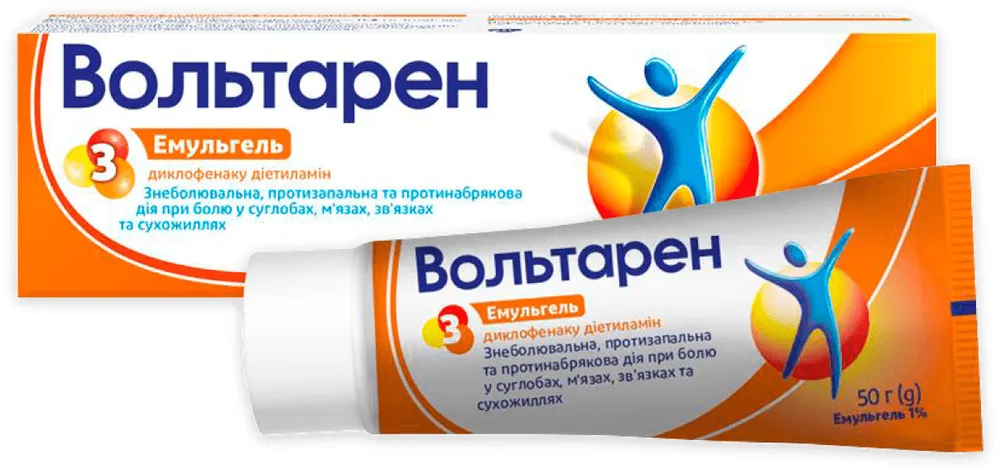
Table of Contents
INSTRUCTIONS FOR MEDICAL USE OF THE MEDICINAL PRODUCT VOLTAREN EMULGEL
Composition:
Active substance: diclofenac;
1 g of emulgel contains 11.6 mg of diclofenac diethylamine, equivalent to 10 mg of sodium diclofenac;
Excipients: carbomer, polyethylene glycol cetyl stearyl ether, coco-capric/caprylic triglyceride, diethylamine, isopropyl alcohol, mineral oil, flavor 45 (containing benzyl benzoate), propylene glycol, purified water.
Pharmaceutical form. Emulgel for topical use.
Main physicochemical properties: soft, homogeneous cream-like gel, white to yellowish in color.
Pharmacotherapeutic group. Topically used agents for joint and muscular pain. Topical non-steroidal anti-inflammatory drugs. Diclofenac.
ATC code M02A A15.
Pharmacological Properties.
Pharmacodynamics.
Diclofenac is a highly effective non-steroidal anti-inflammatory agent with pronounced anti-rheumatic, analgesic, anti-inflammatory, and antipyretic effects. The main mechanism of diclofenac's therapeutic action is the inhibition of prostaglandin biosynthesis via cyclooxygenase-2 (COX-2).
Due to its water-alcohol base, the preparation also produces a local anesthetic and cooling effect.
Clinical study data.
In inflammation and pain of traumatic or rheumatic origin, Voltaren Emulgel reduces the recovery period of movement in affected joints, ligaments, tendons, and muscles. Clinical data have demonstrated that Voltaren Emulgel reduces acute pain within 1 hour after the initial application. The preparation reduces movement-related pain by 75% within two days. 94% of patients responded to Voltaren Emulgel within 2 days of treatment, compared to 8% responding to placebo. Pain relief and restoration of joint mobility are achieved after 4 days of treatment with Voltaren Emulgel.
Pharmacokinetics.
The amount of diclofenac absorbed through the skin is proportional to the application area and depends on both the total applied dose of the preparation and the degree of skin hydration. After topical application of 2.5 g of Voltaren Emulgel to a skin surface area of 500 cm², the extent of diclofenac absorption is approximately 6%. Application of an occlusive dressing for 10 hours results in a threefold increase in diclofenac absorption.
After application of Voltaren Emulgel to the skin over the wrist and knee joints, diclofenac is detected in blood plasma (where its maximum concentration is approximately 100 times lower than after oral administration), in the synovial membrane, and in synovial fluid. Protein binding of diclofenac is 99.7%.
Diclofenac accumulates in the skin, which acts as a reservoir from which the substance is gradually released into adjacent tissues. From there, diclofenac predominantly enters deeper inflamed tissues, such as joints, rather than into blood plasma. There, it continues to act and is found in concentrations up to 20 times higher than in blood plasma.
Diclofenac is primarily metabolized via mono- or multi-step hydroxylation followed by glucuronidation, or by glucuronidation of the intact molecule.
Diclofenac and its metabolites are primarily excreted in urine. Total systemic plasma clearance of diclofenac is 263 ± 56 ml/min, and the terminal half-life in plasma is 1–2 hours. Four metabolites, including two active ones, have short half-lives of 1–3 hours, while one has a slightly longer half-life but is practically inactive.
In renal or hepatic insufficiency, the metabolism and elimination of diclofenac are not altered.
Clinical characteristics.
Indications. Local treatment of pain and inflammation of joints, muscles, ligaments, and tendons of rheumatic or traumatic origin.
Contraindications. Hypersensitivity to diclofenac or to any of the excipients. History of asthma attacks, angioedema, urticaria, or acute rhinitis induced by acetylsalicylic acid or other nonsteroidal anti-inflammatory drugs; last trimester of pregnancy.
Interaction with other medicinal products and other forms of interaction.
Since systemic absorption of diclofenac following topical application of the product is very low, the likelihood of interactions is very low.
Special precautions for use.
Use with caution in combination with oral nonsteroidal anti-inflammatory drugs.
The possibility of developing systemic adverse effects (which occur with systemic forms of dicloenac) should be considered when the product is applied to larger skin areas or for longer durations than recommended. In such cases, the medicinal product should be used with caution in patients with hepatic, renal, or cardiac insufficiency, as well as in those with active peptic ulcer disease.
VOLTAREN EMULGEL should be applied only to intact, undamaged skin areas, avoiding contact with inflamed, injured, or infected skin. Contact of the product with eyes and mucous membranes should be avoided. The product must not be swallowed.
If any skin rashes occur, treatment with the product should be discontinued. VOLTAREN EMULGEL should not be used under occlusive airtight dressings; however, application under non-occlusive dressings is permitted.
VOLTAREN EMULGEL contains propylene glycol and benzyl benzoate, which may cause mild localized skin irritation.
Due to the possibility of photosensitivity reactions, exposure to direct sunlight and use of sunbeds should be avoided during treatment and for 2 weeks after discontinuation of treatment.
Caution should be exercised when smoking or being near open flames after application of the product due to the risk of serious burns, as the medicinal product contains mineral oil, which may become potentially flammable after penetration into tissues (e.g., clothing, bedding, dressings) and accumulation therein. Laundering of clothing or bed linen may reduce accumulation of the product but does not ensure complete removal.
Use during pregnancy or breastfeeding.
Clinical data on the use of VOLTAREN EMULGEL during pregnancy are lacking. Even though systemic effects are lower compared to oral administration, it is unknown whether systemic exposure to VOLTAREN EMULGEL achieved after topical application could be harmful to the embryo/fetus. During the first and second trimesters of pregnancy, the medicinal product should not be used unless clearly necessary. If used, the dose should be as low as possible and the duration of treatment as short as possible.
During the third trimester of pregnancy, systemic use of prostaglandin synthesis inhibitors, including VOLTAREN EMULGEL, may cause cardiopulmonary and renal toxicity in the fetus. At late stages of pregnancy, prolonged bleeding may occur in both mother and child, and labor may be delayed. Therefore, VOLTAREN EMULGEL is contraindicated during the last trimester of pregnancy (see section "Contraindications").
It is unknown whether diclofenac is excreted in breast milk following topical application; therefore, use of VOLTAREN EMULGEL during breastfeeding is permitted only if the expected benefit outweighs the potential risk to the infant. If there are compelling reasons for using the product during breastfeeding, the product should not be applied to the breasts or large skin areas and should not be used in higher amounts or for longer durations than recommended.
Data on the effect of diclofenac on human fertility following topical application are lacking.
Ability to affect reaction speed when driving or operating machinery. Diclofenac has no effect when used topically.
Method of Administration and Dosage
The product is intended for topical use only.
Before first use:
- Aluminum tubes: Before first use, the protective membrane must be punctured using the piercing device located on the outer side of the cap.
- Laminated aluminum tubes: Unscrew the cap, turn it over and place the reverse side onto the protected nozzle of the tube, then twist to remove the protective seal.
For adults and children aged 14 years and older, apply Voltaren Emulgel 3–4 times daily, gently rubbing it into the skin at the site of pain. The amount applied depends on the size of the affected area (e.g., 2–4 g, corresponding in size to a cherry or walnut, is sufficient for application to an area of 400–800 cm²).
After applying the product, wipe hands dry with a paper towel or similar material, and then wash hands thoroughly, unless the hands themselves are the treated area. The used paper towel should be disposed of in a waste bin. Avoid contamination of wastewater (do not flush down the toilet or wash into sinks).
Allow the applied product to dry completely before taking a shower or bath.
The duration of treatment depends on the nature of the condition and the response to therapy.
Do not use the product for longer than 14 consecutive days in cases of injuries or soft tissue rheumatism, or for longer than 21 days in cases of arthritic pain, unless otherwise directed by a physician.
Consult a physician if symptoms do not improve or worsen after 7 days of treatment, in order to rule out other potential causes of pain.
Elderly patients and patients with hepatic or renal impairment may use the standard adult dosage.
Children. Voltaren Emulgel is not recommended for use in children under 14 years of age. If used in children aged 14 years and older for longer than 7 days, or if symptoms worsen, consult a physician.
Overdose. Overdose is unlikely due to the low systemic absorption of diclofenac following topical application. However, adverse effects similar to those seen with overdose of diclofenac-containing tablets may occur if the product is accidentally ingested. In such cases, note that one 100-g tube contains the equivalent of 1 g of sodium diclofenac.
In the event of accidental ingestion leading to significant systemic adverse effects, symptomatic treatment should be administered, employing therapeutic measures appropriate for poisoning with nonsteroidal anti-inflammatory drugs.
Side effects
The following adverse reactions have been observed with the medicinal product Voltaren Emulgel.
Infections and infestations
Rare (<1/10,000): pustular eruptions.
Immune system disorders
Rare (<1/10,000): hypersensitivity reactions (including urticaria), angioedema.
Respiratory system disorders
Rare (<1/10,000): bronchial asthma.
Skin and connective tissue disorders
Common (≥1/100; <1/10): rash, pruritus, eczema, erythema, dermatitis including contact dermatitis.
Occasional (≥1/10,000; <1/1,000): bullous dermatitis.
Rare (<1/10,000): photosensitivity reactions.
If adverse reactions occur, treatment should be discontinued and medical advice should be sought.
Shelf life. 3 years.
Storage conditions. Store out of reach and sight of children, at a temperature not exceeding 30 °C.
Packaging. 20 g, 50 g, or 100 g of gel in laminated aluminum or aluminum tubes with a membrane, sealed with white or blue screw-on polymer caps of round or triangular shape. One tube per cardboard box.
Prescription status. Over-the-counter.
Manufacturer.
- Haleon CH S.a.r.l. / Haleon CH S.a.r.l.
(manufacturing of the medicinal product, primary and secondary packaging, quality control, batch release).
- Haleon Italy Manufacturing S.r.l. / Haleon Italy Manufacturing S.r.l.
(primary and secondary packaging, quality control, batch release).
Manufacturer's address and place of business.
- Route De L’etraz 2, Nyon, 1260, Switzerland.
- Via Nettunense, 90, Aprilia, 04011, Italy.