Wobenzym
Ukraine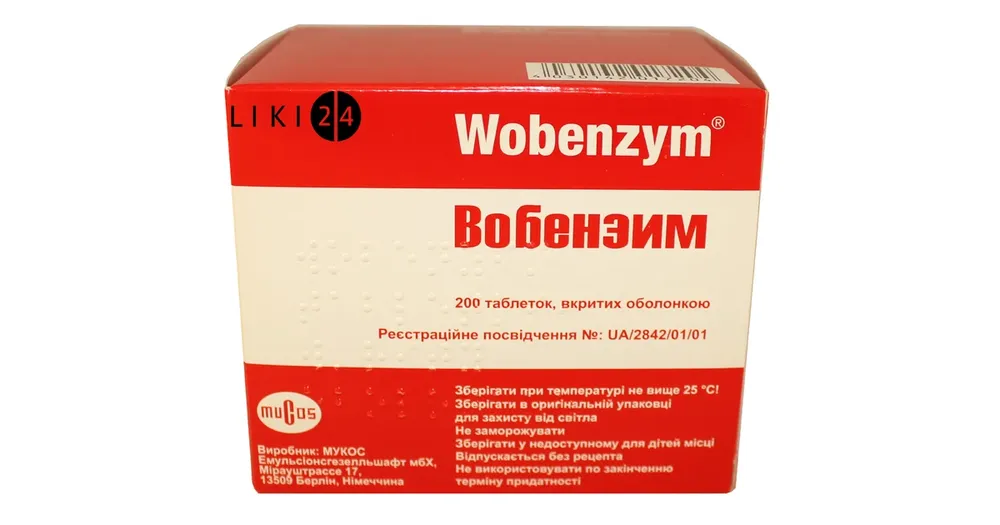
Table of Contents
INSTRUCTIONS FOR MEDICAL USE OF THE MEDICINAL PRODUCT VOBENZYM (WOBENZYM®)
Composition:
Active ingredients: 1 enteric-coated tablet contains: pancreatin – 300 Protease units (100 mg); papain – 90 FIR units (18 mg); bromelain – 225 FIR units (45 mg); triacylglycerol lipase – 34 FIR units (10 mg); amylase – 50 FIR units (10 mg); trypsin – 360 FIR units (12 mg); chymotrypsin – 300 FIR units (0.75 mg); rutoside – 50 mg;
Excipients: lactose monohydrate; pregelatinized starch; magnesium stearate; stearic acid; colloidal anhydrous silicon dioxide; talc;
Tablet film coating: film coating: methacrylic acid–methyl methacrylate copolymer (1:1), sodium lauryl sulfate; talc, macrogol 6000, triethyl citrate, stearic acid; color coating: hypromellose, hydroxypropyl cellulose, microcrystalline cellulose, glycerin, talc, titanium dioxide (E 171), sunset yellow FCF (E 110), ponceau 4R (E 124).
Pharmaceutical form. Enteric-coated tablets.
Main physicochemical properties: orange-red, round biconvex tablets with a film coating.
Pharmacotherapeutic group.
Agents used in musculoskeletal disorders. Enzymes. Trypsin, combinations. ATC code M09AB.
Pharmacological Properties
Pharmacodynamics
Anti-inflammatory effect
The combination of components in Wobenzym, as well as its individual enzymes—bromelain, papain, trypsin, chymotrypsin, and pancreatin—reduce edema of inflammatory origin and edema caused by injuries (sports, surgery). These enzymes assist in the breakdown of plasma proteins that penetrate into the interstitium during acute inflammation and promote the elimination of degradation products. This also applies to inflammatory mediators such as bradykinin, which are more effectively depolymerized and removed.
Anti-edematous effect
Inflammatory edema resulting from protein leakage and fibrin deposition resolves more rapidly. Simultaneously, impaired microcirculation is restored, facilitating the removal of inflammatory products and ensuring adequate delivery of oxygen and nutrients. The anti-edematous effect is also influenced by a reduction in oncotic pressure due to the breakdown of macromolecular substances in the extracellular space and improved blood rheology.
Fibrinolytic and lipolytic effect
Wobenzym induces fibrinolysis by activating plasminogen, depolymerizing fibrin, altering the structure of the fibrin network, dissolving microthrombi, opening physiological drainage pathways, reducing blood viscosity while maintaining hematocrit (thus improving blood rheology and perfusion), and lowering cholesterol and triglyceride levels.
Immunomodulatory effect
In various immunopathological processes, so-called pathogenic immune complexes play a key role. High concentrations of immune complexes lead to phagocyte dysfunction. Combined enzyme preparations can improve immune complex clearance by enhancing serum hydrolytic activity and stimulating phagocytic efficiency.
Experiments have demonstrated that proteases destroy circulating, aggregated, and tissue-fixed immune complexes and also suppress the formation of pathogenic immune complexes.
Further studies show that proteases can modulate the function of certain immunocytes (macrophages, granulocytes, NK cells, T-lymphocytes). For example, they enhance phagocytic and cytolytic activity, induce the production of certain cytokines (TNF-alpha, IL-1-beta, IL-6), and promote the generation of oxygen radicals (in vitro, ex vivo).
In cases of pathologically elevated levels of certain cytokines (particularly TNF-alpha, TGF-beta), enzymes contribute to reducing their concentration and limiting their adverse effects (pro-inflammatory, cachectic, fibrogenic).
The action of proteases can be explained both by their direct proteolytic activity and by the effects of complexes they form with antiproteases (mainly alpha-2-macroglobulin). These complexes are capable of binding pathologically elevated cytokines and accelerating their suppression and elimination from the body.
Proteases selectively affect the expression of certain surface adhesion molecules on various cells (e.g., CD4, CD44, B7-1), thereby potentially influencing numerous physiological and pathological processes.
Secondary analgesic effect
Since the enzymes act on the causal and consequential factors of acute inflammatory pain, they may exhibit an analgesic effect. They suppress pain mediators, reduce tissue oncotic pressure and tension, improve blood rheology, enhance blood flow, promote the removal of toxic metabolic products, and improve oxygen delivery to tissues.
Carrier effect
There is evidence indicating increased serum levels of certain antibiotics and chemotherapeutic agents when co-administered with Wobenzym.
Pharmacokinetics
The pharmaceutical formulation of Wobenzym is designed to resist gastric juice and dissolve in the small intestine.
The enzymes contained in Wobenzym, like other high-molecular-weight substances, are absorbed in the small intestine via various cellular mechanisms: absorption at the tips of villi (paracellular transport between enterocytes), endocytosis by columnar enterocytes, uptake by M-cells over Peyer's patches, and by free lymphocytes. Experimental data have demonstrated that hydrolases can transiently open tight junctions between intestinal epithelial cells. After entering the bloodstream, the enzymes bind to carrier proteins (e.g., alpha-1-antitrypsin, alpha-2-macroglobulin). Through the formation of such complexes, antigenic determinants of proteases are masked, but enzyme activity remains unaffected. Chromatographic studies using radiolabeled enzymes have shown the following absorption rates in high-molecular-weight form: 45% of amylase, 26% of trypsin, 14% of chymotrypsin, 18% of pancreatin, and 6% of papain. Six hours after Wobenzym administration, the biologically active fraction of absorbed components amounts to 21%. The kinetics of individual enzymes indicate that with repeated dosing, their concentration increases and reaches a maximum within 24–48 hours. With continued administration, these concentrations are maintained at a steady level and return to baseline approximately 48 hours after discontinuation of treatment.
Due to chronobiological differences in intestinal absorption throughout the day, Wobenzym is recommended to be taken during absorption peaks—immediately after waking, before lunch, and before bedtime. The preparation should be taken with sufficient fluid (approximately 250 mL of water), strictly maintaining a 30-minute interval before meals to prevent food interaction, which could impair absorption. Absorbed enzymes are eliminated via cells of the mononuclear phagocyte system, primarily through the liver. Non-absorbed active substances are either degraded during intestinal digestion or excreted in feces.
Clinical characteristics.
Indications.
Wobenzym can be used as an alternative to existing treatment methods in the following conditions:
- post-traumatic edema (e.g., edema associated with fractures, distortions, dislocations, contusions);
- lymphedema of various etiologies;
- fibrocystic mastopathy.
Wobenzym can be used as an adjunctive therapy in the following conditions:
- rheumatic diseases: rheumatoid arthritis, soft tissue rheumatism, osteoarthritis;
- certain postoperative conditions in surgery (arthroscopic procedures, dental surgery, ENT surgery);
- chronic and recurrent inflammations of the nose, ears, and throat, upper and lower respiratory tract (e.g., sinusitis, bronchitis, bronchopneumonia);
- chronic and recurrent inflammations of the gastrointestinal tract (e.g., pancreatitis, ulcerative colitis, Crohn's disease);
- multiple sclerosis;
- superficial venous inflammations, post-thrombotic syndrome of the lower limbs, vasculitis;
- chronic and recurrent urological inflammations (e.g., urinary tract infections, cystitis, cystopyelitis, prostatitis);
- chronic and recurrent gynecological inflammations (e.g., chronic gynecological infections, adnexitis, vulvovaginitis);
- chronic and recurrent skin inflammations.
Contraindications.
- Hypersensitivity to any of the active substances or to any of the excipients.
- Hypersensitivity to fruits such as pineapple or papaya.
- Congenital or acquired coagulation disorders, such as hemophilia or thrombocytopenia.
- Acute pancreatitis, intestinal obstruction.
Interaction with other medicinal products and other forms of interaction.
Wobenzym may increase the serum concentration of antibiotics, particularly tetracycline, sulfonamides, amoxicillin, etc., as well as their concentration in inflamed tissues when used concomitantly.
Concomitant use of Wobenzym with anticoagulants and/or antiplatelet agents may enhance the anticoagulant effect. Therefore, combination of Wobenzym with such agents requires clear indications and careful monitoring (see section "Special precautions").
Special precautions for use
In case of allergic reactions to Wobenzym, treatment should be discontinued immediately.
Prior to surgical procedures, the fibrinolytic activity of the drug should be taken into account and patients should be monitored accordingly. Wobenzym should be discontinued 4 days before any dental or other surgical intervention.
Wobenzym is not recommended for patients with severe renal or hepatic impairment.
The product contains up to 0.16 g of lactose (0.08 g glucose and 0.08 g galactose). This product should not be administered to patients with rare hereditary conditions of galactose intolerance, Lapp lactase deficiency, or glucose-galactose malabsorption.
This medicinal product contains less than 1 mmol of sodium (23 mg) per tablet, i.e. essentially a negligible amount of sodium.
Sometimes, in chronic conditions, existing symptoms may intensify after initiation of Wobenzym therapy. In such cases, temporary reduction of the prescribed dose should be considered.
This product does not replace antibiotic therapy for infectious inflammation; however, it enhances its efficacy by increasing antibiotic concentration in blood plasma and inflamed tissues.
The product also contains the dyes Ponceau 4R (E 124) and Sunset Yellow FCF (E 110), which may cause allergic reactions.
Use during pregnancy or breastfeeding
Pregnancy
There is no information or only limited data available (less than 300 completed pregnancies) regarding the use of Wobenzym during pregnancy. Animal studies have not shown any direct or indirect toxic effects on reproductive function.
As a precautionary measure, Wobenzym administration during pregnancy is not recommended.
Breastfeeding
There are no data excluding the possibility of active substances/metabolites passing into breast milk. A risk to newborns/infants cannot be ruled out. The decision to discontinue breastfeeding or to discontinue/abruptly stop treatment with Wobenzym should be made by the physician after evaluating the benefit-risk ratio for the mother versus the fetus/child.
Fertility
There is no information available on the effects on fertility.
Ability to influence the speed of reactions when driving or operating machinery
Wobenzym has no or negligible influence on the ability to drive or operate machinery.
Dosage and Administration.
Depending on the duration and severity of the disease, the recommended dose for adults is 3 to 10 enteric-coated tablets three times a day. The maintenance dose is 3 to 5 enteric-coated tablets three times a day. The treatment dose is individually determined by a physician. For children, the dose is calculated based on body weight: 1 tablet of Wobenzym per 6 kg of body weight per day.
The medicinal product is intended for use in adults and children aged 6 years and older. For children under 6 years of age, treatment should be initiated only after a pediatrician has evaluated the risk-benefit ratio.
For children aged 12 years and older, the dose corresponds to the adult dose.
The treatment course for acute conditions lasts from 2 weeks until recovery; in exacerbations of chronic diseases, treatment continues until clear signs of remission appear. The average duration of treatment ranges from 2 weeks to 3 months (after consultation with a physician).
Enteric-coated tablets should be taken at least 30 minutes before meals, without chewing, and with a large amount of water (250 ml).
Children. For use in children aged 6 years and older.
Overdose.
Overdose symptoms are considered to be more pronounced adverse reactions as listed in the section "Adverse Reactions." These usually resolve upon dose reduction and do not require additional therapeutic interventions.
Adverse reactions.
There have been occasional reports of adverse reactions such as loss of appetite, nausea, diarrhea, changes in stool consistency, odor and color (without clinical significance), and flatulence (especially at higher doses). Rarely, severe anaphylactic reactions may occur.
These reactions are listed according to system organ classes and frequency of occurrence. Frequency is usually defined as follows: very common (≥ 1/10), common (≥ 1/100 to < 1/10), uncommon (≥ 1/1,000 to < 1/100), rare (≥ 1/10,000 to < 1/1,000), very rare (< 1/10,000).
Within each frequency group, adverse reactions are listed in order of decreasing severity.
| System organ class |
Uncommon (from ≥1/1000 to <1/100) |
Rare (from ≥1/10000 to <1/1000) |
Very rare (<1/10000) |
| Respiratory, thoracic and mediastinal disorders |
asthma-like condition |
||
| Gastrointestinal disorders |
diarrhea, nausea, decreased appetite, change in consistency, odor and color of feces, flatulence, feeling of stomach fullness |
vomiting, abdominal cramps |
excessive feeling of hunger |
| Skin and subcutaneous tissue disorders |
rash, pruritus, erythema |
hyperhidrosis |
|
| Nervous system disorders |
dizziness, headache |
||
| Immune system disorders |
anaphylactic reactions, hypersensitivity |
||
| Investigations |
increased transaminases |
The use of Wobenzym may cause adverse reactions in patients with allergic reactions to fruits such as pineapple or papaya.
Gastrointestinal adverse reactions such as diarrhea and abdominal pain can be avoided by following the recommendations not to take the medication with food and to divide the daily dose into a greater number of administrations.
If adverse or allergic reactions occur, the use of the medication should be discontinued and medical advice should be sought.
This medication contains the colorants Yellow-Orange S (E110) and Ponceau 4R (E 124), which may cause allergic reactions.
Lactose may cause a feeling of stomach fullness, flatulence, and diarrhea.
Shelf life. 2 years.
Storage conditions.
Store in the original packaging to protect from light. Store at a temperature not exceeding 25 °C. Do not freeze. Keep out of reach of children.
Packaging.
20 tablets per blister, 2 or 10 blisters per cardboard box; 800 tablets in bottles.
Pharmaceutical category. Over-the-counter (without prescription).
Manufacturer.
MUCOS Emulsionsgesellschaft mbH
Manufacturer's address and place of business.
Miraustrasse 17, 13509 Berlin, Germany / Miraustrasse 17, 13509 Berlin, Germany.