Vovent-mugos e
Ukraine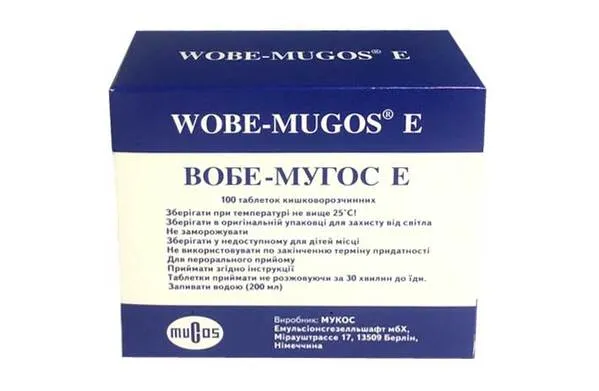
Table of Contents
INSTRUCTIONS FOR MEDICAL USE OF THE MEDICINAL PRODUCT VOB-MUGOS E WOBE-MUGOS® E
Composition:
Active substances: 1 enteric-coated tablet contains trypsin 1740 F.I.P.-Units (63.80 mg), chymotrypsin 12000 F.I.P.-Units (30 mg), papain 270 F.I.P.-Units (72.90 mg);
Excipients: lactose monohydrate; microcrystalline cellulose; macrogol 6000; copovidone; colloidal anhydrous silicon dioxide; magnesium stearate; crospovidone; povidone; talc; methacrylic acid copolymer (type A); triethyl citrate; vanillin.
Pharmaceutical form. Enteric-coated tablets.
Main physicochemical properties: round, biconvex tablets with a smooth coated surface, uniform in shape, greyish-white in color.
Pharmacotherapeutic group. Other hematological agents. Enzymes. ATC code B06AA.
Pharmacological Properties
Pharmacodynamics
In vitro studies have shown that trypsin, chymotrypsin, and papain activate mononuclear and NK cells. This leads to the release of increased amounts of cytokines (tumor necrosis factor, interleukin-1, interleukin-6). The combination of interferon-gamma and enzymes further enhances the production of tumor necrosis factor.
Importantly, the enzyme can again release tumor necrosis factor that has bound to the receptor of a cancer-damaged cell and thus become inactive (in vitro studies).
Furthermore, proteases reduce the levels of transforming growth factor β (TGF-β), as α2-macroglobulin bound to enzymes is eliminated more rapidly. TGF-β acts by inducing metastases and inhibiting cytotoxic lymphocytes.
The supportive effect of proteases is due to a reduction in specific adverse effects occurring after chemotherapy or radiation therapy. Pulmonary fibrosis or thrombocyte alterations induced by bleomycin treatment may be completely avoided. Post-radiation mucositis symptoms (ear, nose and throat, urinary bladder, intestine), such as edema, may also be reduced. Symptoms arising during both treatment modalities (nausea, adynamia, aversion, loss of appetite) may be alleviated as well. This also applies to cancer-related pain. The exact mechanism by which these effects occur on all these symptoms remains unknown.
Pharmacokinetics
Absorption
The absorption of proteolytic enzymes has been studied in vitro and in vivo.
These studies have shown that proteolytic enzymes reduce tight junctions (intercellular connections) and open paracellular transport pathways, thereby enhancing the transfer of molecules across the epithelium by passage through the intercellular space between cells. Large molecules are absorbed in active form from the gastrointestinal tract via various cell-mediated mechanisms, after which they bind to blood transport proteins.
Distribution
It has been found that 60% to 70% of administered trypsin covalently binds to plasma proteins in rats and humans (Report 915.040, Heisig, 1991b). This finding is based on the physiological inhibition of proteases such as trypsin by α2-macroglobulin and α1-antitrypsin. Initially, absorbed proteases bind to antiproteases—α1-antitrypsin (for trypsin) and α2-macroglobulin (for papain). Trypsin is subsequently transferred to α2-macroglobulin. The α2-macroglobulin-protease complexes are completely cleared from the blood via low-density lipoprotein receptor-related proteins, which are widely distributed throughout tissues. When proteases bind to α2-macroglobulin, the molecules transform from a slow form into a fast form. This form of α2-macroglobulin possesses clearance properties for cytokines and interacts with cell surface receptors (Lamarre, 1991; Borth, 1994).
Biotransformation
There are no data available on the metabolism of the drug VOBEMUGOS E. The body generally metabolizes proteins via proteolysis, which also applies to the active ingredients of the enteric-coated tablets VOBEMUGOS E. It has been calculated that during biotransformation, the half-life of orally administered trypsin is approximately 12.5 to 20 hours, and that of papain is 36 to 48 hours.
Elimination
Preclinical data on the elimination of VOBEMUGOS E are lacking. However, it can be assumed that unabsorbed enzymes are excreted in feces, either denatured or digested.
Bioavailability
In a 1996 study, 21 healthy subjects received 4 or 8 enteric-coated tablets daily for 4 days. Each tablet contained 48 mg trypsin, 90 mg bromelain, and 100 mg rutoside. Plasma levels of trypsin and bromelain increased within 5 hours after oral administration; peak concentrations were observed on day 2 or 3. Peak bromelain concentrations were 3.3 ng/mL and 5.6 ng/mL, with AUC values of 141.6 ng × hour/mL and 295.4 ng × hour/mL, respectively. Maximum trypsin concentrations were 1.26 ng/mL and 2.10 ng/mL, with AUC values of 65.1 ng × hour/mL and 118.9 ng × hour/mL, respectively. Since rutoside and quercetin were not detected in plasma, their metabolites—homovanillic acid and 3,4-dihydroxyphenylacetic acid—were analyzed. The concentration of homovanillic acid measured 24 hours after the first dose was 96.9 ng/mL (after 4 tablets) or 98.8 ng/mL (after 8 tablets); AUC for both doses was approximately 4.75 μg × hour/mL. Maximum concentration of 3,4-dihydroxyphenylacetic acid, measured 30 minutes after the first dose, was 79.8 ng/mL (4 tablets) or 83.6 ng/mL (8 tablets); AUC for both doses was approximately 3.4 μg × hour/mL.
In 1997, a randomized, multiple-dose, crossover study was conducted involving 22 healthy subjects. During the study, subjects received orally 4 or 8 enteric-coated tablets four times daily for 4 days. Each tablet contained 120 mg papain, 90 mg bromelain, and 100 mg rutoside.
Maximum bromelain concentration, measured at 75.5 or 48 hours after administration, was 2.29 ng/mL or 4.46 ng/mL, respectively, with AUC values of 111.8 ng × hour/mL or 255.9 ng × hour/mL, respectively. Maximum papain concentration, measured at 101 or 86 hours after administration, was 1.85 ng/mL or 5.31 ng/mL, respectively, with AUC values of 84.1 ng × hour/mL or 338.4 ng × hour/mL, respectively.
Clinical characteristics.
Indications.
Alleviation of adverse effects of radiation and chemotherapy.
Contraindications.
- Hypersensitivity to the active substances or to any of the excipients listed in the section "Composition".
- Hypersensitivity to pineapple or papaya fruits.
Interaction with other medicinal products and other forms of interaction.
Clinical studies on interactions with other medicinal products have not been conducted.
Special precautions for use.
If a patient has been taking Vobe-Mugos E prior to surgery, their blood coagulation parameters may be reduced.
The medicinal product should be used with caution in patients with severe congenital or acquired coagulation disorders (e.g., hemophilia, severe liver or kidney impairment) or when anticoagulant agents are being used.
Diabetic patients should be informed that one tablet contains an amount of carbohydrates equivalent to 0.020 XE (carbohydrate exchange units).
Patients with such rare hereditary conditions as lactase deficiency or glucose-galactose malabsorption should not take this medicinal product.
Use during pregnancy or lactation.
Data on the use of Vobe-Mugos E in pregnant women are lacking or limited; therefore, the product should not be used during pregnancy.
Ability to influence reaction rate when driving or operating machinery.
No studies have been conducted.
There are no data indicating that Vobe-Mugos E affects the ability to drive or operate machinery.
Dosage and Administration
Dosage
It is recommended to take 2 enteric-coated tablets three times a day, starting 3 days before radiotherapy or chemotherapy and continuing for up to 7 days after completion of treatment.
For elderly patients (aged 65 years and older)
Clinical studies have not revealed any differences in dosage requirements between elderly and younger patient groups.
For patients with renal impairment
Caution is advised in patients with kidney dysfunction due to insufficient clinical data.
For patients with hepatic impairment
Since the components of VOBЕ-MUGOS Е enteric-coated tablets are not metabolized by the liver, dosage adjustment is not required in patients with impaired liver function.
Administration method
The tablets should be taken orally. It is recommended to swallow them whole, without chewing, 0.5–1 hour before meals, with a glass of water.
Children
The safety and efficacy of VOBЕ-MUGOS Е in children (under 18 years of age) have not been studied. Data are lacking.
Overdose
Even with prolonged use of high doses, no toxic effects have been observed. Mild diarrhea may occur, which resolves after discontinuation of the drug (without additional treatment).
Adverse reactions.
The frequency of adverse reactions is defined according to the following conventional terms: very common (≥ 1/10), common (from ≥ 1/100 to < 1/10), uncommon (from ≥ 1/1000 to < 1/100), rare (from ≥ 1/10000 to < 1/1000), very rare (< 1/10000), frequency not known (cannot be estimated from the available data).
Adverse reactions observed during clinical trials and/or the post-marketing period:
| Organ system classes |
Uncommon |
Very rare |
| Gastrointestinal disorders |
Discomfort related to the digestive organs |
Diarrhea, nausea, vomiting, flatulence |
| Skin and subcutaneous tissue disorders |
Rash, itching, erythema, increased sweating |
|
| Nervous system disorders |
Headache |
|
| Immune system disorders |
Allergic reactions |
Adverse reactions following the use of VOBÉ-MUGOS E usually disappear quickly. They may also occur with higher intensity in cases of overdose.
Gastrointestinal disturbances can be avoided by taking the daily dose in smaller portions throughout the day, while strictly adhering to the recommended timing (approximately 30–60 minutes before or at least 90 minutes after meals).
Use of VOBÉ-MUGOS E may lead to changes in the consistency, color, and odor of feces, which can be attributed to the specific action of non-absorbable enzymes.
Shelf life. 2 years. Do not use after the expiry date.
Storage conditions.
Store in a dry, dark place at a temperature not exceeding 25 °C.
Packaging.
20 enteric-coated tablets in a blister; 1, 2, or 5 blisters per cardboard box.
Prescription status. Prescription only.
Manufacturer.
MUCOS Emulsionsgesellschaft mbH, Germany.
Manufacturer's address.
Miraustrasse 17, 13509 Berlin, Germany.